This was a seven week road trip that would result in an impossibly long single piece so, as with other long trips, for convenience it has been divided into eight separate posts. The several Parts will be published, in order, at regular intervals over following weeks.
Part 1: Prelude, Structure of the Trip and Practicalities
Part 2: Catalonia (Aiguablava) and Madrid
Part 6: Salamanca
Part 7: The North West: Puebla de Sanabria, Cambados and Pontevedra
Part 8: The North West: Ferrol, Santiago de Compostela and Heading Home
SALAMANCA
Length of Stay: 5 Nights
On the Road: Zaragoza to Salamanca

Or perhaps on the road and on the train, as this was one of those occasions when the length of the trip by road (around 7 hours without any diversions other than for petrol and coffees) meant it helped for one to take a more relaxed and comfortable journey on the train. The direct train takes a rambling seven-hour trip that curls around the towns north of the capital, but the ability to move around far more easily than in the car makes a considerable difference when it comes to journeys of this length. And the scenery is much more engaging (and more easily taken in by the traveller) than the scene on the autopista/autovia. Because of its length, the drive is a bit of slog, a way to get from A to B, but in this case with such an elegant B as its destination.
The City of Salamanca
In contrast with Zaragoza, we became enamoured with Salamanca. A place where, with the temperature rising to 26° C (79°F), the bright, sunny days could be enjoyed to the full. A place to luxuriate amongst the honey coloured stone buildings of its old city core, where the cathedrals sit high on a bluff above the gently moving Tormes River. Salamanca’s university is the fourth oldest in the world, dating from the earliest years of the thirteenth century. Like its counterparts, Oxford and Cambridge, which were founded at a similar time, this is a university embedded in the heart of the city. Thus it derives a special ambience from having its student population enmeshed with the inevitable tourist throngs.

Our focus was on the historical centre, which is enclosed by a modern, circular boulevard that straightened out along the wooded flood plain of the river on the south side. The two key anchors are the eighteenth-century baroque of the Plaza Mayor and, at the south end on the bluff above the river, the double cathedral. Yes, a double cathedral, for a Romanesque (12th/13th century) church has had a grandiose sixteenth century church added on its north side its entrance facing the Plaza de Anaya. The spine linking the two is Calle Sanchez Freire (or often simply the Rua Mayor), a pedestrian street lined with cafés and restaurants (whose tables often fill the centre of the street), a few local services and an assortment of shops selling anything (from t-shirts to perfumes) that the tourists might be tempted to buy.
Places Visited and Activities
Walking the Old City
Wandering from one historical building to another is the best way to take in this beautiful city. There are so many such buildings that it becomes a fruitless task to pick one over another: here a palace with a galleried courtyard, here a convent with its secluded cloister, here an engaging museum, here a tower to give a rooftop view, here a façade decorated by shells as part of another palace. And it is an area dotted by a wealth of stopping places for that reflective time sipping your coffee and to watch the flow of students and tourists through the traffic-free streets. So just wander, go into buildings and take your time.
A special mention for El Cielo de Salamanca, not only because of the wonderful fifteenth-century mural painting of the zodiac which was uncovered by restoration works in the middle of twentieth century, but also because it sits in a peaceful cloister in the heart of the oldest part of the university. The exit from the south end of the cloister allows you emerge into the more recent parts of the university quarter in the south-west of the old city area, away from the nearby bustle of the Rua Mayor.

For views from the bluff head to a little gateway in a stone wall tucked at the end of a side street off Plaza de los Leones down behind the cathedrals. Here Huerto de Calixto y Melibea is a small formal garden that opens out above the remains of the Roman walls where generation-spanning family groups and socialising students gather towards sunset to chat and picnic.
Mobility Access
The old part of the city is largely flat and well-paved. To give a sense of how walkable the area might be the distance from Plaza Mayor to the cathedral is about 500 metres. In this part of the city the streets are traffic free for the most part. Local traffic ventures up some streets which means taxis can take you much closer to certain places than the bus system which only gives limited access to this area. However, care is needed in planning walks because the land slopes away very steeply at the bluff end. Also, although Calle de San Pablo runs in a gentler slope from the base of the bluff to Plaza Mayor, it is still a lengthy (600 metres or so) from the riverside road, Paseo del Rector Esperablé. Should you try to walk from the bottom end of that Calle (closest to the Paseo del Rector Esperablé) directly up the side street to Plaza de Anaya in front of the cathedral, you will be faced with a slope of an altogether more challenging gradient. As mentioned, cafés are plentiful as resting places.

For the more sedate there is a Tren Touristico that leaves from Plaza de Anaya but we did not try it, so I can offer nothing other than a suggestion that you search for the tren on the internet. I could not find a specific website for the tren itself, but various others have quite a bit of information about it.
The car lived at the hotel. We did use it, but as a shuttle (drive up to the old city, drop off, return to parking space behind the hotel, driver walks back up). There are public car parks but only outside the encircling boulevard and parking spaces for tourists in the old city are, effectively, non-existent.
Plaza Mayor
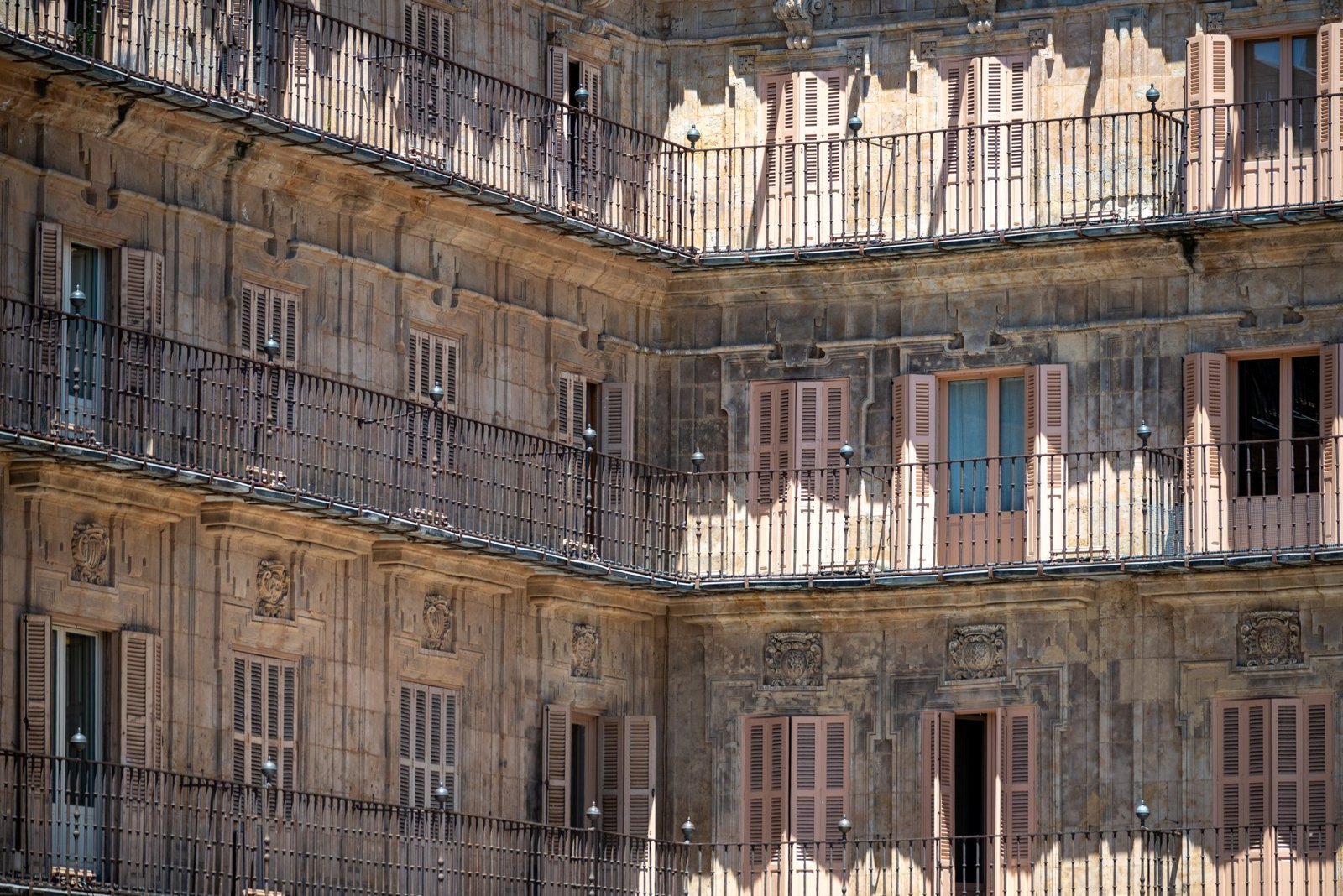
This place is abuzz with activity for most of the tourist daylight hours – and on into the evening. The harmonious baroque buildings that face into the square present an elegant face to the onlooker as she sits at the tables of the many, slightly touristy (and very busy) restaurants and shops which line the arcades. The tables of the restaurants spill out onto the plaza in the centre of which there may be an event or activity such as, during our stay, a book fair. Mercado Central de Abastos, another proper market that caters primarily to the locals need to buy produce, sits in its own early twentieth century building just across the small Plaza del Mercado on the east side of the Plaza Mayor. It, too, is worth a visit. The market has a website, parts of which are entertainingly rendered in English – grocery stalls are ‘Feeding’ stalls and butchers specialising in offal and the like operate ‘Piglet’ stalls (http://mercadocentralsalamanca.com/?lang=en).

Mobility Access
The plaza itself is paved and flat. The land around is slightly lower to the north-east, so you would need to climb a set of around 12 steps to approach from that side. The opposite side has a level access out of the plaza leading towards the Ruta Mayor. A taxi rank sits off to the east side next to the Mercado Central. The Mercado Central has been agreeably refurbished so now there are slopes up from the Plaza del Mercado to the market level and, within, it has a flat, smooth concrete surface. No seats here but there are cafés in the external arcades of the Plaza Mayor on the other side of Plaza del Mercado.
The ’Double’ Cathedral
The contrast between the ornateness of the baroque ‘new’ cathedral and the relative spareness of the Romanesque ‘old’ cathedral (there are some highly decorative rooms) make for a fascinating walk around, quite unlike other cathedrals of the Iberian Peninsula, or anywhere else for that matter. You can take a self-guided tour using an audioguide but we did find that the history was overlaid with a bit too much didactic praise of the glory of God. Nonetheless the place is such a maze of differing rooms and artwork that it may still be a useful companion. You can buy your tickets online but we just waited until the queue died down towards the end of the day and were able to buy at the entry kiosk and go in without any waiting around – https://catedralsalamanca.org.

Mobility Access
As will become clear I came very close to giving this a red designation. The ‘new’ cathedral is all on one level with stone floors. There are, as so often in religious buildings, plenty of pews to use for resting in the naves of the two cathedrals but there are no real resting places in the several other rooms that make up the complex. We did not check if portable stools were available. Wheelchairs could not be used because the ‘old’ cathedral sits at a lower level than the ‘new’, meaning you need to take a flight of steps down to access that section and there are steps to be negotiated throughout the older part. Those with difficulty managing too many steps need to think carefully about how to manage a visit. All we can say is that is that it may well reward the effort. It is a pity that the otherwise comprehensive cathedral website seems to contain no information for those with mobility issues.
Casa Lis (Museo Art Nouveau y Art Déco)
Viewed from Paseo del Rector Esperablé at the bottom of the bluff on which the museum sits, you get a sense of the entertaining art and décor within from the broad two-storey façade of the building, all coloured glass and ironwork, a hint of the feast of Art Nouveau within. Built in 1905, the museum contains decorative artwork from the two periods that give it its name. Art Nouveau dominates, not only in the artwork within but in the design of the interior centred on a fabulously over-the-top galleried space roofed over with stained glass. There is a café within from whence you get an excellent view down across the river plain. It is not expensive (€5 at the time of writing).

Mobility Access
Inside it is fine with level, smooth floors and a lift to the upper floor. We did not ask about the availability of stools or wheelchairs. There are benches in only a few of the rooms. Getting there requires a little more thought. It is tucked on a back street behind the cathedrals in that section of the old city that is, principally, intended to be approached on foot unless you are a resident. The roads are smooth and paved, only in some places succumbing to a grey-brick surface but the access from the south, and the main road of Paseo del Rector Esperablé, is up quite a steep road. Approached from the north side by the cathedrals, the roads slope down (but less steeply) to the entrance gateway. Taxis may be able to use the roads to drop at the entrance gateway but from any bus stop is quite a slog upward over a minimum of 300 metres.
Puente Romano (The Roman Bridge)
And parts of this structure do date to Roman times, although it has been subject to some reconstruction over the centuries following flood damage. It now provides a gentle, flat stroll of about 400 metres from one side of the river plain to the other (only cyclists share the space with pedestrians). It starts close to the point where the steep road from the old city hits the Paseos (that carry the road traffic on the riverbank) and cuts across the river and the low sandbanks, many covered in trees and shrubs. The vegetation gives a semi-rural feel to the scene, but with the cathedrals rising magnificently on your skyline. In this warmer weather some people are swimming in the slower moving parts of the streams whilst in other places the slightly stronger flow draws out plumes of river plants just below the surface. On the south side is a park area; a mix of paths and cycleways, of trees and open grass.

Mobility Access
The bridge is laid with a fairly smooth grey-brick surface and half-way across there is a wider bridge pier with some stone benches. Bus stops can be found close by on the roads that bookend the bridge. Getting down to the river and sand banks at the north end of the bridge requires going down a flight of steps but at the south end the land rises gently to meet the bridge and moving down to the park is straightforward.
Ballet at CAEM (Centro de las Artes Escénicas y de la Musica)
CAEM is part of a city-wide cultural organisation that is a purpose-designed modern theatre and concert hall (opened in 2002) that serves up an offer of both theatre and concerts with ballets as part of the mix. When we were in the city the Ballet Nacional de Cuba was performing Don Quijote and we were able to get tickets (online). The website is in Spanish but Google seemed all too happy to translate the page – https://www.ciudaddecultura.org/es/fundacion/recintos/caem-centro-de-las-artes-escenicas-y-de-la-musica. The building is a rather undistinguished modern box in a rather unprepossessing (light industrial and residential) section of the city, about 1.7 km (1 mile) from the old city but it was a delightful evening of very impressive ballet. There is a small bar/café in the large light lobby.

Mobility Access
There is a small flat paved plaza outside the venue and, once inside, the access is as well organised as you would expect in a modern concert hall. There are only a few places to sit in the bar/café and no others in the lobby area. Taxis seem to be the only realistic way of reaching the venue, which does mean you are waiting with a crowd of others for your (pre-called) taxis at the end of the evening. Fortunately the crowd when we were there was very polite and most people were careful to ensure no-one jumps into a taxi someone else has ordered. However you do have to wait at the side of the street which is fine on warm evening but might be more awkward in colder or wetter weather.
Swimming
The municipal pool, San Jose, is a collection of five pools (two outdoor) with both therapeutic and lap pools indoors. It sits on the south side of the river only around 600 metres east of the Roman Bridge, so is easily accessible from the centre of the city.
Mobility Access
The modern complex is on the same level as the adjacent street with no issues inside other than that the lap pool only has ladder-step access. Outside there are bus stops with direct routes from and to the city centre on the street outside.
Food and Drink

Casino Cafeteria (https://www.cafeteriacasino.es/quienes-somos/)
To English ears this has a faintly tacky sounding name but is actually part of the particularly splendid Casino de Salamanca housed in the Palacio de Figueroa, a sixteenth century palace that is now neither casino nor palace but an events venue. The Casino Cafeteria is actually accessed from the rear of the building, facing onto the small Plaza de la Libertad. We happened upon it as one of several restaurants that have outside tables in the plaza during the warmer months. We had not booked anything and were looking for somewhere around the Plaza Mayor. The eating places in the main plaza were so hectic that this area, just 50 metres up a street running off the north-west corner of the Plaza Mayor, seemed peaceful, if only by comparison. The menu runs the full gamut of the Spanish offer, including some vegetarian options. It also gave us a chance to try patatas meneas, a traditional Salamanca dish that had been bigged up by the Salamancan family who were our travelling companions on the Tren Phillippe II way back in Madrid. It turns out this is basically a tasty version of mashed potatoes – https://www.yourspanishshop.es/en/traditional-dishes/revolconas-potatoes-meneas-or-removed/n-104. Service here fell into that slightly indifferent, ‘we-are-serving-tourists’ category.
Mobility Access
We ate outside so I can give no guidance on the situation inside. The flat, paved plaza presents no issues if you are eating outside. The immediate area is largely within the pedestrian centre but taxis can get in to the west side of the plaza. Public transport is further afield, 400 metres down the hill to the east and slightly further off to the west.
El Mesón de Gonzalo (https://www.elmesondegonzalo.es)
This restaurant, just across the road from the south-east corner of Plaza Mayor, was suggested by our hotel for our first night and the images and the décor would lead you to expect a good quality place. Indeed the food, once we had realised that the menu is structured as sharing dishes, was indeed good. There is a choice of Spanish seafood and meats on the menu (in English when you scroll down from the Spanish menu on the website). The restaurant has two entrances, one to a brick-lined semi-basement vault and the other to a more modern-feeling room looking out over the small Plaza del Poeta Iglesias. They also set up outside tables. We were in the indoor, upper floor space. Where the restaurant fell down was in treating us, we felt, rather off-handedly. Unwanted place settings were cleared onto a shelf beside our table and one staff member knocked into us when stretching to put other things on the same shelf. The apologies that followed the clumsy knock became a little too over-familiar. It felt unnecessary and not a little as if we were being treated without proper care because we were never-to-return tourists, not locals.

Mobility Access
Whichever entrance you use there are six or seven steps to be negotiated to reach the tables. In the upper space there are a couple more steps up to reach the toilets. This is in the heart of the old city although taxis can drop you in the small plaza. The Plaza Mayor taxi rank is a short 50 metres or so to the north.
iPan iVino (http://ipanivino.com/#inicio)
Self-described as a taberna and vinobar, this was the restaurant we enjoyed most in Salmanca. We went twice. It has a cuisine based on local ingredients and wines and we found both high on quality. The concept is tapas-based but here using the slightly larger sharing plates known as raciones (in whole or half portions) but all freshly cooked. There are some options for vegetarians. Service was thoughtful and friendly. The décor is clean-lined modern and the restaurant is not large. It is also peaceful. They do have some tables set up in the street outside. It is in the old city in an area that is a forest of restaurants and eating places (and even an Irish-themed bar). It is in the short side street that slopes down from Rua Mayor to Calle San Pablo and, with tables from a number of eating places blocking the street, it is pedestrian only. The menus are in Spanish but by this stage we were more familiar with the language of menus – and there is always the internet to fall back on for translations.
Mobility Access
One step up from the sloping but smooth, paved street to access the stone-tile interior. Thereafter no issues. Taxis can drop on Calle San Pablo, a short uphill 50 metres from the restaurant. Buses stop much further down the slope, around 300 metres away. Getting away afterwards is a matter of going to the taxi rank in Plaza del Mercado alongside Plaza Mayor, a walk of around 250 metres.
The Hotel
The Parador in Salamanca is on rising ground on the south side of the Tormes River and gives views across to the old city. However, with the difficulty of parking in the old city added to the fact public transport is not on the doorstep of either the Parador nor the old city, we decide we wanted to be closer to the old city. The walk from the Parador to Plaza Mayor would be a roller coaster of slopes over a distance of about 2 kilometres (1,250 yards).

So our research led us to push the boat out a little on pricing and thus to the Hotel Rector, an elegant five-star, boutique hotel (https://www.hotelrector.com/EN/home.html). It is set on the river plain just below the Roman walls and the bluff where the old city sits and only a short walk from the Roman Bridge. Bus stops were sited on the road immediately outside the hotel. It feels boutique; only 16 rooms in a handsome 1930s building with staff who were attentive and helpful, but never stuffy. There is a small gym, but the joy of the place lies in the well-kept restrained décor and a peaceful set of public spaces where there always seemed to be a quiet corner when needed. There is a garage but, for reasons that now escape me, our car was parked, quite happily, in the quiet street at the back of the hotel. The words quiet and restrained elegance also described our room, which also all we could need in terms of facilities.
We ate breakfasts in the small dining room but only used room service one evening for dining. The reception staff deserve a special mention for ensuring everything worked for us (taxis, restaurant bookings and recommendations) with one person even going to the lengths of using his personal account to log us on to the tennis channel so we could watch Rafael Nadal’s final match at the French Open in our room.
Mobility Access
Although the entrance door seems to run without steps onto the pavement (sidewalk) outside, once through it there are ten steps down to the main lobby and public area on the ground floor. Once within there are no issues. The floors are flat and a lift services all the floors and, of course, the hotel is small and so no there is no distance between the constituent parts. There is an access at the back of the hotel that is at the same level as the public areas.
We used taxis and Shanks’s pony to reach the old city as the Plaza Mayor is a 600 metres walk up the gentle slope of Calle San Pablo and the cathedrals are a much steeper 400 metre walk up the winding road that climbs the bluff opposite the hotel.

Browsing this today I remembered my year of study abroad in Salamanca – a completely different experience as this was towards the end of Franco’s rule. Children’s reading primers without exception began with the words “Franco manda y nosotros obedecemos” (Franco orders and we obey). The Tormes was where women washed their clothes – my landlady was ecstatic when “Los Reyes Magos” brought her a washing machine.
Revisting in 2001, after European money had poured in, it was transformed. Only the Plaza Mayor remained the same. Tapas were free with a glass of cheap wine! I’m so glad its still as honey-coloured and more vibrant than in those sad old days. Thank you for the memories!