Choosing Our Destinations
Like so many travellers the list of places that we want to visit seems to grow as the years progress. One result is that there are relatively few places we return to. We live in a vibrant city and enjoy trips that take in other such cities. Some of those draw us into return visits, such as Paris, Venice, New York and Delhi. Of countries, apart from the more obvious and accessible European nations such as France, Italy and Spain, India is one of our few ‘return to’ destinations. But often a return to these countries still means taking in parts we have not previously visited.

In recent years, recognising the likely physical changes that have come with age, we have generally prioritised those places that are, we perceive, likely to be more difficult for us to access as we get older.
Booking Our Travels
Given our preferences we tend to either research and book our own travels in regions whose culture we are more familiar with, such as the western European countries and the North American sub-continent. Otherwise we use a travel adviser to arrange bespoke holidays where we can have a fair bit of input into the itinerary. For some years now we have used Audley Travel for this (https://www.audleytravel.com) whose service we have found to be both knowledgeable and responsive, both before and when you travel with them.
We are organisers and that has meant we had always had our itineraries firmly fixed before we travelled. Then, just before the COVID-19 pandemic kiboshed everyone’s travel plans, for the first time we set off on a rail trip to eastern Europe (in the autumn of 2018) with only the first few days of our accommodation booked. We would then spend a little time in each place deciding on our next destination, how to get there and where to stay. Initially unnerving, we gradually encompassed that exercise as part of our travels and ended up going to so many places we might otherwise never have been – the Tatras in Slovakia, Timișoara in Romania, Novi Sad in Serbia and Podgorica and Lake Skardar in Montenegro amongst many others.

When I book online, I often do it direct with the operator – be it for flights, trains, hotels, car rentals. However, having generally been an advocate for direct booking of flights, recent experience with Trailfinders suggests that, for reasons I cannot begin to understand, it can be much cheaper to book a quasi-package with them rather than booking flights direct with the airline. I call it a quasi-package because, on a trip to the United States in 2025, we booked only the flight and the car hire with Trailfinders but booked all the hotels ourselves. The cost was almost half that of booking the flight alone direct with the airline. The same price difference would have applied had we booked just one hotel through Trailfinders but not the car hire. I am assuming other large travel companies probably secure similar arrangements. I cannot say if this applies to all travel but it is certainly something to bear in mind.
Afore We Go
A destination chosen, I read and I go to the internet. I used start with a guidebook from a favoured series and then I moved to starting with Audley’s own website or an official tourist information website as the best way to get an overall sense of a destination and what places or activities will appeal to us. Now for many destinations I will turn to AI (see below) as a first step.
On longer trips outside Europe and the United States, we try to work out a broad sense of where to go and for how long before going to our travel adviser. We then work with them to hone the itinerary, taking heed of their advice. This is why we only use travel advisers, like Audley Travel, who can provide a bespoke service, using an individual who has actually been to the relevant destination and, therefore, knows the accommodation and activities on offer, often from first-hand knowledge.
On the other trips which we arrange ourselves, having worked out a general framework itinerary, it is a dive into a melange of internet research on possible hotels or rental properties, train timetables, events and car rental locations. I treat the organisation of travel as an enjoyed part of the travel experience – and I have the time to do it!
To the extent it is helpful, here are our thoughts on some research approaches which you may find useful, if you enjoy the sort of travel we do.
AI (Large Language Models or LLMs)
If you read Mustafa Suleyman’s excellent, but terrifying, book, The Coming Wave, on the increasing impact of the new technologies, AI is here and is just going to infiltrate more and more of our lives, for both good and ill. And so we have taken to using AI LLMs to help us research information associated with our travels. We have used the free service provided by both Chat GPT and Claude and they are, honestly, very useful tools. I still have to double check information and do my own in depth research. They still have a quirky tendency to ‘hallucinate’ (make up answers if there is no available answer to a question you pose) but their ability to reduce hours of research to a few seconds cannot be denied. I do try and make sure to ask clear questions without giving up too much personal data that can disappear into the maw of Open AI or Anthropic. In particular AI’s ability to ferret out difficult to find information on access issues for those with mobility constraints has been particularly useful. I have to say that since Anthropic took a stand agains the US Government over unlimited access (and Open AI apparently did not), I have favoured its AI tool, Claude over Chat GPT but that is a personal choice.
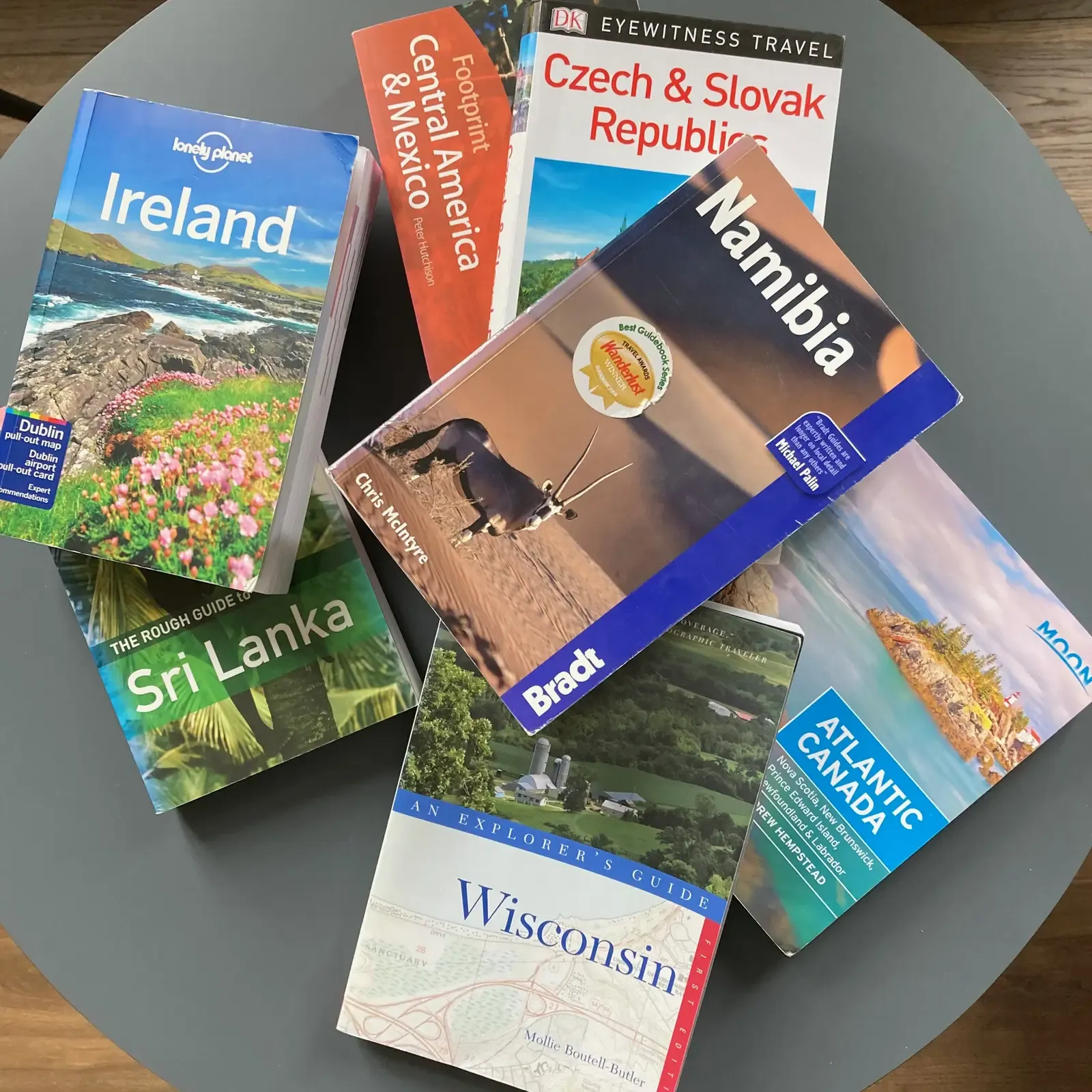
Guidebooks
I do still try to look at the physical books before I travel as, for me, that is the only way to assess whether one will work best for a particular destination. It is also often the only way to find out how up-to-date a particular guidebook is, a point that has become even more critical with the havoc wrought on the travel and leisure industries by the COVID-19 pandemic. (Grumble time – I dislike the fact that it is so hard to find when a particular guidebook was published. All too often the publication date is buried deep within the difficult to find copyright information in print that ageing eyes find it increasingly awkward to read.)

So, in London, my ‘go to’ for travel books (both guides and country-related reading) is Daunts in Marylebone High Street. Another choice is Stanfords, who have shifted from their historical Covent Garden location on Long Acre slightly north to Mercer Street. Stanfords has much the better selection of maps and road atlases, but Daunts remains the favourite because each country section contains not only guide books but also novels which are set in the relevant country, pertinent history books and travel writing about the country. And, of course, the travel books are housed in that superb Edwardian setting with glass skylight and oak galleries.
For more distant or less popular destinations, my starting point is often to see if the Bradt series covers the place but, if not, both the Lonely Planet and the Rough Guide series are usually reliable fall backs. For better known city and regional destinations I was a bit of a sucker for the Dorling Kindersley’s DK Eyewitness series, although recently we have been introduced to the 500 Hidden Secrets of… series which we found an excellent in depth city guide recently in the Belgian city of Ghent. I intend to try others in future to see if they match up. If you want to go pocket-sized for your city guides, my partner likes the Everyman series with their individual pop out area maps.
For guides to the individual states in the United States, I prefer those published there, choosing either the Explorer’s Guide series or Moon Travel Handbooks with Fodors as a fallback.
Hotel Accommodation
Given our preferences I often start with ‘Best Hotels in….’ online and filter out the sponsored or less focused websites (amongst which I include Tripadvisor and booking.com). I may look at Mr & Mrs Smith’s selection (https://www.mrandmrssmith.com), adding in Relais et Chateaux (https://www.relaischateaux.com/us/) and SLH (Small Luxury Hotels) (https://slh.com) where appropriate. Then I look at each individual hotel’s website and flick through the photo gallery to get the feel of the place (ignoring as best I can the ‘arty’ shots and food shots that tell you nothing at all). I tend not to rely too much on guidebook recommendations although Fodor’s online resources can be helpful in the United States (https://www.fodors.com/world/north-america/usa). For less well known destinations that these groups do not cover it is down to more detailed interent searching and researching of hotel websites.

Then the detailed questions: what is the room size, can I get a king-size bed (at just under 2 metres tall I need it), is there a bath (tub), is there a lift (elevator) or a ground floor room? This last question is surprisingly difficult to find an answer to. Shame on hotels for not making this, and other clear accessibility information, more easily found on their websites. This is where I find Tripadvisor or booking.com can be a help. In both just type ‘stairs’, ‘lift’ (or ‘elevator’) into the search function in an individual hotel’s review section and you will usually find an entry that gives you some relevant first-hand information. The booking.com entries also have a Facilities section that covers this (in the sub-section headed ‘General’). This is a particular area where AI’s LLMs are helpful in digging out hard to find information on accessibility.
Another search I often use is of a maps app, like Google Maps. If a hotel’s website gives no sense of its location in relation to the surrounding area – how built up is it, what is nearby, where is it in relation to shops, restaurants and the like and, importantly for city hotels, where are the nearest transport links (bus, tram or metro) – a maps app and Streetview can be helpful in resolving these questions.
If I am making a choice between options, I also run quickly through recent reviews on both Tripadvisor and booking.com to see if there are any common themes that might be a concern for us. For example, there may be several references to street noise in a city hotel. One or two references can be discounted as the sensitivities of those who may not be used to the white noise always present in cities, more references may indicate it is better to think about being elsewhere. Then I go back to the hotel website for availability and pricing. In this day and age I have found no real difference in pricing between booking direct and websites like booking.com. So direct booking is my preferred option and it makes raising questions direct with the hotel much easier.
Finally I mention that if, after we have stayed at a hotel, we have a particular concern with a hotel’s offer, facilities or service that I point out in my writings, we will have raised that concern directly with the hotel.
Culture and Events
I tend to have a good rootle around the websites that cover cultural events and exhibitions in towns and cities. There are no specific websites I know of that cover these types of activities so, keeping it obvious, I start with the local tourist information websites and move from there.

Rental Properties
Renting holiday properties was not something we had done for many years (bar our one-off two-month stay in Venice). In part we were put off by the quality of product. Perhaps understandably, the few places we stayed in years ago always felt as if they were decorated and supplied on the assumption that the owners expected their renters to behave badly and trash the place. And an assumption seemed to be made that only the most rudimentary attempts at cooking would be made (is it really that difficult to supply a knife-sharpener?). Then came the COVID-19 pandemic and, barred from overseas travel and with hotels still closed, we looked to renting in the UK for our breaks – and found that, if you search it out, a world of quality properties exists out there. Since then we have rented both at home and abroad. The key point is that you really have to put in the research time, planning well ahead if you want a high-quality rental when and where you need it. In the UK, as well as doing one direct rental, we have found two sites that we have used on more than one occasion: Boutique Retreats (https://boutique-retreats.co.uk) and Unique Homestays (https://www.uniquehomestays.com). Of course the properties on these websites are costly but, in our limited experience, you are getting what you pay for in terms of quality and services. Unlike many, many others we have not delved into the world of Airbnb. What started as as an emotionally-based dislike was fuelled by some negative news items a few years ago. However I am aware that so many people we know have used the service successfully and will, no doubt, continue to do so. Somehow natural stasis on our part has kept us working with the devils we know.
Abroad our recent experience is noted in the appropriate Destination entries.
Apps We Use
Here are a few apps that I have downloaded that I find useful when travelling:
- Google Maps – bluntly, for ease of use this has taken over from most other sources for finding good public transport options as well as for other direction finding, but be aware of the limitations. I have tried to highlight ones I find in individual entries, if relevant. One, in particular, that can be irritating for those with mobility constraints is that it can insist you walk what it regards as short distances even if there is a public transport option that only takes one or two stops or a requires the use of a roundabout route.
- DB Navigator – for European rail travel I tend to use the app from Deutsche Bahn, the German national rail company to search out journey timings and timetabling of trains.
- Google Translate – even if it is only to put up the translation of ‘Thank You’ to be shown to the seller of train tickets who has had to suffer through my total lack of Hungarian, Serbian, Bulgarian, etc….
- National Rail Enquiries – for UK trains, tickets and journey planning.
- XE Currency – just to keep an eye on cost and for quick currency conversions.
It is often worth downloading the app for the local transport service in a particular city (e.g. RATP in Paris or ACTV in Venice), even if you just delete it after you return home.