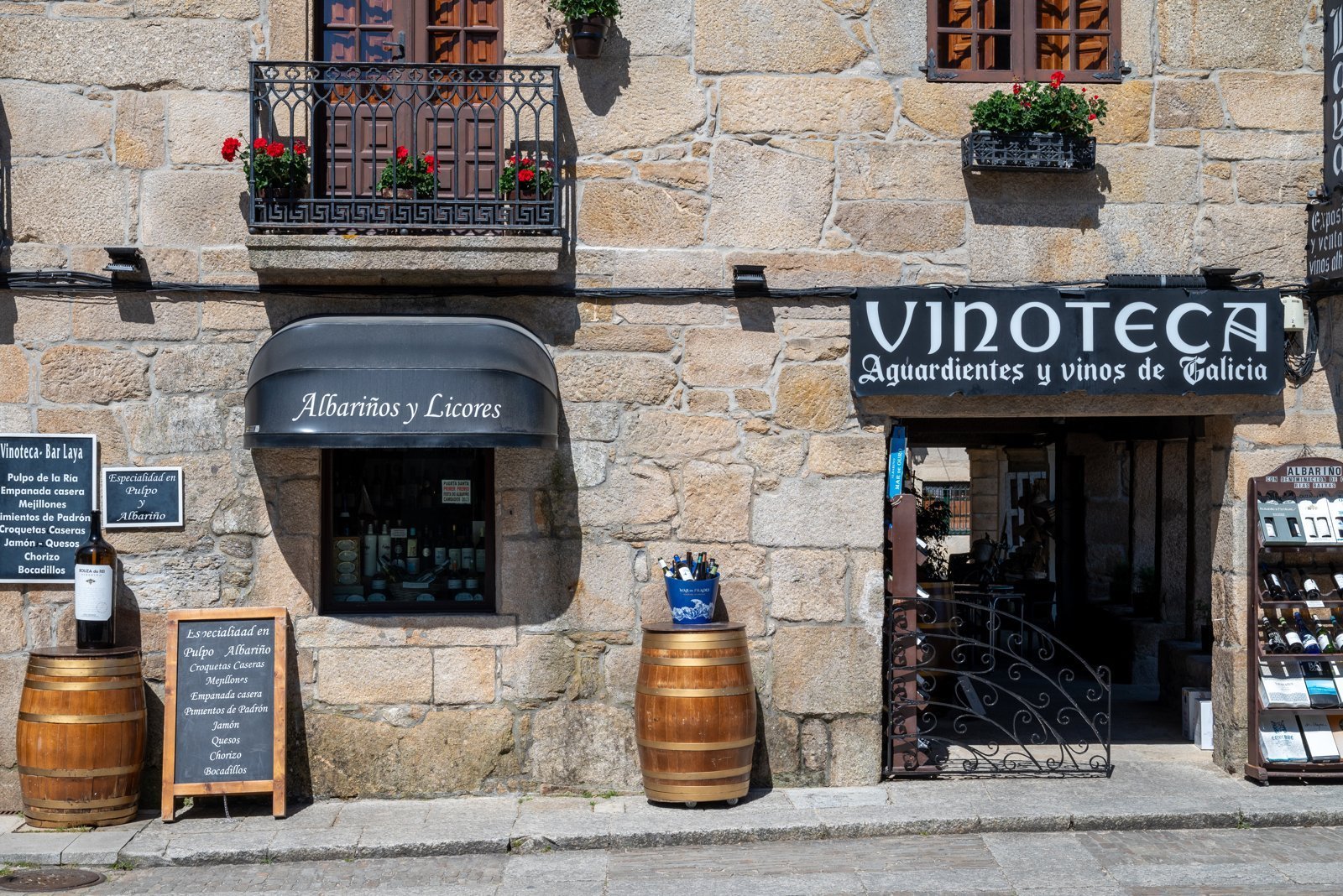
This was a seven week road trip that would result in an impossibly long single piece so, as with other long trips, for convenience it has been divided into eight separate posts.
Part 1: Prelude, Structure of the Trip and Practicalities
Part 2: Catalonia (Aiguablava) and Madrid
Part 7: The North West: Puebla de Sanabria, Cambados and Pontevedra
Part 8: The North West: Ferrol, Santiago de Compostela and Heading Home
THE NORTH WEST

The landscape changes dramatically as you move from the central plain with its ancient cities and slightly arid ambience north and west towards Galicia. The brown emphasis turns to a dark green of forest as the susceptibility to the rain coming off the Atlantic imposes its colour palette on the scenery. And the wide high plain becomes vigorously defined hills and valleys where rivers like the Tormes, Duero and Tera cut deep winding canyons. Rather than race to Spain’s western coast in one day we took a break in the small town of Puebla de Sanabria deep in this landscape.
On a practical note the native language of the far north-west is Galician (Gallego) and this will often sit alongside, or appear instead of, Castilian Spanish. For example beaches are no longer playas but praias and city squares are no longer plazas but prazas.
PUEBLA DE SANABRIA
Length of Stay: 3 Nights

This appealing town (only 1,500 people) gave us a very different view from the sophisticated cities that we had stayed in hitherto. Physically there were superficial similarities. An old town dating back fifteen centuries (topped in this case by a 15th century castle) perched high on a bluff above the junction of the Rivers Tera and Castro, with the newer parts spread out below. A Parador built on the slope of the valley opposite with views encompassing the old town and the castle on the bluff. But the humps and rolls of the hills, layered with woods and green meadow, gave the surrounding landscape a contrasting sensibility to those seen elsewhere. And here we also ventured out into that natural landscape to enjoy the scenery of this touristically less well-known region. It made for a very congenial change from the historical cities of the Meseta. There is a municipal website that has short pieces of the main sights (but only in Spanish) – https://www.pueblasanabria.com.
Getting There
On Google Maps the drive from Salamanca to Puebla de Sanabria is only around two and a quarter hours unless, like us, you take a thoroughly enjoyable slow wander on the side roads past cork tree plantations, diving up and down the steep river valleys that criss-cross this region and winding along the roads that track the edges of reservoirs along the river valleys. Then, in a deep gorge of the Duero/Douro River, a dam appears. This marks the border with Portugal at Miranda do Douro. Here you drive through the north-easterly corner of that country and re-enter Spain thirty kilometres (19 miles) further on. A final dawdling drive into the forest-covered hills of the Sierra Segundera follows before you roll over a crest in the road to see the forbidding façade of the town’s castle in front of you. Another drive that was punctuated by refreshment stops in village cafés and, for us, a supermarket bought picnic on a roadside table beside a seemingly derelict children’s activity park high in the hills.

Just a minor quirk to watch is that Portugal operates in the same time zone as the British Isles, so you suddenly find your smartphone has jumped an hour back when you cross the border.
Places Visited and Activities
Walking the Town
Small meant narrow streets crammed onto a hilltop with old stone houses, the aforementioned castle and a peaceful town square overlooked by a picturesque twelfth century church. It also meant steep slopes leading up the square and castle which cluster together at the top of the hill. It also made for spectacular outlooks, especially from the terrace outside the castle entrance and the walkway along the top of the walls that runs along the east side of the hill on which the old town sits. And along those walls are a few café/restaurants where you can just sit at outside tables and enjoy that view. We did not go into the castle.
The main road through the town runs up from the river along the side of the bluff ending in a high street at the bottom of the old town. Here are small hotels, a number of local shops (a few of which betray a focus on tourism) and eating places, some with outside tables. Down some of the side streets are free car parks with a short walk back uphill to that main road.

Mobility Access
The streets of the old town are all paved and relatively smooth but there are those changes of level to contend with because the town is so small. There are some places where you can find relatively flat sections – around the main square and castle and along a section of the city walls leading away from that area – but you need to find a way to get up there. No public transport, no parking spaces and difficult to navigate streets that seem to have signs that warn off car-using tourists, even if you are just trying to drop off those with mobility constraints. We did our drop off as near as we could to the main square, then the driver retreated to find parking in the lower reaches of the town.
There are the wall-hugging cafés for the stops but, whilst walking down may be easier than walking up, it still involves negotiating slopes and steps for about 300 metres to reach the main street through the town. Having said that, if you can find a way, it is a lovely place to spend some relaxing time.
A Walk along the Rio Tera
A walk on altogether flatter ground can be taken along the eastern banks of the River Tera opposite the heights of the old town where you get a clear view up to the castle from the riverside. It is a pleasant place to stroll for short distances on grass or tarmac with the river running under the arched bridge, a weir populated by river birds and Spanish families and couples taking their ease in the sun.

Mobility Access
The riverside walk is a contrast to the old town with easy road access from the main road through town and with plentiful parking. The paths are flat and paved and there are some benches on the grassy river banks.
Parque Lago de Sanabria
The full name of this national park is Parque Natural del Lago de Sanabria y Sierras Segundera y de Porto and, only a 25 minute drive from the town, it is a peaceful and leisurely landscape of wooded hills centred on a glacial lake. There is a substantial, modern visitor centre and museum on the road into the park from the town (it was closed when we were there). The national parks website is in Spanish but the entry for the park has photographs and videos which give a sense of the place – https://patrimonionatural.org/casas-del-parque/casas-del-parque/casa-del-parque-del-lago-de-sanabria-y-alrededores-galende.
On the road that runs along the south shore of the lake are a number of small sandy beaches with locals swimming, sunbathing and picnicking but never enough to make it anything but a peaceful place to be. Indeed we came twice, once to explore what was here and then again the next day to do our own relaxing and resting. There are simple cafés and some watersports and boat hire places, but they seem to adhere to the same season as other facilities, namely that summer in Spain does not start until 1 June. There is also a road that winds up through the hills on the north side of the lake on which there are a few miradors with views that take in the whole lake and its remote-feeling setting.

Mobility Access
You need the car to get here. Once here there are lakeside car parks and easy access to the beaches and areas of ground where you can sit amidst the trees and gaze out across the lake.
Parador
https://paradores.es/en/parador-de-puebla-de-sanabria
This parador looks like a modern building but was refurbished from the skeleton of a 1930s hostel on one of the many pilgrim routes that filter west towards Santiago de Compostela. It is now a clean-lined two storey building with outside spaces where you can relax and the grounds, whilst not large, are big enough to provide privacy from the small town houses, school and businesses that are the nearest neighbours. Another ‘seasonal’ pool lurks in those grounds. It is another place which shared many characteristics with others in the network which is to say, all very clean, comfortable and, we think, such good value. We ate here every night as there is nowhere else in sensible walking distance of the Parador. It is about 850 metres down to the river and then back up to the main high street of the town and its wider selection of eating places. The food was, as in every other Parador, an enjoyable selection of Spanish dishes with a number of local dishes.
The adequate car parking was immediately adjacent to the building but, like in some other places, the spaces in the shade are all snapped up by early afternoon.

Mobility Access
Stone tile and carpeted floors with no awkward steps and a lift to the upper floor mean that there are really no concerns here.
CAMBADOS
Length of Stay: 5 Nights
This modest municipality of around 14,000 souls sits on the glorious Galician coast facing west across the Atlantic, part fishing and seafood port, part centre for the surrounding vineyards of the ‘wine of the sea’, the albariño of the Rias Baixas, and part local tourist centre. As with each other town or city we have visited, there is an old town area where pedestrians (and locals) are prioritised. Here an open square with church and winery is on a low rise of ground up from a seafront of promenades, small parks, fishing facilities and beaches. With the Parador tucked behind a seaside park, it gave us a place where we happily spent time, walking, relaxing, visiting the low-lying coastal islands and taking trips into the nearby (much busier) historical centres of Pontevedra and Santiago de Compostela. It is described as having abundant rainfall given its oceanic location but we enjoyed several warm, sunny days (temperatures up to 27°C (80°F) dropping to comfortable sleeping temperatures at night). With our next stop of the naval port city of Ferrol, Cambados provided a different way to enjoy the western Atlantic coast, these two urban centres a real counterpoint to the cities of the Meseta.

Getting There
Again it was only a short drive from Puebla de Sanabria using the autovias (around two-and-a-half hours) but here was another reason to take the side roads: the forested mountains of the Galician Massif and the steep-sided valleys of the Sil and Lor Rivers. Here the road rises over 1,000 metre (3,300 foot) high passes before slowly wending its way down to the more populated, vine-dappled coastal areas. En route it visits towns that act as ideal stopping places, often tucked into the bottom of those river valleys, like A Gudiña, Chantada and Lalin. All these places are, very much, local towns with no obvious tourist sights, but all with those satisfying, unpretentious cafés.
Places Visited and Activities
The town has a Spanish only website which is worth a glance if only to get a flavour of the town from the photographs – https://www.cambados.com. There is a tourist office tucked into a courtyard behind the small plaza that sits at the heart of the seafront promenade – https://cambados.es/oficina-de-turismo-gl/.
Walking the Town
This really falls into three areas: the small old town centre, the seafronts and the Pastora hill; all quite small scale compared to the several storey buildings and more enclosed feel of the places visited earlier in the trip. The old town only covers an area about 350 x 400 metres with ground that rises gently up from the seafront to the surprisingly sizeable open town square, Praza de Fefiñáns, with its plane trees that have been subjected to a short, back and sides pollarding. The totality also has pleasing peacefulness, especially during the week (there are more locals taking advantage of the glorious weather at the weekends). There are no ‘wow’ sights, but along with the equally peaceful and small scale of the rest of the old town, with its many eating places and cafés, the praza is a good place to wander and sit.

There is a tren touristico which takes a 40 minute tour around the town. It departs from Praza de Fefiñáns with a small kiosk in the square where you buy the tickets but seems to have rather an eccentric departure arrangement. It leaves only when there are at least ten passengers. On a weekday in particular, this means you could be sitting for a fair while for a suitable departure. No website; just a reference, in Spanish only, on the town council website (https://cambados.es/es/item/pavi-tren-2/) so no booking in advance.
The seafront is also pretty quiet and it is possible to walk along paved walkways and open areas from a tidy promenade backed by a small park through the fishing port area, past the lively weekday market, circle the harbour beach taking in the historical manor house (Pazo de Montesacro) and stroll through another section of narrow streets and older residential buildings and end by taking the causeway out to the small islet where the ruins of the Torre de Sadurniño seem to emerge from the sea like the conning tower of some submarine. Beyond the islet lies another quiet urban beach. There was a wealth of sights and people to interest me on a walk of about 1.6 kilometres (1 mile). You do have to walk back of course.

I continued by taking a different route from Torre de Sadurniño up through the quiet residential streets to one of the roads into the town where the architecture turns towards the final quarter of the 20th century and the road slowly rises for around 1 kilometre (1,000 yards) up to the base of Pastora hill, an area of wooded parkland with those packed gravel paths that rises, after a short climb of about 200 metres, to a mirador (a viewpoint) that looks out across the town and the sea. The real fascination, for us, was found at the bottom of the climb where the visually startling ruins of Santa Mariña church are the centrepiece of one of those fascinating cemeteries that is still in use. Here you can just sit and watch the locals tending open graves or solemnly bringing flowers to those strange (to me) walls of cavities that feel like residential blocks for the dead set in their grid-pattern avenues. A quiet but haunting place.
Mobility Access
In the old town paved, pedestrian-priority streets (only locals get their cars into this area) with relatively gentle slopes up to Praza de Fefiñáns, and all within a contained space and plenty of stopping points for a drink and a watch of the people going about their business, mean it works pretty well for those with mobility constraints.
Down on the seafront wide promenades and quiet streets with pavements (sidewalks) that are all at sea level (ergo, no slopes) make short walks, or even longer ones with rests on benches and walls, within the compass for most of us.

The uphill walk to Santa Marina church ruins and the cemetery probably makes this too much of a stretch from the town centre on foot. With a car you can park on the street very close to the cemetery and the ruins where there are six steps up to the cemetery. Within there are gravel paths some of which are quite uneven and there are more small changes of level, thus more steps to manage, within the site. The climb up Pastora hill is not a realistic proposition for those with mobility constraints.
Driving the Coast
The whole of the deeply indented coast of this region is a gratifying mix of wooded coastal hills, open sandy beaches in curving bays, small towns and fishing ports with estuarial bays housing low-lying islands. Taking a drive that hugs the coastal roads has its own delights, the more so when you added in the Spanish weekenders enjoying the sunshine in their own equivalents of Camber Sands, Rhossili Bay or Bridlington giving the drive a very human flavour. Of course there are plenty of places to stop for breaks, with or without beverages. South of Cambados sits a peninsula, centred on the improbably named town of O Grove, linked to neighbouring land only by a wide flat spit. Here is a microcosm of the coast. The town shows port and tourism characteristics in equal measure. The small hotels on the roads up the hills from the port seem to echo their counterparts in the south-west of Britain with a sensibility that seems to ooze bucket-and-spade family holidays. Around the peninsula are bays where areas of coarse grass flourishing around sandy paths lead down to open beaches (in Galician praias). Here holiday homes rub shoulders with camping sites, shops selling family holiday necessities (those buckets and spades), restaurants and small hotels. On a sunny June weekend, cars cram the verges along the road as day-trippers bundle supplies, beach umbrellas and children out for their day on the beach. We stopped at a café that was part of a camping site at Praia Area da Cruz only because, after the urge for caffeine overtook us, it was the first place we saw with off-street car parking. Here, in a building that had a seasonal sensibility, we sat on a terrace at their Lina Limón café with its floor of artificial grass and watched the whirl of cross-generational Spanish families enjoying the warmth and the comfort food. Fun watching local fun.

Mobility Access
For us this was just a drive with stops to stretch out, to take in views and to have beverage breaks. So no issues from that perspective. I cannot comment on the accessibility of beaches although there are some wooden boardwalks and access to most from the road seems fairly flat. We did not stop in O Grove so no useful comment to be made.
A Illa de Arousa
For us, the island of Arousa held a different ambience. We only visited one part but it is a part apart. Having crossed the causeway road to the island, watching the kite and wind surfers swarming around in the Atlantic breezes, we turned off to the south end of the island and the Parque Natural de Carreirón, a reserve whose woods cover a flattish landscape of small sandy bays and wetlands. The road reaches a dead end by the edge of the reserve beyond which the 500 metre stretch of sand, Praia de Xastelas, also marks the starting point for back-and-return walks that can be as long as a couple of hours (if you circle round the reserve) or just a few minutes, if that is all you want to manage. There are local walkers and, in the secluded bays, a few determined isolationists (including the odd naturist) are sunning and paddling but, in general, it offers peaceful walks through nature. Maps showing the routes of walks are on signboards at the access point to the reserve. There is one wooden hut serving drinks and snacks but it is open only seasonally and even then it was not open during our visits. The island has its own website but only in Spanish – https://www.ailladearousa.com/que-visitar/parque-natural-de-carreiron/.

Mobility Access
The paths leading away from the car turning circle that acts as a drop off point are hard, packed sand and pretty level, so short strolls without undue hazard are possible but, once you head into the woods and onto the coast-hugging path there are changes of level, rocky stretches and more uneven surfaces. Whilst it might be seen as a place for easy walks, for those with mobility constraints it is not a practicable proposition. The only seats available are on the occasional stone benches, on the rocks that pepper the shoreline and on the ground itself, so bring your own seat or take a rug and just sit on the beach of Praia de Xastelas and enjoy the peace. Car parking is on the generally shaded verges of the road down to the turning circle. It can be quite busy, meaning a walk of a couple of hundred meters or more down the road to the beach and reserve access point. An enterprising local has set up a fenced off area as a car park only 100 metres from the drop-off point with a day charge of a few euros.
Another Laundromat: Another La Colada
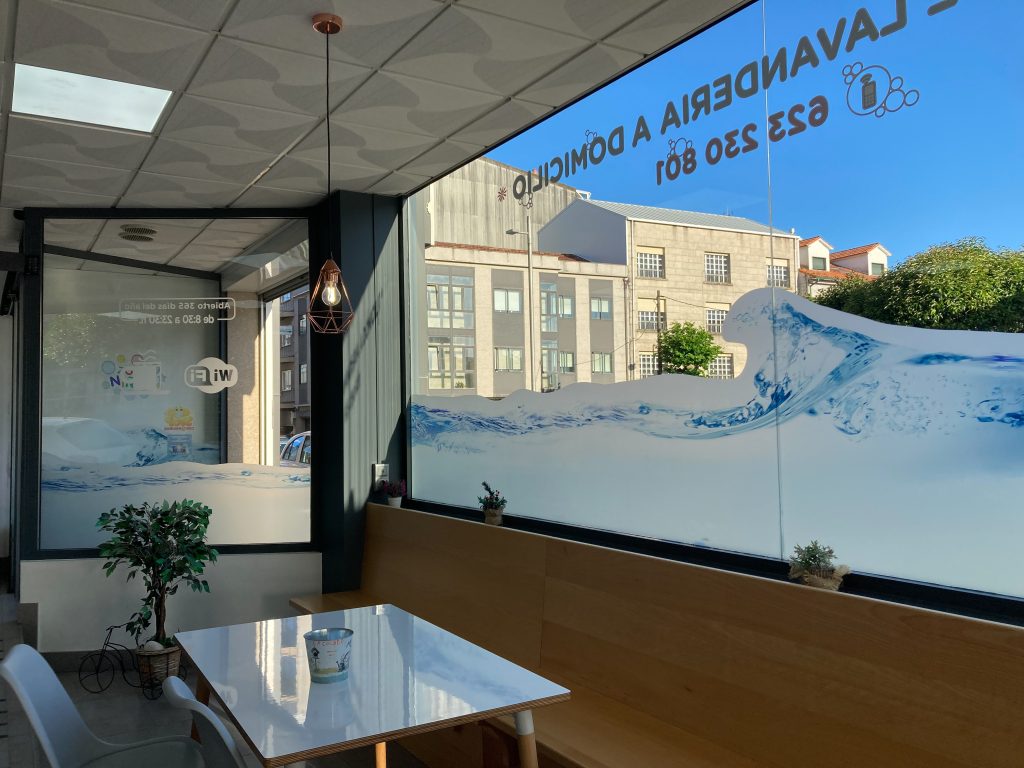
This Europe-wide franchise has outlets across Spain and this one, on Cambados’ main street up from the sea, joins other laundromats on these travels by being clean, fresh and light with seats and tables, as well as baskets, for customers. Card operation, but with coins needed for the dryers (a change machine gives coins for notes) with washing powder included in the wash price. Early morning on a Saturday proves to be quiet and we are done in time to return to the nearby Parador for breakfast.
Getting Around
This is too small a town to have anything other than an irregular bus service and we could use the car to reach places like the Pastoria hill and the Torre de Sadurniño, and free car parking was usually possible on the streets. With the Parador on the edge of the old town, walking to any of the restaurants from there was straightforward.
Parador
https://paradores.es/en/parador-de-cambados
The Cambados Parador is almost perfectly situated just across from the seafront promenade, on the south-eastern corner of the old town, within easy reach of the shops and restaurants all around and surrounded by small but sufficient grounds to make it feel a haven from within. It is an old manor house or pazo (a feature of Galicia – https://turismoriasbaixas.com/en/tu-destino/imprescindibles/pazos) dating from the 17th century, a two-storey building constructed around a central courtyard that serves as an outdoor café and meeting place for drinks for small families of locals gathering as a precursor to their evening. The décor has a slightly old-fashioned feel but everything works well. The public areas, not just the courtyard, were good places to relax. The room we had was huge and came fully equipped, including air-conditioning that we were grateful for as the temperatures had settled into the high 20s centigrade (around 80°F) during the day with only some after-dark cooling. And it was June so – the pool was open!

We did not eat our evening meals in the restaurant. Nothing in particular stopped us doing so other than a slight hankering for informality and tapas and the wealth of options in the town. Service in the restaurant at breakfast probably felt like it suffered most from that sense you can sometimes get in Paradors that the staff have an order in which they wish to do things, so they can be slow in replacing buffet items that run out and you can feel that they want you out so they can get on with laying lunch service. A small inconvenience in yet another lovely place to stay. Car parking is in the front courtyard.
Mobility Access
Level, stone floors laid with rugs throughout the public space interiors, a lift to the upper floor so no issues of any materiality. The access from the forecourt and car parking area is step free. The pool is set in a low table of raised ground in the garden so a slope up to access the paved pool surround. Only ladder steps are available for entering the water.
Eating Out
Thelma (https://thelmacambados.com)
An online search for somewhere quick and straightforward on our first night in Cambados took us to this burger restaurant, with a few extras like salads and burritos. Not so good for those trying to eat carefully but a nice indulgence once in a while. Vegetarian options are limited but at least there is a vegan burger and burrito on offer. It is small with straightforward, modern décor and a couple of tables on the street outside. When we went on a Friday evening it was quiet.
Mobility Access
There is a tiny lip-step from the flat, paved pavement (sidewalk) outside but otherwise the interior is a flat stone floor. The restaurant is only a 200 metre walk from the Parador across the packed gravel-sand surface of the plaza and then on paved roads.
Ribeira de Fefiñans (http://www.ribeiradefefinans.com)

A recommendation from the hotel for tapas and wine tasting, this place is nicely situated at the bottom of the old town on the seafront with tapas-style high-stool tables inside and tables outside with a view over the harbour. It is a wine shop as well as tapas restaurant and is a magnet for locals who come as the sun lowers in the sky to drink and socialise. We were able to try out different Rias Baixas wines (plenty by the glass) but were a tad disappointed by the food. The simplest things were the best (jamón iberico for example). Sitting outside under the umbrellas is a pleasurable place to be, at least until the sun goes low enough to escape the shading umbrellas and subject you to its direct rays.
Mobility Access
A low step into a one-level interior with no issues therein and flat pavements (sidewalks) outside. It is only a 250 metre stroll along the harbour-front promenade to reach it from the Parador.
Taberna do Trasno (https://www.atabernadotrasno.com)
This is a really nice cosy restaurant with quality food in a room of mildly wacky décor in darker shades. It has a Bib Gourmand from Michelin, designating exceptionally good food at moderate prices. It was a designation that we agreed with, so we returned on a subsequent night. The website is Spanish only, as is the electronic menu (on tablets) that greets you in the restaurant, so go armed with Google Translate or other aid to menu interpretation. The food focuses strongly on seafood from the region with some options for the carnivore and next to none for the vegetarian. The wines from the surrounding Rias Baixas wine region (by the glass as well as the bottle) are excellent. (As an aside for oenophiles, the main square, Praza de Fefiñáns, houses the winery, Bodega Gil Armada (https://bodegagilarmada.com) in a lovely old stone pazo). The restaurant was not too busy even on a Saturday evening.
Mobility Access
The restaurant just has two steps up to the one-level interior. Set in the old town, thus on the paved, smooth largely pedestrian streets, it is only 150 metres up a gentle slope from the Parador.
PONTEVEDRA

Our visit to this provincial capital was by way of a day trip. Set on the Rio Lérez half-an-hour’s drive south of Cambados, this fascinating city (of which I knew nothing) is a trove of historical buildings and sights, especially within its old city (Centro Histórico). The city seems laden with awards for urban and sustainable development and warranted more than the day we were able to give it – https://www.visit-pontevedra.com/en/. Nonetheless it rewarded a visit that allowed us to explore the Centro Histórico and give time to sitting and reading in the cafés of the main square, Plaza de España. The urban planning has made the whole of the Centro Histórico prioritised for pedestrians which has the benefit of safe wandering for all, but does mean that that wandering has to be done on foot. The area slopes down from the high point of Plaza de España to the river that snakes around the west and north of the centre of the city. There is, almost inevitably, a tren touristico but we did not try it on this occasion and there is no website specifically for it. My suggestion, if like us you have arrived devoid of knowledge of the city, is that you head for the tourist information kiosk on Plaza de Espana (just above the massive underground car park that sits below the square) where you can arm yourself with a sensible (ad-less) map and some guidance on the sights and areas to visit.

Thereafter just wander as far as you can or want knowing there is no shortage of stopping places in the squares of the Centro Histórico; west across the flat of the top of the hill to the delightfully decrepit church of Santa María lo Mayor with views from its burial ground west across river and city; south down the hill, past the Parador in its palace building, to the Roman remains in an excavation alongside the river; on to the modern-ish (1940s) market building where the fish stalls selling the rich sea produce of this corner of the globe are the star of the show (best seen from the galleried space above the market floor); edging gradually uphill through the elegant small squares with their manor houses (pazos), cafés and shops; topping the hill again at the east end of Centro Histórico where three adjacent squares offer yet more engaging open space, one fully paved, one laid out with formal gardens, the last providing a transition to the newer sections of the city beyond. And so much more had to be left undone.
Mobility Access
Only there for a day and having trundled in by car we did not have to think about using public transport. Walking around is on smooth paved streets with plentiful informal, as well as formal, stopping places for rests. However the slope down to the river (and the climb back up) are probably several steps too far. That having been said a walk across the upper part west (from Santa María lo Mayor) to east (and the trio of plazas in the lee of the church of San Francisco) would keep you on flat ground with slopes so gentle as to be almost imperceptible. The location of the car park under Plaza de España is a boon, as lifts bring you out onto the broad pedestrian plaza that also offers the tree-lined park-cum-promenade of Alameda de Pontevedra.
