Prelude
I cannot think why we had not been before. Perhaps it moved so fast from Yugoslavian curio through a brutal war to a touristic draw to rival that of its historical maritime competitor, Venice, the outcome seemed to me in some way off-putting – swamped by tourists and locals eager to charge high prices for bed, food and sightseeing: a Ragusan theme park.
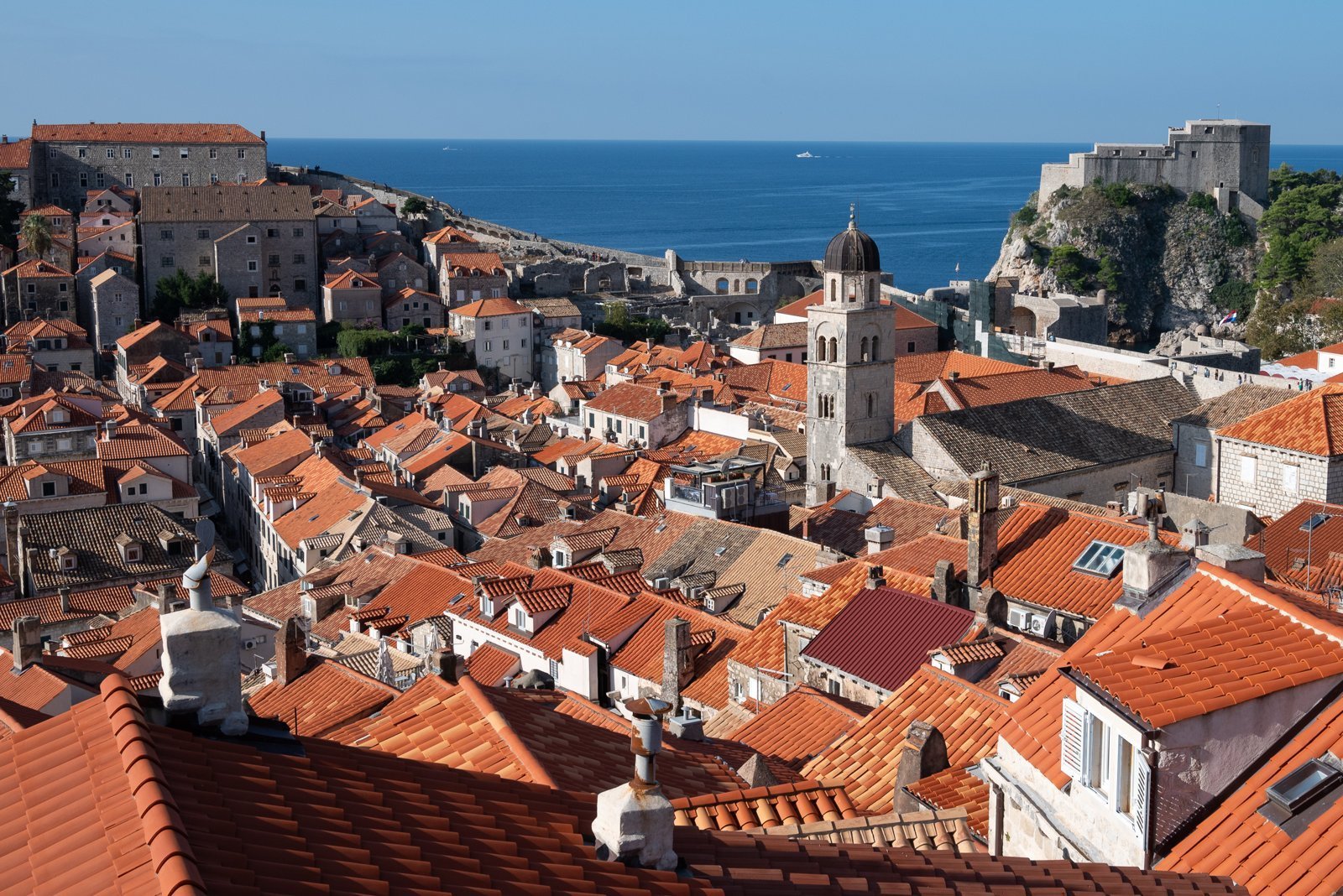
Wrong again, especially at this time of year when the crowds have thinned enough to allow a more mellow examination of the city. And when I say city, I am talking about the Old City that was the political and commercial centre of a maritime republic that flourished from the 1300s through to a time when it, like much of the rest of Europe, fell prey to Napoleonic ambition. This was the Ragusan republic, in land terms tiny but sufficiently wealthy and politically astute to survive as an entity when faced with rapacious kingdoms (Serbia, Bosnia) and expansive empires (Ottoman and Austro-Hungarian) and to stave off the constant attempts to control or curb its capabilities by its larger commercial and maritime rival republic further up the Adriatic.
Structure of the Trip
An autumn break of one week in Europe is the sort of trip that we are content to self-organise, booking hotel and flights. A week, in somewhere with the history and interest of Dubrovnik, gave us the time both to enjoy the sights of the city and to relax and indulge in watching the people in the place at work and play.
Flights
The 2 hour 45 minute flight from London by our usual European carrier, British Airways, had to be from Gatwick airport. A combination of a morning departure and work to rule on the trains meant we were not prepared to risk the stress of trying to get out to the airport in the early hours, so we opted for an overnight stay at the airport. See this blog on flying out of our hometown – Air Travel from London. On our return flight, instead of the usual BA plane we were on a plane operated (for BA) by Avion Express. It was the first time I had come across the world of leasing of aircraft, apparently big business in the aviation industry. Our flight was a ‘wet’ or ACMI leased aircraft (https://www.accaviation.com/acmi-leasing/what-is-acmi-leasing/) and, for practical purposes the key difference for us was the lack of space between the seats. I had to ask the person in front if he would warn me if he was going to move his seat from the upright position otherwise he would crush my knees, which were jammed up against his seat back. We were in a business class seat, which would normally give my knees comfortable breathing space, and were it not for the fact the seat beside me remained empty (allowing me to contort my legs a bit to stretch them out), it would have been a very uncomfortable experience. So a minor demerit for BA here.
Mobility Access:
On this occasion I found an airport, mobility-assistance wheelchair left in the landside departures area at Gatwick, so we were able to use that to move from hotel to check-in to security to departure hall (and BA lounge) to gate and down to the plane door – very handy. It is still important to check in at the mobility assistance counter (near the access point into the security area at Gatwick South Terminal) if you need assistance at your destination. As it happened, because Dubrovnik has quite a small airport, we did not use the assistance there. The baggage hall is not far from the arrival gates and, at this time of year, the airport was not that busy and there was no queue at passport control. For those reasons, we didn’t use the assistance on departure either and our gate was just below the lounge, making transition to the plane very straightforward.
Weather
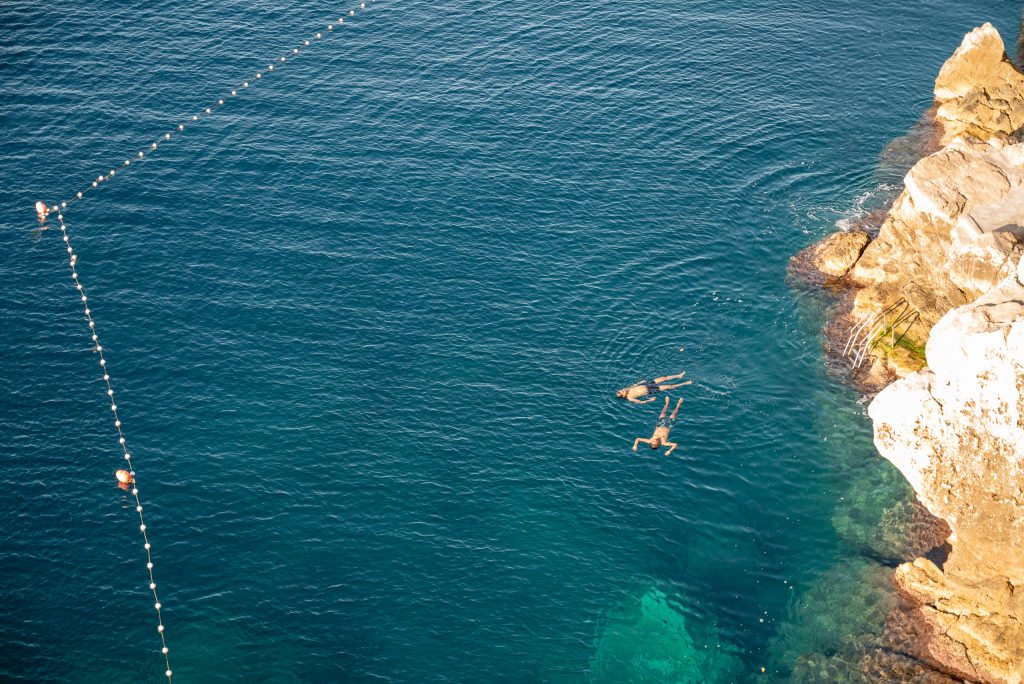
Well, it could not have been better for us. Clear, bright and sunny days and nights with scarcely a cloud to be seen and daytime temperatures up to 25° C (77° F) then dropping down to levels that were comfortable enough to enable us to dine outside in the evenings. It was ideal for our desired mix of sightseeing, wandering and relaxing. The temperatures were just above my understanding of Dubrovnik’s seasonal average for October (usually the low twenties centigrade/low seventies fahrenheit). If so then, for the traveller unencumbered by school holiday constraints, this seems to me an ideal time to come. The Old City is less busy than in the summer, when the cruise ships roll in in greater numbers and prices are often higher.
Places Visited
Old City Wandering
This is the core of any sightseer’s visit to Dubrovnik and, as always, there is a wealth of information out there for visitors. My opening gambit is to head for the tourist information website as a starting point so here it is https://tzdubrovnik.hr/lang/en/index.html#. Given all the information online, from me, just a few thoughts that touch on the practicalities of looking around this beautiful place. First it is fully pedestrianised, so walking the streets to visit the main sights and the old port is a necessity. Secondly, it is small. The famous walls that encircle the Old City are two kilometres around and the main street, Stradun, that runs from east to west across it, is less than 300 metres long. Most of the main sights, including the old port area, are off Stradun or the plazas at its east end and there are a wealth of cafes and restaurants in this section of the city, allowing for places to rest and refuel.

But, for those with mobility constraints there are limitations. Beyond a grid of streets bounded by Stradun and its parallel street, Ulica od Puča, the ground rises quite steeply upwards towards the walls to north (mountain side) and south (sea side). So steeply that the streets become stairs, and long, steep stairs at that. Even Prijeko, which is mentioned in many guides as restaurant central (and it is that) and which runs parallel to Stradun on the north side, requires one set of stairs to be climbed. Some of the streets that are less steep, like those climbing from near the old port and circling round under the city walls on the seaward side, have wooden boards to enable the trolleys that local delivery people use to reach the upper parts of the town. Theoretically a wheelchair user might be able to make use of these.
Running from Pile Gate at the west end of Stradun to the Old Port at the east end, the sights that can be reached without recourse to steps (except for two or three to step up to thresholds and doorways) are the Onofrio Fountain, the Church of St Saviour, the Franciscan Monastery, St Claire Convent (dominated by the Hard Rock Café), War Photo Limited and, clustered around the plaza at the east end, the Sponza Palace, the theatre, Rector’s Palace, the Church of St Blaise (patron saint of Dubrovnik) and the Cathedral. And through small gates in the city wall at that east end of Stradun are the flat paved quays of the Old Port where there are some public benches for sitting and staring.
Beside the Sponza Palace a paved street slopes gently up to the Ploče Gate where you can find the Dominican Monastery and the Revelin Fort (and more terraces for those snapshots and café/restaurants for those rest stops). So the only major sights that require negotiating substantial flights of steps are the Jesuit Monastery and its adjacent Church of St Ignatius and the astonishing City Walls.
Mobility Access:
From the foregoing you can see that many of the key sights and plenty of shops and eating places are readily accessible for the mobility constrained. To get into the Old Town the two main access points are the Pile Gate and Ploče Gate. At both there are wide paved pedestrian access streets with slopes leading down the level of Stradun. The only hazard is when the gates become crowded with tour groups off the coaches and cruise ships but, at this time of year, that was only the most minor inconvenience.
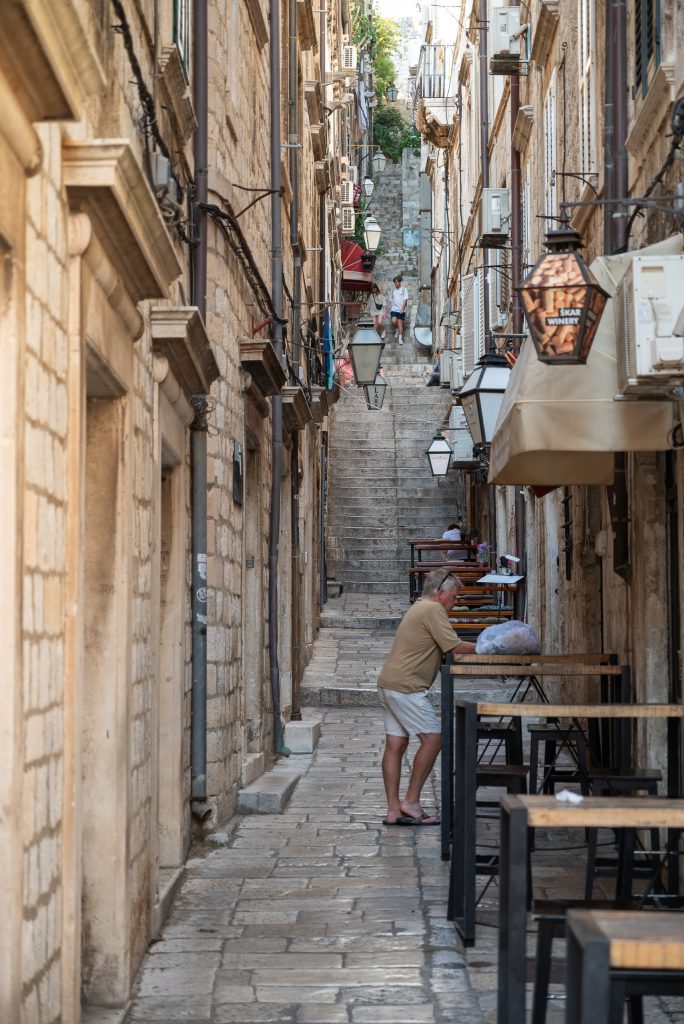
Do not make the same mistake as two American women in their sixties and get dropped at the Buža Gate on the north side of the Old City. They came through that gate with their two large suitcases and other smaller bags looking for their accommodation just off Stradun. They were horrified when I showed them Stradun far below, reached by descending one of those steep stair-streets, down which they had to struggle with their luggage.
City Walls
The allure of the Old City lies in its elegant historical townscape and the City Walls are the jewel in the crown of that townscape. Not only for their own sake but also for the stunning views they give across and down into the Old City, across the bright blue of the Adriatic Sea and upward to the steep rise of Mount Srd. There are three main access points – at the two main gates (Pile and Ploče) and close to the Maritime Museum down at the Old Port – but once you are on the walls you can only walk round one way, anti-clockwise and you can only get down at one of the access points. There are very good reasons for this, not least of which is the fact that some parts of the walkways are no more than a single person wide. However there are plenty of broader areas and larger fort platforms so the walk never feels claustrophobic. Also as the wall height above the level of the walkways is, for the most part, little more than waist high, the views are clear in every direction. And the joy is being able to look inward as well as outward, especially where the small domestic gardens butt up against the walls, alive with trees, flowers and vegetables. Here laundry hangs from windows and, in two places, incongruous hard sports courts marked out for basketball, five-a-side soccer and handball create alternative colour patches amidst the sea of red roofs. The near two kilometre walk occupied just over two hours of thoroughly enjoyable rambling viewing this little Ragusan world through eyes and camera.
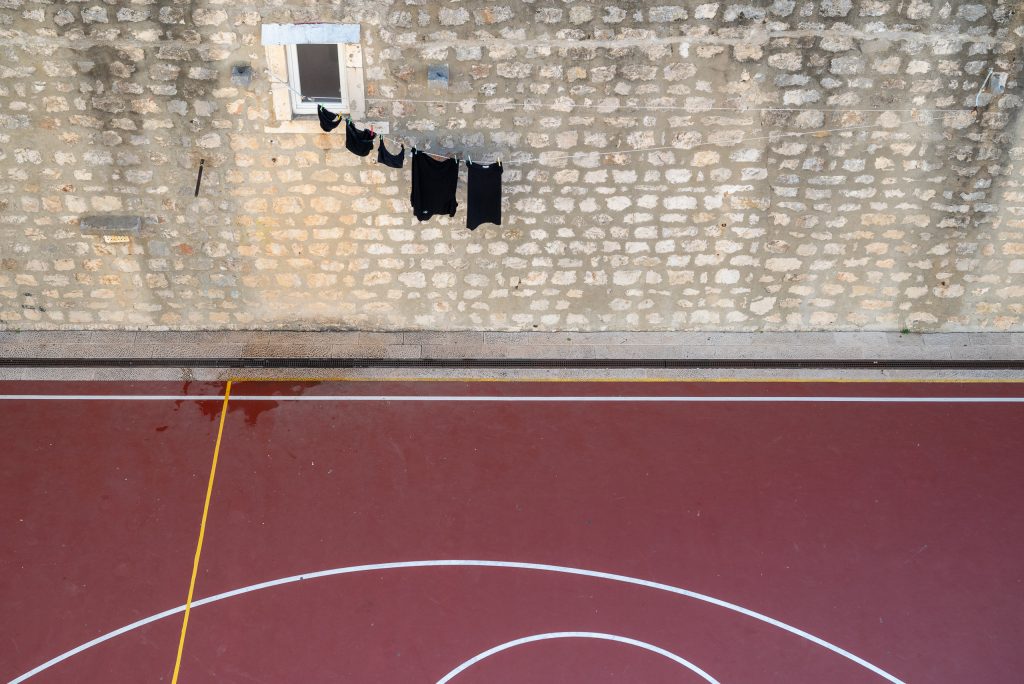
I decided to go first thing in the morning (the walls are open from 08.00) to reduce the impact of potential crowds. Even at that hour there were 20 or more people queuing to get in but, once we had climbed up to the walls and begun our peregrinations it never felt at all crowded. By the time I finished there were many more people bustling round the entrance and small tour groups were gathered which would have slowed down those guiding themselves – but only a bit. Up at the top of the seaward side there are a couple of cafés on the fort platforms with outside tables. I did not stop there.
Tickets can be bought at the entrance gates and also online at https://shop.citywallsdubrovnik.hr/en/webshop. Entry is free with the Dubrovnik Pass, of which more anon.
Mobility Access:
To all intents and purposes a walk around the city walls is impractical for those with mobility constraints. At the Pile Gate entrance there are 75 stair-steps up to the walls. The other two main entrances have shorter sets of step-stairs up to the walls, but not that much shorter. And once you are on the walls, and walking round, the changes of level and the accompanying step-stairs or slopes are a regular feature. It would, I think, be best for those with some, but limited walking and step-climbing capacity, to consider going up at the entrance near the maritime museum and to walk round to the entrance close to the Ploče Gate, a distance of about 300 metres. This is the flattest part of the walls and circles around above the hive of touristic activity that is the Old Port.
The Franciscan and Dominican Monasteries
Although these two buildings bookend each end of Stradun, I have grouped them because they have a superficial similarity with a small museum of religious art, a large church and a quiet cloister. I preferred the Dominican one, set up a slight stepped slope from the street that feeds off the east end of Stradun. This is purely an emotive reaction to a feel the place had. The cloister, with its small tree-filled garden, well-head and arched gallery was so peaceful in the morning sun. I just sat there for some time, quietly enjoying this haven away from the madding crowds outside. A haven disturbed only briefly by the 1980s playlist coming tinnily out of the attendant’s laptop. The Proclaimers’ 500 Miles was not the best accompaniment to the peace of the cloister. The church was undergoing a major refurbishment when we were there and was closed.
Entry to the monastery was only €3. It is not covered by the Dubrovnik Pass.
Mobility Access:
As long as you can cope with the walk from one of the gates and the odd step or slope these places are pretty accessible.
Sponza Palace and Rector’s Palace
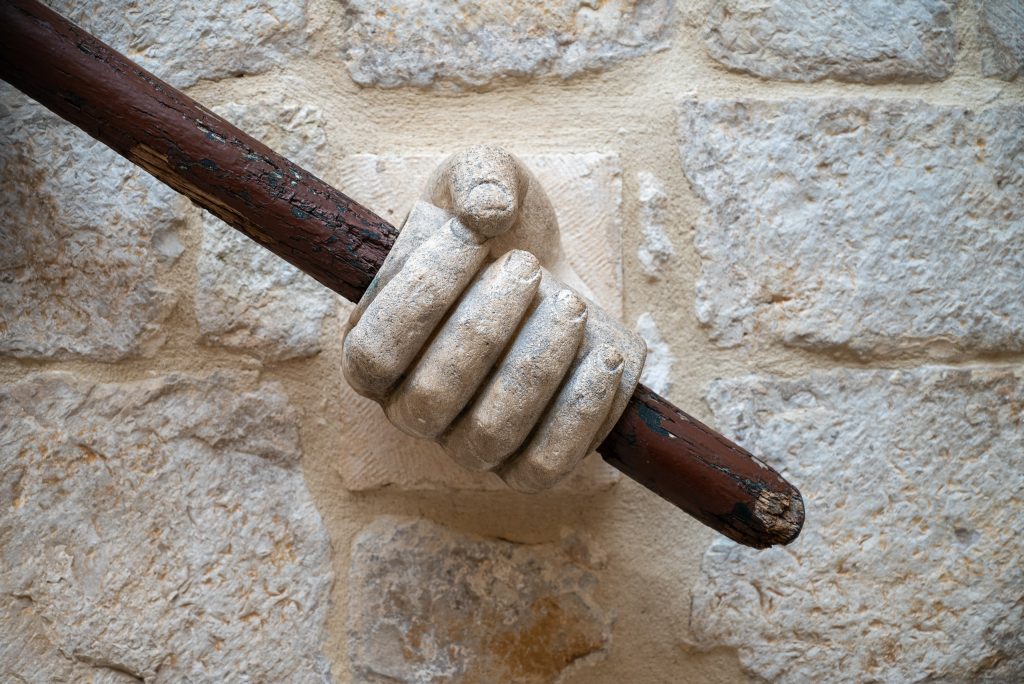
I feel palace is the wrong word to be applied to these exquisite buildings with their mix of Gothic, Renaissance and Baroque architecture, a mix necessitated in part by the need to restore after the destruction visited on the city by the 1667 earthquake. Palaces conjure visions of places like Versailles or Buckingham, huge grandiose structures with endless over-decorated rooms. These are small buildings in a graceful stone with a central courtyard and a stone staircase leading up to a galleried upper floor, off which are set the former offices and living rooms for the administrators of the Ragusan Republic. Both contain artworks and displays of historical items such as coins, illustrated books, weapons and silverware. My enjoyment came from the architecture and the space rather than the artefacts. They were not particularly busy despite the occasional tour group. There are quite a few seats and benches scattered through the buildings so time can be taken just imagining the commercial and political activity of the republic in its heyday.
The Sponza Palace was free. The entry fee for the Rector’s Palace was €15 but is only €3 if you have the Dubrovnik Pass.
Mobility Access:
The courtyards of the places are on a level with the plaza outside (bar the odd threshold step). The artefact display rooms in the Sponza Palace are on the upper floors accessible by stairs only. In the Rector’s Place there are some ground floor rooms but the bulk of the rooms, including the Rector’s Office itself are only accessible by the grand stone staircase in the courtyard.
Cathedral and Churches
Not being an aficionado of churches I did not take time in any of these except the Cathedral, a building whose external grandeur belies a rather austere but wonderfully light interior. Except, of course, for the bombastic Baroque altar, side chapels and the gleaming organ: Baroque not being my favourite artistic style. However there is no charge to go in and just to sit in the pews watching the entertainment of visitors who encompass the religious and the crass.
Mobility Access:
All very straightforward as access to the building only requires going up a few short steps or slopes from the surrounding flat, paved plaza.
War Photo Limited
This is a combination of exhibition space and archive which, as the name indicates, is focused on conflict photography. It is a smallish space spread over two floors. It is found about 30 metres along a small side street off Stradun not far from the Pile Gate. See https://www.warphotoltd.com.
The approach is to have one floor devoted to an exhibition that changes and the other focused on a documentary record of the recent conflicts that have disfigured this region in the last decade of the twentieth century: the Croatian War (1991-95), the Bosnian War (1992-95) and the Kosovo War (1998/9). Whilst we were there the temporary exhibition was of images from the current Ukraine conflict going back to 2014, when the Russian paramilitaries sought to grab the Donbas region. There is also an extensive print sales archive with many images from those and other recent conflicts around the globe.
The images are, in essence, documentary, acting as a record and a memorial. There are no conceptual photographic responses here. It is an impressive if disheartening display because the repetition of the subject matter of the imagery from conflict to conflict evokes a sense of despair at humanity’s inability to learn from past experience.
There is an entry fee, currently €10. Dubrovnik Pass holders get a 20% discount.
Mobility Access:
The exhibition entry is up one flight of stairs from street level and the exhibition spaces are on that level and the one above. As there is no lift, it is not ideal for those with mobility constraints. Within the galleries there are bench seats and stools for those wanting rest stops.
Mount Srd
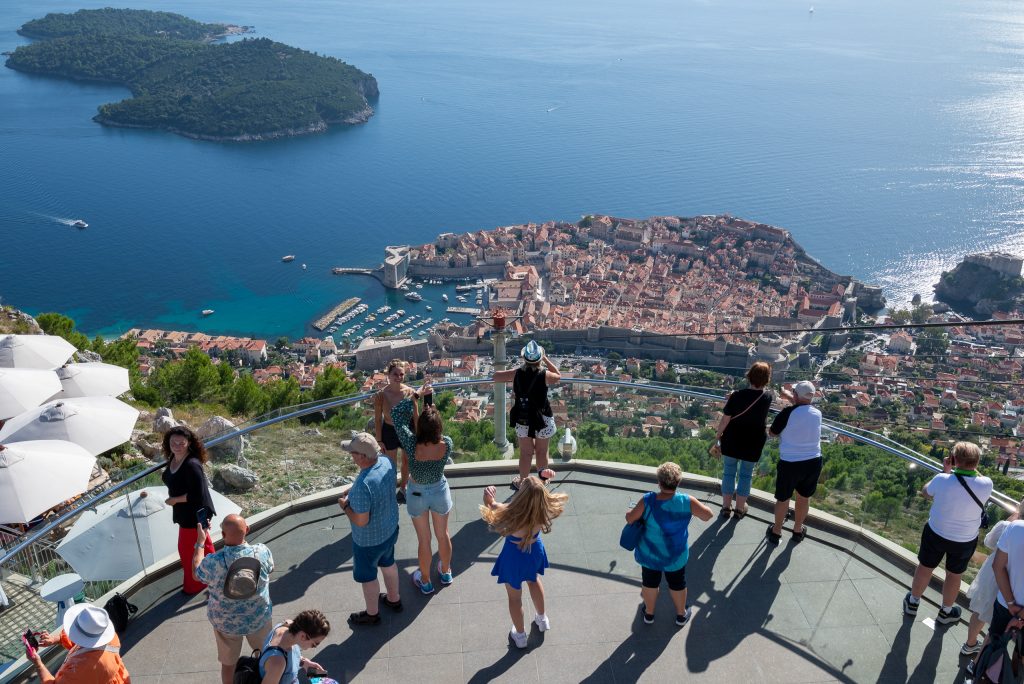
This warranted a double ‘wow’ for the view (see An Introduction to ‘Wow’ ). Rising 412 metres (1,352 ft.) above the city, this hill provides a spectacular viewpoint encompassing the ridge of mountains that mark the Bosnian border only a few kilometres to the north-east, along the rugged coast in both directions and out across the Adriatic Sea. And the Old City is perfectly laid out below. Getting up here, for most people, is by using the modern cable car that runs from a street four minutes’ walk (uphill) from the Ploče Gate. Or you can walk up the hill itself, as to which I quote from the Bradt Guide to Croatia:
‘If you decide to walk up instead, bear in mind that the path is long, steep, and entirely without shade for the last two-thirds. At first it’s through pine trees, with butterflies and cicadas – magic and very cool. There’s no water to be had, either on the way up or at the top, so take plenty with you. And although the path is perfectly safe, and the hillside is said to be clear of unexploded ordnance, you should stick to the main track just in case. Locals tend to hunt with shotguns here too, so be careful where you walk.’
Maybe not, then. We took a third option; a taxi from our hotel to the top over a vertiginous single track road. However you do it, the view repays your effort. The cable car facility at the top has flat observation platforms at two levels, various trinket shops and the Panorama Restaurant for drinks and meals (see below).
Mobility Access:
Leaving aside the walk, the cable car or taxi options bring you to the viewpoint platforms and there is a lift between levels for the mobility constrained. I cannot speak for how busy the cable car gets and whether queueing is part of the experience. There are no seats in the cable car itself.
Jesuit Monastery and Church of St Ignatius
I did not actually go in to either building but, like many people, I went up the grand stairs that lead up to the gravel plaza in front of the buildings. Atop the steps there is a pleasing vista down across the town and the austere architecture of the monastery and the grandiloquence of that of the Baroque church make for a visually entertaining contrast. With several places to park myself I just sat on some steps in the shade and entertained myself taking in that architecture and watching my fellow tourists coming and going. Apparently this is a big selfie-spot because it appeared in the TV series ‘Game of Thrones’ (there are several of these locations dotted round the Old City and the Old Port areas) which added to its entertainment value.
Mobility Access:
A non-starter for those who are mobility constrained. 75 steps up the grand staircase to reach the plaza. There are other ways up through the narrow back streets but ‘up’ is the operative word, as all involve steps and slopes.
Lokrum Island
No-one lives on this small island which is given over to a nature reserve and is home to monastic ruins, thick woods, a ruined fort, a few restaurants and cafes, a botanical and a formal garden, olive groves, seaside rocks that are popular with bathers and sun-seekers and a profusion of peacocks. It is less than a square kilometre in size with paths spreading across it. It is only a short 15 minute ferry ride from the Old Port. It is ideal for a change of scene from the touristic bustle of the Old City. Not that the tourists do not come, they do, but the island is so peaceful that, during our half-day there, I often had the feeling there was no-one else around.
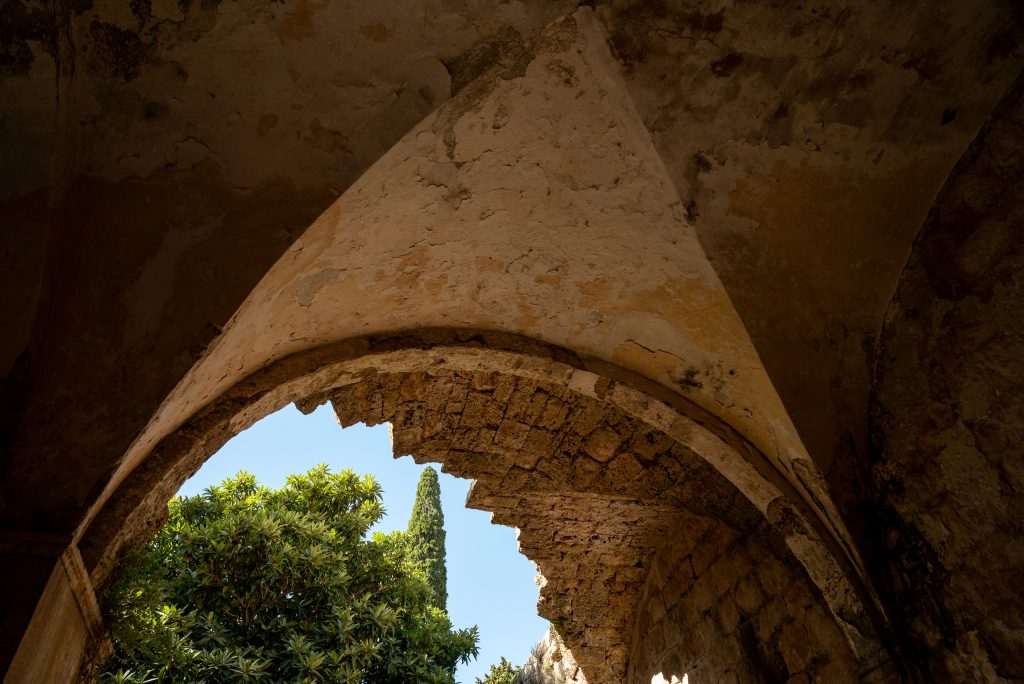
They have a straightforward website (http://www.lokrum.hr/eng/) for the island that has a helpful map and full details of the ferry timetable (generally one ferry every half-an-hour each way). The fares (€27 euros at the time of writing) include the Nature Reserve Access fee and are subject to a discount if you have the Dubrovnik Pass. You can buy tickets online. We bought ours at the kiosk set in an alcove in the City Walls of the Old Port, half-hidden behind the many day-tour sales people whose stalls are lined up just through the gate leading from Stradun to the Old Port. On the island we confined ourselves to the east end where the bulk of the ‘sights’ are found and all the café/restaurants. It is also the lowest part of the island, so walking from one side to the other only means a relatively gentle rise and fall in the land. The island was a peaceful place to sit, whether in gardens or woods, and there is no shortage of benches on which the body can be rested.
Just a word to the wise about the peacocks. These are all over the east end of the island where they wander slowly around, looking stately. They are unfazed by human presence. They (indeed all the birds) should not be fed but despite the signs, some people do. I do not know if what my partner saw at one of the restaurants is a result of expectation being created or was just a more basic instinct for food. One of the waiters at a restaurant was having an early lunch at an outdoor table. She was holding a piece of roll in her hand whilst eating. A passing peacock shot a beak forward and took the bread out of her hand giving her a sharp enough peck to elicit a scream of pain and fright.
Mobility Access:
Boarding and disembarking the ferry is easy – no slopes or steps – and the vessel is large enough to have a fully covered deck area with plenty of bench seats. At the island end there is a gentle slope up for the first 100 metres or so then the paths flatten out. The main path from the jetty which runs up towards the monastery complex has an odd surface of rounded stones embedded in concrete or some similar fixing. This means that, ostensibly flat, they are not the best for those who have problems with knee and ankle stability. If you turn off that path into the restaurant gardens alongside, the paths are a compacted mud/packed gravel that is much smoother and can be used to walk on towards the monastery and gardens. Whilst the paths are a bit rougher and steeper in the woods that cover much of the island, there is plenty to see for those who have difficulties with slopes and unstable surfaces. And there are always the café/restaurants to fall back on when a rest is needed.
A warning about boarding in the Old Port. The first ferry of the day is in late morning and large queues build up to board. When we were there, it was about 100 metres long. Not good for those for whom standing for a long time is problematic. Wait for the next boat is my advice. It will be much quieter. There is a café/restaurant (Lokanda Peskarija) where you can have a drink and keep an eye on the boat and the queue and watch the bustle around the port, particularly the locals manning the serried ranks of stalls who importune every passer-by to take their own variant on a boat tour.
Hotel
Hilton Imperial Dubrovnik (https://www.hilton.com/en/hotels/dbvhihi-hilton-imperial-dubrovnik/)
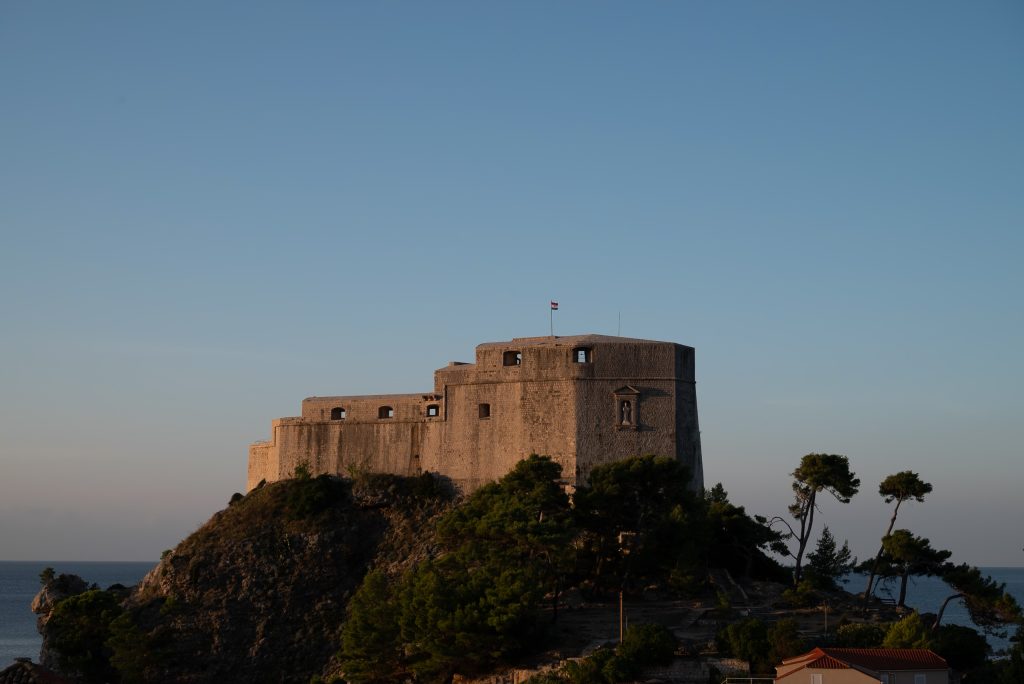
After a major refurbishment following extensive damage caused by the shelling of the city in the Croatian War, this grand 19th century hotel has re-opened with all the bells and whistles of a five star establishment. We thought it was excellent for our purposes. I don’t know what it is about the Hilton hotels in the Balkans, but they belie my expectation that Hilton hotels do not quite have the cachet they used to have in my younger days. We stayed at the Hilton in Podgorica a few years back and it was very good. Ditto, this hotel. The location was ideal for us, being only a couple of minutes’ walk from the Pile Gate entrance to the Old City and the city’s main bus interchange. Lifts could be taken to all levels, including in order to avoid the nearly 30 steps up from the street to the main entrance. There was a small indoor pool, just big enough to allow laps to be swum. The staff were generally very helpful and available including a good concierge service. The restaurant had a lovely situation on an outdoor terrace and the food was good enough to warrant us returning more than once for dinner. There were also plenty of other indoor and outdoor quiet spaces for relaxing to read and write. Our room had all we could need for a week-long stay, including enough hangers in the wardrobe for our clothes (not always a given in so many hotels). One of its best features was the balcony, with table and chairs, that gave a captivating view across the Old Town and the Lovrijenac fortress with the sea beyond. After the sun had sunk behind the hills in the evening it was such an enjoyable place to sit writing and watching the bustle below.
Why did we not stay in the Old Town itself? Primarily because our research did not throw up a suitable hotel that either had a lift or could guarantee a reasonably accessible ground floor room. A secondary reason was the access the Hilton gave us both to the facilities we wanted and because it sits less than one hundred metres from the Pile Gate transport interchange.
Food and Drink
Taj Mahal
– not Indian but Bosnian cuisine.
To a Briton brought up on old-style flock wallpaper Indian restaurants the name is off-putting. Don’t allow it to be. The food is traditional Bosnian, a melange of Greek and Middle Eastern style cooking with an emphasis on grilled meat and vegetable dishes and it is good. There are two branches: one in the Old Town and the one we went to, which is in the Hotel Lero in the more modern part of Dubrovnik just a ten minute taxi ride west of the Pile Gate. In the gentle warmth of the evening we sat outside on the terrace and ordered a mix of dishes that we could share. It all seemed freshly cooked and flavourful. When we were in Dubrovnik we had no trouble booking online the day before using their website – https://tajmahal-dubrovnik.com/.
Mobility Access:
It is on the ground floor of the Hotel Lero so straightforward access.
Proto
– quality Old City fish.
This was a well-written up restaurant specialising in local fish dishes (https://www.esculaprestaurants.com/fish-restaurant-proto-dubrovnik/). Given its write ups online, we had booked the day before, but the restaurant was not that busy, so we had a very enjoyable meal on their first floor terrace open to the warm evening air. This is up one flight of stairs but they have tables downstairs and on the street outside for those for whom the one flight might be too much. The food was of good quality leaning on the freshness of the seafood and fish and my partner had a very nice Croatian rosé sparkling wine. This was one of many really satisfying wines that we had, by the glass, whilst eating out around the city. Vegetarian options are nowhere to be seen.
Mobility Access:
The restaurant is in the heart of the Old City with the entrance just off Stradun, so a walk from one of the two main gates is needed to reach it. The Pile Gate is closer, about 250 metres away.
Levanat
– the restaurant that didn’t work (for us).
Another well-spoken of restaurant, located on the seafront at the end of the Babin Kuk peninsula in an area of upmarket hotels. We booked the night before and arrived by taxi at a roadside entrance.
Mobility Access:
From the road there was a short, steepish slope down to some steps. It was not apparent how many, so I did a reconnaissance whilst my partner waited up top. There are just over 100 steps down to the restaurant or, to give some context, about 6 or 7 flights of stairs. And, of course, going down would have meant coming up. The waiter I spoke to told me the nearest road (apart from where we had been dropped) was one kilometre along the (flat) seafront walkway in one direction or two kilometres in the other. This meant the restaurant is, for all practical purposes, inaccessible for those with mobility constraints. I cancelled the booking. We called the taxi back to collect us and headed elsewhere. I found it disappointing that the restaurant’s website makes no mention of this relative inaccessibility.
Panorama Restaurant
– the ‘wow’ view.
This is the restaurant atop Mount Srd (see above and https://www.nautikarestaurants.com/panorama-restaurant-bar/). There is an indoor section within the cable car arrival building, but the reason people (us tourists) flock here is to enjoy the phenomenal views over the Old City and the sea coast from the shaded outdoor tables set out on a series of stepped terraces just below the viewing platforms. The food is perfectly reasonable, albeit the menu has the air of catering for all tastes. We did lunch here. You must book and they allocate you a table for a fixed time (1 hr 45 minutes in our case), however the service is pretty slick so, for most of us, that is a goodly time to feed and contemplate that view.
Mobility Access:
You just need to be careful which table you get if you cannot manage too many steps as there are several terraces and it can seem quite a long way down to, and up from, the lower terraces. There is a curved sloping path down to the upper part of the terracing if you cannot manage any steps.
The Kop
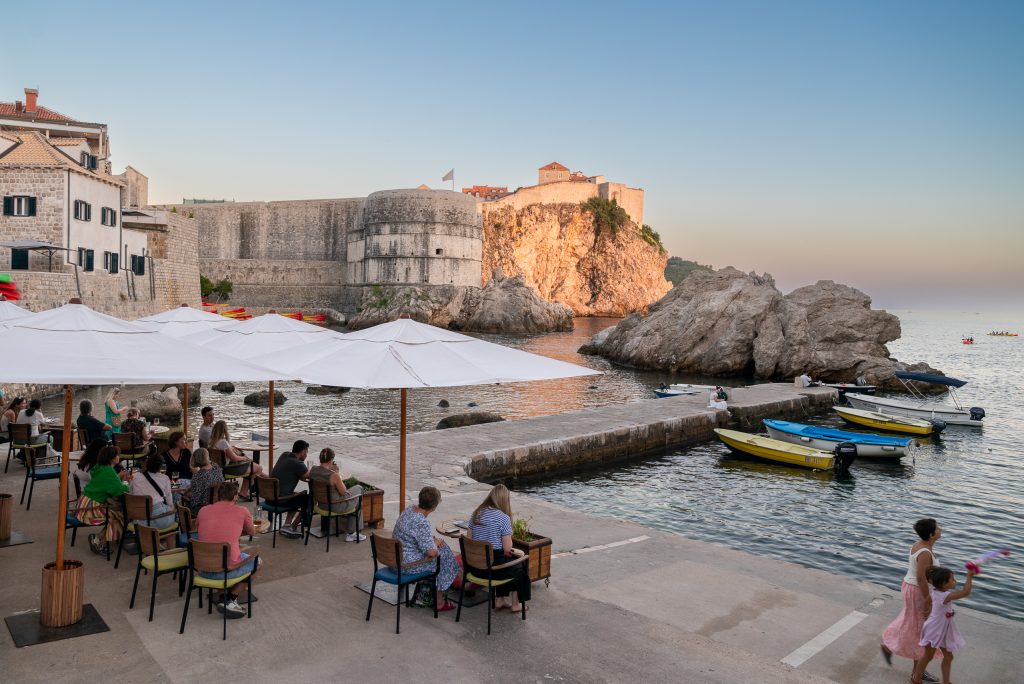
This place to sit and stare is on the waterside of Dubrovnik’s West Harbour below the busy plaza where the tourist buses disgorge beside the Pile Gate. Just a bar with no food, but this simple set of tables with shading umbrellas laid out on the quayside is quite a peaceful, indeed appealing, place to while away time, especially with the lowering sun in the late afternoons giving a golden sand colour to the city walls across the small bay. Why is it called The Kop? No idea, but to my surprise they do mean the famous football stand at Anfield, home of Liverpool Football Club. The words of the club’s anthem, You’ll Never Walk Alone, are printed in the back of the drinks menu and on a wall in the bar. That bar is actually tucked away slightly above the quayside. Sit yourself at one of the quayside tables and just wait for a server to appear and deal with your orders. Not the speediest service but, in this location, you should not be rushing anyway.
Mobility Access:
To reach the quay you walk down the narrow lanes from the plaza by the bus interchange. There are some steps but widely spaced with slopes in between, that can be managed.
Activity
The 1A bus Trek
We decided to start our trek to those parts the tourists may not reach with this bus out west to Mokosiča, where we thought we might get a view of the elegant structure of the Franjo Tudman Bridge. Just north of the cruise port at Gruž, the bus swept under the shadow of the bridge and that was the last we saw of it. The bus circles the long sea inlet that the bridge crosses taking in smaller marinas and small towns that mix some holiday accommodation with a lot more houses and flats for people that, I am guessing, work in Dubrovnik. At one point out on the water of the inlet there was a vast flock of seabirds just sitting, seemingly unmoving. It was a sight I had not seen before.
Mokosiča and its companion town, Novo Mokosiča, are not the most beautiful of places, with uniform blocks of apartments and, painted on a concrete wall beside the road, some rather disturbing looking murals of insignia that had a distinctly militaristic feel. We did not get off at the end of the line but sat whilst the driver smoked his cigarette in the bus before setting off back towards the city. We tried to change buses in Gruž to head out to Lapad and Babin Kuk but our Moovit app said there was a one hour wait, so we just caught the next bus back to the Pile Gate.
St Saviour’s Church: Concert by Candlelight
There are a few venues in the Old Town that offer classical music concerts of chamber music by candlelight. We chose this one over others simply for its convenience in terms of timing and placement, it is just 50 metres from the Pile Gate. A ticket bought on site on the day was straightforward. Care is needed with the choice of seat. They are all hard wooden seats and some seats with no back. Essentially pay more and you get a more comfortable seat. It will give you a delightful concert in a captivating setting. Concerts do not take place every night but other venues take up the approach several times a week. Details can be dug out online or from the Tourist Office in the plaza just outside the Pile Gate.
Mobility Access:
With only a few steps up from Stradun into the church this is a straightforward venue to access.
Practicalities
Dubrovnik Pass
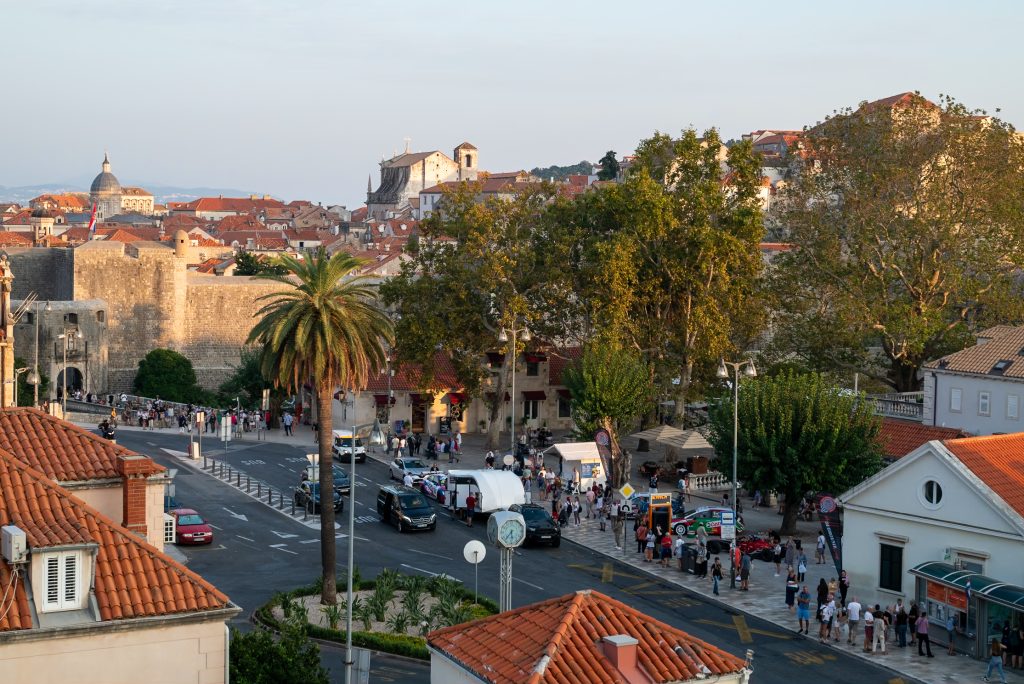
If you are here for any length of time, get one. It is a no brainer if, as we were, you are here for seven days. We paid €55 euros for a seven day pass buying it online before we went (see https://www.dubrovnikpass.com). With the price of a ticket (at the time) for the City Walls being €37 and for the Rector’s Palace €15, you will very soon start making great savings when you consider that with the card you would only have paid €3. A number of other Old City sights are free with the card and it gives you a wide range of discounts on other entry tickets, a number of activities and at certain events and venues. And you get free transport on Dubrovnik’s buses, although first you have to go (with your card) to the bus ticket kiosk at the main bus interchange near the Pile Gate to pick up a physical ticket to use for any bus trips.
Language
So, once again, we were the beneficiaries of the linguistic laziness created by English being the lingua franca of tourism. Everyone we interacted with spoke English more than well enough for all our needs. So, of the Croatian language I remain in ignorance.
Getting Around
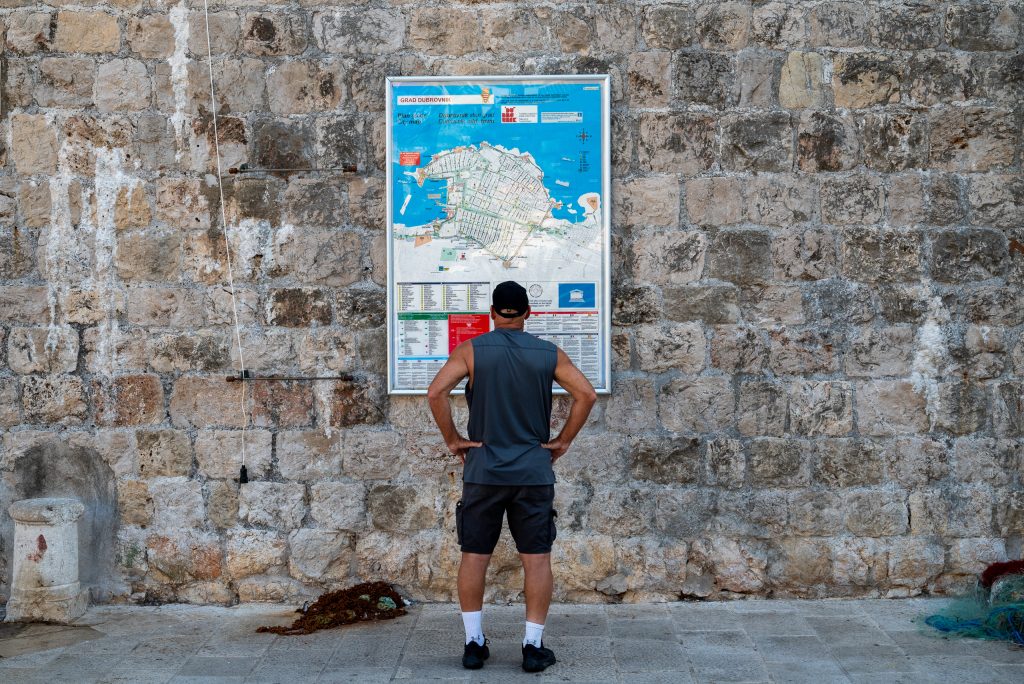
There is a physical limitation on the number of buses that run in Dubrovnik. Because the city is squeezed between sea and mountains rising immediately behind, there are only eleven routes, most of which run west from the Pile Gate bus interchange. Only a couple run past the Ploče Gate. I printed out the City Bus Map route so we could indulge in our usual trek along the routes to see where it took us and what localities we would find – see https://www.libertasdubrovnik.hr/mreza-linija.
The buses get very busy towards the end of the day when those who are staying in the many hotels out at Lapad and Babin Kuk join forces with the locals returning home to generate a stream of standing room only departures. Access to the buses is pretty straightforward with just a single step up to the bus.
Taxis were plentiful with ranks at the main gates to the Old City. Taxi drivers were all too ready to give you their card (with mobile phone number) so you can call them up for the return trip. We found that they were very responsive to such calls and able to be where you needed them within a maximum of twenty minutes. Payment is by card and, sometimes, cash.
Money and Credit Cards
Since the beginning of this year the official Croatian currency is now the euro, so for us European travellers life is made easy. You do see prices in the former currency, the kuna, but usually alongside the euro. For the most part, the credit card pays for all, including taxis. Some taxi drivers still operate in cash as do some smaller retail outlets, so it is useful to have some cash for this and for tips, which are rarely included in restaurant invoices.
Reading
Beyond the guidebooks I found it difficult to find any reading that would lead me into the city’s history. The only one is Robin Harris’ Dubrovnik – A History (https://www.waterstones.com/book/dubrovnik/robin-harris/9780863569593). This is an excellent history of the establishment of an early settlement that grew into the influential Ragusan Republic. It covers all the aspects of civil society: its politics, its maritime and trading strength, its arts and letters and the impact of religion and how it managed to maintain a Catholic Christian religion whilst nominally under the aegis of the Ottoman Empire. It only has limited coverage of the period after the fall of the Republic (in the Napoleonic era) with the twentieth century limited to a four page coda on the civil war of 1991-2.
Hello
I’ve just read all through your Dubrovnik story. Fantastic!! So well written and interesting. It really made me want to go so I shall try to, soon! Thank you. Looking forward to reading other posts now.
Thank you!