TORONTO
If Montréal is steeped in its history as the original French colonial city of North America, Toronto is the brasher newcomer, a child of the Industrial Revolution that drove the expansion of the British colonial project. It has now embraced the twenty-first century, all glass and steel office towers and condominiums seeming to compete with each other for pride of place on the Lake Ontario waterfront. Its galleries, museums, theatre and arts do mirror those of its older neighbour, although it would be argued by Montréalers that theirs are just that bit more sophisticated.
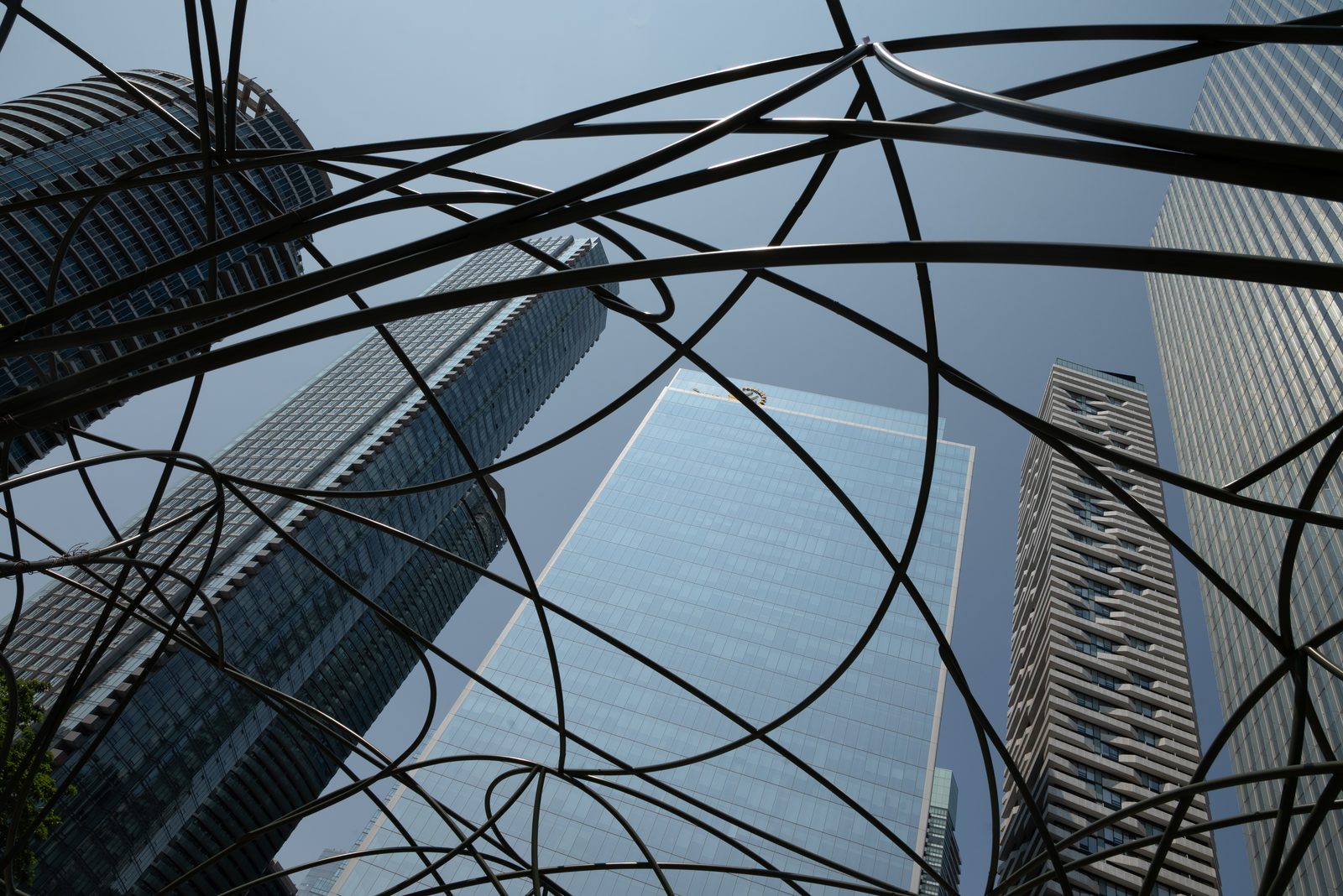
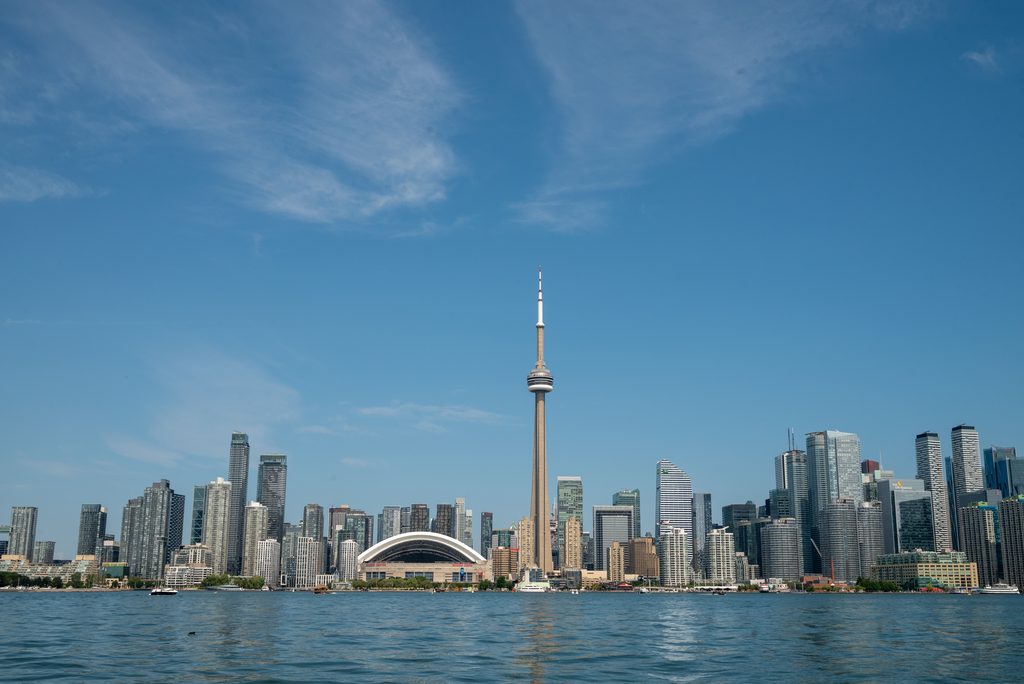
It has no pretensions about its limited historical architecture. Many of its nineteenth century buildings in the city centre have rather oddly been subsumed into massively larger 21st century buildings as if they had been subject to a Borg-like takeover and only retained a small element of their previous existence. (For non-Star Trek aficionados the Borg are a voracious race of cyborgs who assimilate other races by turning them into part machines). Yet there is a real late 20th, early 21st century buoyancy to the sheer scale of the forest of glass towers. And here is a little concession to architectural indulgence. The majority of blocks are unabashedly square or rectangular, going straight up without setback. There are one or two Chicago-style art deco blocks solidly set amongst the glass forest and, of course, the odd place with nods to late 19th century Neo Gothic; several cathedrals or churches and the ‘castle’ of Casa Loma. There is also the behemothic 1920s frontage to Union Station and its grand interior concourse and more recent distinctive structures like the CN Tower and the Rogers Centre, a 1970s stadium for the Toronto Blue Jays baseball team with its once-revolutionary retractable roof.
To us Toronto has a more open, friendly feel than the other city. It does have an even greater ethnic mix, or so the tour leader of our harbour boat ride asserted, informing us that it had just overtaken London as the world’s most ethnically diverse city. We really enjoyed our time in the city.
Hotel
Audley had suggested the St Regis, now part of the Marriott chain, but still very much a five-star option set in part of a towering glass block (their signature restaurant is on the 35th floor which, to my untutored eye, looks only about half way up the looming building). Its location really worked for us. The main station is 400 metres south and the city’s focal point, Nathan Phillips Square, 350 metres north and it is within reasonable stepping distance of streetcar and bus stops and only a shade further to a subway stop. The facilities are all you would expect including a small, but serviceable pool for lap-swimming. The large room had all the necessary accoutrements of a hotel of this standard, thankfully without the inhibiting digital complexity of operation of the room at the Four Seasons. It was once a Trump Organisation hotel and still retains visible patches of the current US President’s obsession with a sort of gold bling styling.
Staffing was largely excellent with a special shout out to the concierge staff who helped us out with a range of queries (finding a physiotherapist, explaining the workings of public transport, suggesting the best harbour boat tours). As always seems to be the case, our reservations revolve around the breakfast service. This has become such a constant minor complaint with up-market city hotels I am beginning to wonder if it constitutes some sort of intractable problem of which we are unaware. Here, it manifests itself in a queue to be given a table, even when there are tables free and just need to be cleared. I always feel people should be given a seat. Surely it does not matter if you have to clear and re-lay a table around them. There is no communication with those waiting to make them aware you have registered their presence. Once seated there seems to be a lack of training of people to be alert to guests’ needs, to look around the room. The people who staff these places seem to be put into rigid roles, so tables are cleared while people are waiting to order or trying to get something and the carry-food-to-table people seemed to be too lowly to attend to other needs. These aspects can be exacerbated, as here, by having no buffet, only a menu-based service. It is such a strange contrast to the service you often get in the evenings or, here, in the Astor Lounge behind the ground floor lobby where the staff were excellent.
Mobility Access
Access from the street and throughout public rooms is straightforward with smooth floors, step free, and elevators between all floors. The room offers no difficulties and has enough space for night time trip hazards to be avoided.
Eating Out
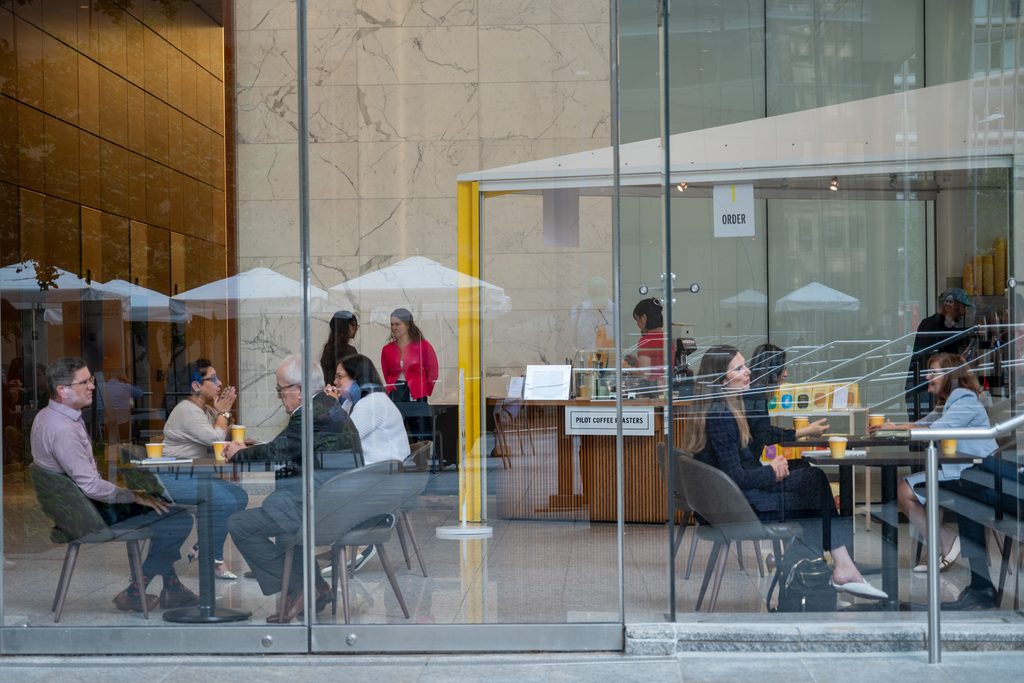
Astor Lounge, St Regis
Seeking somewhere quick and straightforward on our first night in the city we ate in the Astor lounge. It was a very pleasant space with good service and straightforward light soups and bites menu which served our purpose perfectly.
Mobility Access
No issues. The bar is accessed straight from the lobby, which has step free access from the street.
Kiin
Kiin is a restaurant in the downtown area that has a Thai menu and a more upmarket feel to it than many of its UK counterparts. Instead of a lengthy menu that tries to be all things to all people, there are only half a dozen starters and a similar number of main dishes. The dishes we had were both flavourful and good, supported by an accomplished service which had none of that distance you can sometimes get in South Asian restaurants in London. It was fun to revisit a proper green papaya salad, this one fizzing with chilli, one of the vegetarian options available.
Mobility Access
We Uber-ed to and fro and, from the street entrance, it is only a few steps down to the low mezzanine level where they have a few tables. There is then another short flight down to the main body of the restaurant. The toilets are at this lower level.
Jacobs & Co
With apologies to vegetarians but Jacobs & Co is an unashamed steakhouse, but one of very high quality. They have a bewildering variety of steaks of differing ages stored in fridges you can see from some parts of the restaurant. The steaks are also expensive, even outrageously expensive (all the way up to $792 CAD for a Japanese Black 22 ounce ribeye). Was it worth it? Well the steak that I had was truly excellent, as were the drinks. The desserts were a little too much in the comfort food territory for my taste. The service was very good, with clear explanations of the bewildering choice of steaks that managed to be not at all patronising. There are quite high levels of conversation buzz around but that did not intrude as the tables were carefully spaced. However the pricing reflects that this place is all about power-eating on expense accounts and it has that vibe. It sits within a glass tower off a huge second floor lobby. The room is also huge; double, even triple height, with carpeted floors, partitions and a pared-back modern style which bespeaks money.
Mobility Access
The only point to be wary of is finding a drop off point close to the correct access point. Having walked there from the hotel, I found that it is not well signed and I was wandering through vast glass lobbies and going up escalators and lifts, feeling rather like I was entering a Bond movie location. I assume there is an easier access somewhere, especially as the location within the modern tower means within it is fully accessible and on one level throughout.
Canoe
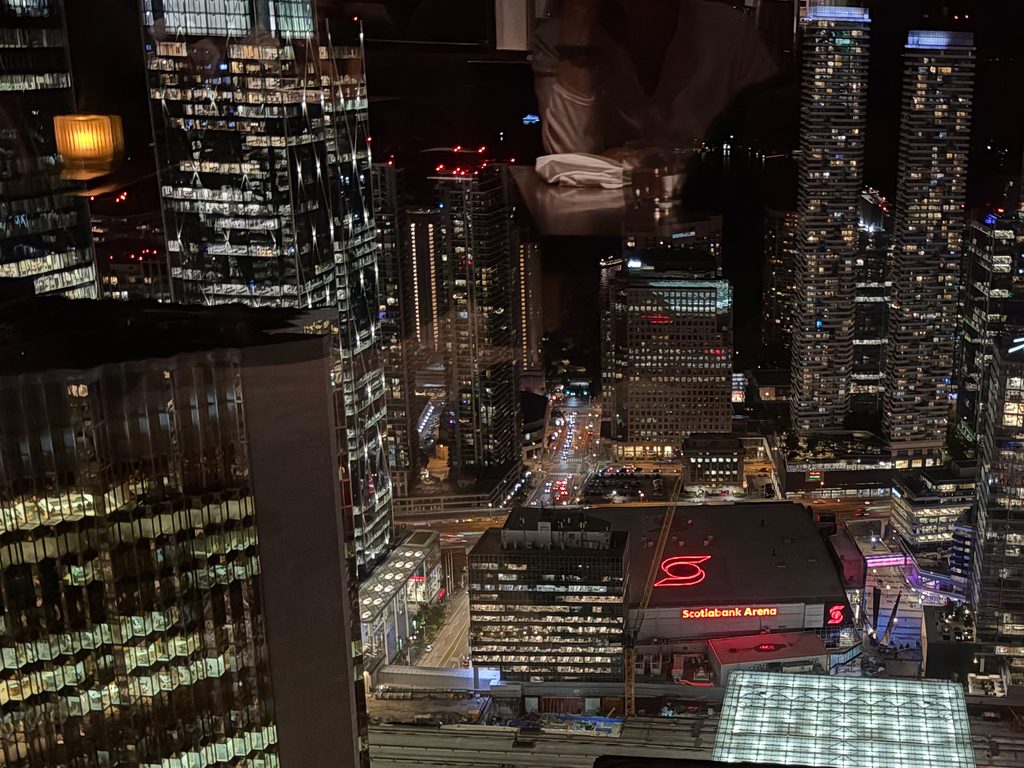
Always suckers for a restaurant with a view we had considered the revolving restaurant atop the CN Tower for our last night splurge, once I had overcome my vertigo concerns (mention of glass floors and glass fronted lifts), only to find it was fully booked. Canoe is the alternative, 54 storeys up and with a better, well-reviewed food offer. The view was splendid with picture, full height glass giving out across the city, the harbour and the expanse of Lake Ontario. The sunset attracted many to raise their smartphones at the red sphere as it sank below the horizon and we took further delight in the light and bustle of a glass-towered cityscape after dark. Overall we were underwhelmed by food and service. First of all, we were greeted at the desk and asked to wait for over ten minutes past our booked time, something that has not happened since we were booked at popular restaurants in New York and which always sets us off on the wrong foot. There is never any explanation nor apology, but we are reverentially told we have a fine table by the window, as if we were being done a favour. The table is rectangular, but we are sat at the long ends so conversation and contact cannot be as intimate as we would prefer. There is then what feels like a prolonged wait for first service, after which the service settles down to a quality that matches the aspirations of place and menu. For us the food is no more than okay, despite its nouvelle aspirations. There are good vegetarian options if wanted.
Mobility Access
Uber drops us in Wellington Street from where it is a walk up around 17 wide steps across a rising plaza (there are stabilising hand rails at hand) to reach the lobby of the tower and the lifts up. There are two levels within the restaurant, one a couple of steps up to ensure that those tables at the rear have access to that view. We are on the lower level. Toilets are on the lower level.
Activities
Hop-on, Hop-off Bus Tour
This mainstay of nearly every city with tourist aspirations the Ho-Ho is often, we find, a helpful way to orientate yourself within a new city. Toronto’s tour, with City Sightseeing, lasts two hours and comes with a human commentary, rather than the pre-recorded crackle that so often plagues these sort of tours. That meant it more than fulfilled its purpose as a straightforward and entertaining way to see the many sites and districts of this city.
Mobility Access
Fine, as long as you stay on the unwanted lower deck as there is just the one step up to get on the bus. Upper deck – different story, up and down the steps common to all double-decker buses.
Art Gallery of Ontario
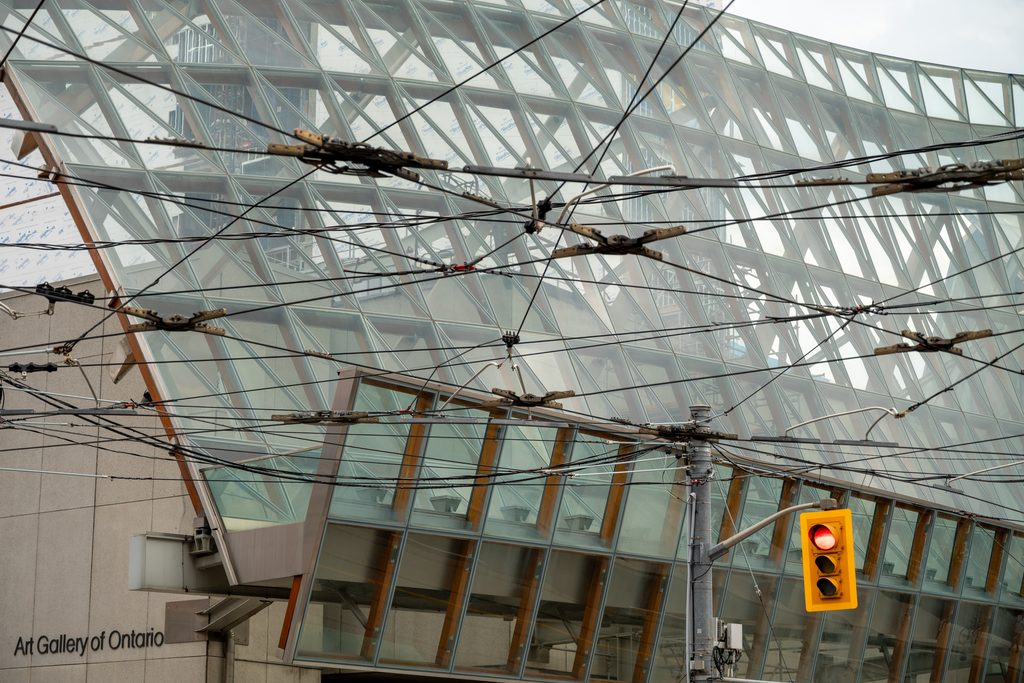
This is another building that has a slightly sprawling interior with an intriguing (to me) internal architecture. Its face to the outside world is a surprisingly low-key Frank Gehry design (given his extravagances elsewhere). The Art Gallery hides a widely varied set of indigenous and international art work including a fabulous gallery room of Henry Moore sculptures and maquettes. The main draw for us was a temporary exhibition on Impressionism. Because it was drawn from another collection, which was clearly very extensive, many of the paintings were unfamiliar to us, giving us a surprising and different insight into the work of paintings whose artists work you can become rather conditioned to. The café was a good place for a recuperative sit and contained a small bronze of Rodin’s Le Penseur, seemingly unseen by many passers-by.
Mobility Access
The building entrance is several steps above street level which street has streetcar stops quite close by. The modern interior has carefully worked slopes and means for getting between levels. They have wheelchairs available. Stools were not obvious and are not mentioned on the fairly comprehensive Accessibility page on the website.
Harbour Tour
Our boat tour round the harbour and into the waterways of the barrier islands is courtesy of Toronto Harbour Tours. They are one of many companies along the waterfront operating various ferries and tours around and across the harbour and to and from the barrier islands. It is an entertaining tour and was endorsed by our concierge as one of the best. The boat carries around thirty people with bench seats in a cabin and a small rear poop deck. The ebullient tour guide was both informative and entertaining – another human voice showing that this method works so much better than pre-recorded commentary. We run around the inner harbour with its stupendous city skyline and on into the channels that divide the wooded parkland of the barrier islands, which act as leisure destination for locals and tourists alike.
Mobility Access
There are a couple of steps up to the boat’s poop deck from the quayside then several more down a steepish set of steps down into the cabin interior.
City Walking
Once again in an urban environment I found the website GPSMyCity a useful guide to some strolling around the city. I explored three broad areas using bits from different walks on that website.
Distillery District
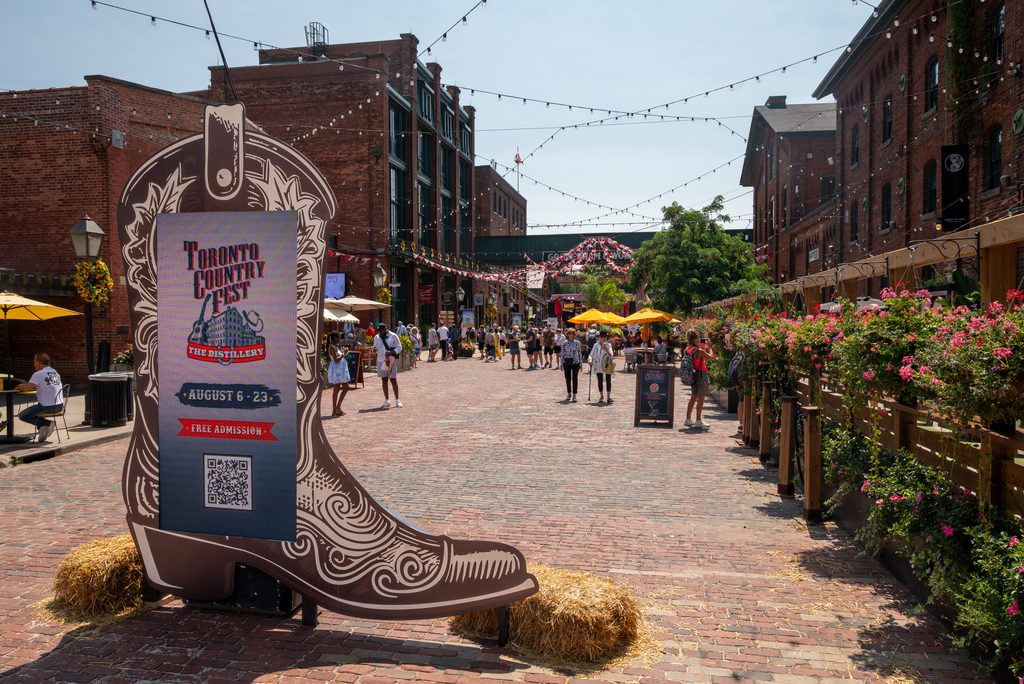
This is a small complex of 19th century brick buildings that once housed a distillery and all its ancillary workings. Now it has been upscaled in a manner rather reminiscent of London’s Covent Garden. Craft and independent stores meld with eating places of all varieties and spaces for outdoor demonstrations and performances (a country and western festival whilst I was there). It is busy with locals and tourists on a weekend. It is engaging but does prompt me to wonder whether, like Covent Garden, the history of the place seems rather subsumed by the experience offer which I feel has a certain ubiquity with other urban areas that have been fully repurposed for the modern age. It almost feels like a theme park islet amidst the swathes of condominium towers that rise and rise into the clear Toronto sky around it.
Mobility Access
The area is pedestrianised but is not large (about 200 metres by 300) and it has access to streetcar stops within 250 metres or less. The streets within the space are laid with standard bricks, which have only the faintest hint of uneven cobble surfaces, and the adjacent sidewalks are paved. There are, of course, a multitude of places to stop for a break over a coffee or meal, many with outdoor seating.
Waterfront
Once a hub of heavy industry, which has now moved to the city of Hamilton further down the Lake Ontario shore, Toronto’s waterfront has been upscaled and filled with parks and squares alongside the ferry terminal, marinas, tour boat jetties, the Marine Fire Department and other new and repurposed buildings, mainly used for arts and leisure. Just inland of the Queens Quay, the boulevard-wide street that runs along the shore, are a glut of towering glass condominiums (and the CN Tower). It is easy to wander along the shore. I took it from east to west; from the tram stop near Love Park, with its cheesy heart-shaped pool, along to the Music Garden. It is just over a kilometre but any walk will involve weaving in and out of the grass and tree-filled squares, along the carefully paved waterfronts, over pedestrian bridges, past the sculptures dotted about and taking time just to stop and watch the world at play. You can rest on the grass under the trees, lie back in the deckchairs on the HTO Beach, head into one of the many bars or restaurants for a fuel stop or simply sit on a bench to take in the goings on. And the goings on often include a festival of some sort.
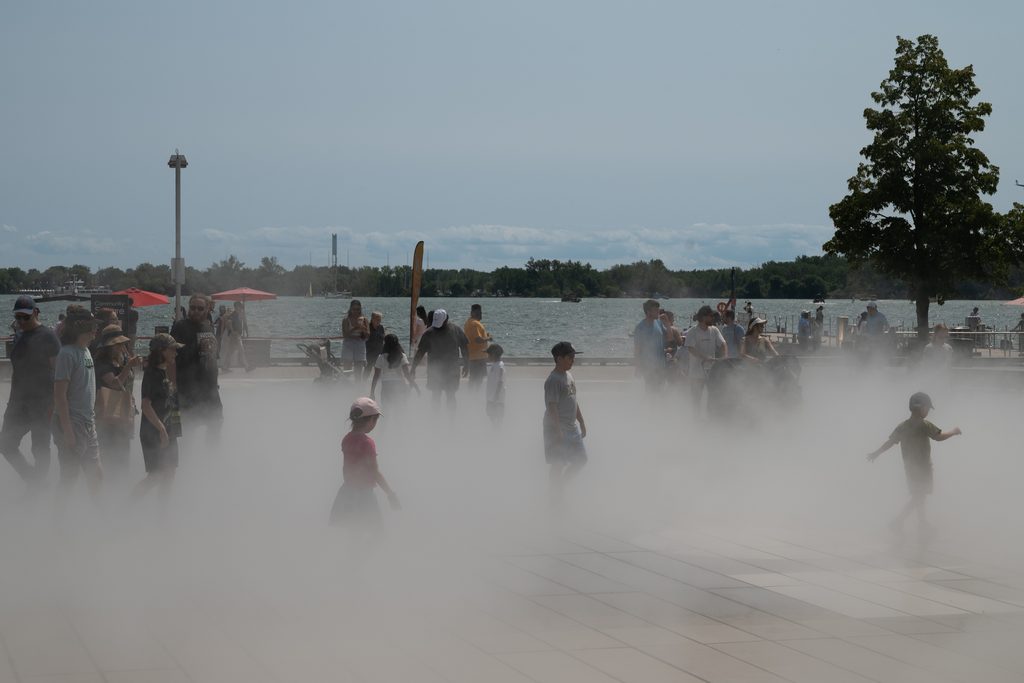
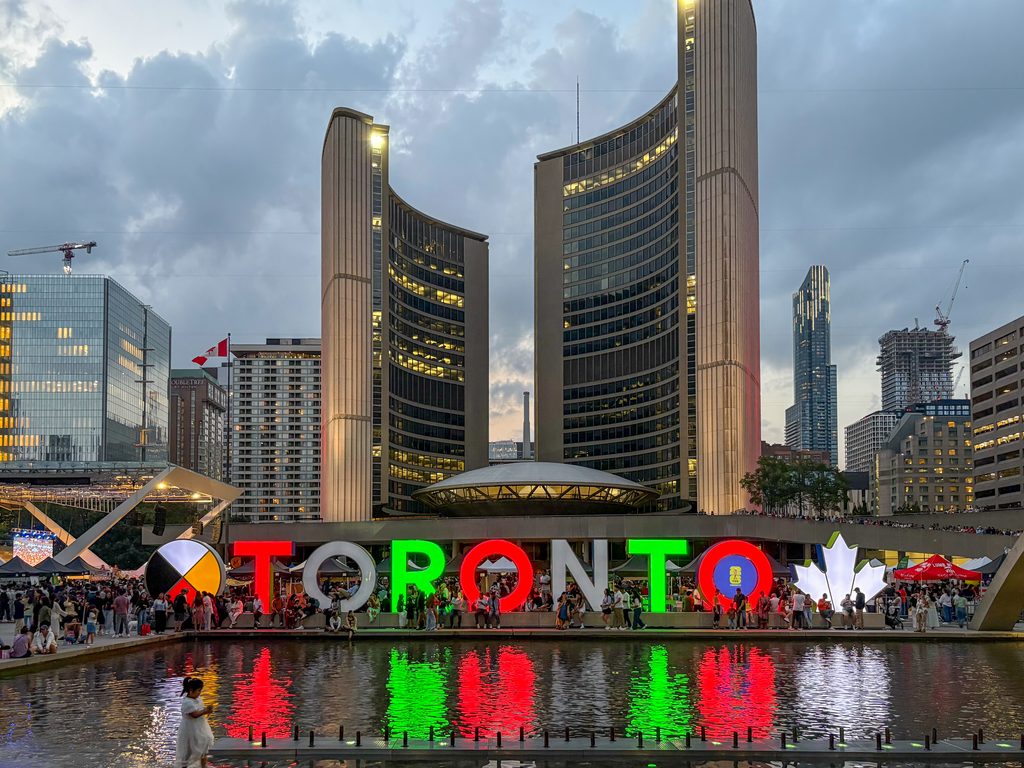
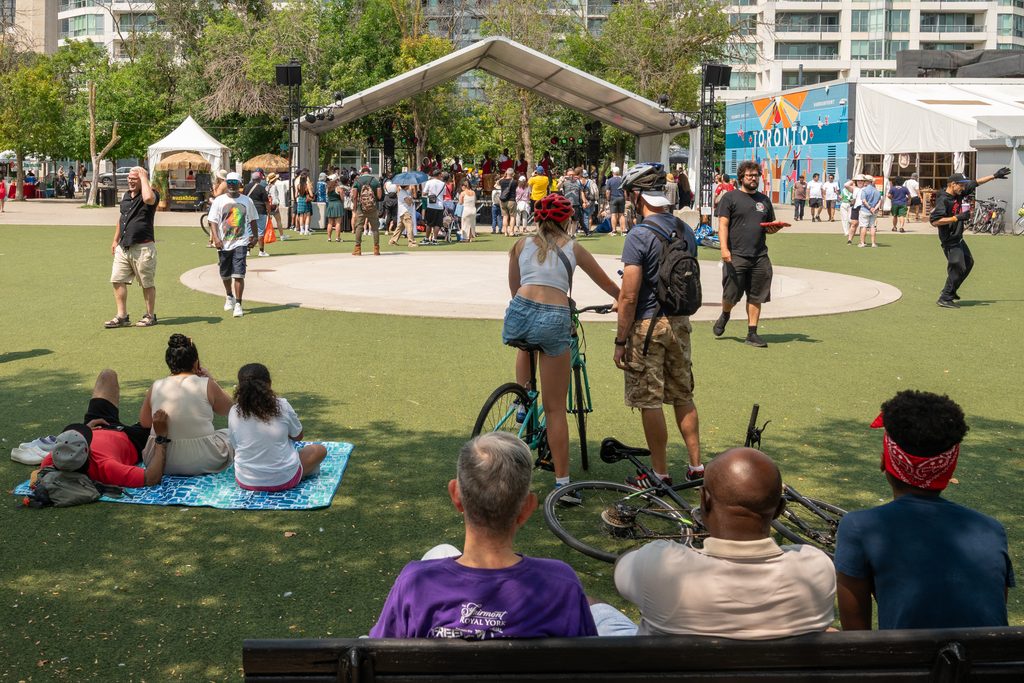
For it seems that Toronto loves a good festival. Not an all-encompassing festival that swamps the city, but small festivals that often cater for many elements in the city’s ethnic mix. On my first evening I had strolled up to Nathan Phillips Square, in the heart of the city. Here a boisterous festival, the Himalayan Mela, was in full session with a large stage where a glitzy band played to an enthusiastic audience dancing the night away. It was surrounded by many temporary food stalls and swathes of folk, many from Hindu, Muslim and Sikh communities, just enjoying the warm evening. Back on the waterfront on a warm Sunday, the festival is one of celebration of Caribbean and African music. A group of drummers from Burundi, set up in Ann Tindal Park, looked like they were shortly to face competition from a reggae band warming up underneath the adjacent Harbourfront Centre concert pavilion. Down in the Music Garden careful planting hides winding paths and small, bench-filled spaces for people to relax. At the Garden’s heart is a small grassy concert bowl which allows groups to gather and listen to live jazz and classical performances. It is a delightful way to spend a morning, an afternoon or even a day enjoying the ambience of Toronto.
Mobility Access
Streetcars run along Queens Quay and provide easy access into other parts of the city. Walking can be taken slowly and there are plentiful places to stop and rest. The pedestrian bridge (Amsterdam Bridge) that runs over the marina from Ann Tindal Park can only be accessed up a flight of about 20 steps but otherwise all is smooth and flat, apart from the gentle humps and slopes that are a design feature in some park spaces.
Churches, Theatres and Civic Buildings
Taken from GpsMyCity’s Historical Buildings Tour, I started this two kilometre stroll in St James Park. Because much of pre-19th century Toronto did not survive devastating fires that ripped through the predominantly wooden structures of the time, the ecclesiastical buildings along the appropriately named Church Street (Anglican, Catholic and Methodist) are all late 19th century Neo-Gothic structures set in locations that are somehow similar. The first is the Anglican cathedral of St James, looming over neat, tree-filled, grassy St James Park. Criss-crossed by paved paths and housing a fountain and play park alongside a modern pavilion of almost sculptural design, it has a general air of well-being and neatness.
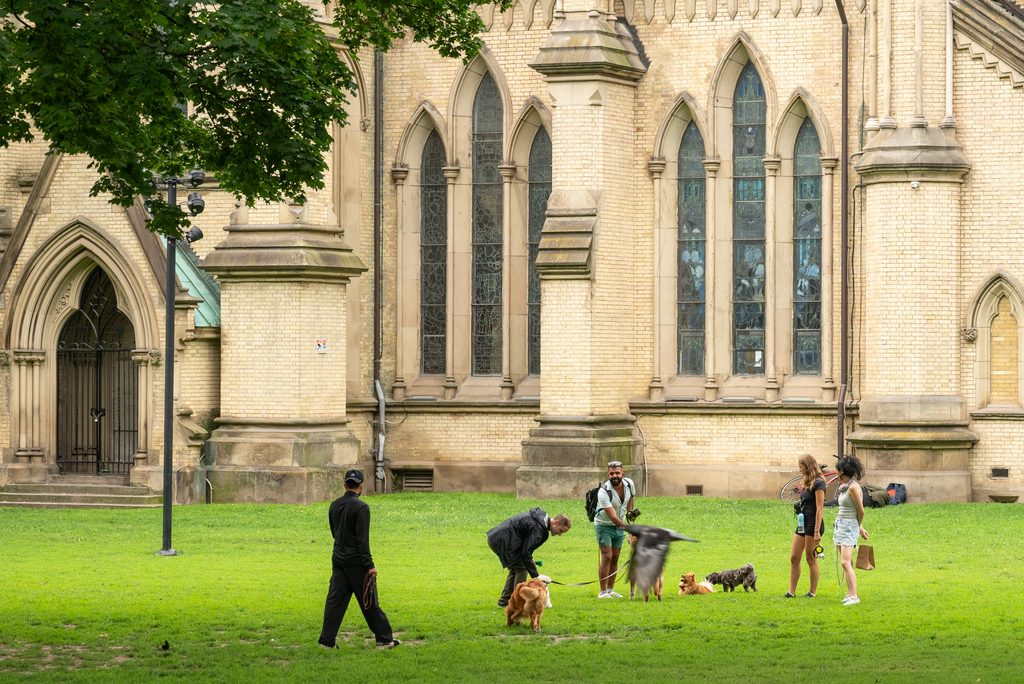
Dog walkers meet and greet, children play and folk sit at the public tables for chats and to consume lunch. A 500-metre walk north is a similar public space in front of the United Metropolitan Church, without the play park, pavilion and fountain and with a very different ambience. Here in contrast the people are the unhoused, sleeping on benches or gathered in small groups. The third church, the Catholic cathedral of St Michael’s, seems to be firmly shut to us mere tourists; a contrast to the other two which have boards outside inviting passers-by to step inside and enjoy the interiors. Wending onward you take in the well-known venues of Massey Hall, dating from the 1890s, and the ornate, 1920s Ed Mirvish Theatre before circling down past the Romanesque Revival grandeur of Old City Hall and ending in Nathan Phillips Square under the shadow of the contrasting 1960s, modernist Toronto City Hall.
Mobility Access
This could be doable in bits depending on your walking capacity. There are fewer refuelling stops along Church Street, but plenty in the central city areas around the theatres and Nathan Phillips Square. Benches in the squares offer some relief for sitting and observing.
Casa Loma District
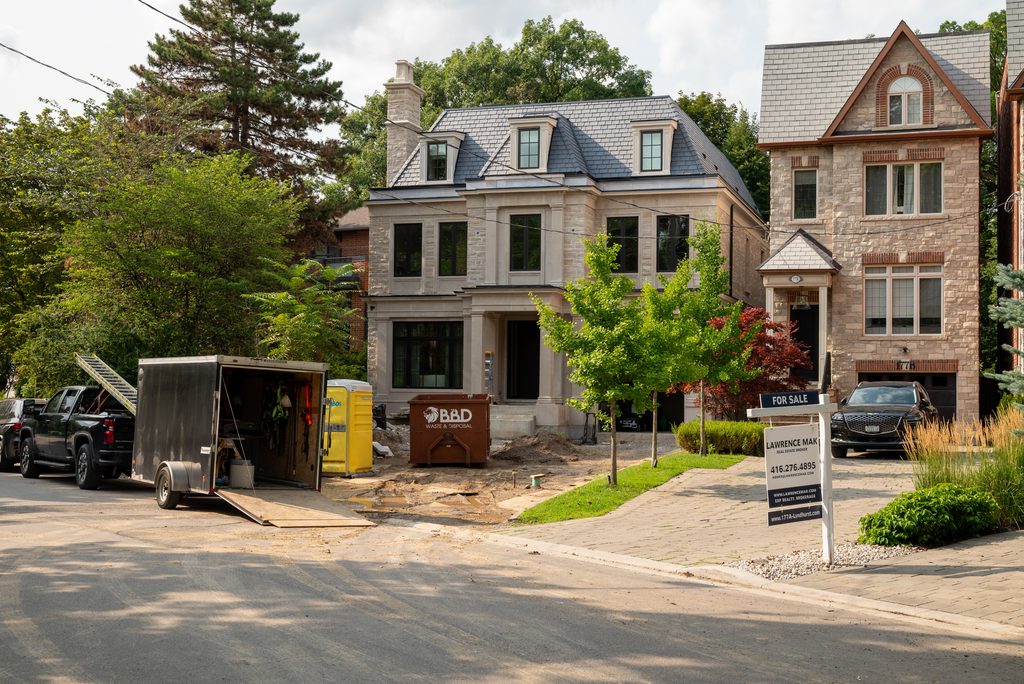
The centrepiece of this area is Casa Loma itself, an overdone Gothic Revival ‘castle’ now used principally as an event venue (although it is, at times, open to the public). It sits atop an escarpment to the north of the city centre a short trip up the Route 1 subway line. To me it was less interesting than the nearby Spadina Museum and the upscale residential area of smart, large houses in the styles prevalent early in the 20th century; Edwardian, Arts & Crafts, Tudor Revival, Georgian. Set in tree-lined streets it is somewhat reminiscent of Oak Park in Chicago. Activity here is limited to the service world; the construction workers doing works to tart up the properties, the gardeners unloading lawn tractors from their pickups, the domestic workers walking the dogs.
Mobility Access
Not at all easy, although you can just take a taxi up to Casa Loma. If you take public transport, you will face a climb up to the escarpment. The steeper one from the south involves taking Baldwin Steps (over 100 of them) which climb up to the small park beside the castle. To reach the bottom of the steps involves either a bus ride to a stop at that point or a subway ride to Dupont station on Route 1 then a 300 metre walk from Dupont up the rising slope of Spadina Road. The slope is gentler, but much longer to reach Casa Loma, if you are coming from Saint Clair West subway stop to the north; a walk of around one kilometre.
Spectating Tennis
Sobeys Stadium, like IGA Stadium in Montreal, is a purpose-built facility but sits on a smaller site. It has similar-styled catering and sponsor stall facilities (both tournaments share the same key sponsors). About 25 kilometres from Toronto’s downtown, the stadium is set in the midst of the sprawling York University campus. It takes a couple of journeys out to work out that using public transport may be the best way out and back. The first time we took an Uber. As seems to be the case in so many standard cars, I am squashed into the back with insufficient headroom, which is not fun when the trip can take up to an hour depending on the traffic. The main downside of using Uber in such a location becomes obvious on our departure that evening when we discover only ride-shares are available. We use the single waiting taxi and are whizzed in a hair-raising zoom down the expressways back into the town centre. All this makes us wary of using Uber or cabs. We discover that using the subway Route 2 from Union Station to Pioneer Village leaves you with just a one stop trip on the 106 bus to a stop immediately outside the entry to the tennis complex. And that entrance is right next to the main stadium court making for much easier access than in Montréal. Indeed the whole complex is less spread out than at IGA Stadium in Montréal. The proximity to the bus stop just outside the entrance works very well travelling the other way in the evening although, potentially, you could face weights of up to 20 to 30 minutes for a bus if you get your timing slightly wrong.
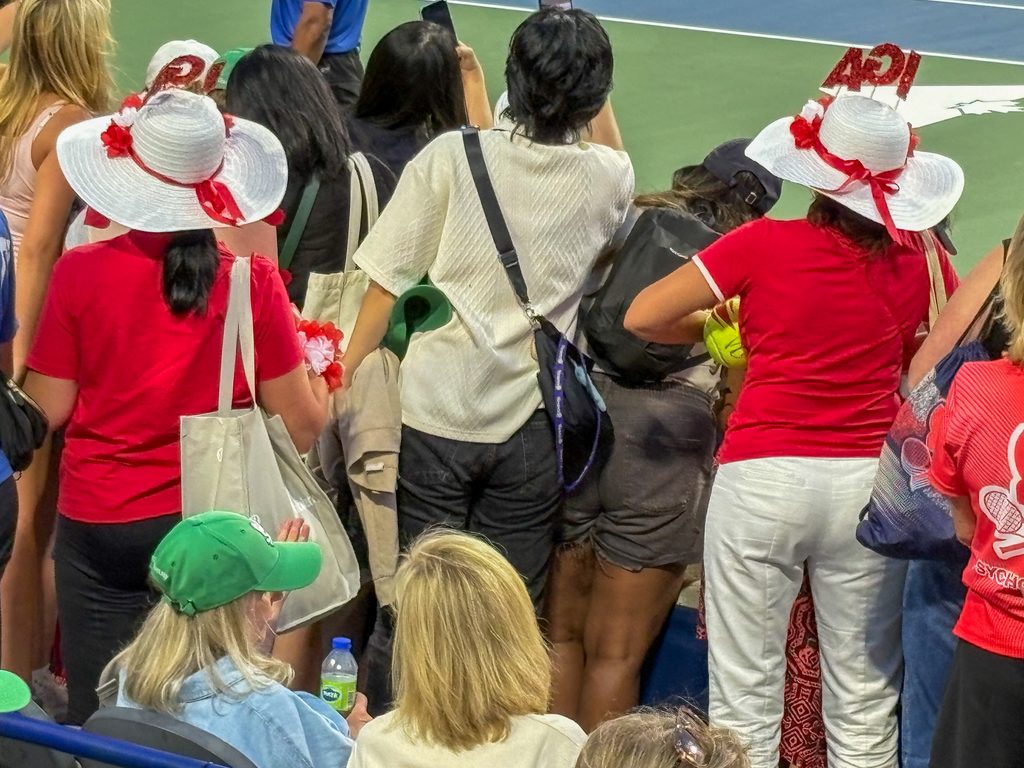
Although the food offer at both stadiums is superficially the same, we felt there was slightly more variety at Sobeys. However, unlike at the Montréal complex, there seemed to be nowhere to buy coffee, until I finally spotted a machine tucked away in the Kim Crawford bar concession. It seemed to be the only coffee outlet for the whole of the Toronto complex. That we felt there was a better atmosphere in the Sobeys Stadium was partly to do with the stage of the tournament reached (watching the quarter and semifinals). It also had to do with the enthusiasm of the ex-pat communities supporting certain players, most noticeable when the Ukrainians supporting Elena Svitolina and the Poles supporting Iga Światek were chanting the players names during their semi-final. We had three evening sessions at the tennis, there being no day sessions at this stage of the tournament.
Mobility Access
Sobeys Stadium does come with an elevator but, because there is only one access level into the stadium at about the mid-level of the seating, there can be quite a walk up to or down the concrete steps to your seat. One advantage of Sobeys over IGA Stadium in Montreal is that the toilet, food and water facilities are all within the ticketed part of the stadium so that you are not trapped outside after accessing them, needing to show a ticket to return to your seat. This also means that the food outlets and toilets are much closer to your seats than in Montréal. Also the toilet queues seemed substantially less at Sobeys Stadium which may have been, in part, due to the fact there were fewer matches going on as it was later in the tournament. Also, as I have said, access to the complex main entrance is only metres away from the bus stops and not much further to the vehicle drop off area which, coupled with the main stadium’s proximity to the entrance, means much less walking within the complex than in Montréal.
Laundromat
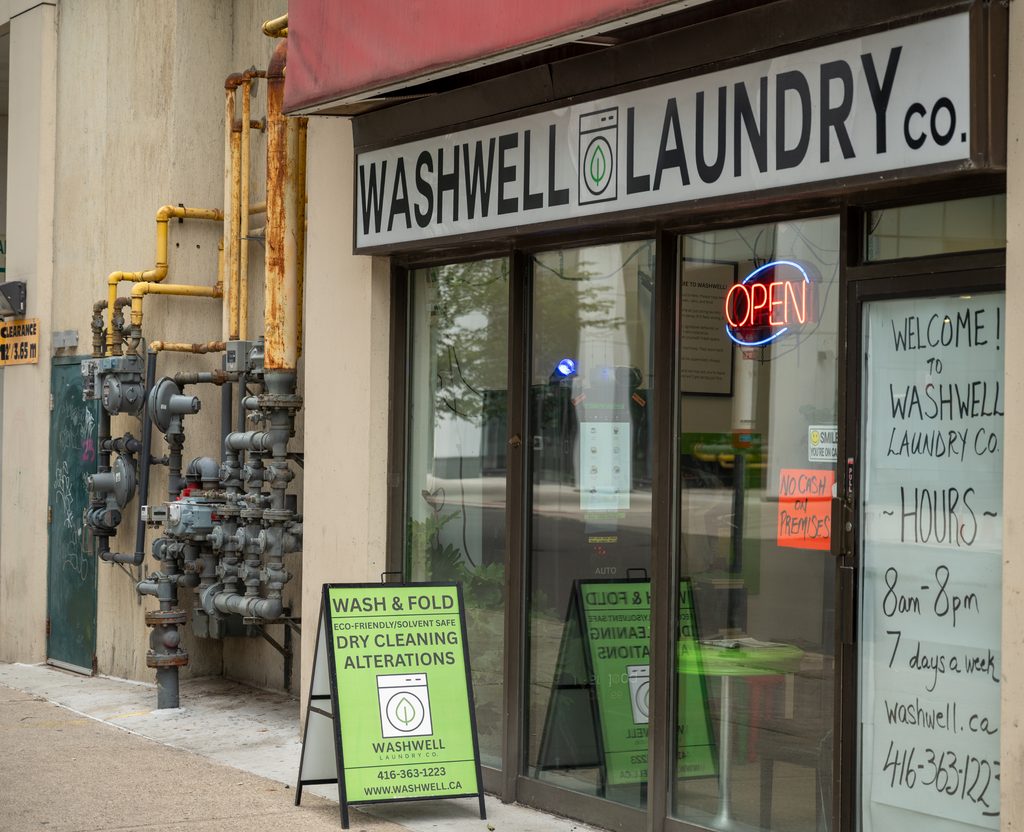
The Washwell Laundry Co. on Princess Street is another gem of a place that is close to the Distillery District. Empty, except for the very helpful woman running the place. Loads of machines. A change machine. Powder packs in a vending machine (although the woman sells us pods for $2 CAD) and the whole wash costs no more than $15 CAD. Tables, chairs and a coffee machine for those waiting. We actually nip round the corner to the St Lawrence Cafe, an odd, faintly bohemian place that has its tables surrounded by craft items for sale; clothing, small artworks, jewellery. It is laid out as two small spaces with no more than half a dozen tables and a washroom reached by pushing aside a curtain and walking through a jumbled office and a storage area. We end up with a hotel room festooned with drying clothes hanging from cornices and with ironing to be done but, once again we have experienced a different, more local side to the city.
Getting Around
For us, public transport in the core areas of Toronto revolved around streetcar lines supplemented by bus routes. Of the subway lines only one (Route 1) loops into the city’s central area, linking Union Station to destinations in the outer areas. For us these resources provided the main means of moving around, with recourse to Uber only when, for mobility reasons, we needed to get closer to individual locations. As those who have dabbled in earlier posts will know, we are fans of what we choose to call ‘tram touring’; just getting on trams and seeing where they take us, often seeing areas less visited or sights less seen. Toronto’s streetcars worked well for this aimless sightseeing as well as for just getting easily from A to B. The subway we only used for getting to the tennis. TTC, the unified transport authority, has a pretty comprehensive website.
For the short-term visitor (less than a month) ticket purchasing could not be more straightforward. There is one single flat fare that operates across the network. If you pay with a credit or debit card when you board the streetcar, bus or subway, you get two hours of travel within the Toronto area for a single fare. This makes journeys that involve more than one bus, streetcar or train very straightforward. With no reduced rates for day tickets and no special tourist limited day passes, paying the flat fare is both simple and cheaper than buying tickets with cash. You just tap on the reader when you board a bus or streetcar or when you go through the subway gates.
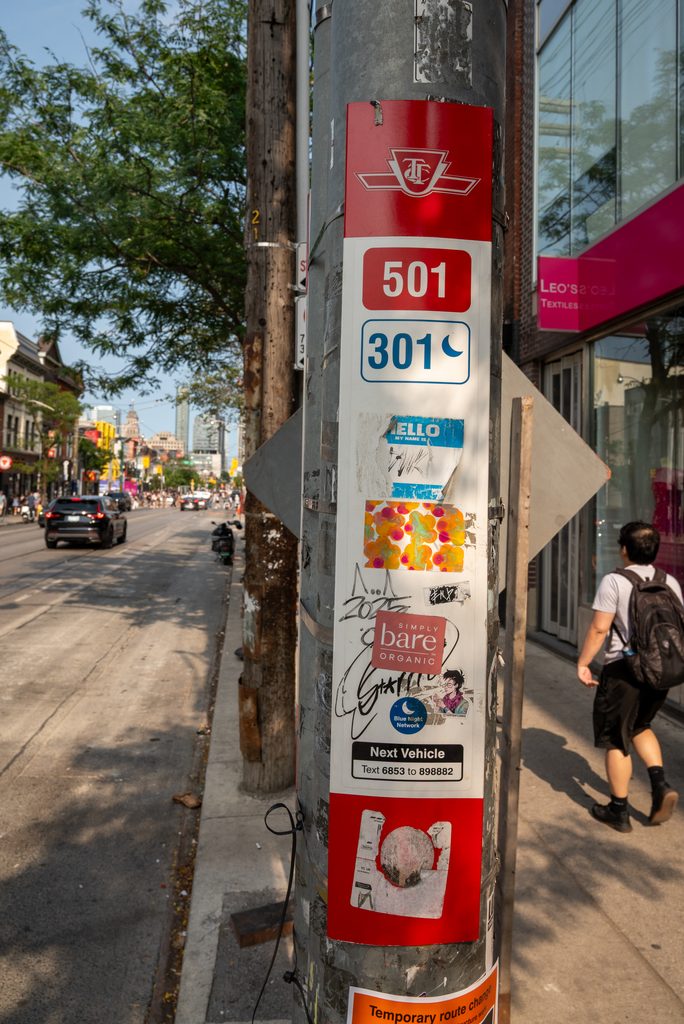
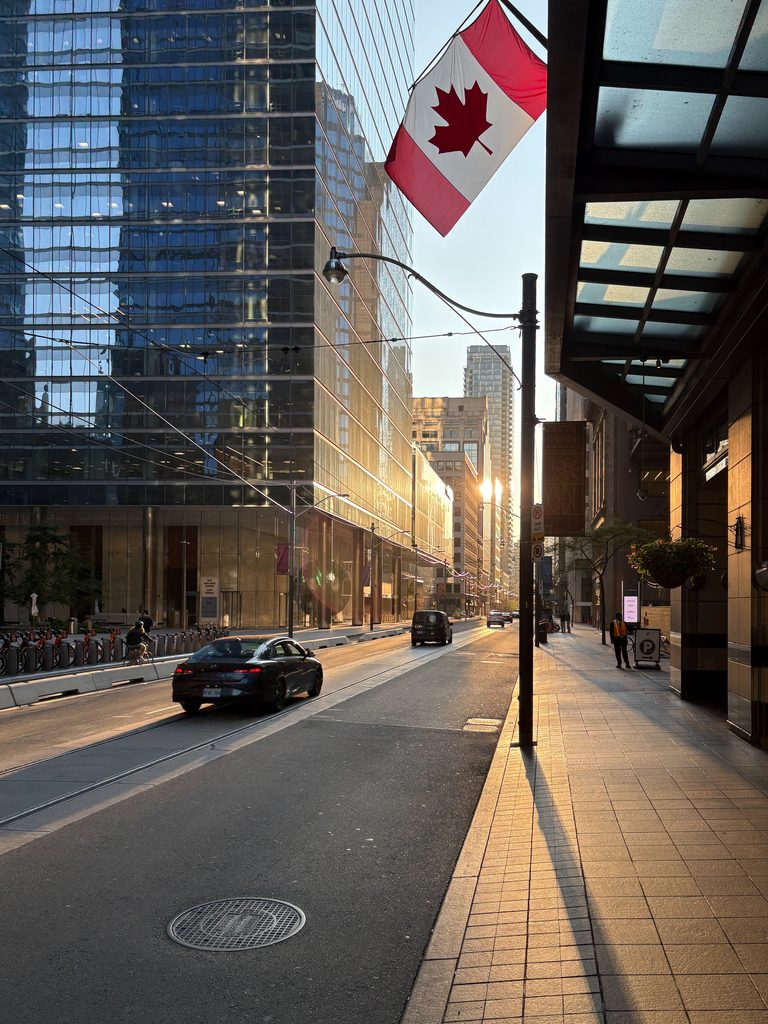
A minor wrinkle lies with the bus and streetcar stops. Sometimes these are difficult to identify because they are no more than low-key signage on a lamppost (see photo). This can make spotting stops quite difficult from a distance especially when you are on a street busy with other visual distractions (people, traffic, other signage).
Toronto also has a public walkway system – underground. At surface level you will see logos for PATH. These are the entry points to a complex of 30 kilometres (over 18 miles) of linking pedestrian walkways below ground. These are no ill-lit, graffiti-laden passages to be avoided but a network of clean, brightly-lit passages that link all the main buildings in the downtown area. Because they are on the lower ground floor of the multitude of corporate tower blocks (and Union Station) they are akin to an up-market underground shopping mall; all smart retail, restaurants, coffee bars, hairdressers, smart takeaways, food courts and leisure venues. From a brief acquaintance their many denizens are principally the office workers from the buildings above. There are maps of the network (see the website) and plentiful signage, but the walkways are so extensive finding your way around can be disorientating. They can be useful if you need to move around when the rain is pelting down.
Mobility Access
Buses require just a step up to board. With streetcars, it depends on the stop. Some have platforms level with the entry points onto the streetcars. Others involve stepping from the sidewalk into the street, and a further step up into the streetcar itself.
Although the subway system has pretty good escalator or elevator access at most stations, care is needed as many downtown stations have multiple access points but only some of those have escalators or elevators available. Finding the right one at street level is not easy and I cannot readily find an online resource that addresses this issue.
PATH walkways are well looked-after and accesses down to them is usually by escalator from the street or within building atria. Of course, below ground there are distances to be walked and it can be difficult to estimate these. There can be a few steps up or down to change levels, although there is often a slope or a chair lift that can be found.
MONT TREMBLANT
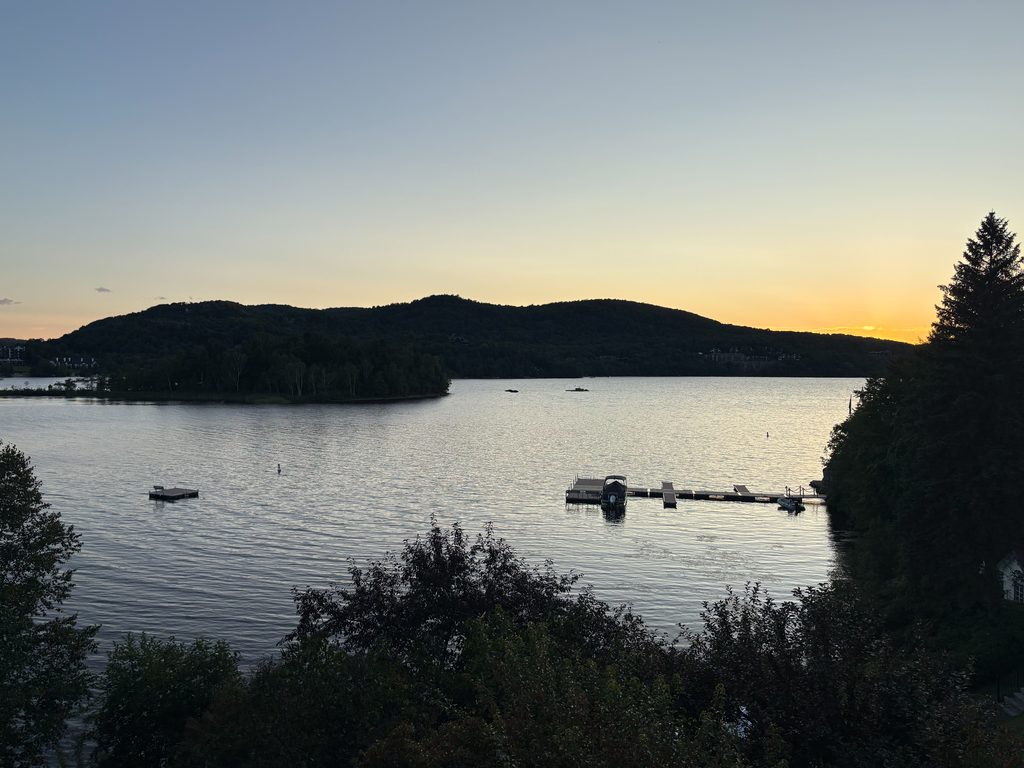
The Laurentian Mountains stretch in a diagonal swathe across Québec and Labrador. This is one of the oldest mountain ranges on earth. The south-western reaches of the mountains, in reality only a little more than high hills at this point, are home to some of the most popular recreational areas in eastern Canada – summer and winter. We were not drawn by the extensive outdoor activities on offer but by the promise of a hotel, deep in forested hills, for a stay focused on relaxation. Oddly that was what we found. I say oddly because the resort village of Mont Tremblant, where our hotel is located on Lac Tremblant, positively heaves with summer holiday activity. This is all the more so at weekends when the Montréalers head up the roads from the city to fill the car parks and shuttle buses that funnel leisure seekers into the resort.
Getting There
From Toronto Union Station a four-hour train ride to Ottawa station; a twenty-minute taxi ride to Ottawa airport and a touch of faffing around at the National Car Rental desk before we pick up our usual SUV for a three-hour, cross-country drive. Eschewing the autoroutes we opted for a longer ride that allows us to take in the changes of landscape. The whole of the ancient shield landscape in this area north of the St Lawrence River is characterised by water; rivers, streams and lakes, both large and small, are a near constant companion. First it was a backdrop to the train journey through the largely flat, farmed and wooded landscape out of Toronto. Then came a brief glimpse of the Ottawa River and the eponymous city on our drive through, leaving us with a feeling that this was a place to which we could readily return to spend some time. Beyond, as we leave the Ottawa River behind, the road starts to climb upward and we moved into the forested landscape of the mountains, where the thick sprinkling of lakes remains and the rivers take on a more rapid-like character as they fall down hillsides.
The Resort Village
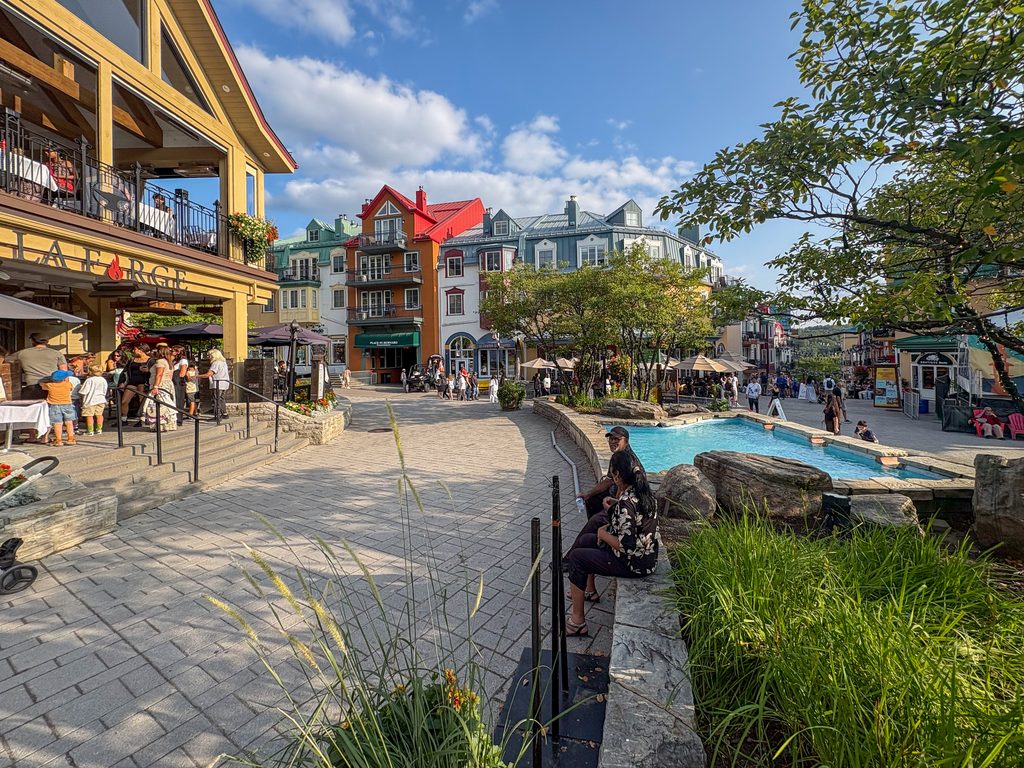
The pedestrianised village of Mont Tremblant Ski Resort (aka Tremblant to its US-based corporate owners) was established in the 1930s as a ski resort and has been completely re-developed in the last three decades into an all-year-round, privately-owned resort within a group that operates nearly twenty such ski resorts across North America. This means there is a certain style to the village that makes it feel a bit like a theme park. It has the artificiality and colouring of Portmierion, that folly village in North Wales that acquired notoriety from the cult 1960s TV show The Prisoner, cross-bred with a Disneyfied version of an Alpine ski resort. A melding of condos, food outlets, retail outlets and thrill rides with the buildings in summery shades of yellow, blue, green, orange and pink, it is set on land that rises up from the lakeside into the hill. On a summer weekend the eating places are rammed with diners and the streets are a tide of folk of many ethnicities climbing up or down to the top of the village where the plaza is activity central. Here children trampoline, adults and children queue lengthily for the summer luge (that descends a constrained, concrete track from the hilltop), people march off up hiking trails that wander around the wooded slopes, a gondola loops people up to the top of the eponymous mountain and much more besides.
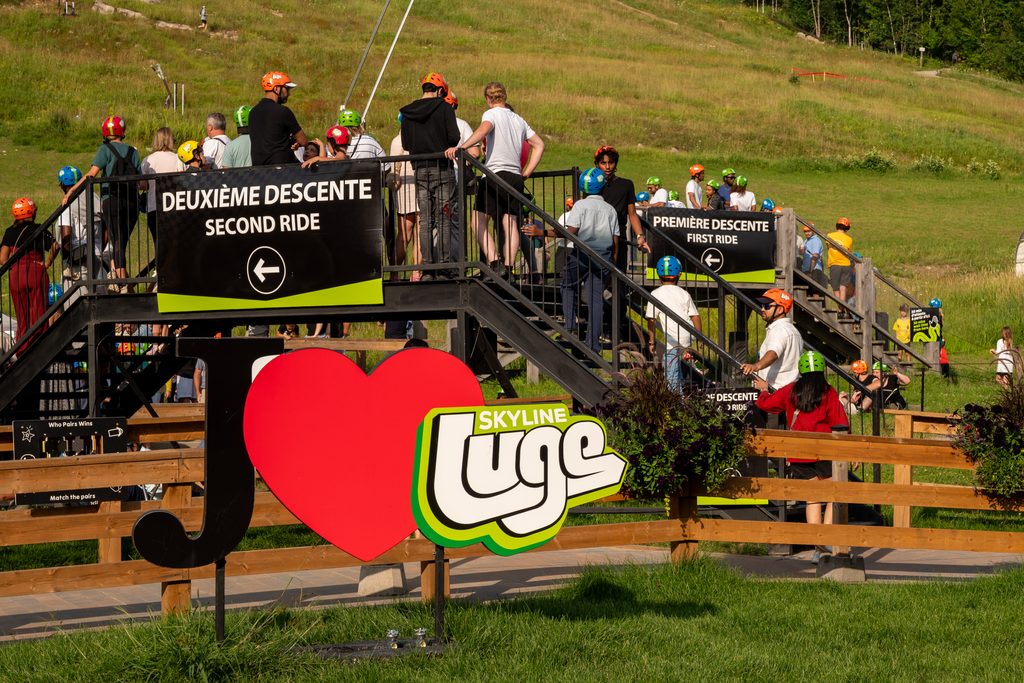
The resort village encompasses other plazas, where stages promise evening action. Outlets will sell you leisure fashion and outdoor clothing souvenirs and, provided you are happy to join the queue, gelato. If you are looking for more day-to-day needs the one convenience store (improbably labelled Épicerie on one sign) has some basics but is sadly short of variety and range – whilst happy to sell you maple syrup in maple leaf-shaped glass bottles. For facilities that provide those day-to-day needs you need to drive the 12 kilometres (7½ miles) down the road to the neat little town of Saint Jovinte. Here there are tidy little North American-style shopping malls with good quality supermarkets and services, such as a pharmacy, along with the nearest gas stations.
If the resort all sounds too much, let’s return to the hotel.
Hotel
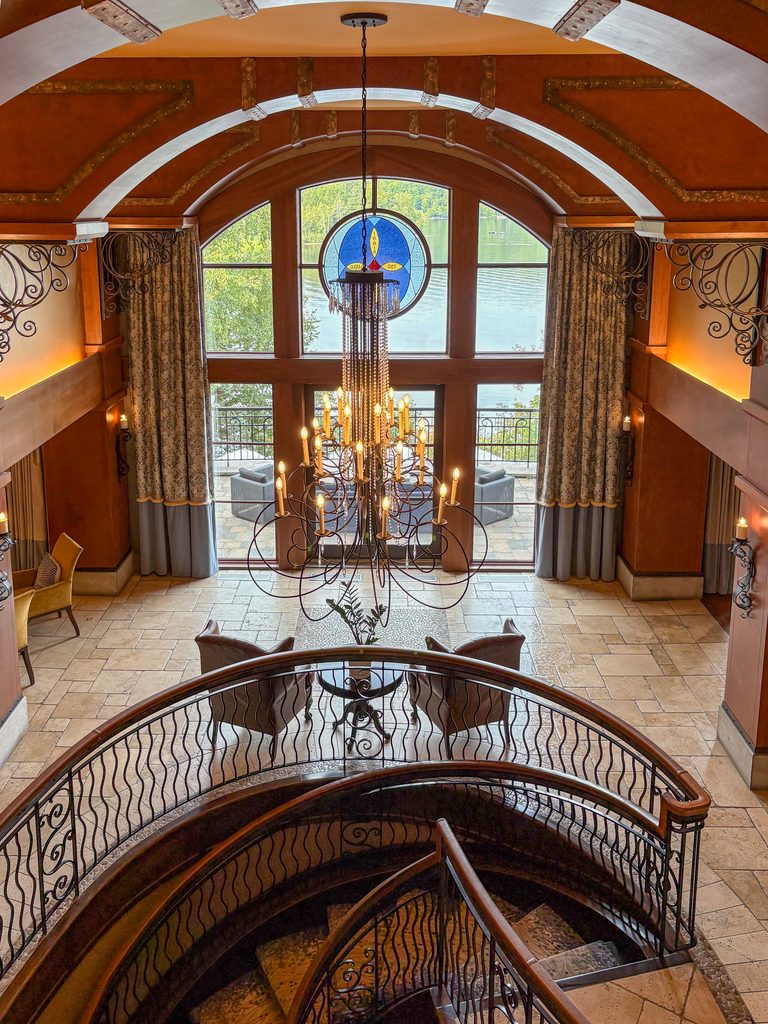
The hotel is key to our stay here and was selected on that basis. Despite the bustle of the resort barely 250 metres distant, we found that the Hotel Quintessence, tucked amidst the trees of its own gardens, suited our needs perfectly, offering places to sit, relax, read and eat (both indoor and out). Because the people come to the hotel to do the activities on offer in the area, the hotel is quiet in the day. It had a number of relaxing spots for us, inside and out. The restaurant has a large terrace, with umbrellas to provide table shade, and there is another terrace outside the lobby and above the restaurant level, with bar chairs and high tables below yet more shading umbrellas.
Although it is a Relais et Chateaux property, it does not quite feel a full on five-star establishment, but that does not matter as the staff are extremely friendly and helpful. French is the first language and there can be minuscule moments of misunderstanding that result. The style of the place is lodge-cum-chalet with brown wood and grey stone the keynotes of interior decor. It sits on a slope down to the lakeside. Tidy gardens fill the space between the building and the lake shore with resort facilities tucked in various spaces; an outdoor heated pool, a spa (with a gym, steam room and sauna) and a water sports centre. At the last of these you can use or rent a variety of watercraft: kayaks, various electric watercraft (paddle boards, surfboards and e-scooters) and motorboats. At weekends these join a cornucopia of other craft on the lake; small dinghies and yachts, water skiers, and tour boats as well as the hardy swimmers.
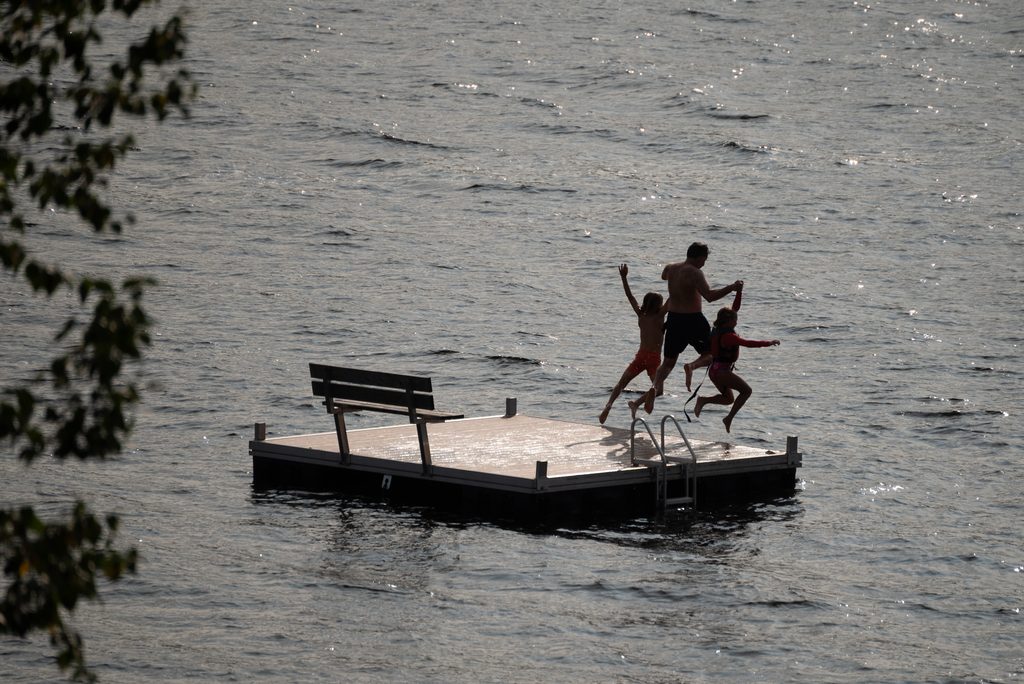
For us the only downside is the constant piped music spilling over the lobby, restaurant, terraces and bar. To me it is just unneeded, either in the quiet of the day or in the busier times during the evenings. Fortunately it is relatively anodyne with only the occasional beat heavy insertions.
The room is suite-sized with a sitting area in front of a usable fire, a dark wood cabinet TV and a fitted desk which sits in front of one window. The bed is super-sized and sits a little high from the floor. Behind us, in the back of the room is a large wardrobe and lobby area with a drinks alcove (coffee machine, kettle and fridge furnished with all the necessary for coffees and teas). Alongside that a huge en-suite with separate shower and toilet and a free-standing bath lurks behind sliding doors that can be opened onto the room. We have a toilet flood at one point but it is very quickly fixed by the staff whilst we are out that morning. A full height glass door gives onto a balcony space with two chairs and a small coffee table. All the rooms face west out across the lake and many have balconies.
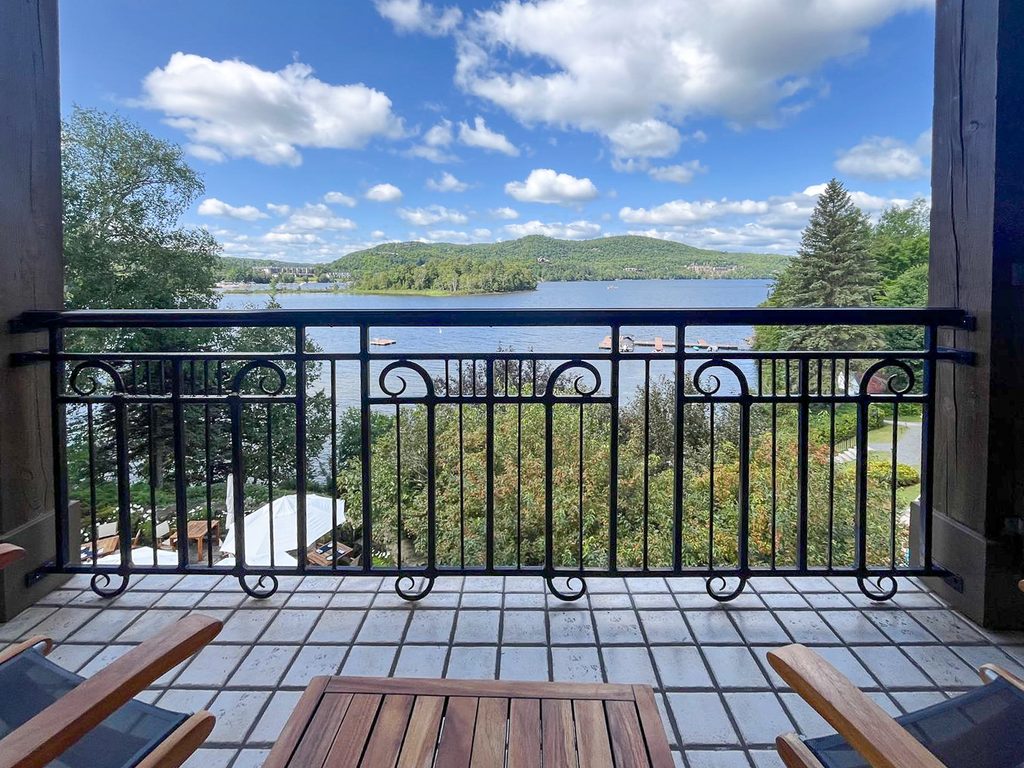
The food in the hotel is good enough that we do not feel the need to venture out into the melee in the resort. The menu-based breakfasts have a good choice of North American style dishes laced with a French overtone. The dinners are uniformly good with some dishes better than others and a reasonable selection of vegetarian options. There is enough variety for the five nights of our stay. The outdoor terrace was our chosen location in the evenings but the edge to the air in the mornings kept us indoors. Unlike our hotel breakfast experiences in the city, service was good, both at that meal and at our dinners.
We found what we really wanted with this hotel and it is certainly a place we could readily recommend to others, whether you seek to make the most of the outdoor activities the region has to offer or whether you just want to sit and relax in the landscape, as we did.
Mobility Access
Within the hotel flat, smooth surfaces are the norm and the same goes for the terraces. Moving between floors is by lift or stairs. Some rooms can be a little bit further from the lift so it can help to ask for one closer to the lift. The rooms have smooth floors with no trip hazards. The main restaurant has two levels but there is only a couple of steps between them. Walking around the grounds and down to the lake does involve negotiating the slope of the ground but there are paths and the grounds are not large. Arriving cars pull up at the sheltered lobby entrance and a valet service is on hand to unload luggage and park and fetch your car from the car parks.
A Weather Note
Up here in the hills the weather is noticeably cooler and less humid than in the cities. Daytime temperatures in late August reach 21-23°C (70-74°F) and the nights drop down to around 14°C (57°F). Still warm enough in the evenings to dine on the hotel’s terrace looking out over the water; first watching the sun set then Venus rising and, as the sky darkens, the stars emerging, so much brighter up here in the clear air with the Milky Way dusting a band across the skies. You do need a second warming layer to ward off the cooling evening air, but the hotel has blankets to hand for those that need them. The mornings are the coolest time (as one guest summed them up well as ‘frisky’) but some still felt able to breakfast on the terrace.
Activities: Mont Tremblant National Park
This was not a place for activity for us. We spent most of our time relaxing in the hotel. On just one day we took a drive out into the adjacent Mont Tremblant National Park. We had identified a loop road of around eighty kilometres (fifty miles) or so from the hotel to southern park entrance, across the park and emerging on the north-western side of the park before looping around Lac Tremblant back to the hotel. An access pass purchased online is $10.30 CAD for both of us.
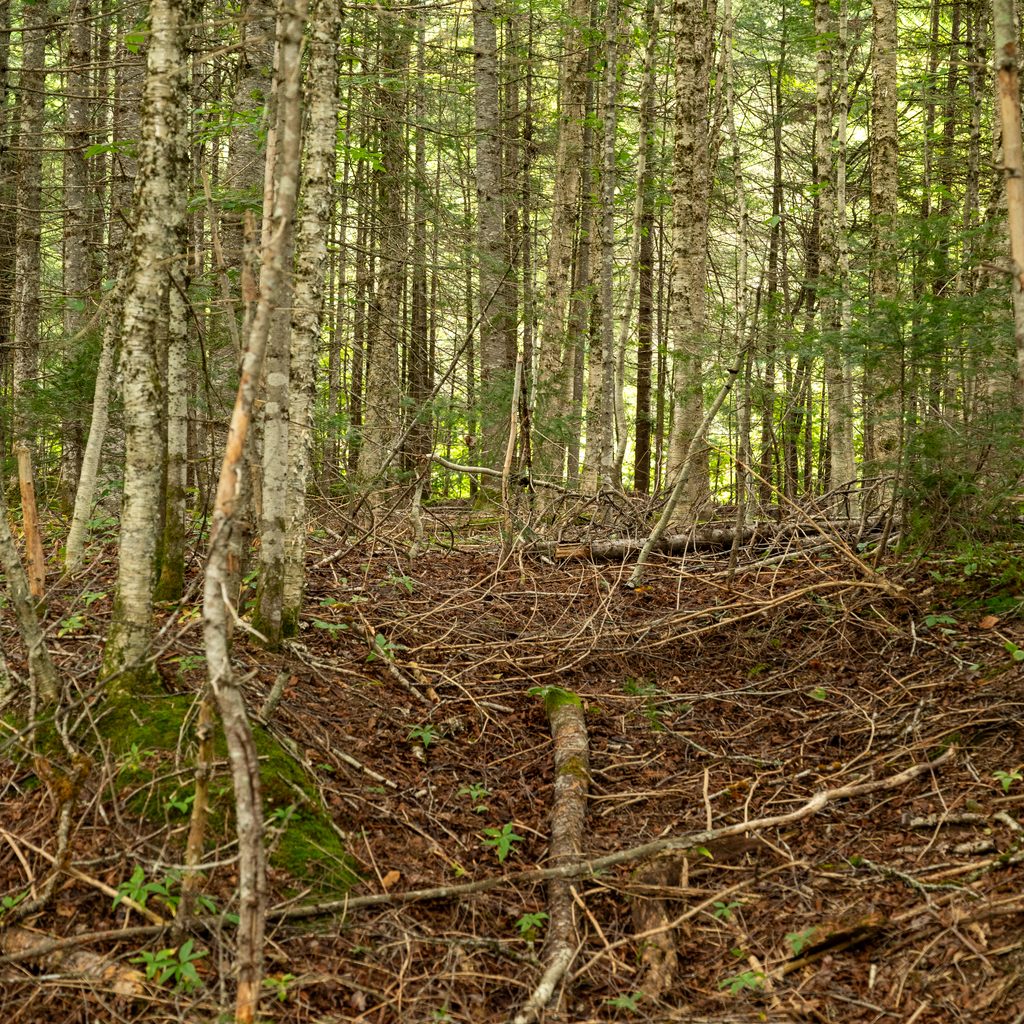
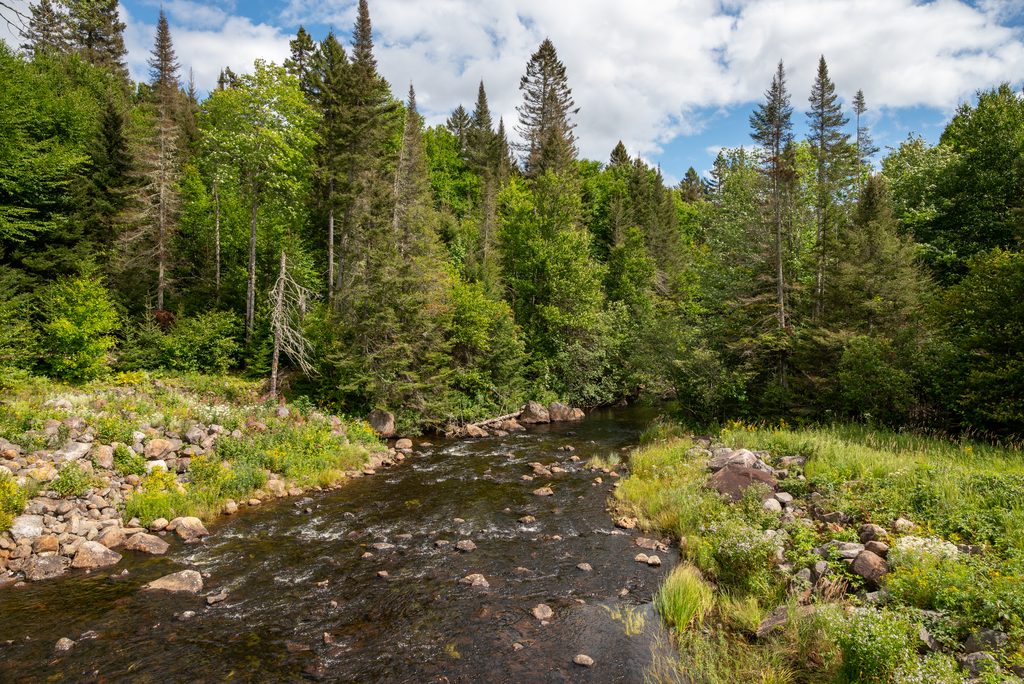
It soon becomes apparent that the park itself is heavily focused on outdoor activities; campers, hikers, walkers, cyclists, canoeists, hunters and fisherfolk. It is not set up for the casual visitors who, like ourselves, just want to take in the natural landscape from the comfort of our car. Many of the stopping places identified in the park information are trail heads buried in the woods that crowd the road. There are often only glimpses of the lakes or streams through those all-encompassing trees and any stopping places to take in the quiet and the scenery are accidental, almost unmarked, pull offs. This is a contrast to our experience of the US National Parks that are, for the most part, orientated somewhat more towards the spectator and casual walker. Even the shortest trail of about 500 metres is down a dirt track through the trees, too steep and uneven for us to venture on to it. There are no real facilities for the casual visitor (no shops, no cafes) other than a small shop in the Centre de Decouverte, a smaller version of US visitor centre. This shop sells clothes, souvenirs and camping goods but the only comestibles are bags of trail mix and chocolate protein bar-type snacks and a fridge of cold drinks. The road into the park is a good tarmac one for several kilometres. It then becomes a well-kept graded road, pretty much smooth and pothole free. However, when we turn off Park Route 1 onto Park Route 2 and head north out of the park, the road becomes just a narrow near track, the sort where the grass grows in a line along the centre of the road. There are no passing places. It may be they are not thought necessary because we see not another soul for nearly 20 kilometres (12 miles) until we pass a Park Ranger pick up, at the point where the road opens out back onto a wide graded one. The Park Rangers here are acting as a registration point for the hunters taking their kill out of the park. On this part of the route there are no trailheads, no campsites not even a mobile signal – nothing but us and the woods.
Mobility Access
This was a drive and, given there was no walking involved and only roadside stops for those glimpses of the landscape, the experience is clearly a green designation. Just make sure you have enough gas in the tank and take water and snacks to feed yourself en route.
Return to Montréal
Our return from Mont Tremblant was to Montréal Airport to drop off the rental car and catch our flight. Despite the rain, another delightful drive through the rolling hills before encountering the urban sprawl of the outskirts of the city. It has to be said that Montréal Airport at the time of our visit is a bit of a mess. Extensive infrastructure works are in train around the the airport and within the terminal areas. Traffic queues build up on the roads into the airport. The shuttle from the rental hall, used by all the companies, stops in a scruffy drop off area. There is then a walk of about 400 metres along a narrow temporary walkway in an underpass. After some to-ing and fro-ing with airport staff it is apparent that there is a golf cart that runs along the underpass and drops you about 25 metres from the terminal door. For us, travelling with Air Canada, it would be the case that their check-in desks are at the opposite end of the terminal building! Fortunately there are wheelchairs aplenty in the terminal building, so we snaffle one.
The Air Canada lounge is packed. Although the food selection is very good, the information about flight departures is rather thin on the ground and about 35 minutes before our due take-off time we head down to the gate where there is no plane! The passengers are crammed into the gate lounge area. Air Canada’s messaging is quite poor and an announcement that there has been a delay in getting the plane to the stand because the airport is busy comes with no further information about how long the delay will be. Eventually the plane arrives and wheelchair users are called into a separate holding area where we just sit, uninformed as to what is happening. Eventually we board and the plane rolls back from the stand about an hour late.