This was a seven week road trip that would result in an impossibly long single piece so, as with other long trips, for convenience it has been divided into eight separate posts. The several Parts will be published, in order, at regular intervals.
Part 1: Prelude, Structure of the Trip and Practicalities
Part 2: Catalonia (Aiguablava) and Madrid
Part 7: The North West: Puebla de Sanabria, Cambados and Pontevedra
Part 8: The North West: Ferrol, Santiago de Compostela and Heading Home
THE NORTH WEST: FERROL
Length of Stay: 3 Nights

What made Ferrol so different for us was that, at the last, it was the only city where the primary port and commercial functions mean the tourist element is secondary, even tertiary. Fewer tourists make it this far north and west and it was noticeable that the Parador was both quiet and also had an unusually large proportion of non-tourist guests. If that suggests it was an uninteresting place to visit that was far from the case. It just means it has an ambience that contrasts with the many the more overtly elegant cities that we had visited. It helped that the coastal hills seemed steeper here compared to the flatter, more estuarial landscape of the Rias Baixas, changing the quality of the setting. Ferrol is one of those places that needs a little time to engage with. On first view, apart from its spectacular harbour location, the city seems bland, a little scruffy but there is real charm in its history and its architecture.
Getting There
A drive of just under two hours passing Santiago de Compostela on the way. We did what we always tell ourselves we should not do – spend just a day in a city of considerable historical significance, in this case probably the single most visited and well-known place in the entirety of north-west Spain. In practice we had not intended to visit the city at all on this trip, perhaps saving it for another time, but the journey was so short and the city so close, so…
SANTIAGO DE COMPOSTELA

The terminus of El Camino de Santiago (declared by the Pope in 1492 as one of the three great pilgrimages of Christendom), a UNESCO World Heritage Site, home to the shrine to the eponymous saint (in the cathedral which dominates the large Praza de Obradoiro), a place housing, quite possibly, the most well-known Parador in the network, Hostal dos Reis Católicos, facing onto that square, the location of a wealth of other tourist sights embedded in the old city that spreads out around the Praza de Obradoiro, Santiago de Compostela justifies the hype. So what do you do with a day? You take the tren touristico (alas, no longer – see below). You wander the largely pedestrianised streets of the old city enjoying the architectural scenery as you go. You visit the old market now part food mall, part market. From the many cafés that spill onto the streets, you sit and watch the swirl of people. And, most of all, you sit on the stone benches that line the low walls of Praza de Obradoiro and watch the scores of pilgrims and walkers at the end of their slog across northern Spain slumped, with selfies taken, their rucksacks as pillows and their crossed walking poles as symbol, on the stone floor of the plaza. The crowds cover the generations and all lie, stand or sit facing the cathedral as if they were positioning themselves for a day at Glastonbury Festival, before the bands appear.
So, yes, we did make the most of our day in the city but, no doubt, treated it unfairly. Also, in contrast to the local vibe of Cambados and Ferrol, it cannot help but feel over-touristy. Nonetheless it is an astonishing place to be. If you are planning a visit there is probably much more helpful information to be dug out from electronic sources than I can usefully add here, so I offer only a few snippets.

Car Parking
Car parking is at a premium near the city centre and the traffic shuffles slowly round the streets and has to lurch up and down the hills on which the city is built. If you are in a car then head for the Aparcadoiro PARKIA – Santo Clemente with its entry on Avenida de Rodrigo del Padrón (your map app should do the trick here), because this underground car park is on the very edge of the old city and only 300 metres from Praza de Obradoiro. It also has the advantage that the ground between the two (on foot) is flat and of smooth, paved stone and there are lifts from the parking areas to ground level.
Getting About
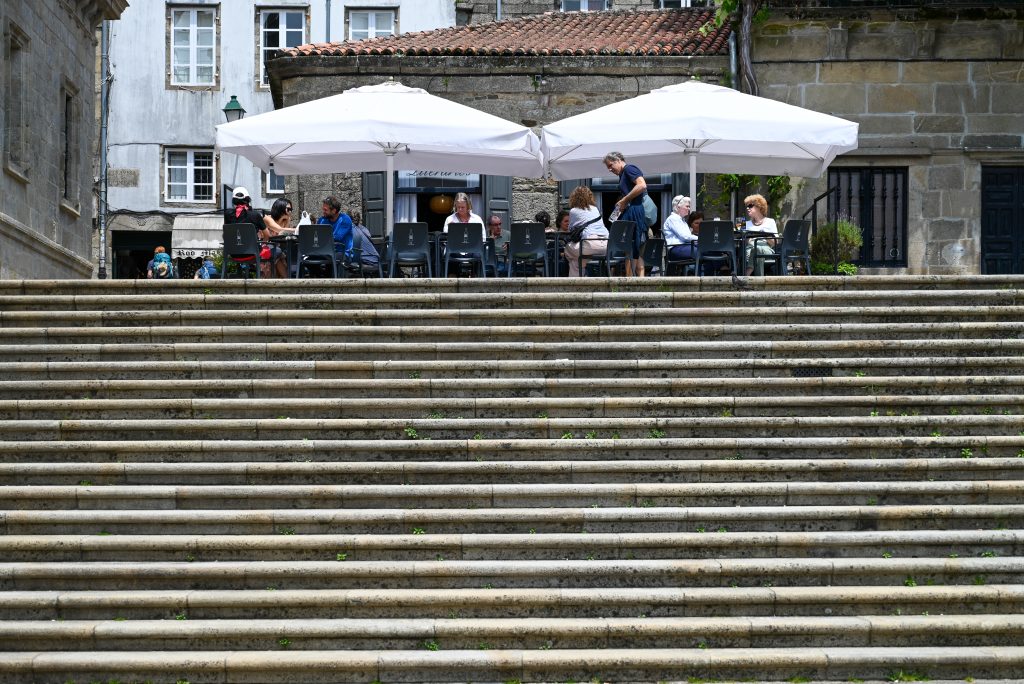
I was about to wax lyrical about those with mobility issues being able to use the tren touristico to give a real sense of the old city, then I checked the website and found that, for reasons never explained, it closed in October 2024. This does mean that it is now a bit more difficult for those with mobility constraints to get a wider sense of the old city as it is definitively a place for walking around. It does not help that, even if you come from the above parking, the ground slopes up from Praza de Obradoiro as you head east through the narrow streets towards the Mercado de Abastos. Also, if you chose to walk around the cathedral, to take in the several smaller prazas and their fascinating architecture set on the north, east and south façades you would be faced with several changes of level en route, including two separate flights of 15 to 20 steps.
Mobility Access
Please refer to the points I have made in the above sections. You can still enjoy Santiago de Compostela’s glories but I suggest you need to pace yourself and make use of the plentiful rest stops. These include the many cafés that have both indoor and outdoor tables located in the arcaded, largely pedestrian streets, like Rúa Nova and Rúa do Vilar, that run south to north through the old city. I also suggest you give yourself more time than the paltry day we gave the city.
THE CITY OF FERROL
Places Visited and Activities
Museo Naval and Museo de la Construcción Naval

The Arsenal (Darsena) or naval dockyard at Ferrol dates back to the 16th century and is a real marvel to me. Seen from the terrace on a hill above (in the Praza Edouardo Pondal) the symmetry of the white walls, red and dark grey roofs and pediments of the buildings set striking visual patterns in the differing lights. Now housed within this complex, this pair of museums (Naval Museum and Museum of Naval Construction), found on opposite sides of the entrance gate across the road from Cantóns de Molíns city park, turned out to shed fascinating light on the history of Ferrol. In the former case (https://museos.xunta.gal/en/museos/ferrol-naval-museum) its role as a naval port from the Spanish colonial rampages in the sixteenth and seventeenth centuries to its current place as a modern naval base. In the latter case (https://museos.xunta.gal/en/museos/shipbuilding-museum-exponav) a more technical examination of the shipbuilding that started in that colonial period and continues in the modern era. Here I found a particular fascination in the sculptural quality of many of the exhibits on display. At the time of writing entry to the former is free and that to the latter only 2 euros.
Mobility Access
Both are accessed from the street over paved stone surfaces across one of the courtyards of the Arsenal, replete with its collection of historical anchors. Within, surfaces are flat and firm and there are lifts to the upper floors. The availability of stools and wheelchairs was not checked here. No café but, across the small city park, there is a selection of places on and around the plaza, Praza de Constitución. We did not venture onto public transport in Ferrol and reached the museum using our car. There is a large underground car park (with lifts to ground level) beneath Praza de Constitución with the exit only 100 metres from the entrance gate to the Arsenal.
Barrio da Madalena

The older part of the city is very different from that found in nearly every city we had visited hitherto. This barrio is a grid pattern of streets about 1.2 kilometres (1,300 yards) from east to west and just over 200 metres from north to south. It houses a fascinating mix of architecture, characterised by three to four storey houses with glazed and open balconies built for the merchant classes of the city. As well as these there are several religious and administrative buildings on streets that are now partly prioritised for pedestrians. These share the barrio with commercial and retail enterprises and with eating places, some of whose tables spread across those streets and are ideal for that all-important watching of the local world going by. Two large plazas bookend the central area. One, Praza de Amboaxe, is a quiet place with a circle of trees, plentiful benches and a couple of cafés with outdoor tables. It feels very local. In the other, Praza des Armas, the grand town hall looks down on an open, stone-paved plaza bordered by a concrete bench and is the administrative and retail heart of the city. Its overall sensibility is, for me, not dissimilar from the main city squares of South American cities like Lima, Iberian but with that colonial twist.
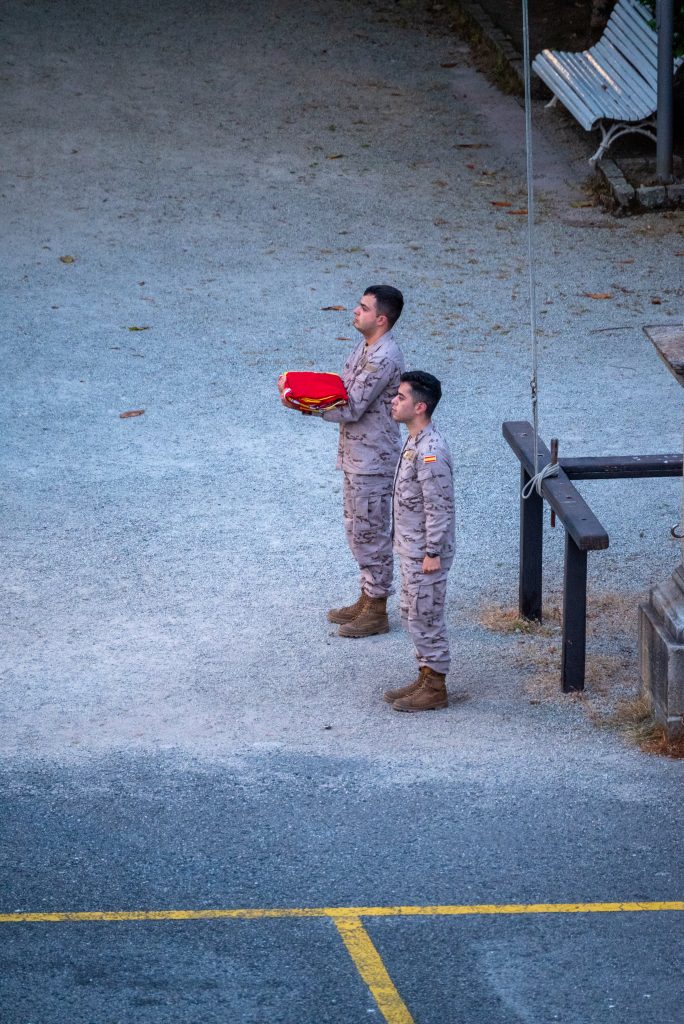
There is plenty to see around this area, but I also make mention of Praza Edouardo Pondal at the western end of the barrio. I have already touched on the view from the terrace out across Ferrol’s marvellous natural harbour. Here also sit the tower-less military church of Parroquia Castrense de San Francisco, the modern Museo Semana Santa and the splendid former mansion that now houses the Parador, with its elegant, glazed balconies. Across the plaza is the similarly-styled military administration building where white-uniformed sailors come and go and, at sunset, there is the brief spectacle of the Spanish flag being lowered in a simple ceremony.
Mobility Access
Whilst the barrio is an area of roads and pavements (sidewalks), cafés and benches, there is quite a rise in the ground both from the east end near Praza des Armas to Praza Edouardo Pondal at the west end and from the harbourside up to the same praza at that west end. The slopes are not impractical to manage but an awareness of them is needed when moving around the barrio. Buses do not really pass through the area but taxis can take you to many parts. Because of the location of the Parador at the west end of the barrio, we moved around by foot, taking plentiful stops to regenerate limbs, or used the car, stopping in the car park beneath Praza de Constitución. As well as giving access to the two museums this car park is only around 200 metres from Praza des Armas.
A Coastline of Bays, Castles and Lighthouses

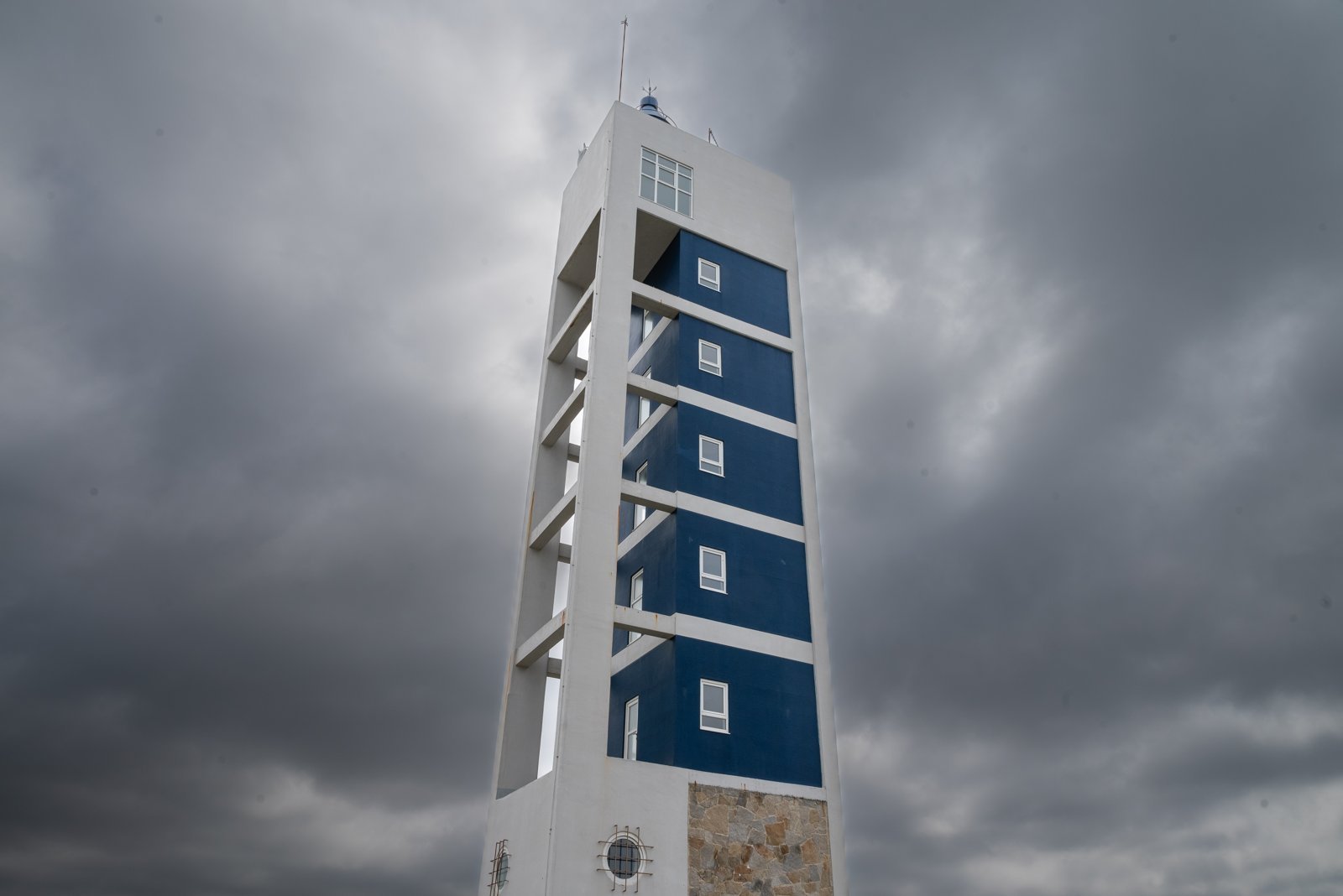
A drive north out of the city, that hugs the narrow coastal roads, takes in coastal scenery and architecture. First stop is the eighteenth-century Castelo de San Felipe, one of the two forts that sit, like Scylla and Charybdis, guarding the narrow neck of the harbour of Ferrol. We had failed to take account of the lengthy Spanish lunch break and the gates of the castle were firmly closed when we arrived so take careful note of the opening hours on the Ferrol tourist information website (https://visitferrol.com/castillo-de-san-felipe/?lang=en). Nonetheless the striking location and the sloping stone jetty at the shoreline was a pleasing introduction to this coastline. Here the coast is more indented, wooded and steeper-sided than further south, with small villages in tight sandy bays alternating with imposing rocky headlands. Two of those headlands, jutting out at the junction of the Bay of Biscay with the Atlantic Ocean, sport two differing lighthouse structures. Faro do Cabo Prior is a low single-storey structure atop which its lantern rises like small pimple, whereas Faro de Punta Frouxeira is an improbable avant-garde design which looks like a block of flats has escaped its urban location then gone on a crash diet – https://www.apfsc.com/en/port-of-ferrol/navigation-aids/punta-frouxeira/. The more interesting element of a visit to Faro do Cabo Prior is the criss-cross of tunnels built into the rock beneath the lighthouse. These concrete relics of batteries constructed in the 1920s (as part of the naval defences of Ferrol) are intriguing, if faintly spooky, places to explore. The bastions at the end of each tunnel give onto dramatic views down onto the rocks at the end of Europe. The almost empty sandy beaches that fold into the coast between the headlands provide a pleasing contrast. With Faro de Punta Frouxeira only 20 kilometres (12 miles) north of Ferrol, the whole drive makes for a gentle half-day excursion.
Mobility Access
This is a car-centred excursion and the only point to add is that the tunnels at Cabo Prior have to be accessed either by some stone steps or across uneven ground on the headland. Inside the tunnels are flat stone but it can be quite dim and damp, so care is needed. The tunnels, laid out in a cross pattern, are only about 75 metres long. Car parking is straightforward at all stopping points along the way and there are car parks at both lighthouses.
Parador
https://paradores.es/en/parador-de-ferrol

The Parador at Ferrol is housed in an attractive building and its location high above the harbour is splendid. It was quiet and thus ideal for us. Our large corner room gave us views out across the Arsenal and the harbour and over the comings and goings of the military and locals alike in the adjacent plaza. The staff were diligent and helpful and there were no concerns with the restaurant staffing here. We ate in the restaurant all three nights during our stay. For two nights we were the only diners as we sat at our table by the window looking down over the harbour as the dusk gradually darkened the sky. The food was pretty good too. We enjoyed this as the final stop on our tour – peace enveloped us here.
Mobility Access
Eight steps up from the drop off point in the plaza but there is also a slope up to a separate entry door. Inside stone, tiled floors offer no material hazards and there are no awkward changes of level. A lift serves the upper floors. Car parking is outside in the plaza and that can get crowded but, with a little help from reception staff, we never found ourselves without a space.
HEADING HOME
Ferrol to Madrid
One on the train, one taking the car, for this journey is a 650 kilometre (400 mile) drive and the train is much easier on the body. Ferrol station takes the city’s air of scruffiness to heart. It (and its small café) are is not the nicest of places to wait for a train, but at least there is a direct train (but only two a day) to Madrid Chamartín. For car and train it is a one-day redrawing of our seven week journey turning from green to brown, the lush, wooded swooping hills and valleys of the north west giving way to the drier, flatter land of the Meseta. Then the relative tumult of Madrid and a car drop off back at Atocha (see Getting There in Part 3).
A Night in Madrid (Atocha)

And for that the priority was accessibility to Atocha station to allow easy access to our AVE high-speed train to Barcelona the next day, to enable us to catch our onward flight to London that same day. With a number of similar types of hotel near the station we plumped for the Only You Atocha (https://www.onlyyouhotels.com/en/hotels/only-you-hotel-atocha/), part of a chain that pitches itself as a bit more modish, even cool, compared to equivalents like the NH chain (the one that we had used in Zaragoza). And it worked pretty well, with a vibey décor and efficient, cheery staff, albeit the seemingly inevitable overloud music in the public spaces. The room was quite small, especially after the wide open spaces we had been used to in the Paradors, but had all that was necessary. It was thoughtfully laid out for the one night stayers that must make up the bulk of its guests (a sensible space for leaving an open suitcase for example). We ate in, on the basis it was easiest, at their weirdly-named Sép7ima restaurant on the top floor (a location lost on us given the darkness without). We had a perfectly passable Italian meal albeit hardly an appropriate farewell to Spain and its cuisine. Breakfast was good; a very extensive buffet with plenty of sensible options.
Mobility Access
With drop off (to deliver luggage) directly outside and no-step access from the pavement (sidewalk) and, within, flat, solid flooring and lifts there were no issues here. Access to Atocha station is very straightforward. Across Calle de Alfonso XII there is a lift in front of the Anthropological Museum that drops directly down to the station concourse level. Once there, it is still quite a long walk to the AVE high speed platforms so leave plenty of time to allow for that and the security queues at the AVE access gates.
The End
There is nothing more sensible to add about trains to Barcelona Sants, travelling to the airport, moving about there and the BA flights from Barcelona that I have not already covered in Part 1.
