Prelude
A chance to return to a long-lost acquaintance (Rome), revisit a loved old friend (Venice) and make a new one (Turin), this was a trip stitched together from three different drivers. First a half-term wish by a pre-teen relative to see Rome. Then a realisation that the end-of-year tennis finals were only a week or so after that in Turin, thus giving us the perfect excuse to fill in the gap with a first return to Venice since the height of the COVID-19 pandemic. Thus developed our autumn venture into Italy which, whatever the seeming chaos of its politics, always draws us back to see new and old places.
With the possible exception of Turin, these are such well-written about places that you will find few practical details of public transport or any comprehensive coverage of sites and history in this blog. There is so much writing and information that is more easily found so I take it is as read that, for most people, the Colosseum or the Rialto (and many other sights) are familiar from seen imagery even if they have not been seen in the flesh. As to Turin, there we had focused on the tennis, with apologies to those to whom this is of no interest, so we had only enough time for an impressionistic view of a city that so clearly warrants more of our time.
It really is worth thinking about a city break at this time of year in Italy. For those more interested in culture, history and people-watching than in ensuring that they have the warmer weather I suggest it is an ideal time to go. After the autumn half-term the crowds are less overpowering than we know they can be (in Venice at least) and, of course, prices are lower for accommodation. Services and sights are less booked up and the queues correspondingly less frightful.
Structure of the Trip
The Rome stay was five nights in a hotel with a rooftop view over the Roman fora, then that in Venice was seven nights in an apartment on the quayside of the broad Giudecca Canal and, finally, our stay in Turin was five nights in a hotel slightly out of the city’s central area that gave us the conveniences we needed when the key factor was to be within a short taxi ride of the tennis venue at Pala Alpitour.
This sort of trip is one we feel comfortable self-organising, booking the flights with BA, hotels direct through their own websites, the apartment through our long-favoured provider based in Venice and the trains (our chosen mode of travel between the cities) using the TrenItalia (Italian Railways) website. See the general section on Planning and Researching for a bit about how we research and choose our hotels.
Flights
BA provided the needful from Heathrow to Rome and for the return flight from Turin to Gatwick. I used to say you knew what you were getting with BA but, after our Dubrovnik experience (A Week in Dubrovnik), I was a bit more wary. And, indeed, we are told shortly before our flight that our BA flight would actually be with a Finnair plane and crew. I am sure that the reason Finnair (with a crew clearly from that northern European land) are operating a flight between the United Kingdom and Italy would be grasped by those in the know about how the airlines operate but, to me, its striking feature was its incongruity. That said the crew and service were crisply efficient and the space (for my long limbs) no different from that on standard BA flights, which is to say pretty good in business class for a short haul flight. Our return flight to Gatwick was on a standard BA operated flight.
Mobility Assistance:
Since our last visit to Terminal 5, BA and Heathrow Airports have considerably improved their mobility assistance service. On this visit it worked extremely well for us. A new, larger area has been created behind the check-in gates and more staff seem to be available to help. The person greeted us and offered us the option of taking a wheelchair ourselves (in the past we have had to ask if this option is available). If it is on offer, we always take this option as it gives us flexibility airside to visit shops, eating places and the lounges before trundling off to the gate and on down to the door of the plane where the wheelchair can be left.
At Rome we are met by the wheelchair service on the jetway but an administrative mix up meant the assistance person found he had two people to cater for. I saw a nearby unused wheelchair but I was not permitted to self-drive. Fortunately the other person’s mobility concern was that she has an injured arm so she could walk. Once we collected the luggage at the carousels, I was able to manage the luggage trolley with both our cases and hers to speed things up for the mobility assistance person. In Rome you are dropped in the baggage hall right next to the landside exit doors, just beyond which are obvious, almost strident, signs to the nearby taxi queueing area. We had to wait but a moment or two for a taxi before we were on our way into the city. There is a very clear flat fare for trips to the city centre (about a half-an-hour’s journey), so no worries about being taken to the cleaners by rogue drivers.
On the return leg from Turin the mobility assistance seemed to work well and efficiently at both ends. It may have helped that it was a less popular time of year and a midweek. Both airports seemed quiet, Gatwick certainly more so than recent experience. Turin is not such a large airport and we had an immediately available person to push the wheelchair to the lounge and were collected and taken all the way to the plane door from there. The Gatwick service was brisk and efficient with the assistance person marshalling three people needing the service out of the plane, onto the buggy and on into the baggage hall where our luggage was already on the carousel waiting to be collected.
Trains
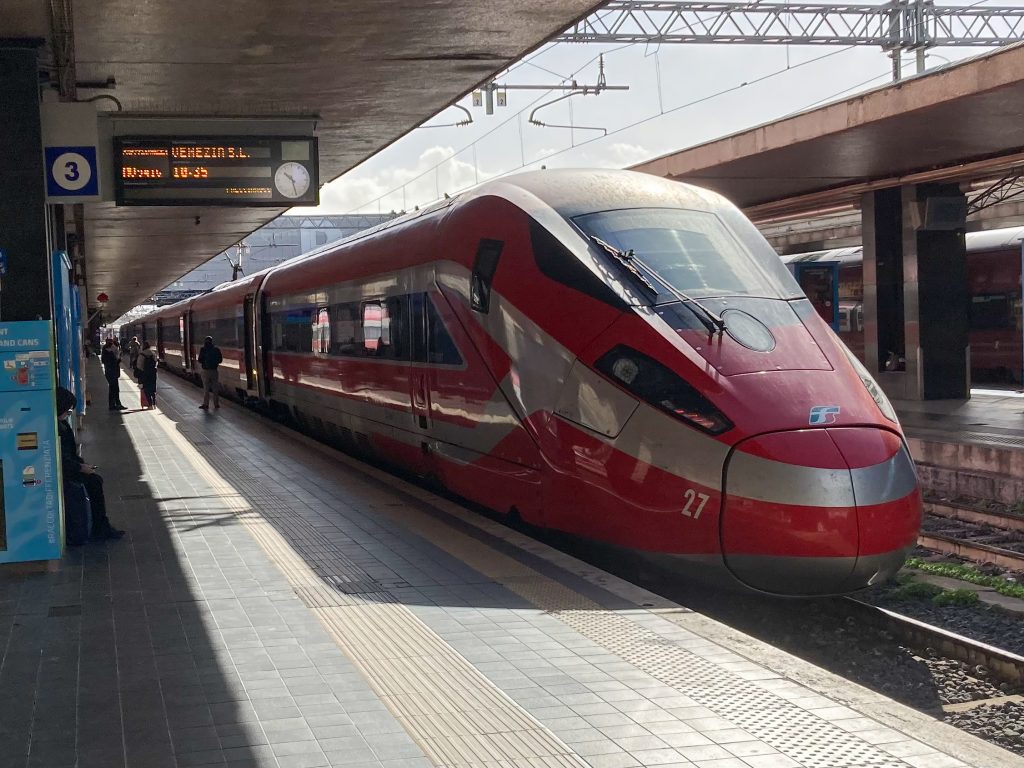
We used high speed trains to get from Rome to Venice, a direct service which takes about 4 hours, and from Venice to Turin, which takes about 4 hours 20 minutes with a change in Milan. Booking was done direct with the national rail company, Trenitalia (https://www.trenitalia.com/en.html) on the English section of their website. We used the high speed trains called Frecciarossa (Red Arrow). The service is comfortable, fast and trains between the major cities are frequent. The varied scenery of Italy, from the rolling farmed hills of Lazio and Tuscany through to the seemingly horizonless plain of the Po valley and its industrial towns, provides a fascinating backdrop to your journey. There is an alternative high speed service run by Italo. We have not used it, but information on it and all other aspects of train travel in Italy are comprehensively covered by the Man in Seat 61 website (https://www.seat61.com/train-travel-in-italy.htm) as are the layout and facilities at the main railway stations. Another great advantage, in our book, to moving between the Italian cities by train is that the stations are in the heart of the cities they serve. And they have the full panoply of public transport facilities and taxis available for onward movement to your chosen accommodation, without the attendant time taken waiting at, and travelling to, the airport that goes with air travel.
Our train had just left Venice Mestre en route to Milan when the overhead electronic display interrupted its usual mix of information and adverts with this intriguing message:
Dear passengers, we inform you that the train has stopped due to ongoing police investigations nearby Grisignano di Zocco. At present, rail traffic is suspended. We will keep you informed.
Threatened lengthy delays turned out to be no more than an hour although we never unravelled the mystery of the reason for the police investigations. We missed our connection in Milan but the helpful staff there indicated that our non-transferable ticket would be valid on the next service.
Weather
Sad to say that the adverse alterations to global climates, that seem to have created wider variations in our seasonal weather, worked to our personal advantage on this trip.
In Rome, in late October, we had, for the first three days, daytime temperatures that went up to 26°C (79°F) during the day with nights dropping only to 18°C (64°F). With sun coming out of a clear sky, it was gloriously warm for sightseeing, al fresco eating and wandering about. The cloud and drizzling rain that shared our last couple of days with intermittent sun simply cooled temperatures down to around 20°C (68°F) and caused the legion of wandering street sellers to switch their wares from selfie-sticks and phone chargers to umbrellas and waterproof ponchos.
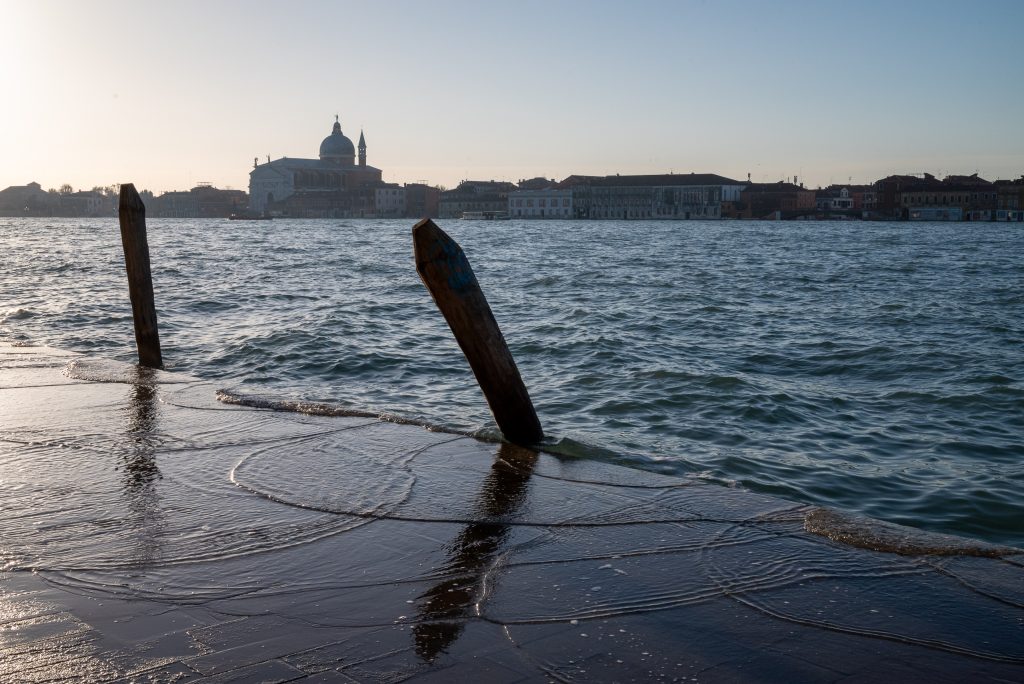
On our last night Storm Ciaran swept through Europe bringing downpours, thunderstorms and damage to many areas but by the time we reached Venice the effects had passed over leaving a choppy lagoon, clear skies and temperatures of up to 16°C (61°F) during the daytime dropping to around 10°C (50°F) overnight. The clear skies and sun stayed with us for several days just giving way to some light rain on our last evening. It was beautiful, the crisp air making the light clearer than I can ever recall in Venice. As long as it was in that sun, sitting outside at the city’s many cafés watching, writing or reading was a joy.
The sun followed us to Turin where the northerly (and higher) location, with the snow-capped Alps visible on the horizon, gave us daytime temperatures of around 9°C (48°F). Evenings were chill (down to around 5°C (41°F)) and gentle rain came to dampen our final day in the city.
Time Zone
The western European one hour ahead of London. Now that the United Kingdom is no longer part of the EU, the possibility of the time changes occurring in Europe at a different time to the United Kingdom has arisen. As October is the set time for such a change, it is conceivable that this one hour difference may be either non-existent or two hours ahead for a short period around this time of year. Bear that in mind when looking at flight timings and other diarised dates.
An Apology
Throughout this piece I refer to the three cities by their Anglicised names. Normally I try to use the names of places as they appear in their own country and language in my writing. Properly I should be referring here to Roma, Venezia and Torino. My excuse is that people reading in English are more likely to be searching for the Anglicised versions of the names and the information here is for English speakers used to using the words Rome, Venice and Turin.
ROME
So I was last here for a meaningful visit over thirty years ago and had retained little other than snapshot memories of cheap, fulfilling pasta and red wine, pockets picked by a group of children, waiting in a barber shop for a shave, gawping within a cavernous, sepulchral St Peter’s and wandering the stones of the forum area. So, with a ten-year old plus parents in tow, it was an opportunity to create new memories of the well-known sights as well as taking in impressions of the city on my more usual wanderings clutching my camera.
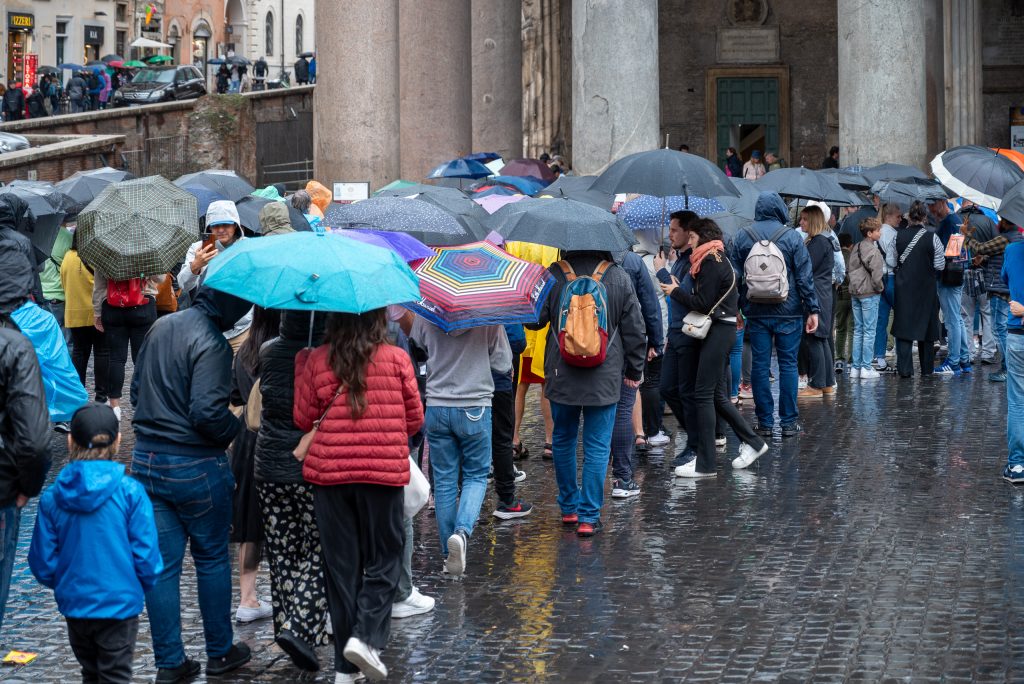
The most obvious change is the crowds. I assume Rome, like Paris or London, is a city that has no real high or low season but crowds of visitors all year. It certainly felt like that when walking the streets of Imperial, Renaissance and Baroque Rome and seeing the queues building up for the “big’ sights and the sightseeing buses packed. We were forewarned enough to have booked for the key elements of our stay before we left.
Areas Visited
Colosseum and Imperial Fora
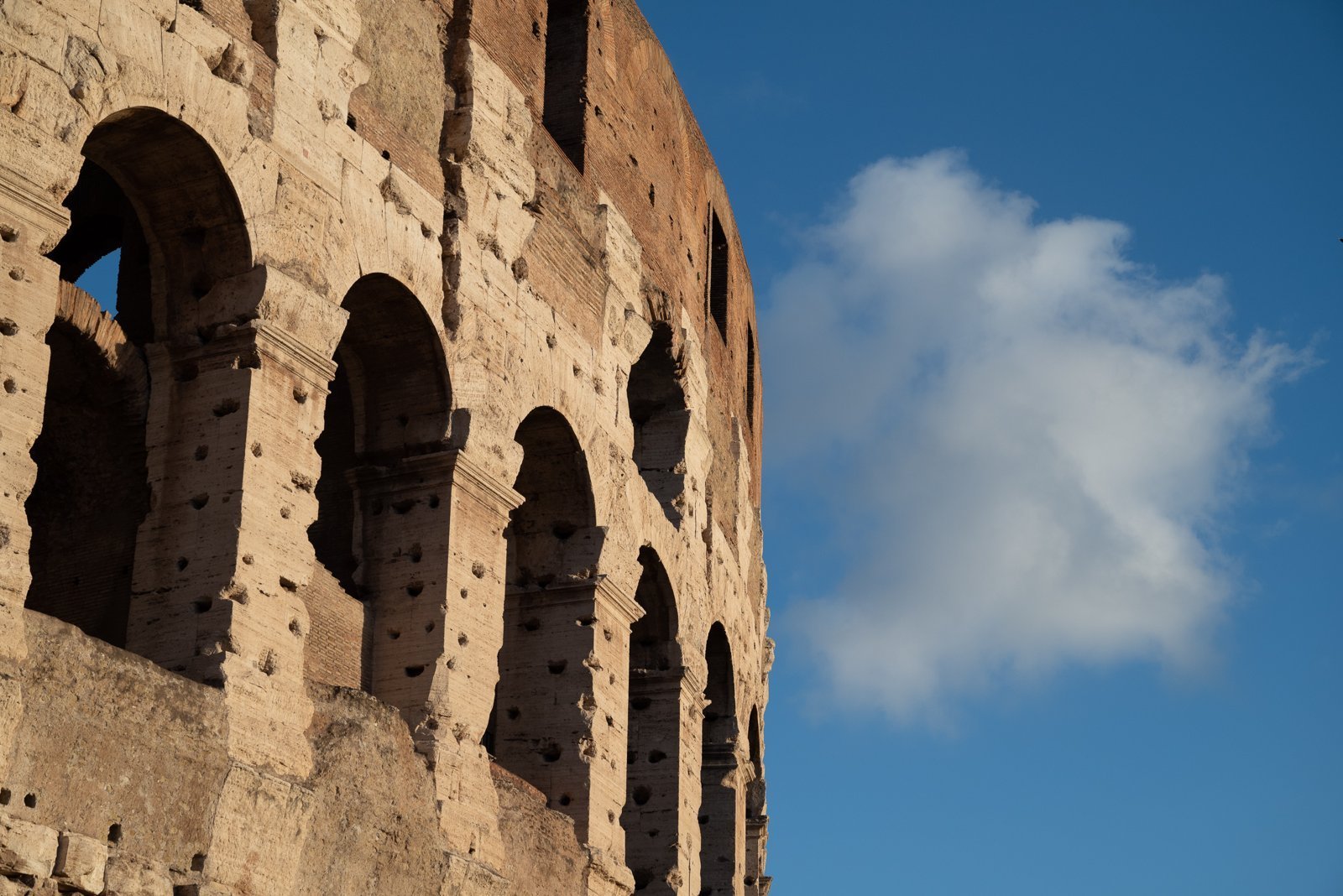
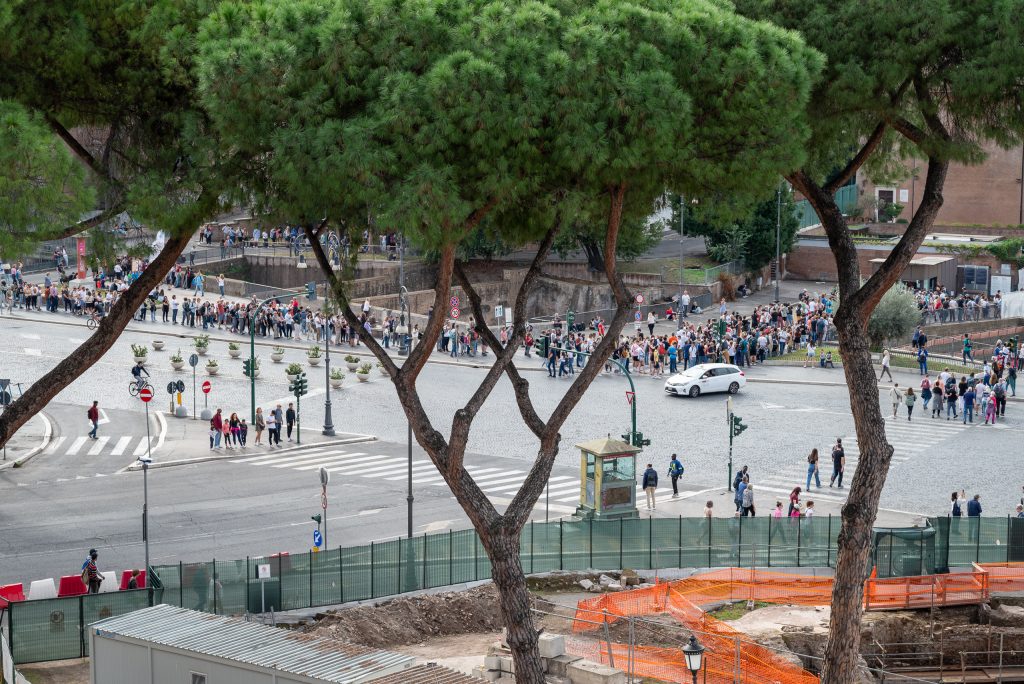
This was no.1 on the ten-year old’s wish list. A friend had warned us to book a tour well in advance. You must if you don’t want to spend hours (and I mean hours) queueing to buy tickets. The queue just to buy entry tickets to the Colosseum stretched three hundred metres from the ticket booth in the square in front of the amphitheatre up the slope towards the Capitoline Hill. It was moving slowly and you still have to negotiate two more queues at the entrance gates, albeit much shorter ones, for security and to check your tickets. Buying a ticket for a tour circumvents the ticket-buying queue but not the need to queue for security and ticket checks. There is a wealth of companies offering tours. When it comes to choosing the type of tour the offer is, in essence, similar. Most last around four hours with variants (and costs) depending upon whether you decide to opt for access to additional areas like the underground areas or the arena floor or for a night-time visit. You are generally in groups of around 30+ with a guide who shepherds you around the sights with their commentary coming over the provided headsets. After a bit of internet research we plumped for Show Me Italy’s tour that included the “Gladiator Entrance”, the ten-year old having been recently to a gladiator ‘fight’ reconstruction back at home – https://showmeitaly.com/colosseum-tours/?view_type=list&destination=colosseum.
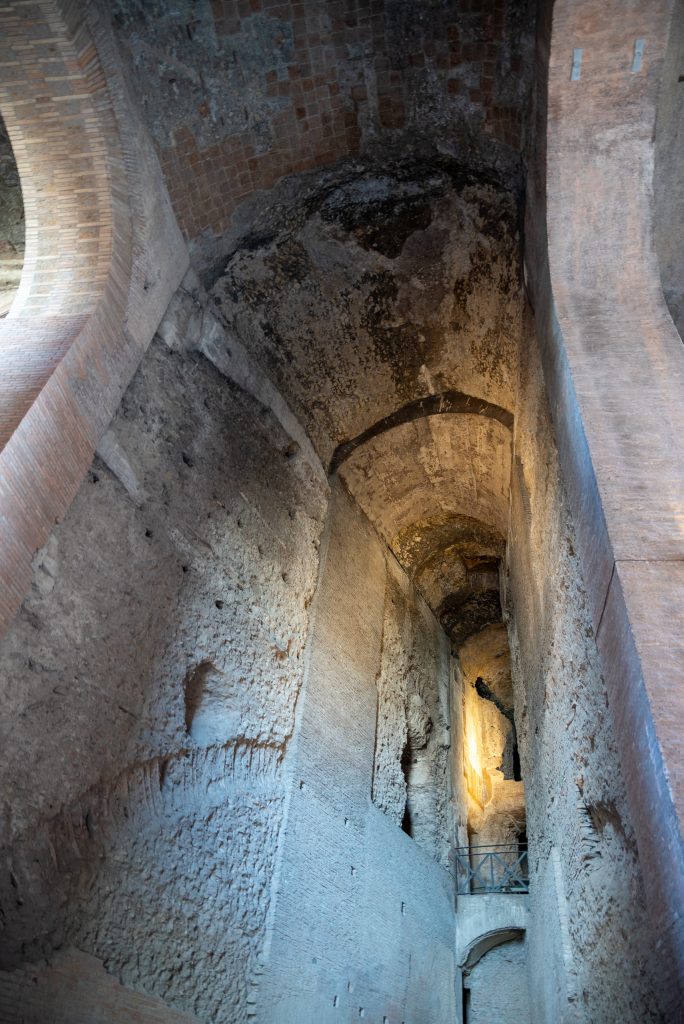
Even at four hours it seemed to work for the ten-year old as well as for the adults. The guide, a Roman local, was enthusiastic and engaging and singled out the youngster on the tour and ensured he was involved at suitable points, including awarding him a laurel wreath whilst she was explaining its purpose in Imperial times. You do move around the sights at quite a lick (not too quickly however) so, once or twice I found that I was dropping out of headset range if I was too long faffing around taking photographs. Moving from the fora and Palatine Hill then on to the Colosseum means the best comes last and, despite some obvious sections of reconstruction (and the swarming crowds), there is a true magnificence to the structure. Personally I would have preferred a little more time to myself to look and to wander but I might then have missed some key elements. In particular the Imperial Ramp of Domitian, with its sloped floors rising in zig-zags to the Palatine Hill under a 35 metre (115 foot) arched roof which makes for an awe-inspiring walk – http://www.thehistoryblog.com/archives/38928.
Mobility Access (Imperial Fora and Palatine Hill):
Even if you bought your own ticket and took your own time, I suspect the Imperial fora and the Palatine Hill complex would be impractical for those with mobility difficulties. It is spread out over quite a large area, the ground is uneven (large irregular stone paving, gravelled paths, steps and slopes between levels and a long haul up the Imperial Ramp of Domitian to reach the Palatine Hill) and then there is the standing in the queues to get a ticket and to get in.
Mobility Access (Colosseum):
The Colosseum itself is a more practical proposition. Yes, you will need to be able to walk around the amphitheatre both in the external arcades and the internal spectator balconies (both reasonably flat) and you still need to be able to cope with the queues, but inside the amphitheatre there are lifts to take you up to the upper levels. There are not many places to rest, unless you access the arena floor section where there is stepped wooden seating. Tours of the sort I have described are not going to work, even if just for the Colosseum, as they tend to move at a pace which forestalls choosing your resting points.
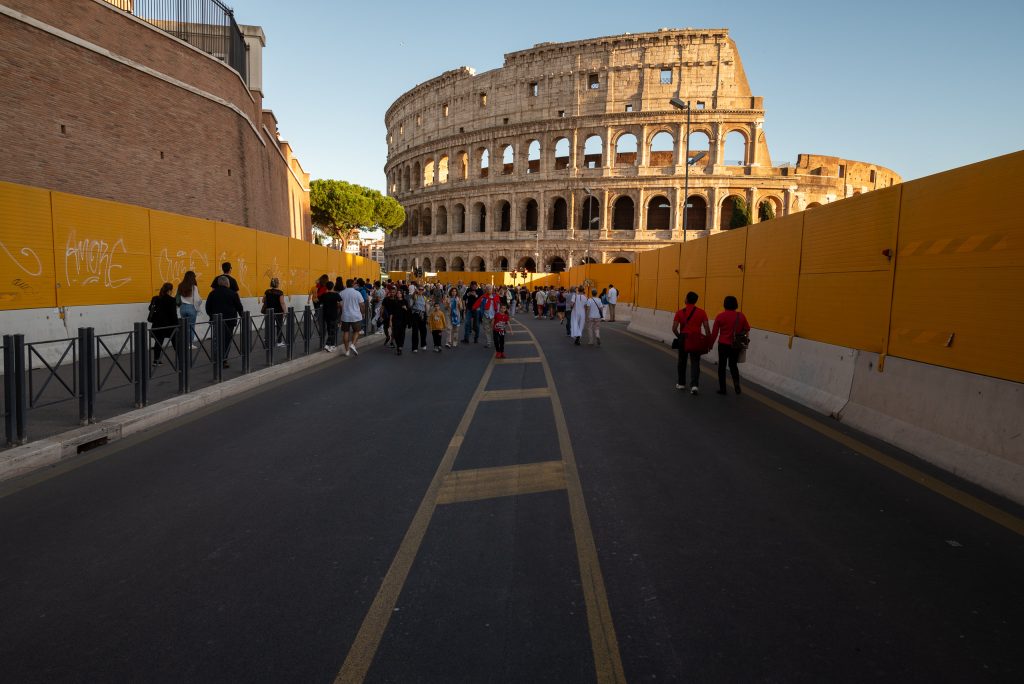
Public and car transport access to the Colosseum is currently constrained somewhat by extensive works to the metro system which means there are hoardings all along the north side of the area and in the street leading up to it from the Imperial Fora area. Colosseo metro stop on line B has its entrance on the street above (and to the north of) the arena. From there it is approximately 250 metres to the entrance piazza including a walk down (or up) about 50 steps. The C line metro will also serve the Colosseum but only from some time in 2025. Public buses stop at points around the ellipse. If you are using the Hop-on, Hop-off sightseeing buses, be aware that the stop for the Colosseum is a fair way down the Via di San Gregorio, about 500 metres south of the Colosseum entrance area. For taxis any drop off point would be about 200 metres from the entrance across the flat piazza area to the west of the arena. Thus a final consideration is that that piazza, where the ticket office and entrance are, is laid with a quite uneven brick-cobble surface that can cause difficulties for those with weak or unstable joints or other walking issues.
The Core Sights Area
I just could not find another shorthand way to describe that part of the city that sits tucked into the curve of the River Tiber with the Borghese Gardens to the north-east, Piazza Venezia and the Capitoline Hill to the south and, across the river, Vatican City to the west. Here lie many of Rome’s other most well known sights: the Trevi Fountain, the Spanish Steps, the Parthenon, Piazza Navona. It encompasses many other lesser sights and a swathe of eating and shopping places. It is also a maze of narrow streets, often cobbled in grey brick, some pedestrianised and during the day seemingly awash with crowds of tourists. It is, of course, huge fun to wander around, getting ‘lost’ up less populated back streets and wandering into the many piazzas adorned with post-Renaissance statuary and fascinating architecture.
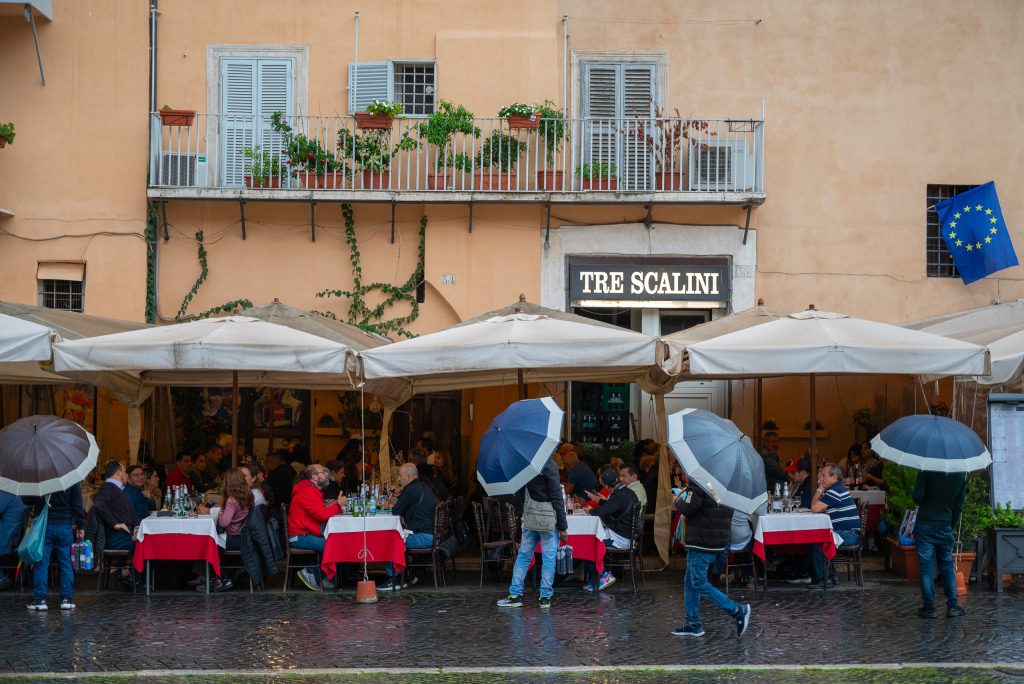
The crowds are unavoidable and that means getting near to the Big Ones (Trevi, Spanish Steps) requires more patience than I could muster, besides there was so much more to see. Don’t think that you can just stop off to visit the Pantheon either. I was there on a grey, dank midweek day in November with a steady drizzle coming down and there were still two queues, each about 50 metres long, of people waiting patiently under their umbrellas to get inside. I passed on to Piazza Navona, a striking space, even in the rain. And, despite that rain and the autumnal chill, the umbrella-protected outside spaces of the restaurants (and their interiors) were busy, with tables snapped up as soon as they came free. I pressed on into the back streets and eventually found a quiet café for a lunch.
There is so much here and I took in what I could in two walks through the area. A return visit is now a must at some point…but there are so many other places to go.
Mobility Access:
It is difficult to move between the sights in this area without walking and it looks as if some queueing would be necessary. Bus routes do run north-south across the area with stops on Corso del Rinascimento close to Piazza Navona (just over 50 metres walk) and on Via del Corso, which is about 350 metres walk from the Pantheon and also about 250 metres from the Trevi Fountain.
A ’just be aware’ is that the Hop-on, Hop-off sightseeing buses only circle around the fringes of this area with stops that mean a bit of a walk is needed to reach the core sights. For example the Trevi Fountain is 650 metres from the nearest stop. Streets in this area are mostly a mix of smooth(ish) tarmac and tightly-laid cobbles so, although the area is largely flat, walking could be a little more difficult for those with joint stability issues. Of course there are plenty of restaurants and cafés to provide resting places, although, as I found, they can get very busy indeed at times.
The Borghese Gardens
Just to the north of the Spanish Steps, in reality this is a large park that sprawls across rolling ground above the heart of the city and a splendid one it is too. Landscaped with a wealth of trees, paths, grassed areas, gardens both formal and informal, lakes, statues and fountains it is also home to several art collections, a children’s park, a zoo, cinemas, puppet shows, cafés, drinks and gelati stalls and even a replica of Shakespeare’s Globe Theatre. There is a wonderful view down across the city (taking in the dome of St Peter’s) from the belvedere at the western edge of the park.
The attraction for our ten-year old lay in the bike rental stands as he had been promised a ride on a canopied four person buggy. These buggies are electrically assisted. A good thing too, as the land in the park rises and falls enough to make the pedalling hard work, even with that assistance. Having come across them elsewhere I am not a fan of these vehicles as they are of a one-size fits all design and my limbs are too long for me to pedal as effectively as I would wish. However it has to be said they are a way for those with limited mobility to move around and see areas they might not otherwise get to. With three people providing the propulsion, the fourth can opt out of pedalling and just enjoy the surroundings. It would have helped us had we realised that the electrical assistance only operated on one of the two pedal chains. Until our mechanically-minded ten-year-old worked this out for us, we had found the pedalling hard work because the unassisted chain had two pedallers and the assisted chain only one. When we switched the ratio around things got somewhat easier. There is only one steering wheel and brake, operated by one of the two people in the front seats, and you have to be 18+ years old to act as driver. Nonetheless our youngster thoroughly enjoyed the hour – which was about all the pedalling adults could manage without retribution on their knees. There are two hiring stands in the park – one near the southern entrance by the grand Pinciana Gate in the old Aurelian Walls and the other opposite the entrance to the zoo in the northern section of the park. They have two person buggies as well as regular bikes.
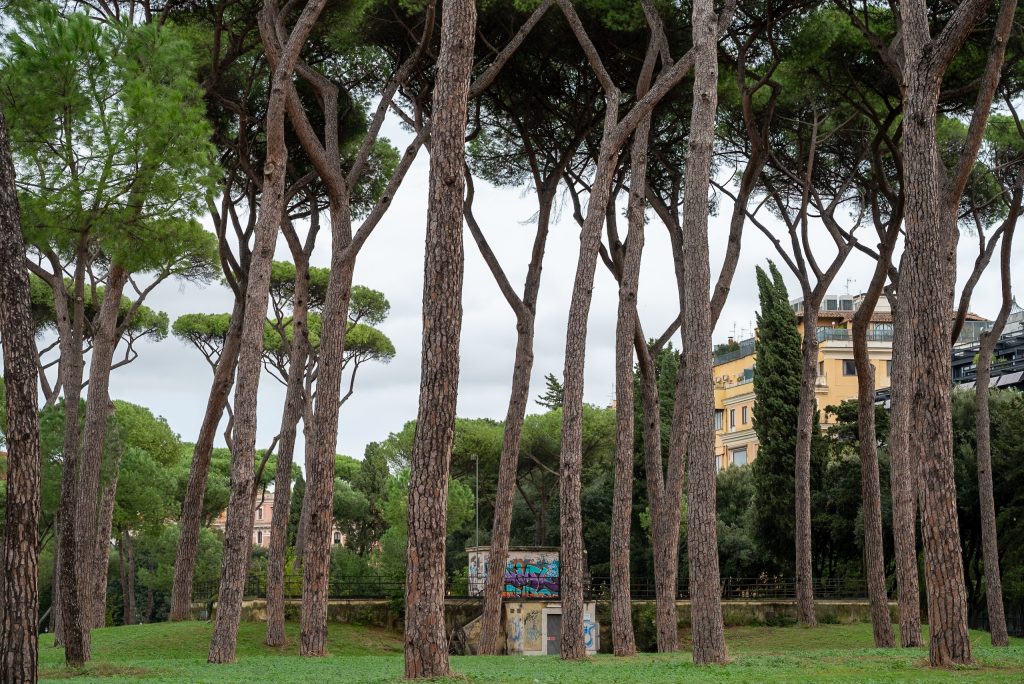
For the culturally minded the seventeenth century Villa Borghese houses the glorious Galleria Borghese, a twenty room collection of renaissance and post Renaissance painting (Caravaggio, Raphael, Titian and many more) and sculpture (Berninis galore) augmented by ancient Roman art and regularly changing other exhibitions. Book tickets (two-hour slots) in advance or you may not get in – https://galleriaborghese.beniculturali.it/en/.
Mobility Access:
The gardens are big so those with mobility concerns will find moving about the key sights in the park requires going on foot. As well as the pedal-buggy rental you can also rent golf carts (at a price). What worked for the two of us was the combined ticket for the Galleria Borghese and 30-minute golf cart tour with a driver. The carts, with space for seven people, allow an excellent overview of the park. The cart picks you up from outside the Galleria once you have finished your visit.
In the Galleria itself the art is in rooms up a grand staircase and there is limited lift access. It seems wheelchairs are available, although we did not use one. If you are arriving by public transport or taxi to visit the Galleria make sure you use the stops, or get dropped close to, the gate near the top end of the Via Pinciana. From there it is only a walk of about 100 metres to the Villa Borghese.
Bus stops are available on the roads that circle the park and on the road that cuts across the park from the Pinciana Gate.
Terme di Caracalla
Set a little to the south of the main sights of ancient Rome these baths date from the middle of the Imperial period. We would not necessarily have gone in the limited time we had were it not for a friend’s recommendation and we would have missed out on a building of jaw-dropping splendour. Even on a slightly grizzly, grey morning the scale of the remains of this public bath complex are truly monumental. In part it is because so much of the building is still intact (or restored). No roof but soaring walls and arched entrances are complemented by extensive floor mosaics on a scale that matches (to my untutored eye) the naves of grand cathedrals. It perhaps gives a sense of the size to realise that six to eight thousand people a day used the baths. An added dimension was given by the flock of green parakeets that seem to live in part of the ruined walls.
For me the visit was given further appeal because there was an exhibition of photographs by the Italian photojournalist, Letizia Battaglia. She is not a photographer that I had come across. Her black and white images were drawn from the 1970s through to more recent times. She became known for her work photographing the campaigns against the Sicilian Mafia in the last quarter of the twentieth century that put her at risk of reprisal, even assassination. This was essentially an outdoor exhibition laid out in these roofless halls and I found it arresting and impressive both in content and execution. It added to my satisfaction with these ruins.
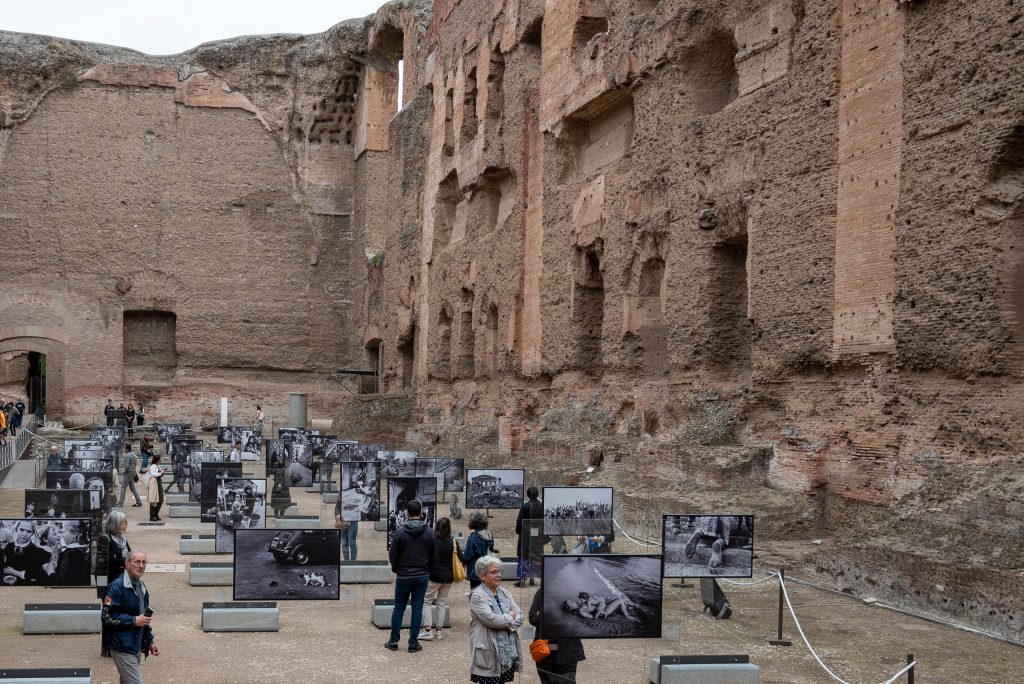
Mobility Access:
Laid out in a flat site accessible by a gentle slope up from the road, I regard this as a sight that can be enjoyed by someone with mobility movement constraints. The paths are firm, compact ground, albeit unpaved, with stretches of boardwalk allowing some areas and mosaics to be seen more easily. The ruins are set in their own small park and there are benches dotted around the ruins that allow rests to be taken. Go early is my advice. We were there when it opened and there was already a queue of about twenty people to buy tickets. When we came out about ninety minutes later that queue had lengthened to a hundred and more. You can get a taxi to drop you about fifty metres from the ticket office. There are buses that drop you in the nearby boulevard, leaving a walk of about 350 metres.
Mercato Centrale and Esquilino Market
These two food markets just 400 metres apart are almost different worlds. They certainly have different purposes. If you read the blurb on their website (https://www.mercatocentrale.com/rome/) you get the impression that Mercato Centrale is a place where artisans come to provide a range of local produce set in a high-ceilinged hall that is part of the city’s central railway station. To me it felt more like the sort of food hall you find in the centre of high-quality shopping malls, albeit with artisanal stalls rather than chains. Amongst the Italian offerings sit burger, empanada, sushi and ramen stalls. There is a central seating area for the punters to consume the wares but most people seem to buy to go. It feels quite tightly squeezed into the space and when we arrived seeking gelatos, coffee and other Italian comestibles it was very busy and seating space at a premium; a problem we solved by heading to the (closed) restaurant on the first floor and using their tables. There were lifts as well as stairs up to that floor. The wares all look wonderful (and ours were fine) but it felt a little contrived.
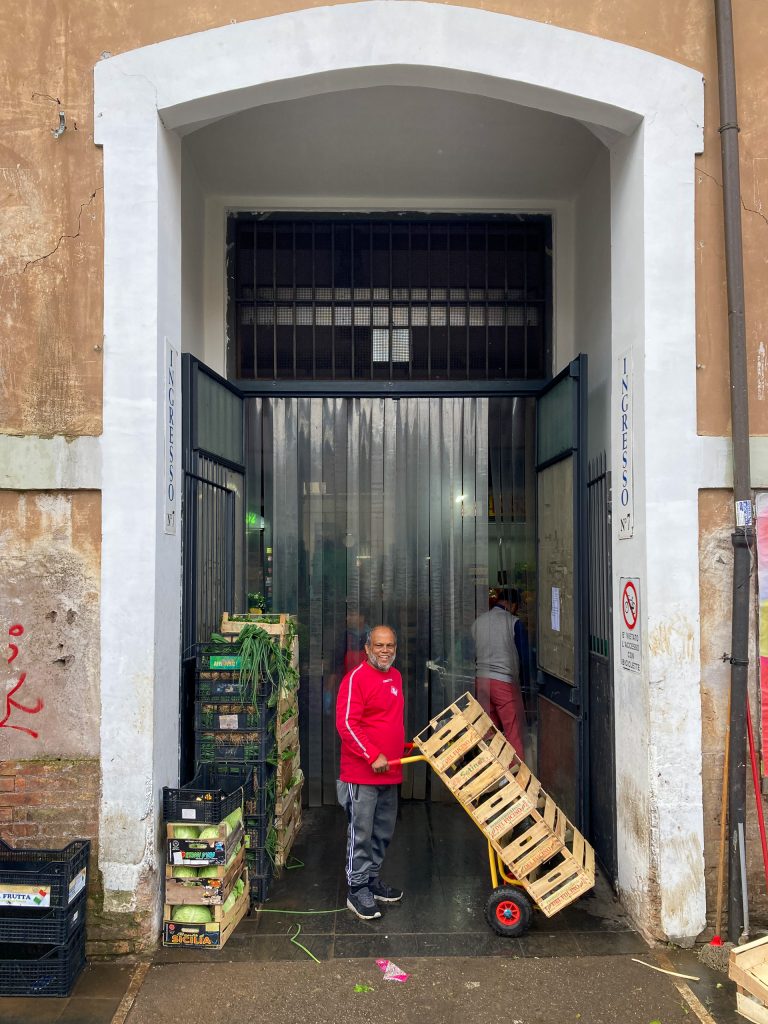
Just a walk down Via Giovanni Giolitti from Mercato Centrale’s location on the south side of the station building is the different world of the part retail, part wholesale Esquilino Market. The taxi driver who brought us all here from the hotel thought we had made a mistake about which market we wanted to go to. Why would any tourist want to come here, he seemed to suggest. But we just relish the chance to visit these sorts of working markets on our travels. Judging by his wide-eyed reaction to the wares on offer (especially the many soggy piles of squid and octopus on the fish stalls) the ten-year-old enjoyed it as much as his gelato in Mercato Centrale. Set in in a scruffy old purpose-built market hall, this rectangle of stalls houses mountains of fresh produce: grocers, butchers, cheesemongers, delicatessens and, in a central hall, swimming in water from its regular hosing down to clear the jetsam of the produce, an arcade of open fish stalls with every conceivable variety of seafood. Many of the stallholders seemed to be from ethnic minorities and their customers likewise. Even when we were there in late morning, after the busiest selling time had come and gone, it was a hubbub of activity and a real contrast to the faintly anodyne market just up the street. Thus we had two very different interpretations of the same word.
Mobility Access:
Given their locations there is no shortage of public transport options dropping at, or collecting from, the two markets. Of course, the station also has a taxi rank in the large transport hub at the front of the station. Neither market area is particularly large (the rectangle of the Esquilino Market is about 70×50 metres) but, given its function, Esquilino Market has no café or other similar sort of outlet, nor any seating for rests, so head to the Mercato Centrale for that. All the area is largely flat paved ground.
Hotel
We needed a reasonably-priced hotel, near to the ruins of Imperial remains and with a room that could sleep a threesome. Our research brought us to Hotel Forum (https://www.hotelforum.com/en/) ideally located next to the Imperial Roman fora and with a spectacular view of the same from its rooftop restaurant. It had a slightly old-fashioned feel and that four-star sensibility which means it lacks the slickness (and facilities) of a more expensive alternative. It served our needs very well, with a staff who were generally friendly and helpful. The small rooftop bar was a good meeting place for our pre-prandial drinks, sharing, as it did, the view across the ruins to the Palatine and Capitoline hills and beyond. It was about 600 metres from the Colosseum. Whilst there was a bus stop on Via dei Fori Imperiali below the hotel, we found it easier to call for taxis (usually readily available) when walking was impractical. The restaurant had a solid buffet breakfast (the ten-year-old particularly enjoying the pancake-making machine) but we did not try it for other meals, preferring to try out the Italianate offer from the wealth of nearby restaurants. On an area of roof on the second floor there is a small courtyard, surrounded by other buildings but, because it is cut off from the city’s bustle, giving a peaceful spot for a quiet read or write. Lifts were available to all floors except the rooftop bar set one set of outdoor steps above the restaurant.
Food and Drink
Al Ceppo
We ate at two restaurants that had been suggested by friends. With a ten-year-old to be catered for from the following day, on our first night we treated ourselves to the more adult orientated of the two. And an excellent suggestion it was. Set in the out-of-centre area north of the Borghese Gardens, it was a 20-minute taxi ride from our hotel. It had the feel of one of those elegant establishments you find in the well-to-do arrondissments of Paris, its clientele local, well-heeled and well dressed and generally closer in age to us than not. The food, well-prepared versions of traditional Italian cooking, was very good and complemented with appropriate glasses of wine. There were plenty of staff, all friendly and, of course, English speaking, presided over by a very severe looking owner-matriarch who patrolled the rooms correcting any perceived minor elements of improper service by her staff and serving wine herself to favoured regulars. See https://www.ristorantealceppo.com.
Pizzeria alle Carrette
For the ten-year-old, Italy meant pizza, pasta and gelato so this pizzeria, just 50 metres from the hotel, was our choice for his first night. Just a doorway off a cobbled backstreet, the interior has a comfortable simplicity with tiled floor and plaster walls, spreading around a corner to give onto a small courtyard area. Pizzas galore (including vegetarian and vegan) which, to the fascination of the younger one, were cooked in a traditional brick wood-fired pizza oven which he could go and watch. And they were good pizzas, for the adults washed down with a fair selection of Italian standbys on the wine front. These included a few half-bottles which is an example I wish more places would follow. The young one enjoyed it sufficiently to want to return when given an open choice of eating places on our last evening.
Apparently there is some regulation which prevents wood-fired ovens being used before 19.00, which is when this one opens. But the Italians eat pretty late anyway so many non-tourist area restaurants do not open before 19.30 or even 20.00. This meant that Alle Carrette was empty when we arrived and packed to the rafters (and there are rafters) long before we left. We did not book but I suspect we would not have walked straight in to a table had we arrived after 20.00. They do not have a website, only one of those faintly unhelpful Facebook pages.
Ristorante Maracuja
Having to eat early (18.00) because of a planned visit to the ballet, we headed for this tourist restaurant near to the hotel. So many guidebooks and blogs warn you off eating at these sorts of places which seem to be operating principally for never-to-return tourists. You recognise them by their multi-language menus and the member of staff who has been detailed to accost every passer by and encourage them to use their eating place and not that of their rival next door or across the road. Grudgingly our hotel receptionist had mentioned this one by name – and it was okay, actually the pasta dishes were pretty well done. Served in a metal balti-style bowl they were freshly cooked with tasty saucing (a properly prepared carbonara with fresh egg, for example). We just turned up and were seated straight away. Again it doesn’t seem to have a website.
3 Quarti
In the heart of the Prati area near Vatican City, this restaurant (one of three of the same name and group) looks less wacky on the website than in the flesh (a Vespa on the bar, for example). Another suggestion made by a friend, it has an eclectic menu that seems more Italian in the reading than the execution. As well as a wide range of Italian dishes there is a burger selection and dishes with hints of a kind of Italo-Asian fusion. Also there is the house speciality:
3Quarti, three small buns realized from the dough of the pizza, manually stretched after 12 hours rising then browned with Italian extra virgin olive’s oil, natural or filled with some of our delicacies…
to quote their own menu on the website – https://www.3quarti.it/en/prati-en/appetizers/. And it was actually a good, small starter for sharing. The other food was solidly done. I found it a bit heavy-handed but the ten-year-old enjoyed his night off from pizza and pasta with a burger. The menu is lengthy and there is something for most diners from carnivores to vegans. Service matches the general hubbub that grows but was never less than effective. We had booked and again were first through the door at opening time (of 19.30) but a flow of customers followed us and the place was soon very full looking. Don’t just turn up hoping to get in.
Activities
The Ballet at Teatro dell’ Opera
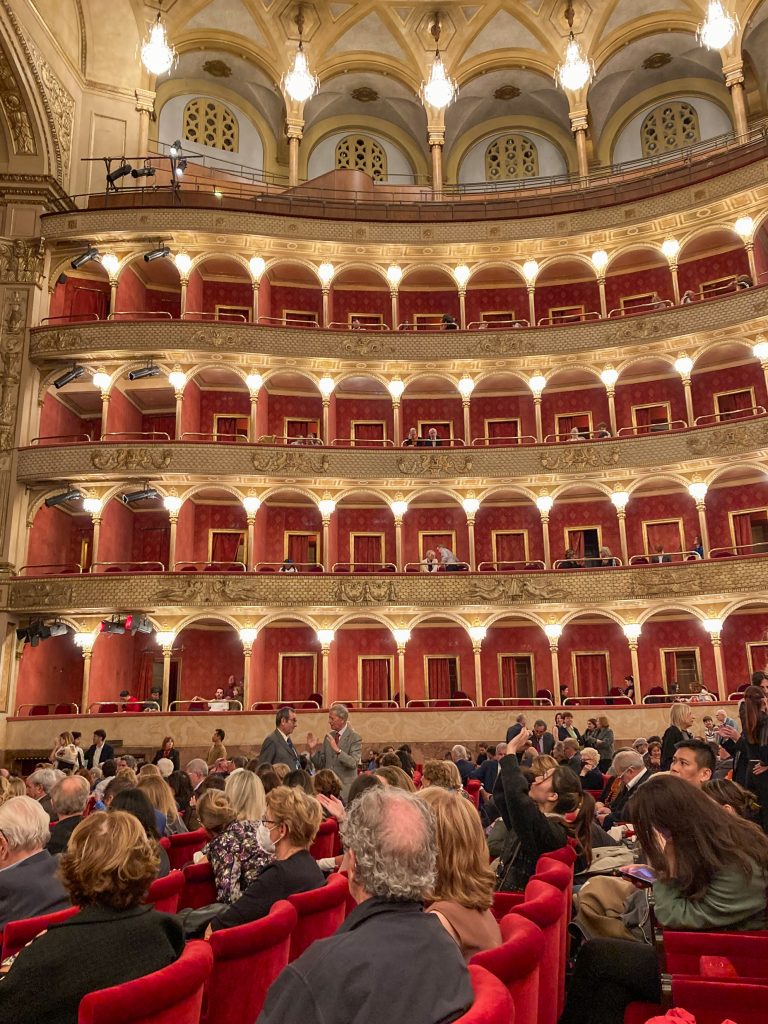
When our taxi eventually found his way there we were faced with an exterior that was surprisingly recent looking, slightly austere (it dates from the 1880s but was extensively remodelled in 1958). The foyer shares this concept. But the auditorium is pure late-nineteenth century ornateness, all tiers of boxes, gilt plasterwork, red velveteen seats and a Palais Garnier style cupola (with less arresting artwork). We had booked our tickets on spec when we were there using the Teatro dell’ Opera’s own website – https://www.operaroma.it/en/. The ballet we saw was a new one called Rossini & Rossini choreographed as a series of separate pieces linked only by the music of Rossini. We do enjoy seeing productions in the opera houses of the cities we visit and seeing how different audiences treat these nights out in different countries. At the interval we stepped out into the piazza that sits in front of the building and were entertained to see the conductor (in his white tie and tails) striding up and down across the piazza on his own, getting his nicotine and caffeine hit from cigarette and espresso. Not a sight I think you would see in the Covent Garden Piazza or the Place de l’Opéra.
Mobility Access:
It all feels pretty accessible for those with some mobility constraints if, as we were, you are in the stalls with only about ten steps down into that level.
Practicalities
Language
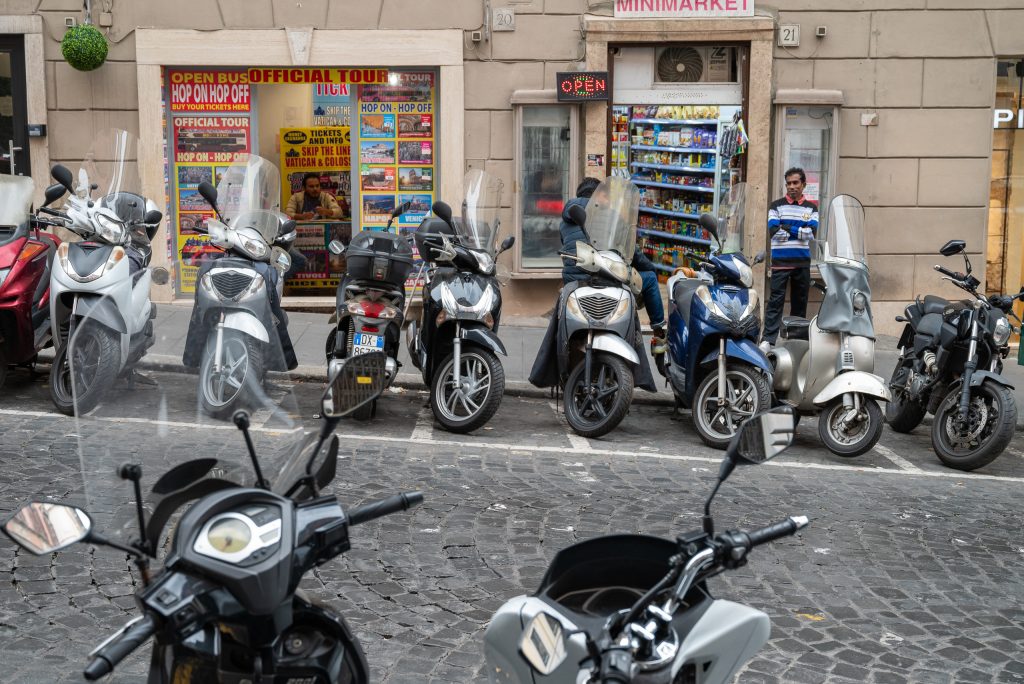
Like so many international tourist destinations the use of English is ubiquitous in the central areas of the city with nearly all menus following suit. The luckless waiters who are charged with standing in the street to inveigle passers-by into the touristic restaurants do so in English; indeed I had a sense many of them were more comfortable in English than in Italian.
Getting Around
I cannot be very helpful on this occasion as we did not use public transport at all. For us, moving around was by taxi when it wasn’t on foot. Taxis seemed plentiful and every single one was a fully-metered ride (so any concerns about dodgy fares just disappeared). And I didn’t find the traffic in Rome as bad as the mayhem nightmare of its stereotype. Like the traffic in so many big cities, it has its own rhythms but is neither as fast, manic nor dangerous as is often supposed.
We also used the Ho-Ho, as the ten-year old loves the open-topped buses. We also find they can also be useful as a way of orientation in a city you are not familiar with. In Rome they have their limitations because the route tends to circle the edges of the main sites. As well as the distances from elements within the Core Sights Area and from the Colosseum (see above), the buses stop around 750 metres from Vatican City and, although they drive through the Borghese Gardens, the nearest stop is around 650 metres down the hill from the south entrance at the Pinciana Gate. The headphone commentary in our seats was either broken in one case or was impossible to hear in the other, although the latter could be down, in part, to the impact of anno domini on my hearing.
VENICE
I find it difficult to write about this visit to one of our favourite cities but one I have not written about before. It is a city we have visited five times previously, never for less than a week and, once, for two months. Do I write about the wonder we have found here before or just what we did this time? Deep mental breath. This will be about our trip in 2023 so newcomers to the city may be disappointed that I do not touch on many of the main sights and galleries. The only thing to be said is that this city is unique. For all that other places are said to have more canals or more bridges, or places are referred to as the Venice of X or the Venice of Y, they just are not Venice. End of. You can be indifferent to that uniqueness or, like us, you can love and embrace it – but you have to give the city time. In my view you cannot ‘do’ Venice in a long weekend and to think, as the cruise ship visitors are made to do, that you can ‘do’ Venice in a day is delusional. You can achieve a tick list in that time: Rialto – tick, St Mark’s Square – tick, Doge’s Palace – tick, Bridge of Sighs – tick. That’s the selfies done, but you will have no real sense of the city; of how you can walk the backstreets of Cannaregio or Castello, take an early morning visit to Rialto Mercato, see the ancient quiet of Torcello or just sit in a waterfront café, watching the functioning of a city that can only be serviced from the water.
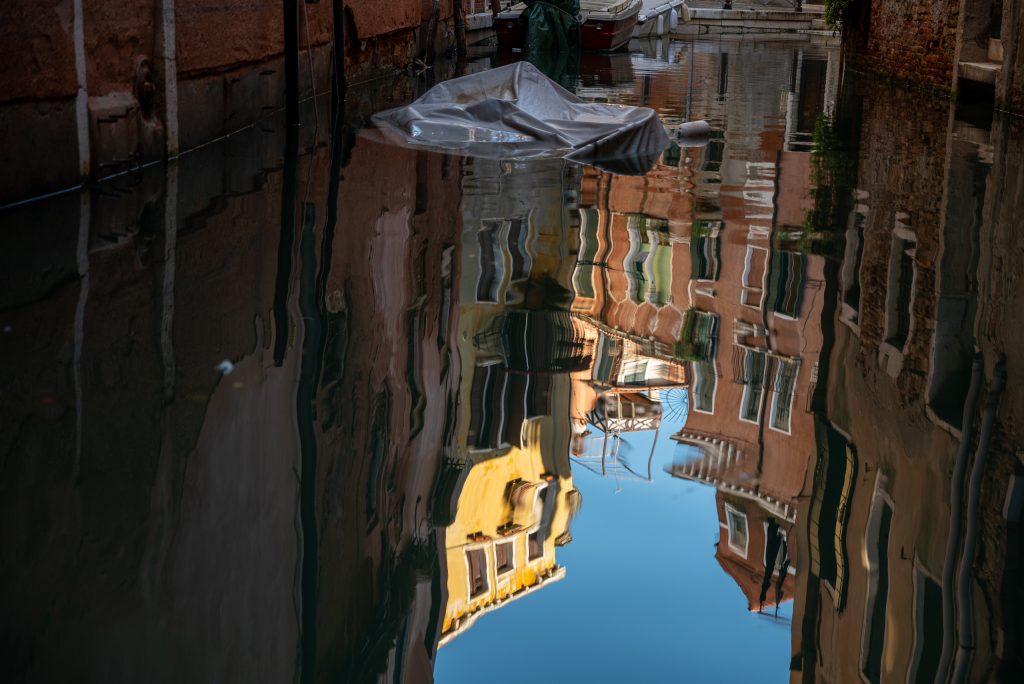
Like Rome, Venice has crowds and queues to contend with. Thankfully it no longer has the No Navi flags that adorned many a balcony the last time we were here, for the city authorities have finally bitten the bullet and banished those out-of-scale cruise ships to the mainland at Mestre. Now your views across the Bacino di San Marco and the Giudecca Canal, especially in the crisp autumnal air, are a joy; Canaletto brought to life.
If you don’t already, it is worth getting know where the six sestieri of Venice lie within the city. The city is made up of these administrative divisions and each has a different ambience. Many people, including me, and many guides – see, for example, https://www.nomads-travel-guide.com/get-to-know-the-six-sestieri-of-venice/ – tend to refer to the whereabouts of sights, galleries, churches, hotels, shops and restaurants by reference to the sestiere in which they are located. Familiarity on my part means I may quickly descend into unthinking references to a particular area, assuming a knowledge some may not have so….
Areas Visited
Scuola di San Giorgio degli Schiavoni.
For the third time visited. A small square building hidden away in the western side of Castello, this Scuola seems too small, too unobtrusive to warrant notice. But, its ground floor contains an artistic treasure, one of my favourites in Venice – Carpaccio’s seven panels of the Stories of the Patron Saints of the Scuola. Like Veronese’s disguised painting of the Last Supper, renamed The Feast in the House of Levi to escape the wrath of the church authorities (which is in the Accademia), this takes a series of serious subjects and inhabits them with a wealth of entertaining detail. To see the portly monks fleeing in terror from St Jerome’s friendly lion is to realise how Carpaccio imbued a sense of fun into these paintings. The room in which the paintings sit is small enough and light enough to allow a proper look and it has aged wooden seats to allow lengthier contemplation.
This time I realised there is actually an upper floor, reached by a creaky wooden stair. Here the Scuola allowed free reign to artists portraying St George (San Giorgio). I think I counted eight differing representations of the saint slaying the dragon, including a banner and a tapestry, with another (fairly discreet) one on the exterior. The upper room is a contrast to the lower floor; gloomily sepulchral, with the feel of a chapel. For information go to https://www.scuoladalmatavenezia.com/home.
Mobility Access:
The ground floor is just a couple of low steps up from the street level and there are the seats inside but, this being Venice, you have to walk to get there. The nearest vaporetto stop is San Zaccaria, which has four separate docks. The Scuola is 650 metres from San Zaccaria E where the 1 line stops. You can knock one hundred metres and have one less bridge to negotiate if you get the 2 line which stops at San Zaccaria B. But whichever way, there are still no less than two Venice bridges to deal with each with their fourteen or so steps up and then the same down. Although the canal runs alongside the Scuola, the nearest drop off point for water taxis is about 75 metres down the Fondamenta dei Furlani.
Palazzo Grassi and Punta della Dogana
I have put these two rather incongruous bedfellows together because they are now the home to elements of the Pinault Collection. The French billionaire, Francois Pinault, has been described, for British audiences, as the French Charles Saatchi (https://www.theguardian.com/artanddesign/2009/jun/03/francois-pinault-venice-art) and these two grand buildings are the chosen outlets in which to display ever-changing exhibitions of his vast modern art collection. The former is a grand waterfront palazzo, located on the knuckle of San Marco sestiere that pushes out into the bend of the Grand Canal opposite Ca’ Rezzonico. Four vaporetto stops further down the Grand Canal, the latter, by contrast, occupies the old customs building, low and functional, that sits on the point at the east end of Dorsodouro. Both buildings have been extensively (and expensively) restored and, in some respects, are worth visiting just to see how the interiors have been repurposed for the display of art.
You buy tickets online (https://www.pinaultcollection.com/palazzograssi/en) that allow access to both sites and you do not have to use them on the same day (I didn’t, it would have been visual overload). Because Pinault Collection includes a large photographic selection, they have had dedicated photographic exhibitions both times we have been to Venice in recent years. This time the draw was a large exhibition of the Condé Nast archive, covering the photography of their famous magazine stable (Vogue, Vanity Fair et al) from their acquisition of Vogue in 1909 up to the early 1980s. The art in the Punta della Dogana was, by contrast, a room-filling collection of conceptual installations and sculptures. Some engaged me, others did not but the building was new to me, so I had as much fun looking at the interior architecture as at the artwork.
Mobility Access:
Both buildings are recently refurbished so have good access. Like any gallery you have walk around to see the exhibits properly, but there were wheelchairs available at Palazzo Grassi (I did not check Punta della Dogana). The only seats inside the exhibitions were few and far between. Both are very close to vaporetto stops; Palazzo Grassi to San Samuele (Line 2) and Punta della Dogana to Salute (Line 1).
Walking and Vaporetto-ing
If you can manage it then there is no doubt that walking is a fabulous way to see Venice. Do the sights by all means but I have learnt that much more enjoyment and engagement with the city has come from walking almost without purpose. The only areas I try to keep away from are the ‘big’ sights during the day – Piazza San Marco and its many star sights, the Rialto bridge, Friari and Scuola San Rocco, Accademia – and keep clear of the routes that the day tourists are directed along to get from the stations (train, boat and bus) to those big sights and back again. And, if you are staying in the city, get up early to walk around. At 08.00 the Rialto and Piazza San Marco can seem deserted and, at that time and earlier, you can also catch the Rialto fish market at its most vibrant.
For those with less ability to wander around the vaporetto is, for us, the equivalent of our tram or bus in other cities except that, as a generality, the views are better. But the vaporetto too floods with the influx of visitors making contemplative sightseeing unrealistic. Again, my suggestion is – go early. A cruise on the 1 line vaporetto down the length of the Grand Canal at 07.00 is a peaceful joy. Equally the 5 line vaporettos, that circle the heart of the city (5.1 anti-clockwise and 5.2 clockwise) add a sense of the wider lagoon and take in the broad Giudecca Canal and the Bacino San Marco.
In my view there is no better guide for slow travellers and walkers than J G Links’ Venice for Pleasure, first published in 1966 but revised several times since – https://www.waterstones.com/book/venice-for-pleasure/j-g-links/jan-morris/9781843681342. The book is conceived as a series of walks around the city but is so much more than that. The core fabric of Venice has changed very little since he first wrote the book which means it rarely feels its age and any guidebook that, early on, contains the sentence ‘perhaps the first thing to do….is to sit down and have some coffee’ and then ‘look around us’ is a winner in my book.
Mobility Access:
The vaporettos are very accessible and the crew are always there at embarkation or when getting off to lend a helping hand if you look in need of assistance. There are plenty of seats outside the busiest times of the day and the floating platforms that act as bus stops, have benches for that wait for the next boat.
Sant’ Erasmo
The Venetian lagoon is dotted with hundreds of islands, only a few of which are visitable without your own boat. Aside from those within the six sestieri, we have visited a few of the other key ones in the past: Murano, Burano, Torcello, Chioggia, the cemetery island of San Michele, the once asylum San Clemente now a hotel within the Kempinski group. I was casting around for a new place to explore and found this island traditionally known as the vegetable garden of Venice and the source of the carciofi (artichokes) that grace the tables of many a Venetian restaurant and can be found, piled high, on the vegetable stalls of the Rialto market. At four kilometres long by one wide, it seemed an ideal place to go for an afternoon’s walk in the autumnal sun away from the madding crowds.
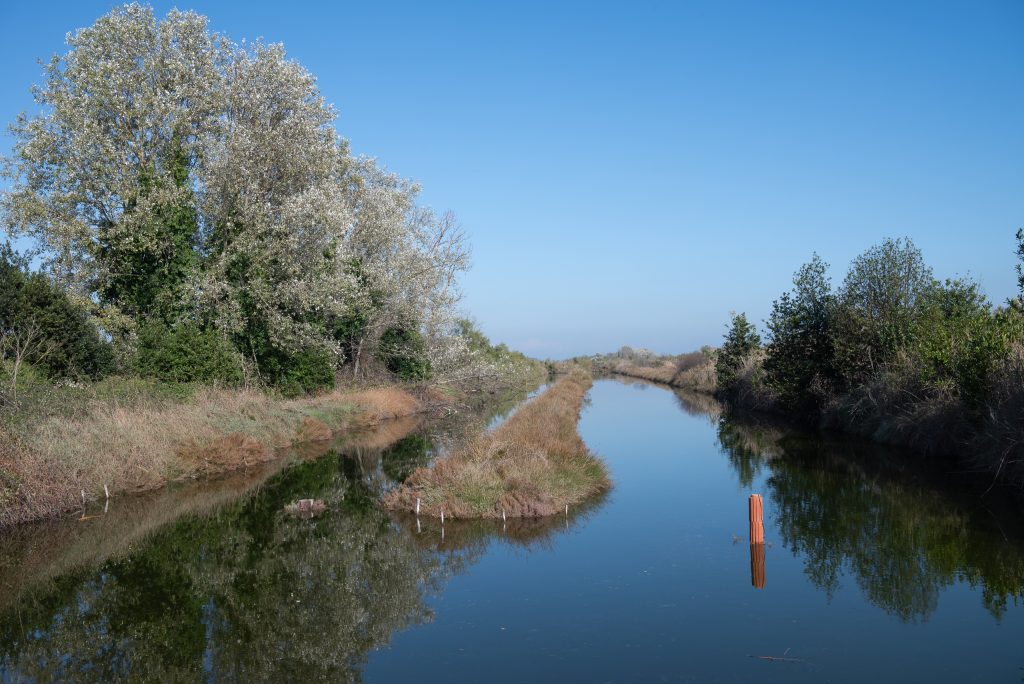
The 13 line vaporetto to the island (and on to Treporti) runs from the stop at Fondamente Nove, the stop on the north side of the city which acts as the hub for all the vaporetto lines to the islands of the northern part of the lagoon. Walking apart, you can get to Fondamente Nove by using the 4.1, 4.2, 5.1 and 5.2 any one of which can get you from San Zaccaria, Piazzale Roma and the railway station (Ferrovia). Just make sure you get on the right route at your starting point to make your journey a short one, otherwise you may find yourself taking an enjoyable but lengthy circumnavigation of the city (and ending up at the Lido if you are on the 5 line). There are three stops on the island, all on the northern shore: Cappanone, Chiesa and Punta Vela. I decided to walk the length of the island by getting off at Punta Vela (at the east end) and boarding for the return at Capannone. To do this (and get to Chiesa) you have to change boats at Capannone even though the 13 line is shown as a continuous route. Off I got to wait for the onward boat to moor up only to discover that it had berthed alongside the boat I arrived on. The knowing locals were already on board and watching me scramble back onto, and then across, the original boat to board the departing shuttle as it prepared to leave.
Sant’ Erasmo was certainly away from those crowds. From Punta Vela I walked into the centre of the island and then west along a lake-cum-drainage canal with reeds rising over my head. Alongside me across the flat landscape were tilled fields dotted with farm buildings whose appearance favoured practicality over elegance. For the first forty minutes I saw no-one. As I moved closer to the few small hamlets at the island’s west end there was the odd person on a decrepit motorbike or walking purposefully across a field. And there are other vehicles, small cars and tuk-tuk-sized pick-ups, pottering round the few single-track roads. It was a peaceful and relaxing walk, but this is an island with no real things to see and few eating places or shops. It is not a neat and tidy ‘garden’ of vegetable production but a faintly scruffy feeling backwater. A place to go if you cannot stand the crowds a moment longer and just need some space to yourself.
Mobility Access:
Getting there is not a problem but, once there, there is virtually nothing to do except walk as there are no eating places or cafes near the vaporetto stops. Seeing the lagoon outside the city has its own fascination, but I suggest a trip to Torcello and Burano offers the same views and experience of this watery landscape with so much more on offer for the mobility constrained once you are there.
Rialto Market
Go, just go, and, as I say elsewhere, go early. The heart of the market is the open arched hall of the Pescheria built in the sixteenth century. Under the venerable roof of this hall the fish and seafood of the lagoon and the Adriatic (and beyond) are on sale from open stalls layered in ice. Alongside are serried ranks of fruit and vegetable stalls and, for those looking to complete their food shopping for their apartment stay, just beyond those stalls, the wonderful delicatessen of Casa del Parmigiano. This cheese and cold meats heaven, manned by white-coated, white-capped staff who have been there for years, is on the Campo Cesare Battisti, next to the Rialto Mercato vaporetto stop. If you go after about 09.30 or 10.00 the ratio of locals to tourists visiting the market will have been reversed and the best of the fish market activity will have died down. By 13.00 the fish market has closed for the day and all you will find is that day’s detritus surrounded by raucous gulls.
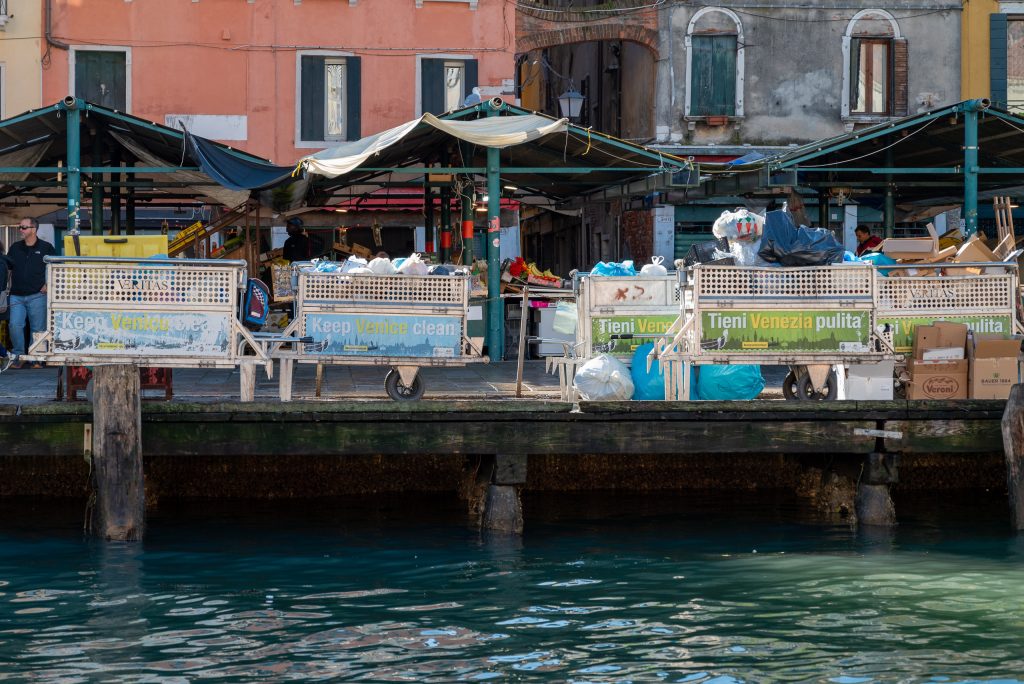
There are plenty of restaurants and cafés around for breaks to be taken but the early morning visitors can join the fish stall merchants at the bar of one of those Venetian institutions All’ Arco or Cantina do Mori for their cicchetti washed down with a bicchiere. And, although it is just across the Rialto bridge (all 50 plus steps up and the same down), I have to give a shout out to Millevini (https://www.enotecamillevini.it/en/about-us), an Aladdin’s cave of Italian (and other) wines expertly run by the rugby-loving, English-speaking Lorenzo Menegus. Whenever I have followed his recommendations of which wine to serve with what dish, I have been introduced to excellent wines that, often, I have never come across before. Just turn left once you come down off the Rialto bridge into the narrow passage of Ramo del Fontego dei Tedeschi to find this hidden away enoteca.
Mobility Access:
The market is served by Rialto Mercato vaporetto stop (on the 1 line). The market is in a compact area, the ground around the market is flat with no need to cross bridges to visit all the places I have mentioned, except Millevini. For rest breaks there are cafés galore, but they get very busy after mid-morning.
Apartment
Since we stayed in an apartment in Venice for two months nearly ten years ago, it has taken over from hotel stays as a favoured way to stay in the city. For that stay we used Views on Venice (https://www.viewsonvenice.com) and their excellent service and well-appointed apartments have kept us using them for all our subsequent visits. They are very much a Venetian organisation, and owner, Filippo Gaggia, rents out apartments in his own home, a palazzo overlooking the Grand Canal. We try to take apartments in different areas of the city each time we come and this time we were in a ground floor, two-bedroom apartment whose small walled garden opened directly onto Zattere, the broad fondamenta that runs along the south side of the sestiere of Dorsodouro facing the wide Giudecca Canal. It was only a bare forty metres from the Zattere vaporetto stop, served by both the 2 line and the 5 line. The great art gallery of Accademia and its vaporetto stop (served by both the 1 and the 2 lines) is only 300 metres north, a walk over flat ground with no intervening bridges.
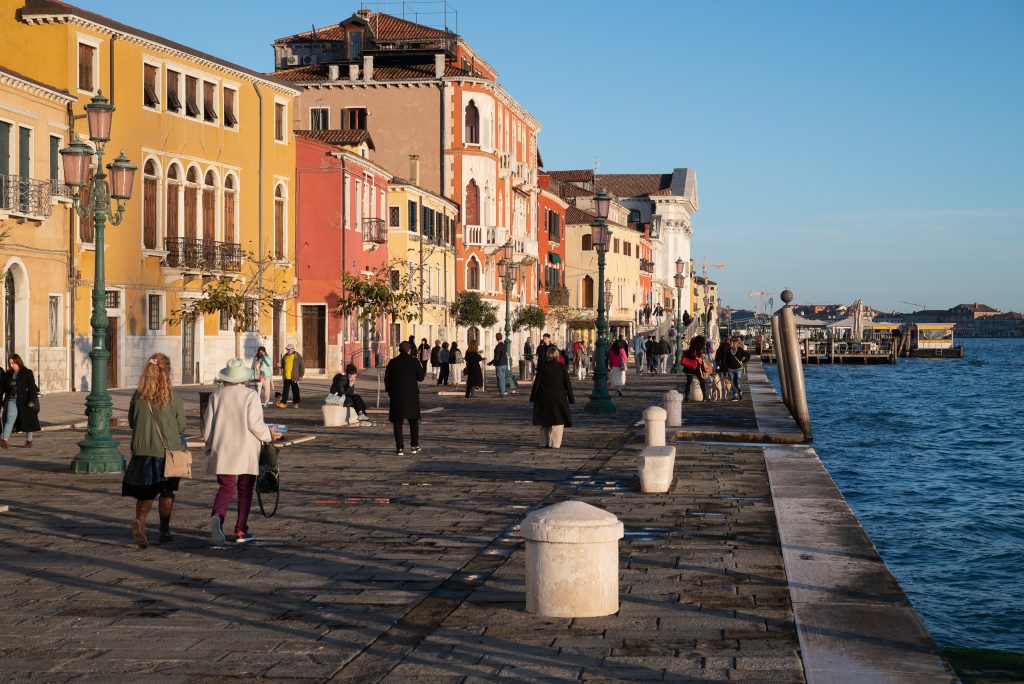
Zattere’s fondamenta has a series of cafés and restaurants with outdoor tables and as it faces south and has no overlooking buildings it has the benefit of the sun for much longer than many other places in Venice. We spent several happy hours whilst the sun shone sitting and watching the canal busy with marine traffic and its backdrop of the Giudecca island waterfront and enjoying the locals using the quay for the passeggiata (https://www.myitaliandiaries.com/italian-passeggiata-what-exactly-is-that/).
Food and Drink
An apartment means we alternate cooking ourselves with restaurant visits. Food for ‘home’ cooking comes from the Rialto market and its surrounding shops, supplemented by visits to the surprisingly good supermarkets that pepper the city. In Venice these do not advertise their presence like those elsewhere. The two at opposite ends of the Zattere waterfront are little more than a discreet doorway in the palazzos within which they nestle. Inside they fan out into small but well-stocked places with fresh fruit and veg and, often, a deli counter.
As to restaurants, it is a time for revisiting more old friends. So a summary and then a word about cafés.
Ai Gondolieri
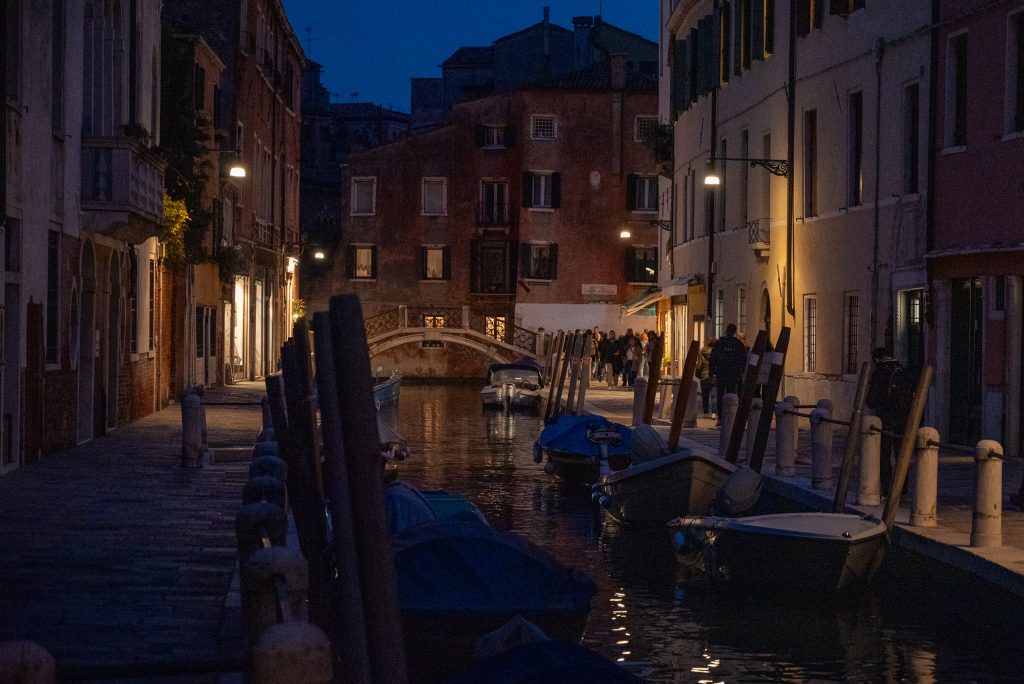
Venetian cuisine is focused on products of the lagoon and the sea but this traditional place is one of the few that turn to Venetian meat dishes as its core offering. Tucked into a corner of a small canal in eastern Dorsodouro near the Peggy Guggenheim Gallery, this old-style (black-tied waiters, white cloth napery, Venetian (male) staff, no piped music) doles out quality Veneto classics in a series of cosy wood-panelled rooms. Bar some champagnes, wines are strictly Italian and listed by region. Vegetarian options are available (including vegetables from Sant’ Erasmo). The small canal outside (Rio de le Toreseie) is another of those unfeasibly photogenic Venetian locations, especially in the evening with light glistening off the water.
Mobility Access:
A walk of 300 metres (from Accademia vaporetto stop) or 350 metres (from Salute vaporetto stop) with either one requiring the negotiation of two small bridges. Inside it has slightly differing levels (a few steps).
Ai Artisti
(No website. T: +31 41 523 8944)
This small (only 25 covers plus the three or so tables outside in good weather) canal side restaurant was our ‘go to’ when we dined with friends during our two-month stay. It is on Fondamenta Toletta in Dorsodouro, only a short step (and one bridge) from busy Campo San Barnaba. The daily changing menu is a modern take on Venetian cuisine with fish at the heart of the cooking, except on Mondays when the fish market is not open. Capable and friendly staff do the business with food and wine. Booking is a must as it features in several of the mainstream guidebooks.
Mobility Access:
250 metres and two bridges from Ca’ Rezzonico vaporetto stop. A step up to get inside.
Club del Doge, The Gritti Palace
Okay, we are in serious splurge territory here in one of Venice’s top hotels. So we indulge once on every trip because this upscale place is part of our memories of our first time in the city. In a gloriously ornate room or, in the better weather, an outdoor terrace with one of the best views in Venice (out across the Grand Canal and the Baroque extravagance of Santa Maria della Salute church) this is an experience to be savoured and that includes surreptitious eyeballing of the outfits and behaviour of your fellow diners. A cocktail in the Bar Longhi in the room next door is part of the whole experience.
Mobility Access:
Unless you happen to be staying, the nearest vaporetto stop is Giglio (Line 1) with a 200 metre walk up the narrow (not wide enough for a golf umbrella when it rains) calle and back down to the canal side entrance (no bridges to negotiate). It is a 600 metre walk from St Mark’s Square. If you go for the grand entrance, a water taxi will drop you straight onto the waterside terrace.
Caffè Florian
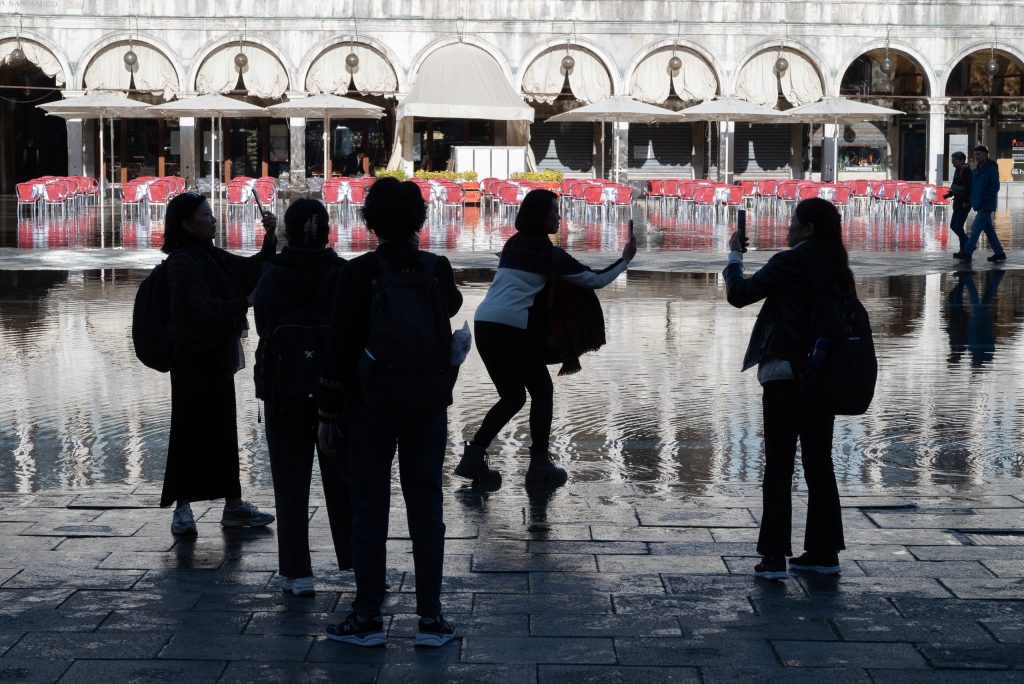
We keep going back just because sitting in this café in St Mark’s Square (which dates from 1720) is, despite the blatant playing to the tourists, a special Venetian experience. Screeds have been written so, attacked by laziness, I have decided to let Condé Nast Traveller do the talking – https://www.cntraveler.com/bars/venice/caff-florian. Only one pointer, go early (it opens at 09.00) and sit inside by the windows. Your company will be the early-rising tourists from East Asia, but you will get a seat and be able to watch the day unfurl over St Mark’s Square.
Mobility Access:
1 line vaporetto stops at San Marco Vallaresso (250 metres and no bridges) and San Marco Zaccaria (400 metres and one bridge but you get to walk past the Bridge of Sighs, the Doge’s Place and St Mark’s Basilica). All smooth paved arcades around St Mark’s Square.
Cantine del Vino già Schiavi
https://www.cantinaschiavi.com/it/index.html
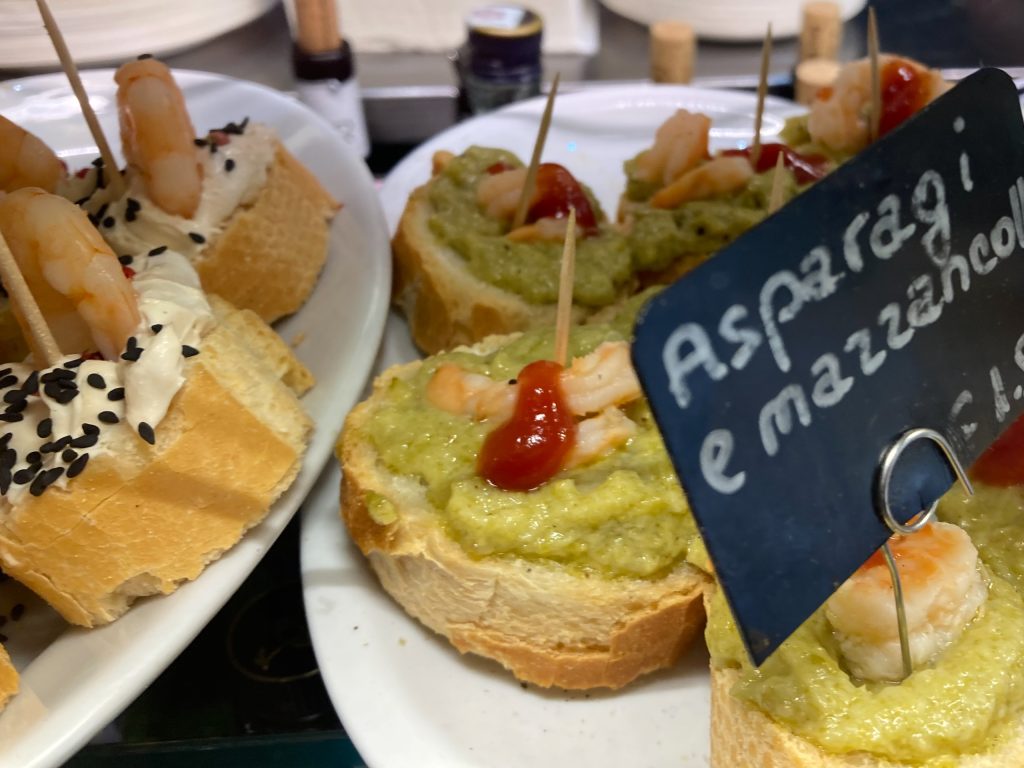
I have not included some of the places we stopped but this one in Dorsodouro, new to us, is a very popular place with tourists and locals alike. Set on a narrow fondamenta that runs on the east side of Rio de San Trovaso, it was only five minutes’ walk from our apartment. It appears to be an unprepossessing wine store from the outside but, in any weather bar damp rain, it announces its presence by the small crowd gathered along the canal wall outside. They are all bearing paper plates crammed with superb cicchetti. With apologies to those in the know, cicchetti are the Venetian equivalent to Spanish tapas, eaten, like tapas, standing and washed down with a glass of local wine. Usually they are a small round of baguette-style bread topped with the produce of the Veneto: crab, artichoke, salt cod (as baccalà mantecato), meats, octopus, peppers, cheese and, here at least, many other varieties (https://www.nytimes.com/2019/02/27/travel/venice-cicchetti-small-plates.html). You can be fed bad cicchetti in Venice, as I discovered the day before when I stopped for lunch in a bar in Cannaregio, but not here. Once inside there is a bar with a large glass cabinet containing a cornucopia of cicchetti. Just go to the bar and order. The questions you will be asked, in English once your tourist status is apparent, are: are you eating inside or out (china plates inside, paper out), how many cicchetti do you want (this determines the plate size) and do you want red or white wine? Then the hard part – choosing which ones to have (they are all labelled in Italian, so have Google Translate to hand alongside the helpful staff). Once done you stand inside at one of the tall tables or outside balancing plate and glass (plastic outside) on the canal wall. Sometimes in Venice quality and tourism do mix. This gem is one of those places.
Mobility Access:
Standing room only once you are here. Getting here is from the vaporetto stops Accademia (Line 1) or Zattere (Lines 2 and 5) both only 250 metres away and with no bridges to negotiate.
Local Cafés
From the sublime to….well, the local. On this trip, really for the first time, I discovered the joy of coffee stops in the more local cafés. These are the simply furnished and decorated places that open early to serve the local populace and provide a whole different people-watching experience. First up was Bar Al Bateo (open from 06.00) right beside Palanca vaporetto stop on Giudecca (Line 2). A narrow ground floor room stretches back from the quay with a bar up one side where the couple managing it dispense early morning coffees and pastries to the succession of local inhabitants and workers. The garbage collectors come and go as do other overalled municipal workers and more smartly dressed business folk en route to the vaporetto to cross to the main part of the city, none lingering more than the minute or two needed to down an espresso at the bar. In the kitchen at the back of the unfashionable, functional interior a grey-clad chef is preparing piles of tramezzini to be lodged behind the bar for the lunchtime trade. The customers who linger are older couples with their papers and young mothers with babies taking a break on their way back from dropping off their elder children at the nearby primary school.
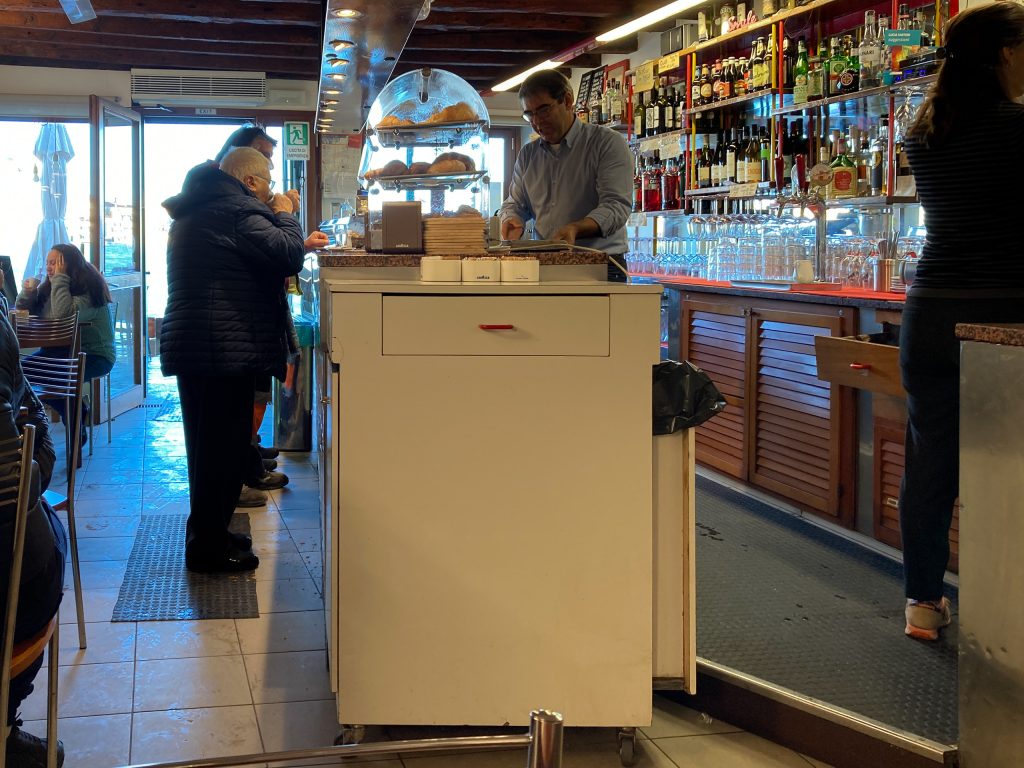
Another lies in western Castello in Campo Santi Giovanni e Paolo (this name is too much of a mouthful for the locals so, to them and on some signage it is Campo San Zanipolo). This is well onto the tourist trail with the glorious marble façade of the Ospedale, the Gothic church of the eponymous saints and the equestrian statue of Bartolomeo Colleoni all gathered here. Several café/restaurants line the south side of the square with tables carefully spreading out into the square. In amongst the places aimed at the passing tourist trade is Rosa Salva, a combined neighbourhood café, pastry shop and gelateria. The interior is divided into two rooms: one contains the bar and pastry counter the other, a simply decorated room, contains functional square tables for customers. Here I sat one morning and watched as the processes of Bar Al Bateo were repeated by the locals in this section of Venice, except that here the mothers with young children were replaced by older folk on their way to, or from, their appointments at the hospital. In neither place were there any pretensions, just a sense that a real city lives under the theme park façade of Venice.
Practicalities
Language
A tourist city means that, by and large, you can get by with English. Indeed, as so often these days, it is easy to do so. My own linguistic skills being weak and my limited Spanish being more extensive than my Italian, I kept bringing the Spanish words for food or objects to the front of my mind when trying to say something in a restaurant or shop but it never really became necessary to speak and blunder.
Getting Around
There is a wealth of information about the public transport services and the best place to start, as always, is with the website of the transport authority, ACTV – https://actv.avmspa.it/en. I confess to finding their pdf map of the routes somewhat confusing. Their interactive map is helpful in identifying which pier at a particular stop is served by which lines and saves a lot of shuttling back and forth at the multi-pier stops like San Zaccaria where there is 350 metres between the first dock, Pier A, and the fourth dock, Pier E. I found this website with its maps of individual lines very helpful when trying to work out where each line actually stopped – https://www.visit-venice-italy.com/water-bus-venice-line-1.html. If you are staying for more than a day then there is a simple answer to the question as to which ticket to buy – get a travel pass for the requisite time you are in the city. Unless you are a manic walker then you will use the vaporettos (waterbuses) for much of the time and they are the only way to get to Giudecca and all the outlying islands. I think the easiest thing to do is download the AVM app and, as we did, you can then buy your pass in advance and use it as soon as you arrive.
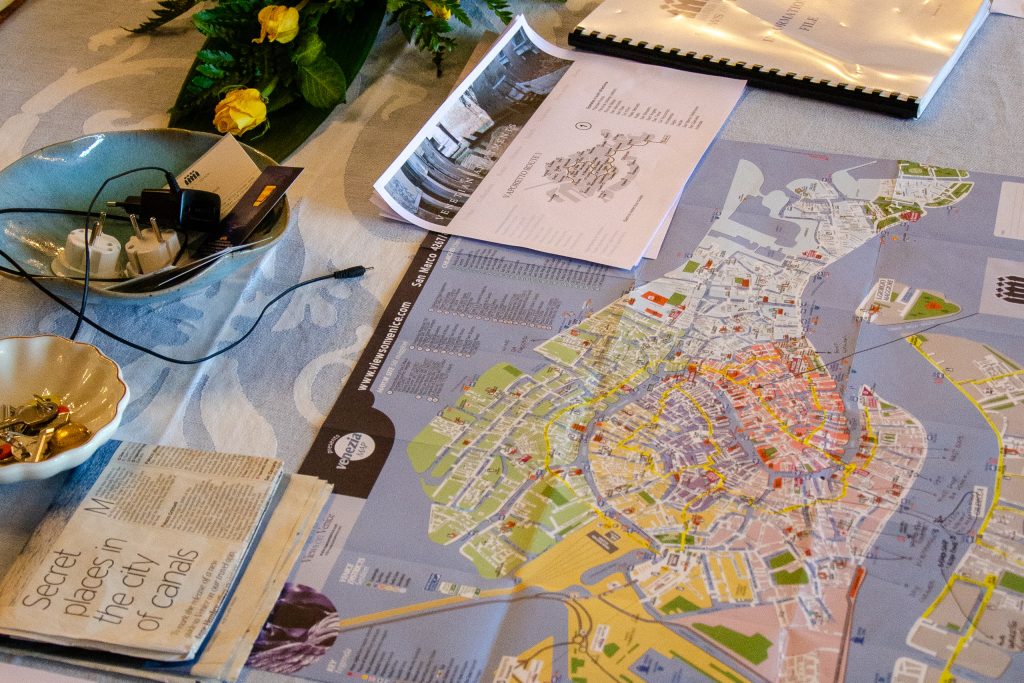
I recently read a recommendation that visitors should lay their hands on a decent physical map of Venice and not rely on Google Maps. I heartily agree, because Google Maps can be flummoxed by the maze of narrow streets and walkways. Somewhat unhelpfully for others, my favourite paper map is that given by Views on Venice to all the guests who stay in their apartments. It is one of the clearest, helpfully colours each sestiere differently and shows the main tourist routes from the Santa Lucia station/Piazzale Roma through to Rialto, San Marco and Accademia. This means if you are looking to walk around the quieter places you can avoid these routes. However, given its relative unavailability, the fold open maps in the pocket-sized Everyman guidebook to Venice are also very good.
As we arrived by train we did not need to get into the city from the airport. In the past most people we know have used the Alilaguna water buses (https://www.alilaguna.it/en/lines/lines-map) or the much more expensive water taxis. With the latter you get a door-to-door service but just be aware that there are a couple of steps to get down into the well of the boats from the pier.
Gondolas are, to me, a thing to do once and are the only way to see some of the narrow back canals. A ride through the evening darkness can be particularly atmospheric. Do be aware that failing to follow the instructions of the gondolier has potentially dangerous consequences – https://www.theguardian.com/world/2023/dec/06/venice-gondola-capsizes-tourists-canal.
Mobility Access:
There are no steps to get onto the floating platforms that act as water bus stops and you step straight from them onto the boats, although there might be a slight step up or down. As previously mentioned, the crew are always able to offer a helping hand. Although they have plenty of seats, the water buses can get very busy through the middle of the day (with tourists) and, on the 1 line in particular, you may find they are standing room only. The other busy time is the rush hour in the evening when both tourists and locals are trying to get back to the station and the transport hub at Piazzale Roma.
TURIN
We were here, principally, for the ATP Finals that are usually the last big tennis event of the year for the male players. We spent two full days (four sessions at the tennis) and for those interested all this is dealt with in a separate section below. My knowledge of, and reading about, the city before we arrived was woeful. An industrial city, home city of the Fiat car empire and location for that car chase with the three Mini Coopers in the 1966 film, The Italian Job (https://www.youtube.com/watch?v=RtWkewqIFDM0) would have been my superficial summary. I should have been paying more attention to the glorious architecture of the arcades, squares and buildings that were the backdrop to the car chase, for this is the city that was capital of the transalpine Duchy of Savoy and also the first capital of a unified Italy in the late nineteenth century. It had the feel more like a central European city like Vienna or Budapest, grand eighteenth and nineteenth century buildings with high arcades fronting the street and large squares all set within a grid pattern of streets. The trams that ply these streets, along with the buses, add to that feel. All this in the clear air which allowed us to see the city backdrop of the snow-capped Alps fifty kilometres away to our west. We could only skim the surface during our time away from the tennis.
Areas Visited
The City Centre
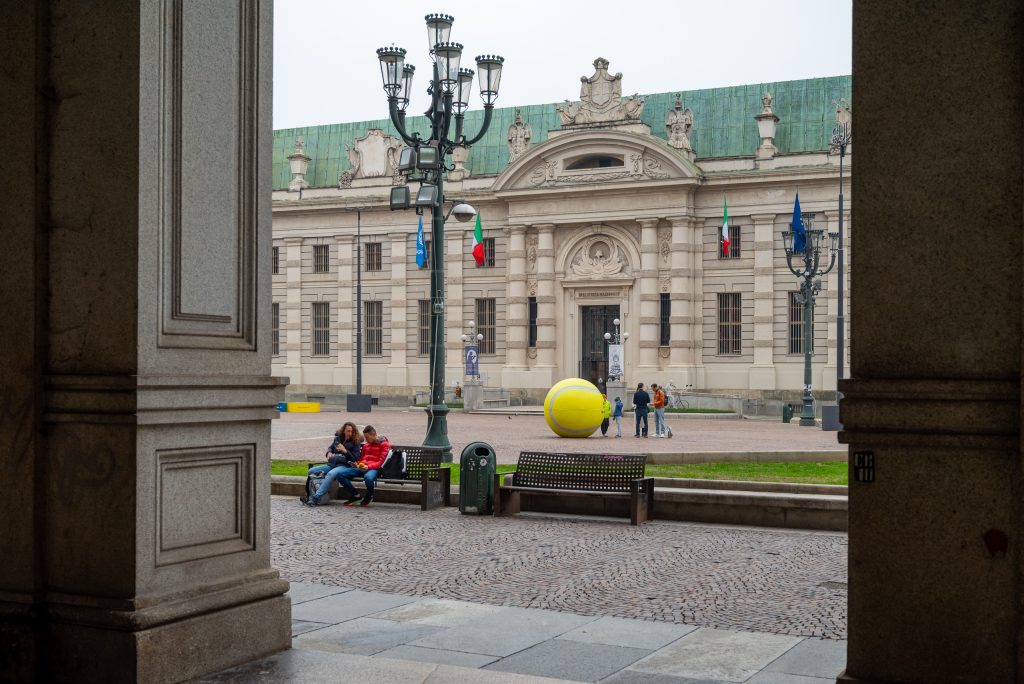
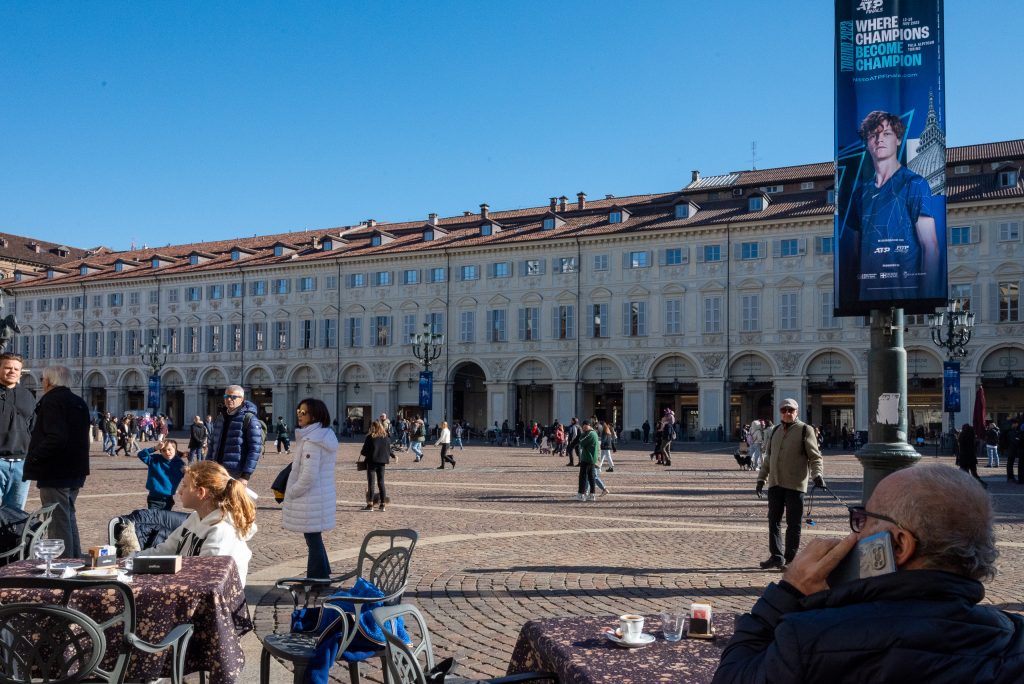
We took two trips into the centre of the city from our hotel. One, on a sunny Saturday, saw us sitting at the outdoor tables belonging to Caffè Torino, one of the grand cafés that populate the arcades in the pedestrianised Piazza San Carlo. It was busy with locals out enjoying the late autumn sun, taking coffee or drinks, meeting friends, walking their dogs and giving young families some fresh air. It is an elegant and social space with the overt presence in the city of the tennis tournament shown by yellow tennis balls the height of an adult dotted around and by the banners advertising the tournament hanging from every lamppost. From each one of these the face of the Italian player, Jannik Sinner, stares determinedly down on the streams of people.
On the second trip we went up to another grand café, Barrati & Milano, in the wonderful three storey high, glass-roofed arcade, Galleria Subalpina. Dating from the last quarter of the nineteenth century this shopping arcade epitomises the grandeur of Turin (see the first section of the clip from The Italian Job) and led us into a walk south through more arcaded squares before fetching back up in Piazza San Carlo where, on a very different day (damp and chill) we tested out the interior of two more grand cafés. It was definitely an area of the city which would repay more time than we could give it.
Mobility Access:
The centre of the city is generally pretty flat and well-paved. Buses and trams serve all of this area and you rarely seem to be more than a couple of hundred metres from a suitable stop. As you can see there are plenty of cafés and other eating places for taking a rest stop.
Tram Touring
I have waxed lyrical about tram touring elsewhere. There was not much opportunity in Turin but we each did a little of our tram touring, moving out of the city centre and down wide boulevards that are lined with trees and late nineteenth and early twentieth century commercial and residential buildings. The age of the buildings decreases as you move outward, the architecture taking on a modern aesthetic.
Mobility Access:
The trams are relatively modern and access at most stops is from a platform obviating the need for steps up and down. Seats, yes but with the obvious caveat of crowding at rush hours and other busy times.
Hotel
The Duparc Contemporary Suites (https://www.duparcsuites.com/en) is away from the central core but still within easy reach of it and the tennis venue, Pala Alpitour. Hence it was our choice. In looking at city hotels we tend to go for hotels that provide us with what we really need: king beds, rooms with a bath as well as a shower, competent service, a decent amount of space, ease of access to the rooms and to public transport for the mobility constrained. That means we do not need hotels that have restaurants that serve dinner and extra facilities such as spas or staff on hand to tend to your every whim. Cities are full of other restaurants to try – as we discovered in Turin, although there were few options that attracted us within walking distance of the hotel.
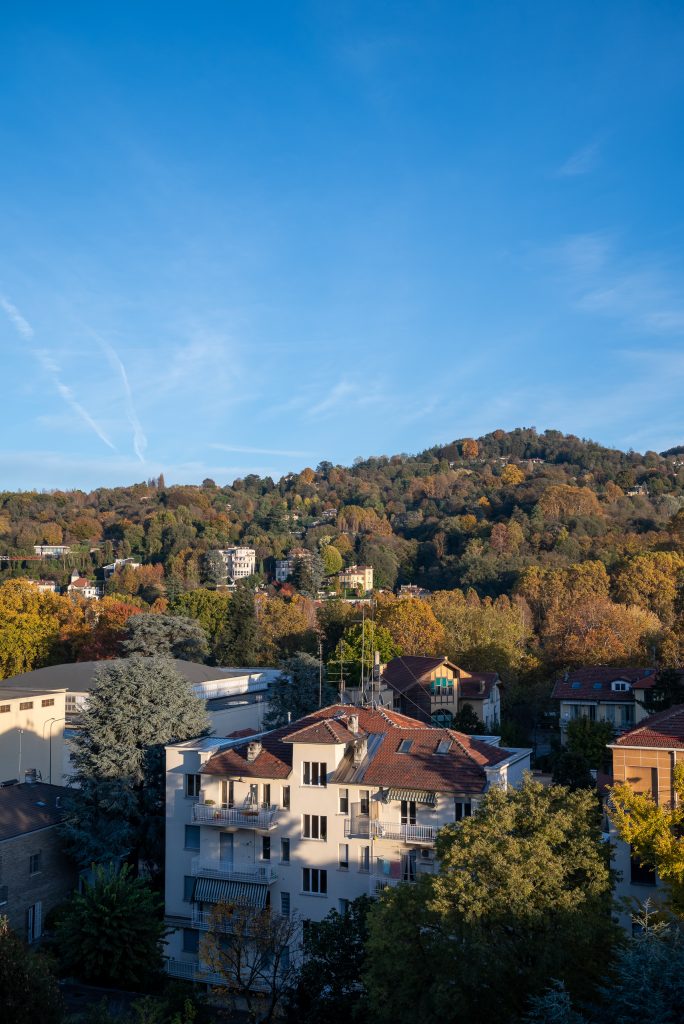
So Duparc had all that we needed in our large room with a view out to the wooded hills to the east. It is an unashamedly modern facility and, although it had a small spa, it was not as expensive as some of the other grander city centre hotels. As an added bonus for us, its TV channel offer included a dedicated tennis channel that meant we could follow the tennis when we were not at the venue. It was reasonably placed for buses and the reception staff had excellent arrangements with a local taxi service with cars arriving within a few minutes of a call. Buffet breakfast was in a functional, light modern dining room and the offering was unexciting and served when we lacked other options.
Mobility Access:
The entrance is directly onto the street. Bus stops were a little away from the hotel frontage (a 300 metre walk). The one minor negative point is that the entrance does not feed directly onto the level of the reception. You need to walk down about ten steps to get to that level and, whilst the lift does serve all other floors, this street level area is on a sort of half-landing and you need to go up or down to get access to a lift.
The Tennis
Turin has the ATP Finals guaranteed until at least 2025 so for aficionados planning a trip some practical information might be useful. It is always best to start with the tournament’s own website for booking tickets and venue information (https://www.nittoatpfinals.com/en/). I hope the following will also be helpful for those with mobility constraints. We bought our tickets well in advance. I certainly would not recommend waiting until you get there. The arena looked almost full for all four sessions we attended and we were there for the first two days of the tournament.
I did scout out public transport access in advance but we ended up using taxis to get to and from the venue, Pala Alpitour. It lies about half-an-hour’s travel south of the central area by public transport. The 4 line tram stops about 200 metres east of, and the 10 line tram 350 metres west of, the venue. Both stops are called Sebastapoli. Various buses also drop off in similar locations The Pala Alpitour is a modern arena built for ice hockey at the 2006 Winter Olympics and now used for concerts, shows and sports events. The site for the tennis has access points at the south and north ends of the building but the north entrance also feeds into the piazza in front of the arena where the Fan Village is situated. This large temporary tented space houses the stalls of the sponsors, a roofed-over play area with two padel tennis courts and the bulk of the food offer in a large food court. Unless you are going straight to your seat in the southern end of the arena, I suggest you access from this north end. Taxis can drop you in Corso Galileo Ferraris just a few steps from the northern entrance gates.
Getting away can be more problematic simply because everyone is leaving at the same time. There is a tolerably well-organised taxi queue set up in Corso Galileo Ferraris marshalled by a couple of stewards. It turns out that the Italians treat queueing in a similar way to the British and the queue is pretty well-behaved and orderly. If anything, anyone trying to queue jump is treated with more overt verbal hostility than they would be in the United Kingdom. Nonetheless sheer numbers mean there will be a wait, even if you scoot out a little early, especially in the late evening when alternatives may not be available. One night session finished well after midnight when we were there. We probably waited in the queue for 20 to 25 minutes on both nights. Taxis do come very regularly so, although the queue can seem long, it does move steadily. There are no seats at the queueing area, just a fast food stall pumping cooking smoke across you as you wait.
In the arena itself ground level brings you in at the top of the lower tier of sets. There are lifts to the upper tier. In each case there will be a walk down steps to reach the lower rows of seats. For three of the four sessions we had seats in the back row of the lower tier which was ideal for minimising steps down and up to get out to the toilets and Fan Village. Once within the venue site you will still need to show tickets again to get into the arena itself. This means queueing unless you go in well before, or well after, play has started. Although queues moved quickly, there could be a couple of hundred people trying to get into the arena area at busy times (towards the end of the break between matches particularly).
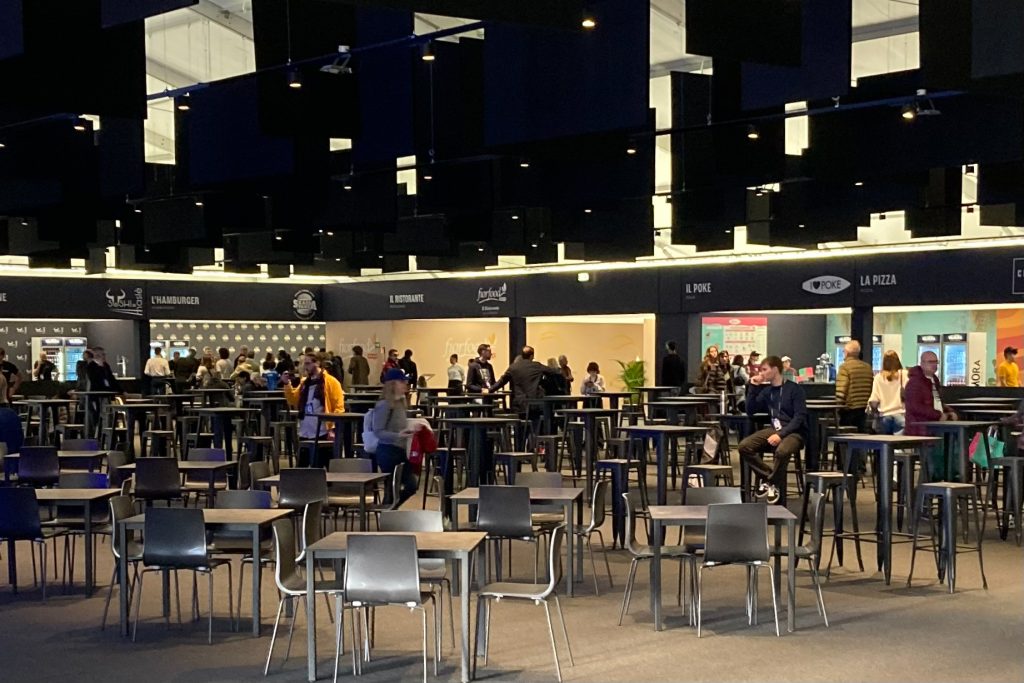
The food offer is not too bad, albeit a bit too carby for our taste, with a shout out to the ‘jacked’ potatoes, prosaically just a simple mis-spelling. The food court area has plenty of seats but they a fill up and the queues at the stalls grow rapidly when a match ends. If there are more than one of you, I suggest you scout out the food offer before play starts then get over there quickly at a match end, grab a table then one of you can go over to your chosen food stall. There is a sit-down restaurant at the back of the food court with a solid, if limited, selection of Italian dishes. There is actually a large bar/food kiosk just outside the arena entrance to the seating area, but you really needed to move fast to be there when a set or a match ended if you did not want to be in a long queue.
All in all, despite the gladiatorial razzamatazz that is part of these type of sporting events – flashing lights and a DJ-led sound system and video screens that would not be out of place at a Coldplay concert for example – this felt like a well-run event with a knowledgeable and tolerably fair crowd (even when Sinner was playing). They certainly did not need the scrolling courtside neon that read ‘Break Point’, ‘Ace’ and even ‘Advantage’ accompanied by a rising riff of music. As the wise person would say ‘No s**t, Sherlock’.
Mobility Access:
As a modern venue this is about as good as it gets for accessibility with moving from street to seat being over flat, firm surfaces – until you get to the steps down to your seat. The queueing is simply an unavoidable part of getting into, eating at, visiting the toilet at and getting away from an event being watched by nearly 12,000 spectators.
Food and Drink
A Grand Café Crawl
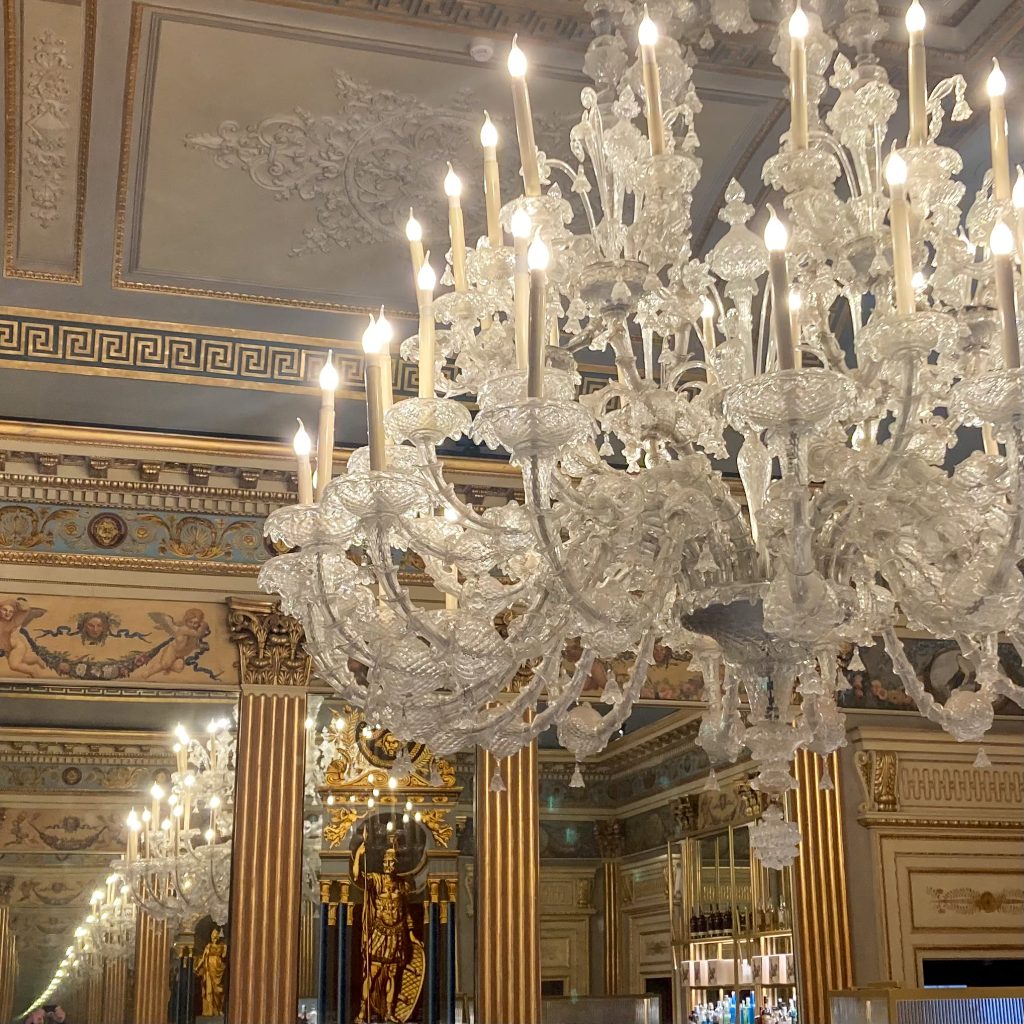
Central Turin seems awash with these ornate, chandelier-toting shrines to cakes, coffee and the bicerin, a Torinese drink made with espresso, drinking chocolate and milk. So on a damp weekday we decide to potter around part of the centre trying them out as we went. We started in Baratti & Milano (https://caffe.barattiemilano.it/en/welcome) in the Galleria Subalpina, wandered through to Caffè San Carlo (https://www.costardibros.it/caffe-san-carlo-torino/) in the eponymous piazza and then just moved south down the arcade to Caffè Torino (https://www.caffetorino1903.it/en/) inside this time. We tried bicerin, coffee, cakes and, for lunch, the Torinese equivalent of the Venetian cicchetti. We gawped at the nineteenth century interiors and the twenty-first century denizens. We chatted and we read or wrote and had a thoroughly enjoyable time. There is no shortage of Grand Cafés to try (https://flawless.life/en/italy/turin/the-best-historic-cafes-in-turin/), so wherever you are you should not be far from an experience to savour.
Mobility Access:
All ground floor places with a step (or a few) to enter. As mentioned, central Turin is largely flat and paved and has good public transport. The toilets in Caffè Torino are in the basement with no sign of a lift.
Del Cambio
And we rounded off our day of European grandeur in this opulent restaurant in a building that dates from the 1750s. Coming here is like stepping onto a stage set for an eighteenth-century drama: the grand building then inside the high ceilings, ornate décor, gilt, red velvet banquettes, the air of solicitude from the staff. I am not a gourmet when it comes to food and often find these elite restaurants (Del Cambio has a Michelin star) lean towards style over substance. We are also wary of restaurants that only offer tasting menus as there can often be something we do not want to eat and, bluntly, there is frequently more food offered than we want to eat. So a joy to find that the seven course tasting menu was exactly that, a tasting menu with suitably sized portions and an equal joy to find that we thought the food excellent. The staff were friendly, helpful (with wine choices) and without the slight sense of distant superiority that can affect the grand restaurant. It is definitely a glorious ‘occasion’ restaurant, and I say occasion because it is seriously costly.
And the tennis seeps onto the menu, even at such an eminent establishment, with our dessert a delicious cake/ sauce combination made into the shape and colour of one of the yellow tennis balls.
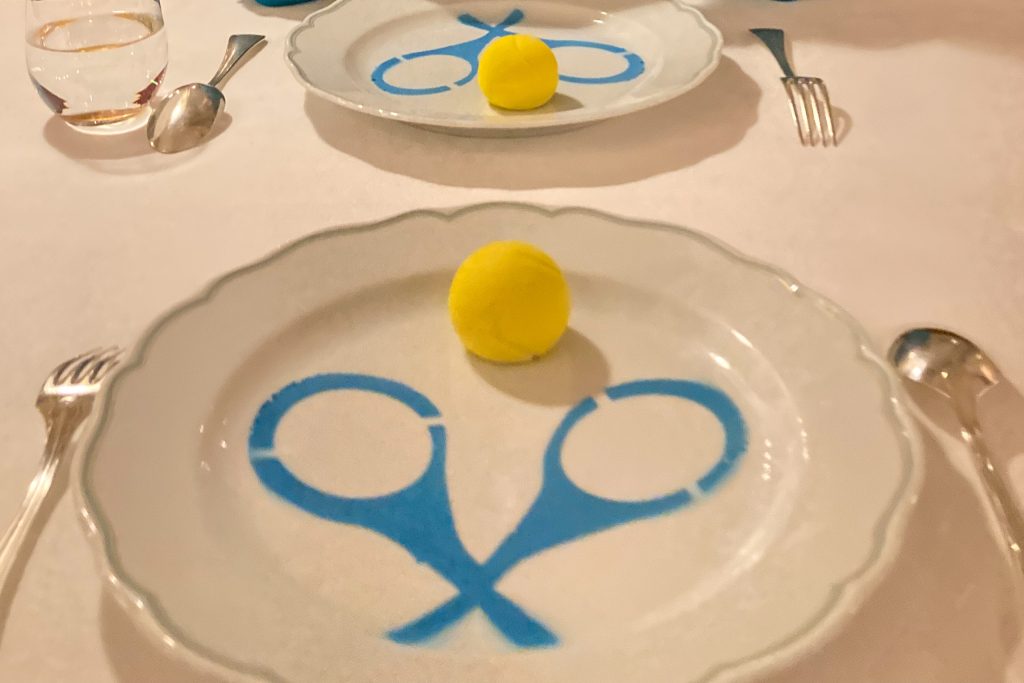
Mobility Access:
A ground floor room with only one step up from Piazza Carignano outside where a taxi can drop you at the door.
Dai Saletta
Hunting out an eatery for some traditional Torinese food on our first night this place, in the San Salvario quarter between the river and the main railway station, popped up in our researches. And delivered. It is in an area of imposing late nineteenth century residential blocks that have much in common with their Parisian Haussmannian counterparts. This was one of several tempting-looking eateries next door to one another clustered near Piazza Donatello. We arrived ten minutes early for our 20.00 booking to find the doors locked. We were the first booking. We strolled round the other places on offer then returned to find a very faintly rustic ambience, a cheery staff, a very toothsome traditional meat-focused menu with some pasta dishes that would work for vegetarians. It filled with locals eating out in small groups of friends and families. There is no website per se but there is this menu page (https://qrmenu.restaurant/risto.asp?i=139&p=XFIVIFEQMC#) and you can book online using quandoo.it.
And the décor was supplemented this week by photographs of all eight players taking part in the ATP Finals, crossed wooden tennis rackets hanging from the walls and, on several surfaces, more (normal-sized) tennis balls. The waiter was keen to learn who we were supporting, hoping for the answer to be Jannik Sinner.
Molo 16
We were so taken with the neighbourhood feel of the restaurants in this area that we came back, having booked this place with a phone call after our brief wander around the night before. Dai Saletta was meat. This charming place was fish. The décor palette was in Mediterranean pastel shades in keeping with the southern Italian origins of the chef. Again we had friendly, patient and helpful staff. Again we had a clientele dominated by locals. Again we had fresh, straightforward, well-cooked dishes (but only one suitable for vegetarians). No website but The Fork has a booking page with a menu (https://www.thefork.co.uk/restaurant/molo-16-r750196#tabSwitch=true).
Mobility Access:
We arrived by taxi and there is only the small step up off the pavement to negotiate for both restaurants. There are bus and tram stops within 250 meters.
Practicalities
Language
Despite Turin being much less of a tourist centre I believe the average visitor will be able to get by most of the time with English and an awareness of some basic Italian words. The smaller, more local restaurants we visited had some staff with little English but there always seemed to be someone who could converse with us tourists.
Getting Around
The public transport system in Turin with buses, trams and one metro line provides comprehensive coverage across the central part of the city. As tends to be the case for large cities, I suggest your starting point for checking out services, fares and journey planning is the website of the transport authority, GTT (https://www.gtt.to.it/cms/en/) which is in English as well as Italian. We only needed to buy a single day ticket when we were there (if you used it only three times it was still cheaper than buying three single journey tickets). We bought ours at a tobacconist shop opposite the hotel. The card activates on first usage, tapping in on the machines on buses or trams. We did not use the metro.
GENERAL
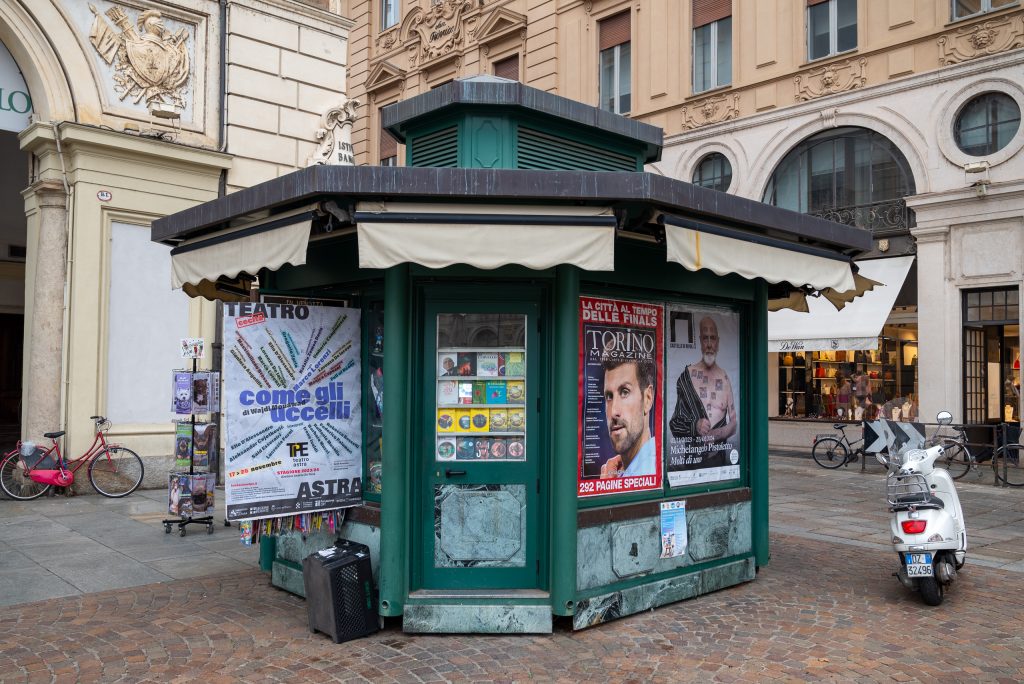
Money and Credit Cards
Like many countries, Italy is moving towards a cashless approach, but we found that we needed more cash than we might have done in other European cities we have visited recently. There was the odd shop with a minimum spend requirement by card of €5 (usually the mini-markets from whom you wanted to purchase that much-needed bottle of water) and taxi drivers who found their card machine was not connecting or required cash from the get-go. We had taken a reasonable amount of euros but found we needed more by the time we got to Turin.
Reading
There are, of course many books about Rome, Venice and, more generally, about Italy that have crossed our paths, but I am confining my comments here to our reading choices for this trip. They were, perhaps, a little obvious. For Rome, Mary Beard’s excellent, readable history SPQR (A History of Ancient Rome) (https://dauntbooks.co.uk/shop/books/spqr/) was a companion to the sights before our eyes. For Venice, we always try to take the latest paperback Donna Leon crime novel (https://groveatlantic.com/author/donna-leon/), in this case Give Unto Others. Through thirty-two books starting with Death at La Fenice, her protagonist, Venetian policeman Guido Brunetti, has not only helped us to relive the city when we are not there but, once we are there, led us to places that might otherwise have gone unvisited, such as Cantina do Mori and Rosa Salva.
One thought on “Three Cities in Italy”