This was a seven week road trip that would result in an impossibly long single piece so, as with other long trips, for convenience it has been divided into eight separate posts.
Part 1: Prelude, Structure of the Trip and Practicalities
Part 2: Catalonia (Aiguablava) and Madrid
Part 5: Zaragoza
Part 7: The North West: Puebla de Sanabria, Cambados and Pontevedra
Part 8: The North West: Ferrol, Santiago de Compostela and Heading Home
ZARAGOZA
Length of Stay: 5 Nights
On the Road: Teruel to Zaragoza
Another journey that would be very short if you took the autopista (around two hours) and another journey that rewards time off the beaten track following your nose or hunting out places to visit in the Autonomous Province of Aragón section of the Spain tourism website (https://www.spain.info/en/region/aragon/). Our wanderings found us at the following spectacular location.
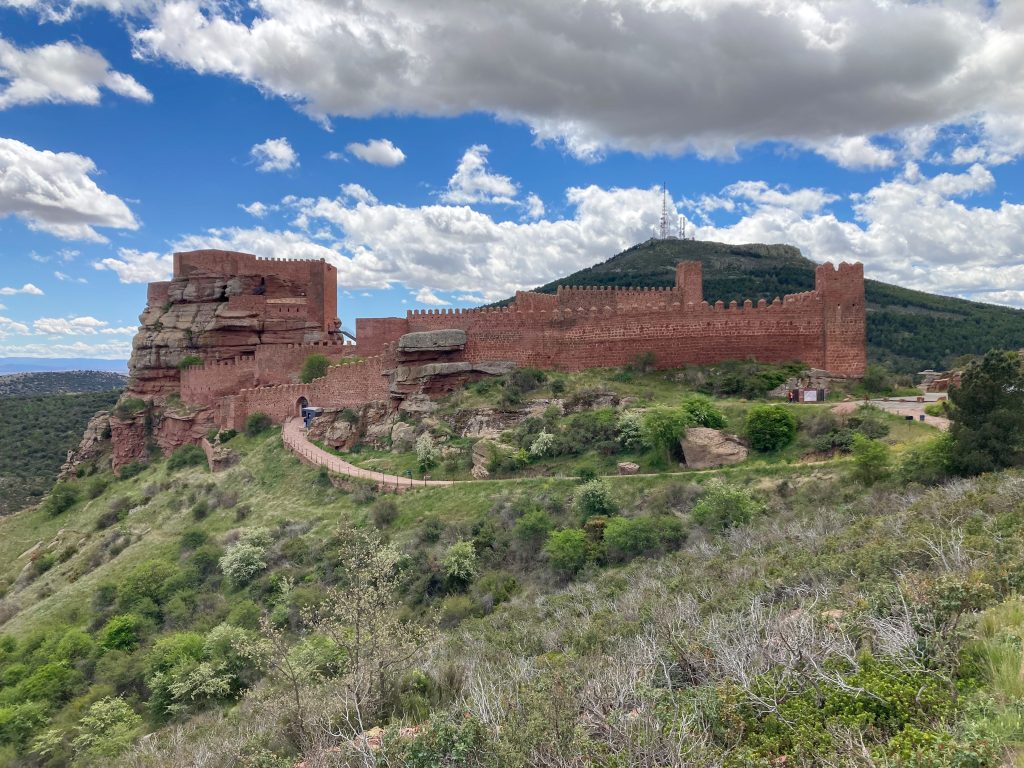
Castillo de Peracense
In a country renowned for its castles that sit proud of the land of the Spanish Meseta this one has a particular allure. It seems to have grown out of the red rock bluff from which its walls were created; from a distance looking as if it was part of the rock. It sits high above the valley plain below and sits above the village whose name it shares. The website is Spanish only but with an information sheet in English that can be found as a PDF on the homepage – https://www.castillodeperacense.es. You can drive up to the small parking area below the castle. Inside the walls, the sense that the small castle has grown out of the rock is enhanced by rock protruding up through the castle grounds in many places. The structure is, as to walls and tower (which you can climb), relatively intact. A few rooms have been reconstructed but the interiors are bare.
Do stop on the approaches from the valley below, and in the village of Peracense, just to gaze up at the red stone bluff. Also, just 50 metres up the road from the castle parking area is the entrance to a crushed gravel/sand path about 50 metres long leading to a wooden platform viewpoint that looks down and across the castle. There are six parking spaces here too. There are no facilities at the castle and the village below feels devoid of even a shop. However if you find the old single storey building at the top end of the restored Calle Iglesia, with its little avenue of trees, there is an almost hidden bar, name forgotten, where you find refreshments and facilities and can sit at a table outside in the peace of the village.
Mobility Access
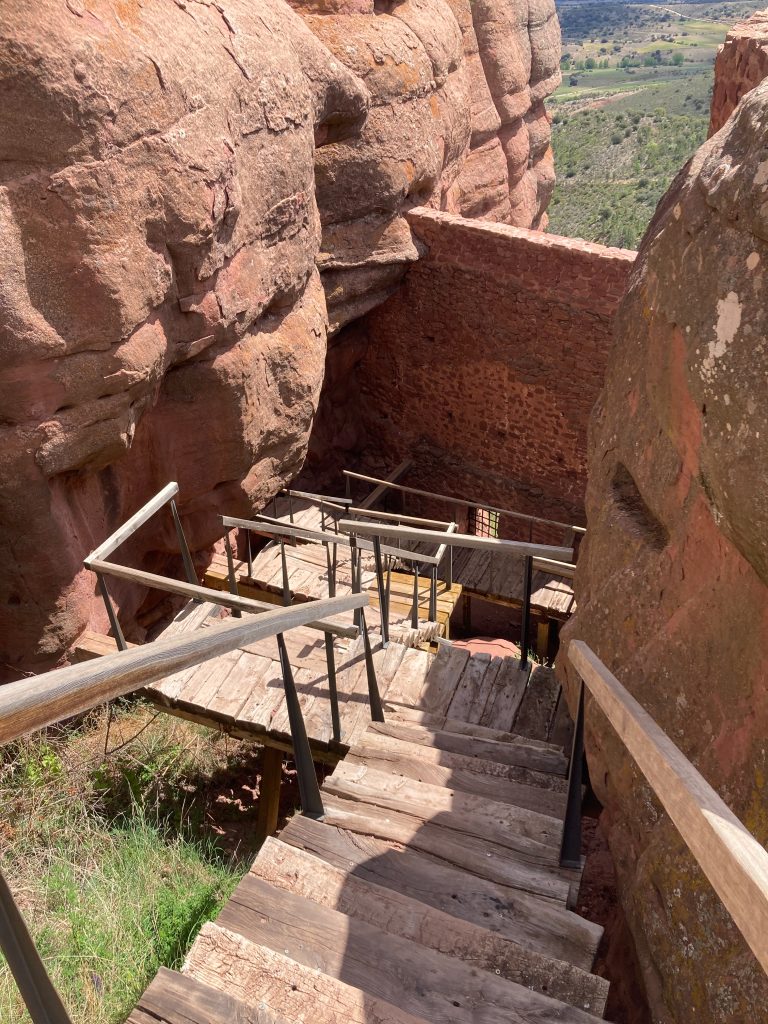
Access to the castle itself is by a path from the car park paved with slightly rough stones that is just over 150 metres long. It drops down slightly from the car park and rises up again to the castle entrance and ticket office. Inside the walls the only way is up – to the relatively flat court area and then, by a series of ever narrowing and ever older steps to the roof of the tower. It was just possible for us to manage the trip to the courtyard level but not beyond. It was worthwhile just to be close to such an unusual structure but, even if the visit inside is not practicable, there is also much to be enjoyed just viewing the castle and its surrounding landscape from near and far.
Beyond Peracense the road drifts through the hills and valleys of the Meseta, gradually flattening out into the broad plain of the Ebro River, one of Spain’s longest rivers. Taking the backroads to reach the city led us through swathes of cherry orchards, many enfolded in protective netting like some green Christo-esque covering.
The City of Zaragoza

One of Spain’s largest cities, Zaragoza’s location in the broad basin of the Ebro river lacks the spectacular high plain location of our previous destinations. At the heart of the city lies the ‘old town’ (Casco Antiguo or El Casco), corralled into a broadly rectangular area about 1,000 metres from east to west and about 750 metres from north to south. Bounded on the northern edge by the river, the street, Calle del Coso, runs along the other three sides with the central hub of Plaza España at its southern edge. Inside this area sit two cathedrals, several other religious and administrative buildings covering the last five centuries, the ruins of a theatre and city walls from Roman times, several museums, the central market, the tapas bar district of El Tubo and the mammoth (450 metres by 50 metres) paved open space of Plaza de Nuestra Señora del Pilar. Beyond, in a sprawling city with a population edging towards 700,000 people, lie plenty of other historical, cultural and culinary locations to draw the urban wanderer. There is no shortage of things to do, sights to see and streets to be wandered through. And yet we felt underwhelmed by the place. This is very much our own emotional reaction and I am sure others would respond much more positively to the vibe there. Even for us some of the places visited or the walks taken were special indeed but, overall, it did not grab us in the way that the cities that we had already visited had managed to do.
Places Visited and Activities
For a starting point of what to do and see here, the English language pages of the city’s own tourist information website (https://www.zaragoza.es/sede/portal/turismo/ver-y-hacer/destacamos) make a useful starting point. For map aficionados the tourist office issues a pocket-sized paper map that is a helpful addition for the city voyager and is mercifully free of the ads that, all too often, festoon such maps. As our hotel had copies to hand out, I assume copies are easy to come by wherever you are staying.
Museo Goya
https://museogoya.fundacionibercaja.es/en/

We have always had a thing for Goya since seeing his bizarre Pinturas Negras (https://onartandaesthetics.com/2015/11/07/goyas-pinturas-negras/) at the Prado in Madrid many years back and read Robert Hughes’ wonderful biography, which I can only find at a sensible price now on online used book platforms. This museum, deep in the old town, contains, principally, hundreds of prints from his extensive output of engravings, all of which are presented in this comprehensive museum. They include his bullfighting series and the disturbing series, Los Desastres de la Guerra (The Disasters of War), about atrocities committed in the Peninsular War of 1808 to 1814. We spent a considerable time here, fascinated. Be aware that, at the time of writing (March 2025), the Museum is ‘closed for extension works’ with no indication of when it will re-open.
Mobility Access
With the works currently being planned there may be changes to the information on access, but I cannot believe the offer we found will be any less effective on re-opening. So the access is direct from the street with no steps. There is a lift to all floors and wheelchairs are available, if needed. There are a great many prints and they are not large (about the size of a piece of standard copier paper) so a lot of standing for close examination is needed. Your own portable stool or their wheelchair is a helpful tool.
Swimming
We were feeling the lack of our favoured cardio and stretch-out exercise, laps in the pool, by the time we hit Zaragoza. None of the tempting outdoor pools were open for use in our previous stops. Here we went indoors at the Centro Natación Helios (https://www.cnhelios.com/instalaciones/piscina-cubierta), a 25 metre lap pool which is part of a massive sports facility, sitting directly across the Ebro River from our hotel room. As will be apparent the website is only in Spanish but the staff were helpful, the pricing was extremely reasonable in comparison to costs in London and the actual facilities easy to navigate.

Mobility Access
The facility was straightforward and, being modern, presents no difficulties in this regard. The pool only has ladder steps for getting in and out. The walk to the pool was just 450 metres across the Puente de Santiago (bridge) over the river from our hotel but involves quite a long flight of steps down from the road level of the bridge to the riverside park. The tram line runs from the old town to a stop (La Chiminea) that shortens the walk to 350 metres over paved surfaces with no more than a gentle slope down to the entrance.
The Tram Tour
Other than the capital, Zaragoza was the first city we visited that did not have a Tren Touristico (although there is a hop-on, hop-off bus) but it has just one tram line (the rest of the city has an extensive bus network for public transport). It was a magnet for one of our tram tours so we took it south from the old town. It was a nine kilometre (5.5 mile) trundle out to the final stop at Mago de Oz running down wide shop-lined boulevards, past elegant parks and the gradually lowering heights of office, retail and service buildings through to a residential area of grid pattern streets and modern low-rise apartment blocks. As always a fascinating insight to the structure of a city and a snapshot of some of its constituent elements. It was only on the way back that I focused on the names of the tram stops in this grid-pattern world – Mago de Oz (The Wizard of Oz), Un Americano en Paris, Cantando baja la Lluvia (Singin’ in the Rain), La Ventana Indiscreta (Rear Window), Los Pajaros (The Birds) and, the closest one to the city centre taking on a new significance as we returned to the old town, Casablanca. The explanation almost seems mundane and begs the question why not Spanish movies or movies by Spanish auteurs – https://www.zaragoza.es/sede/portal/turismo/ver-y-hacer/zgz-de-cine. For tickets see the Getting Around section.
Mobility Access
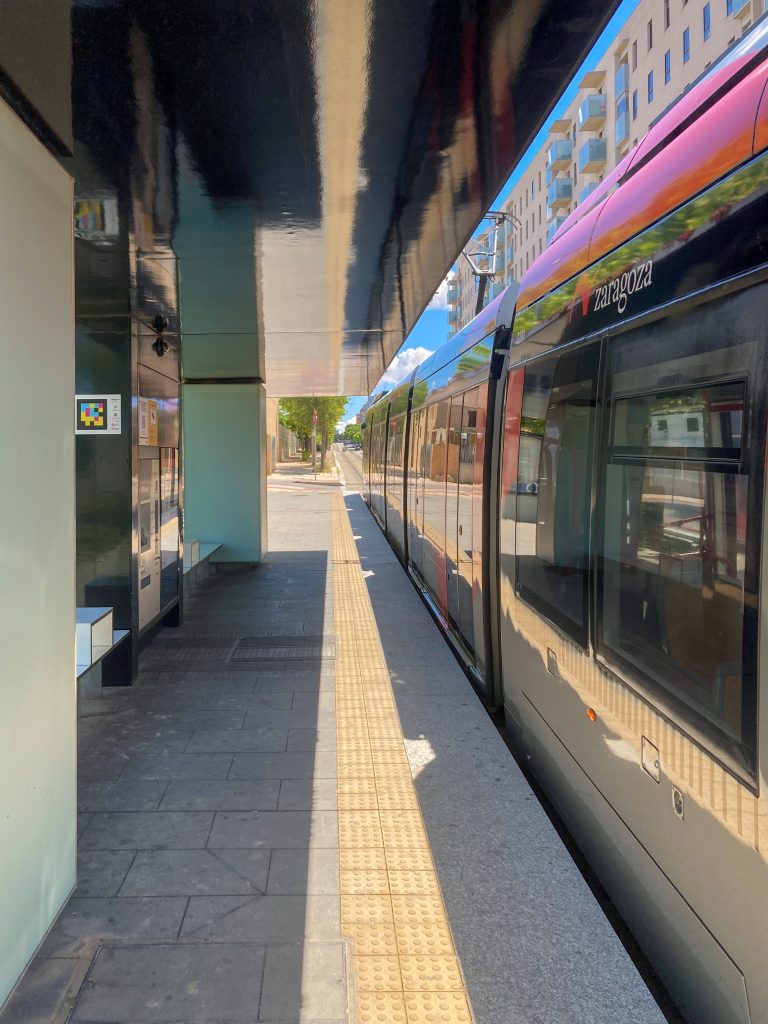
The Zaragoza tram line (and there is only one) has only been operating since 2011 and has clearly been carefully designed to minimise issues for those whose mobility is constrained. The stops all have low platforms, barely 20 centimetres (7-8 inches) above street level, with slopes up from that street level. The trams themselves require no steps to access them from the platforms. Tracks are flush with the street, so offer no trip hazard. The pavements (sidewalks) alongside many of the streets where the trams run are either at the same level as that street or require a minimal step up (and there is usually a slope up to assist in negotiating even that small change in level). Finding a seat is not always easy. Inside there are relatively few seats and the tram is so convenient for locals that it can be pretty busy for much of the day, especially in the central areas. There are places for those with mobility issues but getting to them may be difficult at certain times.
City Walking
The Old Town
No old town of narrow streets that date back centuries and houses, nontheless the wealth of structures that pepper Zaragoza’s El Casco can ever be anything but interesting. And here you add in the collections of shops, services and eating places that grace an area that is not, predominantly, a tourist centre thus giving you the variety of a living city – some elegant, many not so much. So you can walk past the ruins of the Teatro de Caesaraugusta, the Roman theatre, and gaze at it between the railings that line two sides of the site without having to go in, then walk on through the city’s tapas central, El Tubo, with its pedestrian streets narrowed in places to little more than a body’s width by the occupants of high tables and stools of the profusion of tapas bars that line those streets. From there move on into the seeming emptiness of Plaza del Pilar with the grandiose multi-domed cathedral, Basilica de Nuestra Señora del Pilar, looming over all. A stroll onward and you emerge on to the open riverside where the ancient Ponte de Piedra is stepping on its stone piers out across the River Ebro and where, well below the level of the riverside road, the riverside paths await. And you will still have missed out other parts that can be enjoyed, like the Roman wall section and the altogether more human-scale cathedral, Salvador-Le Seo.

Mobility Access
As you would expect from the city’s location in a broad riverine plain, the city and El Casco are all pretty flat with few noticeable slopes and no hills. Within El Casco streets are flat, paved and largely vehicle free with stopping places for rest and beverages plentiful. Buses do run on the roads that encircle El Casco and a couple off the cross streets nearer the east end of the area, so you should never be too far from a bus stop. The tram line runs down the south-west end of the area. To reach the riverside walkways on this side of the river does require taking quite lengthy flights of steps, but you lose little in terms of view by staying on the pavement (sidewalk) of the riverside road, especially as the area around the Rowing and Watersports Club is decidedly scruffy with the usual monotonous graffiti artwork.

El Expo
Often a sucker for modern architecture I was drawn into trying a walk through the site of Expo 2008 laid out in the inside curve of a hairpin bend in the Ebro River about 4 kilometres (2.5 miles) west of the El Casco area. Intriguing notations on maps like the Torre Agua, the Zaha Hadid designed Pavilion Bridge (Pabellón Puente) and the prospect of a riverside walk through the Parque Fluvial de la Expo 2008 seemed to encourage exploration. What a disappointment. The buildings were there but the whole area seemed deserted, with the Torre Agua no more than a modern office block and closed to boot, the Parque Fluvial decaying, temporary fencing around areas needing works, the sprawl of the glass palace of the Palacio de Congresos unused and Mobility City (a museum devoted to ‘The Future of Mobility’ – https://www.mobilitycity.es/en/) closed. Even the structure of the Pabellón Puente felt out-of-place, too overbearing for its situation above the tree-lined river. My mentality switched and the walk became a perfect location for photographing ‘ruin porn’ – https://edition.cnn.com/style/article/what-ruin-porn-tells-us-about-ruins-and-porn/index.html. I saw almost no-one else and, as the walk back toward the centre continued, dark clouds and distant thunder somehow added their own coda. So disappointment turned full circle into engagement by camera. Not for everyone, then.

Mobility Access
You could walk here from the city centre along riverside paths. I caught a bus. The roads around the site have several stops which can be used for arrival and departure. The paths and paved spaces within the Expo area are, largely flat and there are few hazards. Slopes run down from park level to the riverside paths, some of which are packed earth so might be problematic in heavy rain or its aftermath. There were no refreshment stops open when I was there and those stalls that were there did not look like they were going to open up any time soon. Conversely there are plenty of benches and other sitting places.
Parque de la Aljafería
The centrepiece of this park is the eponymous palacio, now home to the parliament (Cortes) of the Autonomous Region of Aragón. You can visit this palace. The everyday guided tours seem only to be in Spanish but you can get free access on occasional days (https://www.cortesaragon.es/English.3240.0.html?&no_cache=1), presumably when the Cortes is not in session. However the exterior of the building, set in a park that is in a shallow basin just under 2 kilometres (2,000 yards) from Plaza de Nuestra Seńora del Pilar, is an appealing sight. Built as a fortified palace in the late 11th century, it now presents as cleverly restored piece of Spanish-Islamic architecture complete with bastions, moat (filled with well-kept lawns and bushes) and a photogenic set of crenellations. This is set off by the surrounding park, neat and peaceful with its avenues of trees and an almost geometric pattern of paths. A walk that circled the moat would run to nearly 500 metres.

Mobility Access
Within the park paths are, for the most part flat, some smooth stone, others those grey brick-shaped cobbles we have learnt to be slightly wary of. Alongside the cobbles the grass lawns can provide an alternative surface. There are plenty of benches. The land slopes down from the roadway on the south side of the park but access is by sloping paths from that side. On the east side access is easier. Bus stops, with buses running from the city centre, can be found on both roads. No cafés in the park itself but there are a few in the buildings on the aforementioned roads.
Mercado Central
Only 100 metres from our hotel this is a real market; all fruit and veg, meat, cheese, fish, delicatessen, flowers with the tapas bars and other take-away food outlets taking second place to its primary purpose. Its emphasis on being a market for locals means the website is helpful, but only if your Spanish can manage it – https://www.mercadocentralzaragoza.com). Although it was built and opened at the beginning of the twentieth century it was completely revamped and re-opened in 2020. The result is that it presents an almost unworldly neatness if you have a picture of European food markets elsewhere forming in your head.

Mobility Access
Inside smooth, flat floors are the order of the day and it is all on one level. The level of the market is set about ten steps above the plaza level at the north end but, because of a slight slope, only 4-5 steps above the same plaza at the south end, where there is a slope access to the market floor for those who cannot manage steps.
Laundromat
Coladaxti Lavanderia Autoservicio
Improbably set in a corner premises that felt it once housed an older-style café, this laundromat is on the side street of Calle de Santa Isabel, deep in El Casco. It was not staffed and quite small, but inside it was a fully, and effectively, functioning example of the breed. Thus card operation, detergent included, instructions also in English and reasonably busy, so we worked in shifts with breakfast breaks in Marianela (see Food and Drink) just around the corner.

The Hotel
The city does not have a Parador so we sought out a comfortable, functional hotel close to the city’s transport that had somewhere the car could be hidden for the duration of our stay. Hence Hotel NH Ciudad de Zaragoza (https://www.nh-hotels.com/en/hotel/nh-ciudad-de-zaragoza) which is part of a Spanish hotel chain that feels somewhere in the range occupied by the likes of the Hilton Doubletree and Mercure chains. This one was a modern building right on the riverfront which meant our corner suite had a balcony that looked over the river and across the rooftops to the cathedral. It was bright with uncluttered functional décor and all we needed from a city centre hotel. The dinner and breakfast we had were not meals we could recommend but, after a first foray to each, the many offers out in the city proved the point that you do not need from a city hotel much more than a place with a comfortable space to sleep and ablute. And it had a tiny gym, a car park and that view. As a 4 star designated place on the edge of El Casco, it had a very reasonable price point. It also had a tram stop (Plaza del Pilar-Murallas) right outside the front entrance and other bus stops within 150 metres. There is a daily charge for the car park, which is underneath the building.

Mobility Access
Step-free access direct from street level, stone floors (flat and smooth) and a lift to all floors (except the tiny gym room on the roof). And that tram stop right outside. Walking to the old town area over flat, paved surfaces was straightforward, with the west end of Plaza del Pilar 100 metres walk around the back of the remains of the Roman walls which sit across the street.
Food and Drink
Breakfast: Marianela
The breakfast at the hotel being somewhat underwhelming we did some digging to find this place, an unprepossessing but oddly timber-fronted storefront 300 metres walk away in the old town. It was actually a very welcoming little place with some healthy breakfast bowls alongside some toasted sandwiches, croissants and savoury brioches, smoothies, chais, coffee and a huge selection of teas. All-in-all a good place for us to keep coming back to for breakfasts during our stay. No website but if you put Marianela, Calle de la Manifestación, Zaragoza into Google Maps you can see photographs in the sidebar of what the place looks like and find the menu – in Spanish only.
Mobility Access
It is a shopfront property with no steps inside to access the tables or the toilets and only a shallow ledge a couple of centimetres high at the entrance.

Cafés in the Parks
In the warmth of a Spanish May we can take simple enjoyment from finding a peaceful place to sit, sip beverages, read, write and watch the world go by. Zaragoza has this pleasant pair in two different park settings.
Plaza de los Sitios
This plaza-cum-park is an almost perfect place for a slow traveller to sit in the sun and indulge in those activities. Set in the north-eastern corner of the district known as El Centro (the area that contains most of the shopping areas and smart hotels in the city which sits just south of El Casco), the plaza with its playpark is at the heart of an upmarket residential and shopping area and has a real neighbourhood feel. After school finishes young children, shepherding their parents, fill the park. Footballs and skateboards appear. Dogs are walked, friends are met, pushchairs are pushed, babies are breastfed. A man with a string and soapy water creates huge bubbles to entertain the children. Sitting at the outdoor tables of Camerino Bungalobar (https://www.camerinobungalobar.com), the café within the plaza, on a warm day in late May was a relaxing, engaging experience.
Mobility Access
The plaza is a town square centred on a fountain, laid out with lawns and paths that are flat and smooth. There is an ample supply of benches and shade from trees. It lies about a 450 metre walk east from the Plaza de España tram stop. Buses can bring you to stops that are a bit closer than that.

Parque Grande José Antonio Labordeta
The antithesis to the town square plaza, this huge (27 hectare) park was inaugurated in 1929. In the district of Universidad about 3 kilometres (2 miles) south-west of El Casco, it is very much a designed park of avenues of trees, an almost grid pattern series of paths and lawns and formal fountains and suitable monuments. It is big enough to have its own tren touristico, Tren Chuchu Zaragoza (https://trenchuchuzgz.com), which only opens on a daily basis when the weather warms up, which for the Spaniards means mid-June, so it was not open on the bright, sunny (21°C/70°F) weekday when we were in the park. There are some cafés and restaurants dotted through the park. We headed for La Tagliatella, the one nearest the entrance from Plaza del Emperador Carlos V (which has stops on the tram line). It is actually an Italian restaurant, but we were able to grab a coffee and water and sit outside in the sun watching a different mix of peoples wandering past. Here were more people doing their perambulations, fewer just stopping to play, sit or chat. The size of the park takes you away from the bustle of the city.
Mobility Access
Like so much of Zaragoza the park is largely flat and, being a formal layout has smooth surfaced asphalt areas and packed earth paths of the sort that adorn public places in France and Spain (think Tuileries Gardens in Paris for example). The restaurant sits on a low concrete platform but is otherwise a single-story edifice. It is about 250 metres walk from the tram and bus stops in Plaza del Emperador Carlos V. Within the park you can take as long or as short a walk as you want. There are some benches dotted through the park.
El Tubo
We did not try any of the tapas bars in this famed section of El Casco just north of Plaza de España. I have hinted at the potential difficulties for those with mobility constraints – pedestrian streets, high tables and high stools for use by those wanting to stand or sit to imbibe. For us the febrile atmosphere, which some will love, was not conducive to a comfortable or enjoyable eating experience.

Dining Out
La Lobera de Martin
We were chasing a hankering for a paella and advice led us here. It is a big place, with two different eating spaces. The homepage of the Spanish-only website (https://www.laloberademartin.org) shows a smart tablecloth-type brick-lined room, La Lobera, but we were in the La Braseria part of the same operation across the corridor. Here the website only hints a vibe that can best be described as industrial. A place that rolls out good food in a once-factory. The walls are plain clouded glass or plaster. The ceiling runs with pipes and wires. Jamons hang in rows like carcasses from the ceiling. The floor is a grey concrete. Tables come easily wipeable (forget those tablecloths in the pictures). Huge iron pans of paella and other dishes emerge from the kitchen and are placed on tables where friends have gathered to share. It is actually enjoyable if you go with the flow. We indulged our hankering and rolled out later, sated. There is plenty on the menu for most tastes, but vegetarians are going to struggle unless they stick to tapas and side dishes.
Mobility Access
La Braseria is on the ground floor with those concrete floors offering step-free access. The entrance is in a small arcade of outlets that runs off the north side of Plaza de España, a plaza that probably counts as Zaragoza’s hub. The tram stops there, as do a number of bus routes.
L’Ontina
Our hotel has a rather grander (older) sister establishment in the smart section of the city (El Centro) near Plaza de los Sitios. Here, after our weighty offering the previous night, we were drawn by the lighter pick and mix offering of tapas away from hectic El Tubo. La Ontina worked well for us – https://www.nh-hotels.com/en/hotel/nh-collection-gran-hotel-de-zaragoza/restaurants. It was quiet, relaxed with quality tapas and, if the food took a little time to arrive that may simply have been a reflection of the fact of its proper preparation.
Mobility Access
There are eight steps up to the restaurant level from the street (the entrance is at the back of the hotel). Once inside much of the restaurant is on one level, although there is a section upstairs. The tram stop at Plaza de España is 400 metres distant with bus stops on the main boulevard, Paseo de la Independencia, around half that distance.
Palomeque
We found this busy place, which is big on Aragonese cuisine, coupled good quality cooking with an engagingly entertaining service, so we went back the following night for a repeat. Busy means book or wait in the street outside for a table (there are some outside as well as in). Another Spanish only website (https://www.restaurantepalomeque.es) with a menu that has a wide variety of culinary options that covers raciones (including a range of regional meats and cheeses) and a vegetarian ‘lite’ set of seafood and meat dishes. The waiters speak enough English to help you out with translations.
Mobility Access
It is on a pedestrian side street just a few metres south from the boulevard that circles El Casco, Calle del Coso, with street level access and no issues inside except that the proximity of tables to one another have limited space to move around between them. The nearest tram stop (César Augusto) is 250 meters away. Some bus stops are closer still.

Getting Around
A city of this size should have a good public transport system and Zaragoza’s is pretty good. Irritatingly the tram and buses seem to be under different administrative control, so you end up with two websites to navigate, neither in English. Buried deep in the bus company website is a useful map of the bus lines that also shows the tram route (https://zaragoza.avanzagrupo.com/mapa-de-lineas/) but, for journey planning, we used Google Maps. Fortunately the tickets you buy operate on both. If you are going to use public transport quite a bit it is best to get a rechargeable card that comes, ready-loaded, with 11 journeys. We bought ours at a nearby tobacconists, although you can go to the Avanza Customer Service Office (https://zaragoza-pasobus.avanzagrupo.com/frm_verdescarga.php?ref=1216). Once bought the card can be charged up again at the ticket machines on the tram stop platforms.
We used taxis sparingly and these arrived fairly swiftly on making requests at hotel receptions. Given the adequacy of public transport and the uncertainties associated with street parking (can you actually find a space near to your destination?), the car went into the hotel’s car park and remained there for the duration of our stay.

Mobility Access
Trams are covered in the Tram Tour section above. The bus fleet is fairly modern and many buses have low entry points but none are more than a step up to get on board.