This was a long trip and, written about properly, it would be an immensely long single blog. For convenience then, this trip is divided into eight separate posts:
Part 1: Prelude, Trip Information and Practicalities
Part 4: Southern Scenic Route and Doubtful Sound
Part 6: The Ahuriri Valley and Lake Tekapo
Part 7: The Tranz Alpine Train and the West Coast
Part 8: Marlborough Sounds and Kaikoura (and Auckland Coda)
Prelude
Oh, the joy of travel. Our first trip outside Europe since the onset of the COVID-19 pandemic is to what feels like an all too obvious destination – the South Island of Aotearoa, or New Zealand as it is known to us Pākehā (that is us non-Māori). But what a place to come. The three words I choose to encapsulate are people, scenery and space. These are the characteristics that made this leisurely (five week) jaunt in the southern hemisphere summer such a special one.
The people we interacted with seem to have an innate helpfulness and friendliness, straightforward but without quite the level of brashness of their neighbours across the Tasman Sea. An approach which adds to the calm, slow approach to life that fitted in with our own unhurried progress. The scenery goes far beyond just the striking landscapes of the Southern Alps and the Fiordland which, of course, do astound. Were our road atlas from the Michelin stable, every road on the west of the island would be edged in green (their designation for a particularly scenic road). But also the drive down the east coast gave us a different taste of varied and striking vistas, as if the land was tuning up for the sublime to follow. And the cities have their own serene elegance. Christchurch and Dunedin (and many smaller places) gave us windows into culture, history and other elements of the land’s society. As for space there is a real sense that this is an open, empty country. This is not a burden but a boon. The simple statistic is that South Island has a population density of 8 people per square kilometre (the United Kingdom number is 231 and even in the Big Country (USA) it is 37). This makes for miles of driving with few other cars, beaches that stretch away, empty but for the odd seal, and towns and countryside that are quiet and peaceful places to be. In short, ideal for our slow mode of travel.

We did not ignore the North Island; it was just that we had spent nearly five weeks roaming around that part of New Zealand back in 2010. So ‘been there, done that’ (in so far as one can ‘do’ any country in just a short stay) but we left then promising ourselves that we would return to explore southwards. Voilà!
We did not engage that much in the sort of outdoor activities that are the main reason many people visit this part of New Zealand – the myriad hiking and biking trails and the water-borne sports. Looking back we perhaps did more outdoorsy activities than I might have realised, however we went nowhere near the adrenaline pastimes like jet boating, whitewater rafting or the ludicrous bungee-jumping. For that reason we spent no time in Queenstown, the ‘hub of adventure, bursting with adrenaline and fun’ (https://www.newzealand.com/int/queenstown/) for there is as much to do and to see elsewhere for slow travellers who are drawn to this serene and striking land.
Structure of the Trip
This was a trip that became one around the globe which enabled us to encompass attendance at the Australian Open tennis in Melbourne and visit friends and family on the west coast of the North American continent (for the former see A Week In Melbourne). For this sort of itinerary, we prefer to use the bespoke service of our long-time travel advisers, Audley Travel (https://www.audleytravel.com/new-zealand). Apart from anything else a trip that involves six international flights and one domestic one is best left to someone who can co-ordinate those elements, sort out the car rental and offer accommodation and activity options. Their advisers are recent visitors to most of the places, so have a good and up-to-date grasp of what is doable. The only elements we booked ourselves were the tennis tickets and our hotel in San Francisco (where we had a particular need to be in a part of the city close to friends). Fundamentally this was a road trip so, from a mobility perspective, you should assume you need a car except in the cities of Christchurch and Dunedin.
Itinerary
The South Island element of the trip covered 36 nights. It was conceived as a driving tour taking a broad figure of eight double loop, starting and ending in Christchurch. The first loop took us south, curling round the east and south coast before heading up along the east side of the Southern Alps on via the glacial lakes back to Christchurch. The TranzAlpine train from Christchurch across the mountains to the west coast gave us a break from driving, before a drive north along the coast, up through the Buller River gorges to Picton. After time in Marlborough Sounds the northern loop was completed by a drive along the east coast finishing in Christchurch. A flight to, and a night in, Auckland was tagged on the end for us to connect with our onward flight to San Francisco.
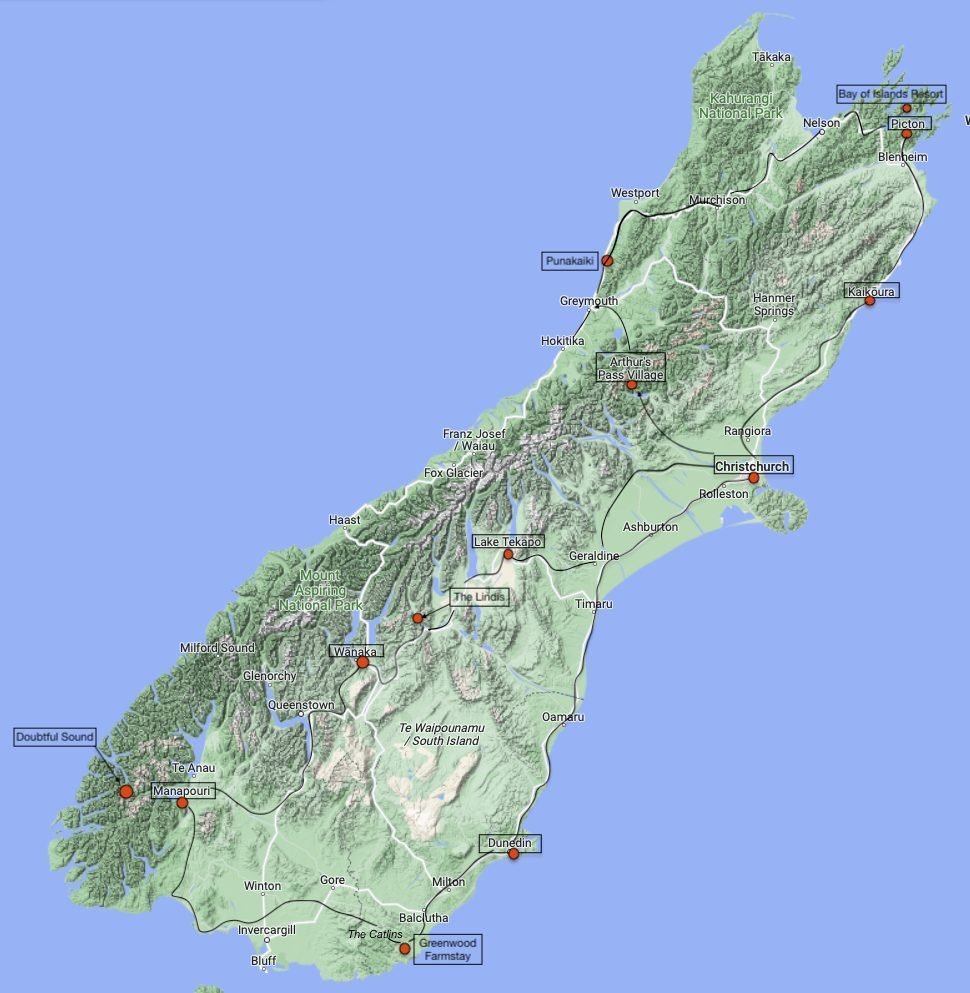
This piece will follow the route of our travels taking sights seen, things done, accommodation and eating out at each place we stayed, rather than trying to take a comprehensive overview. In the piece, I have referred to certain roads by their number. These are State Highways so the designation I have used is SH before the number.
When and Weather
In January to February 2023 when the southern summer provides a way to escape the shorter, gloomier days at the core of an English winter.
Summer meant a good dollop of sunshine but interspersed with some cloudier and rainier days. For the most part the daytime temperature hovered around the low 20s centigrade (from the mid 60s to the mid-70s Fahrenheit). It can get a fair bit cooler, if rain and wind combine to make it so. The South Island gets more rainfall in summer and the West Coast gets much more of what does fall. That said, we had some beautiful days there too. And, in the eastern shadow of the mountains, we had some glorious weather, sunny, warm but not too hot, nor at all humid. Sea temperatures were such (13-16°C; 55-60°F), that a wimp like me only ventured in twice and only then firmly encased in a wetsuit.
Flights
Air New Zealand inbound from Melbourne (economy only), internally from Christchurch to Auckland and finally outbound from Auckland to San Francisco (and the disconcerting fact of arriving, timewise, before you left). Very comfortable all round and a very straightforward automatic check-in and bag drop at the Melbourne end with plenty of helpful staff to guide us through the process when needed.
Mobility Access:
Self-push wheelchairs available in Melbourne and Christchurch made transit at both ends very easy. We took the wheelchair all the way out to the car at Christchurch Airport – we just needed to take a little care learning how to steer two suitcases (with wheels) when you are being pushed in a wheelchair. With a little trial and error it is easier than you think. And we were grateful for the airport to hotel transfer organised by our travel advisers.
Reading
Some of our holiday reading was our usual mix of history and fiction from the place we are travelling.
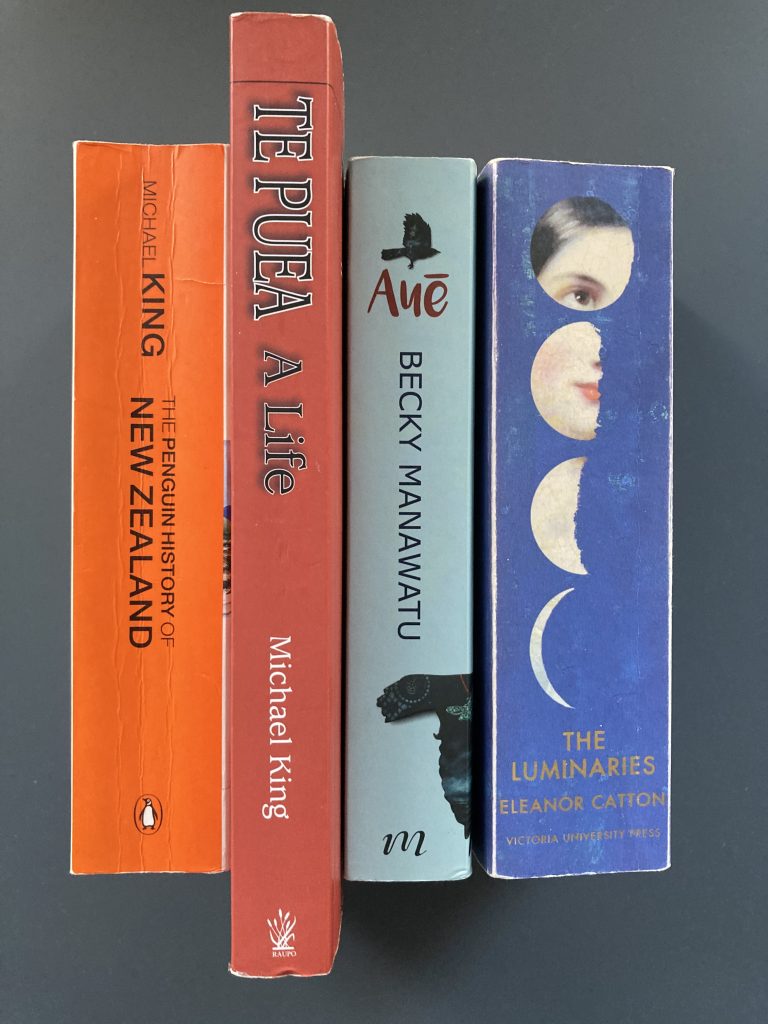
The Penguin History of New Zealand – Michael King
https://www.penguin.co.nz/books/the-penguin-history-of-new-zealand-9781776950805
Despite the dry sounding title this is an excellent introduction into the full history of the country up to 2000. It was last updated in 2003 as, sadly, the writer, academic historian Michael King, died in a car crash in 2004. It doesn’t neglect the South Pacific origins of its history nor the history of the first settler community, the Māori. King was very aware of his Pākehā (white) background when writing about the Māori and makes a special effort to encapsulate the full spread of Aotearoa’s history.
The Luminaries – Eleanor Catton
https://dauntbooks.co.uk/shop/books/the-luminaries/
This much garlanded novel (inter alia Booker Prize Winner in 2013) was one I had forgotten about until we were well into our travels when we saw it in a bookshop in Wanaka. It is a complex novel difficult to categorise – part crime novel, part historical novel, part psycho-drama – but it was one that, despite its length, we both devoured as we travelled round. It also prompted a side-track off our route to visit the west coast town of Hokitika, the location of its mid-nineteenth century action.
Te Puea (A Life) – Michael King
https://www.penguin.co.nz/books/te-puea-a-life-9780143011422
Reading about the extraordinary force of nature that was Te Puea Herangi in Michael King’s History (see above) I wanted to know more about this Māori woman who became one of the leading political figures in the first half of the twentieth century. She reinvigorated Māori culture in Waikato and beyond, set up local Māori community meeting houses and health care centres to deal with smallpox epidemics, took over 100 orphans under her care, travelled the country raising funds to enhance Māori influence and, later in life, fought to secure compensation from central government for wrongs done to her people by the Pākehā. And it is an astonishing story. Like all of us she was a complex personality, not without her foibles and with her own private tragedies.
Auē – Becky Manawatu
https://www.waterstones.com/book/au/becky-manawatu/9781914484674
In the South Island we were casting round for more reading and found, amongst the recent fiction section of a bookshop, this striking novel that portrays the underclass of New Zealand life through the eyes of four Māori protagonists where the undercurrent of humanity shines through the tragedies of life on the margins. It garnered several prizes in New Zealand (including a best crime novel prize, oddly for this is no crime novel as far as I am concerned). It was an evocative book to read, especially sitting in our accommodation near Kaikoura looking at some of the coastal landscape and the farming areas where it is set.
A Decent Road Map
https://hemamaps.com/products/new-zealand-handy-atlas-oe
Well, not strictly reading but we had this one and it added so much to our enjoyment of the looping drive around the South Island. Not only can you both plan impromptu diversions and routes that take you places Google Maps do not even think about and consider the type of roads you will be travelling on (differentiating sealed from unsealed roads can be key) but it also marks all The Lord of the Rings filming locations. The Hema Handy Atlas is also a sensible, portable size making it easy to refer to in and out of the car. Given it is published in New Zealand and the apparent lack of availability in the UK, it might make sense to try and buy one when you get there – try Scorpio Books in Christchurch (https://scorpiobooks.co.nz/contact/).
A Diversion into Laundrettes
Elsewhere I have waxed lyrical about the benefits of using laundrettes rather than the inevitably more expensive hotel laundry service. As a way of seeing parts of towns and cities that take you out of the well-heeled tourists’ zones, we find them interesting on many levels, because they are often set in more everyday parts of the cities and their denizens can be fascinating too. Our first experience in Christchurch was an exception to that rule. An almost kiosk in the parade of shops sheltering under the high glass roof of Cathedral Junction could not have been more central. Unusually in this day and age this was a coin-operated facility so we had to gather the necessary change. Then we discovered no powder was available. (From what I can tell from a bit of online searching, it may be that the laundromat has upgraded since our visit). Next door a small convenience store was, enterprisingly, selling small, clear, unmarked plastic bags of a white powder. Despite the sensation that I might have been buying packs of cocaine, these were just right for one wash.

Seeking potential laundromat locations has become part of our research for trips and through this we had unearthed the world of Liquid Laundromats. This business has 150 laundromats around New Zealand and operates a no-cash system where you simply charge up a card (acquired at your first laundromat) with an amount of credit and it becomes a sort of pay-as-you-use thereafter. It is incredibly straightforward and, on such a trip as this, very worthwhile. All you have to add is the laundry powder – a visit to a Countdown supermarket had sorted that. Our first wash was in the Dunedin suburb of Mornington, a small shopping park in a residential area. All worked quickly and so we had just enough time for a coffee from Alto Café (another gem of a South Island place in a small art deco building – https://www.altocafe.nz) and a bit of a wander to gaze at Dunedin’s steep streets (Mornington is high above the city’s CBD). Location two was in the Christchurch suburb of Riccarton, a stop heading back into the city from our southern loop of the South Island. The suburb was a bit more shopping mall than Mornington, busier but still essentially residential.
An Introduction to ‘Wow’
I always struggle to describe landscape without sounding like a cliché, repeating the use of words like beautiful, astounding, amazing, glorious and their ilk. On the Doubtful Sound boat trip (see Part 4: Southern Scenic Route and Doubtful Sound) a fellow traveller introduced me to ‘wow’ as a landscape descriptive. A particular vista, seen for the first time, would warrant one, two or three ‘wows’. There was nothing conscious about this usage, it was simply an emotional reaction and, therefore, all the more genuine. It became a group joke that a particularly spectacular vista might be described as deserving a ‘triple wow’. In a subsequent discussion I crassly remarked on how ‘wow’ lacked a certain poetry. Another fellow traveller tersely commented that the authentic emotion attached to ‘wow’ gives it its own simple poetry. I was chastened and we started to adopt the phrase for the stunning vistas that populate the scenery of the South Island. Did that vista warrant one wow, two wows or three?

Practicalities
Eating Out – Timing
New Zealanders eat early or rather what someone used to restaurant hours in London or much of urban and southern Europe would regard as early. After being caught out in Christchurch on our first night (we were out later than normal and nearly every restaurant closed their kitchen at 20.00), we took a little more care to fall in with local timings and ensure we were at restaurants before that sort of time. As in some other countries, the COVID-19 pandemic had created staffing shortages in the hospitality industry. The consequence may be, as we found in Lake Tekapo, that some restaurants may only be open for a few days in the week. This may be a situation that is gradually righting itself.
Car Rental and Driving
Audley, our travel advisers, use Avis so they provided the three different cars we used in the South Island. I must confess I find it difficult to find any but the most nit-picking (ergo irrelevant) differences between the large international car rental companies. Service, quality of car and location availability all seem similar and, to me, work well. Their attempts to flog you extras when you book or come to collect the car are also very similar. We had booked a large saloon (sedan) to give us a degree of comfort given we were doing so much driving. For some reason, on our first two rentals we were upgraded to a mid-range SUV which was actually much appreciated.

As to driving this is perfect for the slow traveller. The roads, in comparison to crowded Britain, were quiet, indeed one would say very quiet. On South Island there are almost no dual-carriageways so two-lane highways are the norm and a 100 kph (62mph) speed limit applies outside built up areas, so traffic never feels like it moves particularly quickly. Driving on the left makes the transition from driving in the United Kingdom easier as well. Experience suggests that most Kiwis are sensible, safe drivers and we never felt harassed by people driving too close or undertaking chancy overtaking manoeuvres.
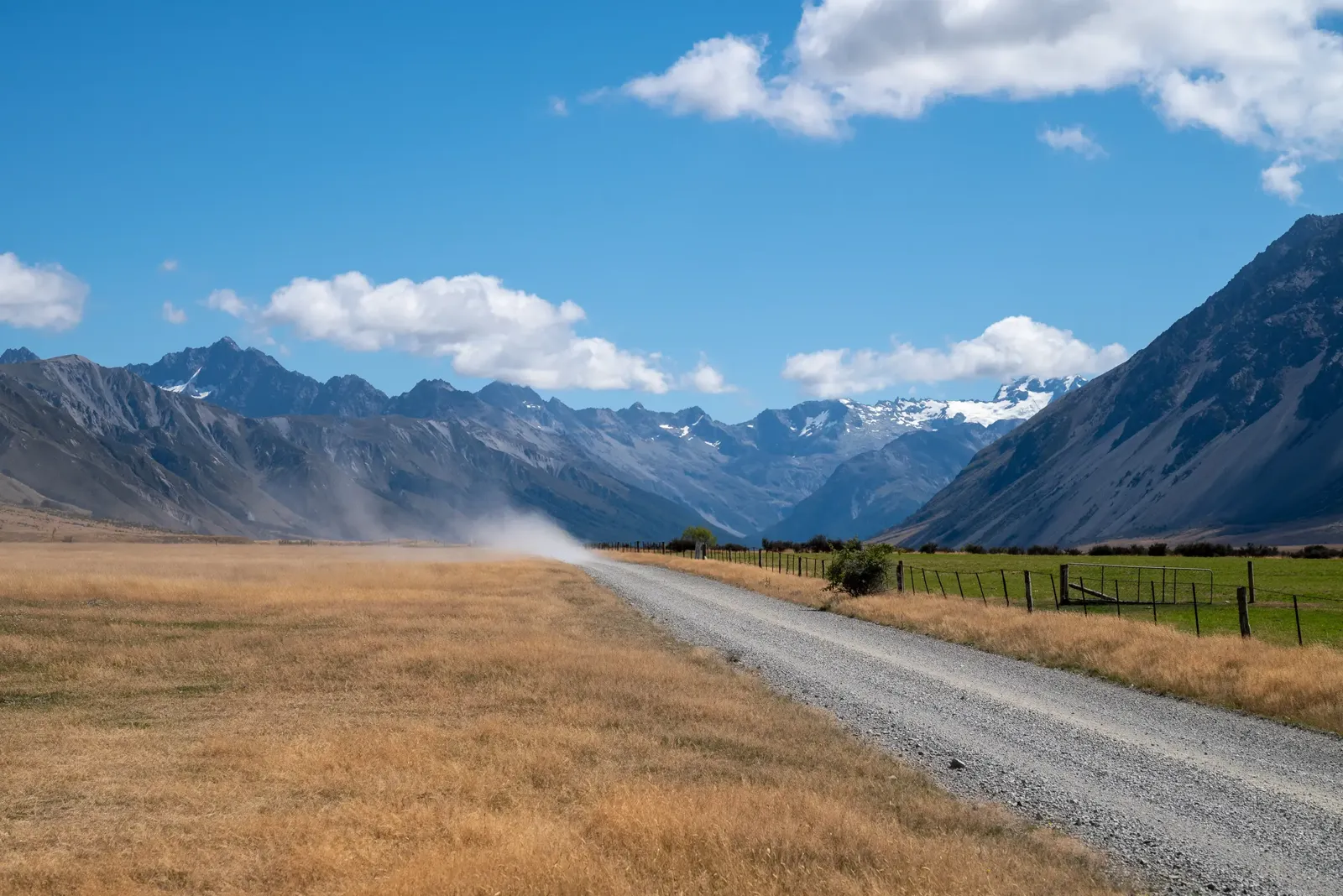
If you drive for any length of time in rural areas you will probably end up doing some driving on unsealed roads. This beast, pretty much unknown to the average British car driver, does need a little care. We were given some sage advice by our host in The Catlins, Helen-May, before we first ventured onto them. Stick to the furrows that other traffic has created in the heavy gravel, she said, and keep your speed below 70 kph (44 mph) because it is all too easy to find the car slipping and skidding on the looser stones. She was right. If you have to leave the furrows (as when another vehicle is heading towards you using the same furrows) even at relatively slow speeds you can feel the car slipping slightly, as if it was on ball-bearings, before grip is regained. Another thing to be aware of is the dust. It was mercifully dry for much of our driving time but that meant travel on unsealed roads kicks up billowing dust. So visibility can be lost either as you pass through the dust from cars coming towards you or from that created if you get behind another car. Dust also quickly covers the rear screen and is difficult to remove with the wipers (it just coagulates and goes streaky if you use the washer). I found the simplest thing to do was stop and wipe the dust off with a tissue. All that said, do not be put off using these roads. Traffic is so infrequent on most such roads that the hazards are minimised. Thankfully the heavy corrugations that were often the bane of driving on some of these roads in the United States are less evident, so you can expect to maintain a steady and comfortable pace.