This was a long trip and, written about properly, it would be an immensely long single blog. For convenience then, this trip is divided into eight separate posts:
Part 1: Prelude, Trip Information and Practicalities
Part 2: Christchurch
Part 4: Southern Scenic Route and Doubtful Sound
Part 6: The Ahuriri Valley and Lake Tekapo
Part 7: The Tranz Alpine Train and the West Coast
Part 8: Marlborough Sounds and Kaikoura (and Auckland Coda)
Prelude
I have read that this city of around 380,000 people (a little larger population than Coventry) is stereotyped as being a quintessentially Anglicised city. If so, it is like no other English city that I know. We only spent five nights here before moving southwards (and one further night when we circled back from the south-west) but my impression was of a city that is quieter, cleaner, neater and, in terms of its built environment, more open than any English city.
In part this is the outcome from the deadly earthquake of February 2011. It is apparent in the grids of open land and deep holes where buildings once stood, in the regulations that enhanced earthquake protective measures for new buildings and which also limit their height to little more than two storeys, in the memorials both transient and permanent that sit around the city and, most strikingly, in the city cathedral that sits behind its hoardings in the centre of the city surrounded by a wide plaza of newer structures. But to characterise Christchurch purely in terms of the earthquake would be to ignore a city that is enjoyable for walking, for its parks and gardens, for its arts, for its architecture, for its gentle riverside ambience, for its trams and its people.
The city sits in the lee of the line of the Port Hills that run across its southern reaches but is essentially flat and widely spread out, with streets in the centre on a grid-pattern except where the necessity of negotiating Ōtakaro, or the River Avon, interrupts the straight lines of streets. The river is almost more of a stream, so the small, low bridges that cross it present little more than a hump for those with mobility issues to negotiate. This makes it an easy city to navigate and to walk around. We did not have a car and felt no need to have one.

Places Visited
An unusual feature of some of the main attractions is that they are under the umbrella of a locally-owned, locally-run business, Christchurch Attractions. I am putting the link to their website here and will not then trouble with repeating it with each relevant attraction https://www.christchurchattractions.nz.
The Tram Tour
Which takes us to one of the main attractions on that site: the Christchurch Tram. I start with this because, as well as an enjoyable ride in its own right, it provided us with both a lay-of-the-land introduction to the centre of the city and, thereafter, the ideal way to move around the city centre, rather than use taxis or buses (it helped that there was a stop immediately outside our hotel). It is a heritage tram (or rather trams) that loop around the city in a figure of eight route. It is rightly characterised as a hop-on, hop-off sightseeing tour with a commentary from the driver (so it has a human aspect often missing from its double-decker bus counterparts elsewhere). The trams date from the early part of the twentieth century but are beautifully restored.
You buy a ticket that lasts all day and the trams run at regular intervals, about one every 10 to 15 minutes when we were there, during the hours of 09.00 to 18.00. The only city centre main sights not right on the route are the Earthquake Memorial and the Transitional Cathedral (colloquially known as the Cardboard Cathedral).
Mobility Access:
It is not perfect because you need to take two steps up to get onto the tram, but there is always a helpful and friendly tram driver on hand to help you. Inside there are cushioned bench seats. Most of the stops have seats and some have shelters. This can be useful when one tram is busy and full – you just wait for the next one.
The Botanical Gardens and Hagley Park
As botanic gardens go, these are a cracker. Set in a broad loop of the Avon River, they are a cornucopia of plant life from both native and international sources, beautifully kept. There are plenty of paths, largely flat, plenty of places to sit and rest, a couple of café spots and all completely free (except the food and drink in the cafés of course). There is a tram drop off in Worcester Street near the Rollaston Avenue main entrance. There are two other access points by footbridge from Hagley Park, both with nearby car parking available. See the website of the city authority for more information https://ccc.govt.nz/parks-and-gardens/christchurch-botanic-gardens.

Hagley Park is a vast green space about the same size as Hyde Park in London or about half the size of Central Park in New York. Like both it is right in the heart of the city and curls around the outside of the bend of the river on the other side of which sits the Botanical Gardens. It is a place for recreation, with sports grounds, a golf course, small lakes and walking and cycling routes, and also a venue for many events (during our stay they were setting up for a beer festival).
Mobility Access:
If walking around the Botanical Gardens is a stretch too far then a great option is the Christchurch Gardens tour run by Christchurch Attractions. Using an electric cart, rather like an elongated golf cart with a full roof, this 40-minute tour is a wonderful way to see the Gardens and, on our tour, the driver provided an added dimension with information and questions answered throughout the trip.
The Earthquake Elements and Quake City
I have touched on the fact that the impact of the earthquake is still visible on the city’s landscape but there are several specific sights which both bring home the impact of the event and the humanity displayed in its immediate aftermath that continues today. The Canterbury Earthquake National Memorial is a long, curved stone wall set in the bank of the river below Oxford Terrace with, at its central point, the names of the 185 people who died carved into the stone. It appears to take inspiration for its style and form from the Vietnam Veterans Memorial in Washington D.C. but here the stone is light, not dark. Even now families of the victims leave poignant reminders of their grief at the bottom of the wall – https://www.canterburyearthquakememorial.co.nz.
Across the city on the south side of the green space of Latimer Square is the Transitional Cathedral, designed, approved and completed less than eighteen months after the earthquake to provide a temporary place of worship for the Anglican community after the city’s cathedral was extensively damaged. The latter remains under careful renovation even now (late 2023). Despite its name the cardboard tubes form only a part of the structure of the tent- shaped building. Nonetheless it is, to me, an impressive achievement and, despite the functional materials used in its construction, a beautiful structure both inside and out. It is open to the public daily and informed volunteers are often on hand to answer questions – https://www.cardboardcathedral.org.nz.

Just across Madras Street from the Cardboard Cathedral is one of the most melancholy memorial spots, CTV Earthquake Memorial Park. This small block of land looks like a slightly scrubby area left unfinished from some previous abortive development. It is the site of the CTV Building, a modern (1980s), six-storey building that, having been declared safe after an earthquake in 2010, collapsed in the 2011 earthquake with 115 people losing their lives. Now the open patch of ground has been left as a garden of remembrance. What seem to be buckled concrete slabs cover part of the ground – the floors of the building – and low-key plantings incorporate a small, almost impromptu shrine festooned with small items of remembrance left by families and friends of the victims. Across the road the cathedral and a vast construction site add to the sombre atmosphere on a cloudy day.
Finally there is Quake City – https://quakecity.co.nz. I think the name does this place no favours, making it sound like a bit like a theme park attraction but that is a gross misreading of this special exhibition, an offshoot of the Canterbury Museum. It is the story of the earthquake and its aftermath and, whilst there are some exhibits that are designed for younger visitors, the bulk is a sober and engaging explanation of the how, why and what. For us the most affecting elements were the videos of the testimony of those caught up in the earthquake or who lost loved ones. Many of those who were spoken to in the aftermath were re-interviewed ten years later allowing a real consideration of the impact over time of such an event. You need to be prepared to take your time as watching each set of interviews (each interview lasts about five minutes) takes an hour or so. Judging by those sitting quietly when we were there, many people are more than ready to give it the time.
Christchurch Arts Gallery Te Puna o Waiwhetū
https://christchurchartgallery.org.nz
Not to be confused with the Arts Centre (see below), this twenty-first century art gallery is visitable both for its art and its architecture. Focusing on modern art by contemporary New Zealand artists, it presents a regularly changing up to five different displays/exhibitions and when on a visit these varied from painting and sculpture through to larger scale installation art. A happy few hours was spent wandering through the galleries and taking in the striking architecture (and the shop and the café). Oh, and entrance is free as are some of the guided tours.

Mobility Access:
As befits a modern structure, given a refresh following a brief life as the Emergency Operating Centre for the earthquake recovery in 2011, the accessibility is nigh-on perfect with lifts, slopes, seats in some galleries and wheelchairs available. The Christchurch Tram has a stop right outside on Worcester Boulevard.
Christchurch Arts Centre
A contrast in architecture and use, this sprawl of nineteenth century Gothic Revival buildings has a layout that is similar to that of an Oxbridge college. Courtyards with grassy lawns have wound round them a series of buildings that were originally built as schools and other educational institutions. Now, following extensive earthquake damage, it is re-purposed as an arts hub with studios for artists, a cinema, events spaces, a small hotel (in the old observatory), offices, craft shops, cafes and an excellent restaurant (see Food and Drink). Work to deal with the earthquake damage still continues but the site is a very pleasant place for a stroll around and a sit, taking in the artwork dotted around the campus. There is a small, interesting display over a few rooms that sets out the history and restoration of the site and there is a guided walking tour available.
Mobility Access:
It is not a vast site so walking around is very manageable with several stopping places. Revamped lifts and slopes are part of the recent works and the whole site is on a flat block of land set between the Art Gallery and the Botanical Gardens. A tram stop on Worcester Boulevard is right alongside the site.
Enjoying the CBD
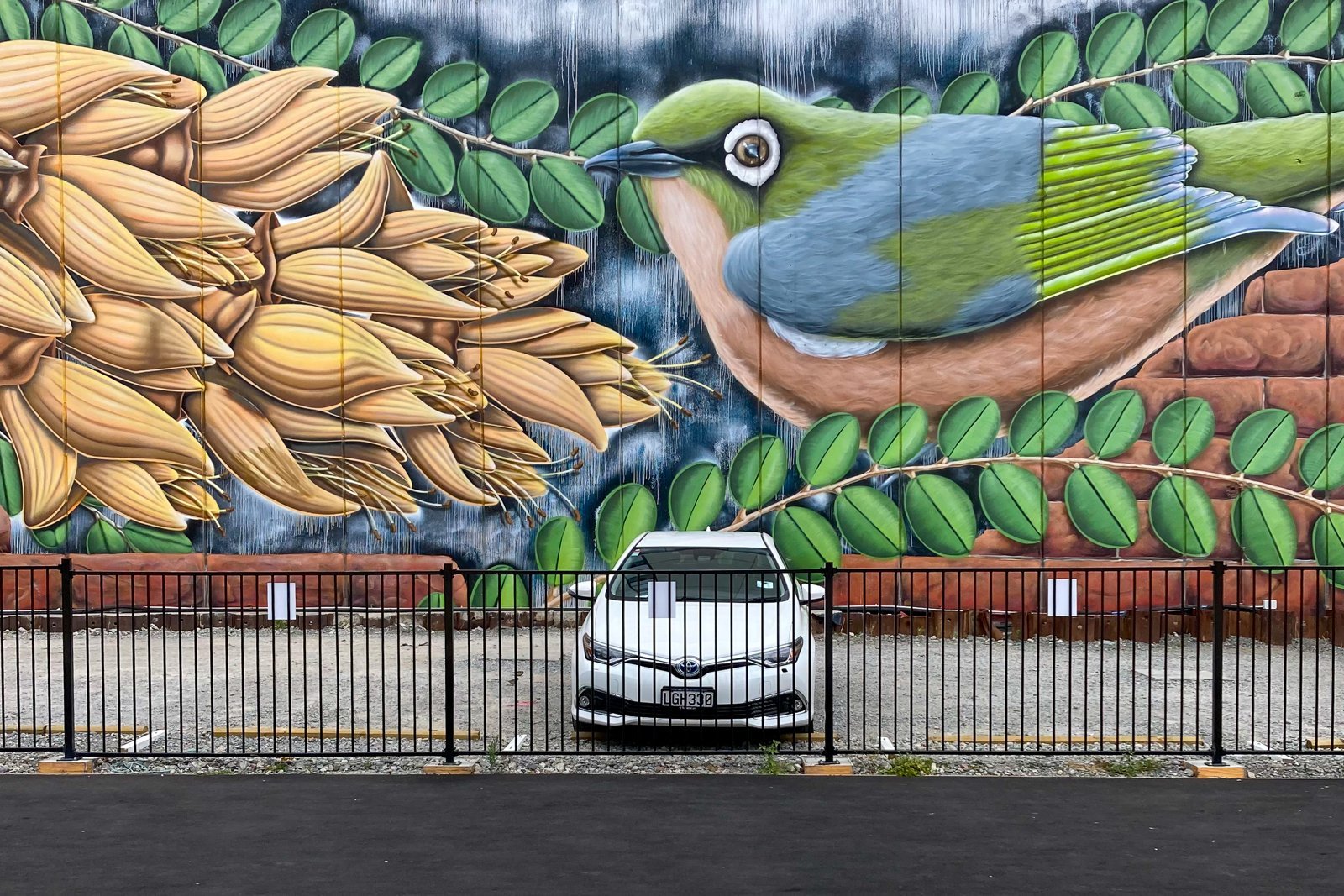
Every Australasian centre seems to have a designated Central Business District but the contrast between this one and that in the recently visited city back across the Tasman Sea (A Week in Melbourne) is as between chalk and cheese. For a city its size I think that Christchurch must have one of the most relaxed, quietist CBDs around. Set in the grid around Cathedral Square it encompasses the restaurants and bars overlooking the river on Oxford Terrace. From there the riverside walks (and cycleways) lead northward to the green spaces of Victoria Square and Margaret Mahy Family Playground. On your amblings you can play I-Spy with the many murals that adorn the walls of buildings throughout the area. The Mission-style architecture of New Regent Street, with its slightly alternative retail outlets and restaurants and bars, crammed up against the tram tracks provide a nice contrast to the more modern architecture of the shops, food court and other eating places along Cashel Street.
And then there are the architectural contrasts on Cathedral Square. Christ Church Cathedral continues its lengthy post-earthquake reconstruction (in our time in New Zealand they had only just completed the stabilisation of the building which allowed construction workers to enter the building for the first time since 2011). The hoardings around the building provide an opportunity to set out the history of the cathedral itself and the reconstruction process, a history you can also find on the dedicated rebuild website – https://christchurchcathedral.org.nz. The strongest contrast is with the ultra-modern expanse of Te Pae Christchurch Convention Centre (https://www.tepae.co.nz/), a visual entertainment of a structure both externally and internally and also because of the installation artwork that lies in and around the site. But there are other contrasts to be relished; between the empty sites of buildings demolished in the aftermath of the earthquake and those tall (for Christchurch) twentieth century buildings that survived, between the red-brick Italianate grandeur of the 1870s Chief Post Office and the khaki post-modernism of the commercial block that has parasitically attached itself to the Post Office, and there are many more besides.

Mobility Access:
Almost all this area is readily accessible, being almost entirely flat with plenty of indoor and outdoor stopping places. Essentially the tram route loops through this area with several stops, so it is perfectly possible to intersperse your short walks with moving around by tram. Or else maybe you can rent a pedal-yourselves pedicab. This turned out to be a good way for three of us (two pedallers and one not) to take in the whole area at our own pace and, for the less mobile ones, to reach beyond the tram route without recourse to taxis or buses. Because the CBD is quite flat this means of transport works but, even then it can require quite a bit of leg power to overcome the gentle slopes in a few places including the humps of the bridges over the river, especially when the pedallers are too tall for the static cycling position. Sadly the rental place that we used no longer operates and I am not sure if other options for pedicab rental exist in the city.
Christchurch Gondola
Another offer from Christchurch Attractions is the Gondola. (I cannot help it but, for me, this word conjures a black craft on the water rather than a cabined ski lift.) And this one is not really a ski lift (snow being a rarity here) but a way for lazy people like me to get to the top of Mount Cavendish. At only 448 metres (1,470 feet) the mountain is hardly more than a hill to some but, sitting atop the ridge of the Port Hills, it provides a glorious view north across the city and out to the sea of Pegasus Bay and south across the expanses of the hills down to the town of Lyttleton and, beyond, the waters of Governors Bay and Lake Ellesmere (Te Waihora). At the summit is a large eco-friendly facility with viewing platforms, café, shop and an ‘Experience’ that I did not visit. You can also walk out onto the ridge where a plethora of walking trails lie to greet you.

Mobility Access:
The gondola is one that operates with 4-seat cabins that slow down momentarily to allow access. Here they are more than ready to stop the gondolas for sufficient time for those with mobility issues to board and dismount safely. At the top the two-storey facility has a lift and the viewing platforms that circle the building are flat. Getting down to ground level on the ridge requires negotiating around 15 stair steps and the ground around the facility is uneven. There can be a little bit of a queue at top and bottom to get onto the gondolas but it moves pretty quickly. Getting to the gondola base station is about a 20-minute drive or a tad longer by the number 8 public bus. Alternatively, Christchurch Attractions run a shuttle bus from the CBD (with details on the website) or for those able to do so, you can cycle – as I did.
Cycling in the City
To say cycling is big in New Zealand would be a species of understatement. It is touch and go whether most small towns and villages in the popular tourist areas have more cycle rental outlets than they do artisanal cafés. Cycleways are extensive and clearly laid out with, in the cities, clear coloured markings. So renting a cycle in Christchurch for several hours to ride out to the gondola base station was straightforward. I used https://www.chillout.co.nz/pages/urban-bike-hire whose shop is not far from Cathedral Square. Of course, not having owned a bike since university days and, since then only having used the three-geared, heavyweights of Santander Cycles in London, I had no idea what sort of bike I needed nor what on earth to do when faced with 24 gears. But the staff at the shop were really helpful and, as well as explaining patiently how the gears worked and kitting me out with straps for my camera bag, a lock and a helmet, let me do brief test rides on the bikes to find one that worked for me. And the ride was another way to see another side of the city, the strip mall areas on the road to the suburbs, the neat houses and bungalows of those suburbs (all on roads with clearly marked cycle lanes) then the path along the Heathcote River and across the green expanse of Ferrymead Heritage Park. Only beyond that did the land start to rise up the Port Hills, defeating me into dismount and push mode on the final section up to the gondola base station. There are bike racks round the back of the base station. With stops to take out the camera, it was about an hour-and-a-half out and a little faster going back.

Hotel
The Classic Villa (https://theclassicvilla.co.nz) was perfect for us. Ideally positioned on Worcester Boulevard opposite a tram stop and the Arts Centre with the Botanic Gardens 150 metres one way and the Art Gallery 150 metres the other, it is a carefully restored 1899 building that has a modern extension tucked at the back. It only has eleven or twelve rooms, eight of which are in the older part and are on the ground floor – another big tick from us as there are no stairs to negotiate. It sounds a negative to say there only seemed to be three staff but the support could not be better as Steve and Jackie, the couple who manage and live on site, seem to be available almost 24 hours a day even if, in reality, they are not.
The room was large, wooden floored and with a generous king-sized bed and sat at the front of the house. Don’t worry about street noise as Worcester Boulevard/Street (it is called both) has one lane and is one way with through traffic discouraged. Jackie and Steve were more than ready to provide little extras when needed: an iron and ironing board, a dryer rack for clothes damp from the laundrette and, knowing we were returning for one night after our 20 night loop southward, extra hangers to take with us for use for drying after laundrette visits and for hanging clothes in hotels that did not have enough of their own. They also have discount vouchers for many local attractions (including the tram, the Botanic Gardens tour and the gondola).
There is a good breakfast served but no other meals which, in a city like Christchurch, matters not a jot. Steve was available with excellent recommendations both before we arrived on e-mail and when we were there. There are half-a-dozen different eating places within 3 minutes’ walk. Steve and Jackie are more than happy to let you eat takeaways in the dining area over a bottle of wine. They have an honesty bar with wine, beer and soft drinks to buy, chilled as appropriate. Crisp and nut type snacks and fruit sit in a serve-yourself section of the dining area, as do hot drinks and Jackie’s home-made cakes. All of these are free and on tap all day. At the back of the house is a comfortable lounge and a small garden courtyard with chairs, tables and shading umbrellas much used for reading, writing and sipping a glass of something.
All in all a friendly, calm place, ideal for slow travellers.
Mobility Access:
The entry door at the side of the building is no more than a step over a door frame, but otherwise, if you have a ground floor room, all is on one level. There is a private car parking area right in front of the building.
Food and Drink
All these places we tried after recommendations by Steve, manager of our hotel, the Classic Villa.
Sadly I cannot find any online sign that Duo, where we ate on our first night, is still open. It was in the ground floor of the Hotel Give just around the corner from our hotel and gave us really good fresh cooked South East Asian food at around 20.30 in the evening when the kitchens of all the other nearby restaurants had closed. A double shame as they provided a really good takeaway meal when our table on the Tramway Restaurant was cancelled at the last minute because of a power outage.
Were we the curse of worthwhile restaurants in Christchurch? It seems Hali is another closure since our visit. A great shame as it had served up the best meal we had in Christchurch. It may be worth trying Inati, another upmarket restaurant run by the same couple.
Cellar Door
So good we went twice (it helped that it was in a quiet courtyard in The Arts Centre only 100 metres from our hotel). Set in a light brick-walled room, it is both restaurant and wine bar and the menu allows for full meals or just grazing. The wine list is monumental with plenty available by the glass, but we suggest you try one of their amazing wine flights (there are nineteen different selections). There is indoor and outdoor space, the latter in the peaceful setting of one of the courtyards of the Arts Centre. Book ahead or you simply will not get in.
Mobility Access:
My recollection, admittedly hazy, is that there are a few steps down (three to six) to get into the cellar but otherwise no concerns. It is a flat, smooth surface walk of about 50 metres from Worcester Boulevard/Street (and the tram stop). There is a closer access through an arched gateway from Rolleston Avenue if you arrive by car.

Tramway Restaurant
https://www.christchurchattractions.nz/christchurch-tramway-restaurant/
At first blush this sounds like the sort of touristic experience that one might be wary of because, well, how can food served on a moving tram possibly be worthwhile? Our advice is to give it a go, for not only does the tram provide a moving window on evening Christchurch but the food is very good and the staff friendly and helpful. The tram runs once the daytime tram service has wound down with a departure at 17.00 and a second at 19.30. We went for the later one as you get a more leisurely two hours plus on the tram as it gently loops twice around the city centre. Departure is from the tram terminus point called Cathedral Junction. The tram only runs to about 25 covers so, in our experience, you need to book well in advance (before you arrive) or hope for a last-minute cancellation.
Mobility Access:
There is the step up to the tram but at Cathedral Junction staff are on hand and a step is put beside the tram to help with getting in and out. Cathedral Junction is pedestrianised but only about 100 metres from end to end so access from the adjoining streets is easy. It is in the CBD.
Getting Around
We were so centrally placed that, for once, we did not use public transport. A mixture of Shanks’s Pony, the rented bike, the pedicab and the Christchurch Tram provided the means to get around. The Christchurch Tram has tickets bookable online for one day or two. Steve, the hotel manager, recommended Uber as the best way to get around the city when we needed to be more precise in being dropped at, or collected from, a specific place and it worked well for us.