Part 1: Prelude, Trip Information and Practicalities
Part 3: Dunedin
Part 4: Southern Scenic Route and Doubtful Sound
Part 6: The Ahuriri Valley and Lake Tekapo
Part 7: The Tranz Alpine Train and the West Coast
Part 8: Marlborough Sounds and Kaikoura (and Auckland Coda)
SH 1 Southbound
With stops to stretch, to have coffee, to eat and to take in more of some places, it was a six hour drive along the main east coast highway to Dunedin. Leaving Christchurch you bowl along a near straight road across the flat coastal plain, running through intensively farmed land of the Canterbury Plains. They are characterised by high (six metres or so) hedges that seem to divide some fields and which, I assume, must be weather breaks. The interruptions in this flat landscape come from the singular braided rivers, a species of river divided into many channels that is a characteristic of the landscape of the Canterbury Plains (https://braidedrivers.org/rivers/#10).
The main town in this stretch is Ashburton, which has the feel of an American strip mall town with businesses in modern rectangular blocks lining the main street. It is here that we stop for the morning’s caffeine ingestion and discover one of the delights of New Zealand: the independent café/coffee shop. Although Taste Café looks like an unprepossessing caff stuck in a bland arcade next to huge Countdown supermarket, it manifests those characteristics that we were to find in so many similar, unpretentious cafés visited on our travels – https://www.facebook.com/TasteNZ/?locale=en_GB. The coffee is good, the tea selection ditto. Alternative non-dairy milks are available. The food selection is varied and goes beyond standard caff fare with tasty vegetarian alternatives in amongst the offerings. I may be wrong, but I do not recall seeing a single coffee shop that was part of an international chain such as Starbucks or its ilk on our South Island travels. These seemingly independent places, found in almost every town no matter how small, became one of the many joys of South Island touring.

Around half-distance the landscape and the weather changed. The flat plain gave way to rolling hills and a very familiar low grey cloud that brought sporadic rain. Oamaru was our next stop for a longer break. The wide main street has buildings that date from Victorian times with a colonnaded opera house as a centrepiece giving it the feel of an English spa town like Buxton. Closer to the small harbour are the relics of an industrial past, centred on the now defunct railway terminus rehabilitated into a variety of retail businesses where the status of Oamaru as the self-styled capital of ‘steampunk’ becomes apparent. I confess that, although the word had crossed my radar, I had no idea what it was. Now I know – see https://www.steampunkoamaru.co.nz. The style of steampunk is now seen not just in that Steampunk HQ but in various installations (including a children’s steampunk playpark) dotted around the green park area adjacent to the harbour esplanade. This appealing town looks like one which we would like to have given more time but we only stopped long enough to huddle away from the pattering rain over a coffee/tea in The Gallery, a ‘steampunk’ design café/restaurant that sits on the esplanade between park and harbour – https://www.facebook.com/TheGalleyOamaru/.
Our final diversion was to Moeraki Boulders Beach (https://www.moerakiboulders.com). This is a well-visited sight on one of those glorious long sandy beaches that characterise the South Island’s east coast. As a geological formation they are interesting to learn about and to see, but, even on a grey day, the selfie-snappers teetering atop individual boulders did rather detract from the experience.
Mobility Access:
The boulders are dotted on only one section of the beach but, from the public parking, that section is a walk across an uneven dune path and soft sand to the beach and then a walk of about 700 metres along the flat, firm sand. The Moearaki Boulders Café is a modern facility with parking and is closer to the boulder-strewn section of the beach but even from there you have to take either a firm gravel path along the dune top with a slope and a flight of ten steps down to the beach by the boulders or several sets of steps at the café down to the beach. Either way steps and slopes are involved and then a walk of about 350 metres or more along the beach.
Dunedin: Prelude
If Christchurch is stereotyped as quintessentially English then Dunedin stereotyping is rooted in Scotland. And with rather more overt justification; the statue of Robert Burns looking down on the main square, the CBD being centred round Stuart, Moray and Princes Streets, the Presbyterian First Church of Otago towering above the harbourside in a way that seems to push the Anglican Cathedral into the background, the large Scottish Shop sitting in the main shopping area touting Scottish paraphernalia from kilts to Irn Bru and haggis, Scottish Gothic Revival architecture alive at Larnach Castle and the Otago Scottish Heritage Council sheltering many cultural and social groups from Scottish country dancing to the Burns Club. Yet Dunedin is, at heart, another quintessential part of New Zealand with much to offer beyond these elements.

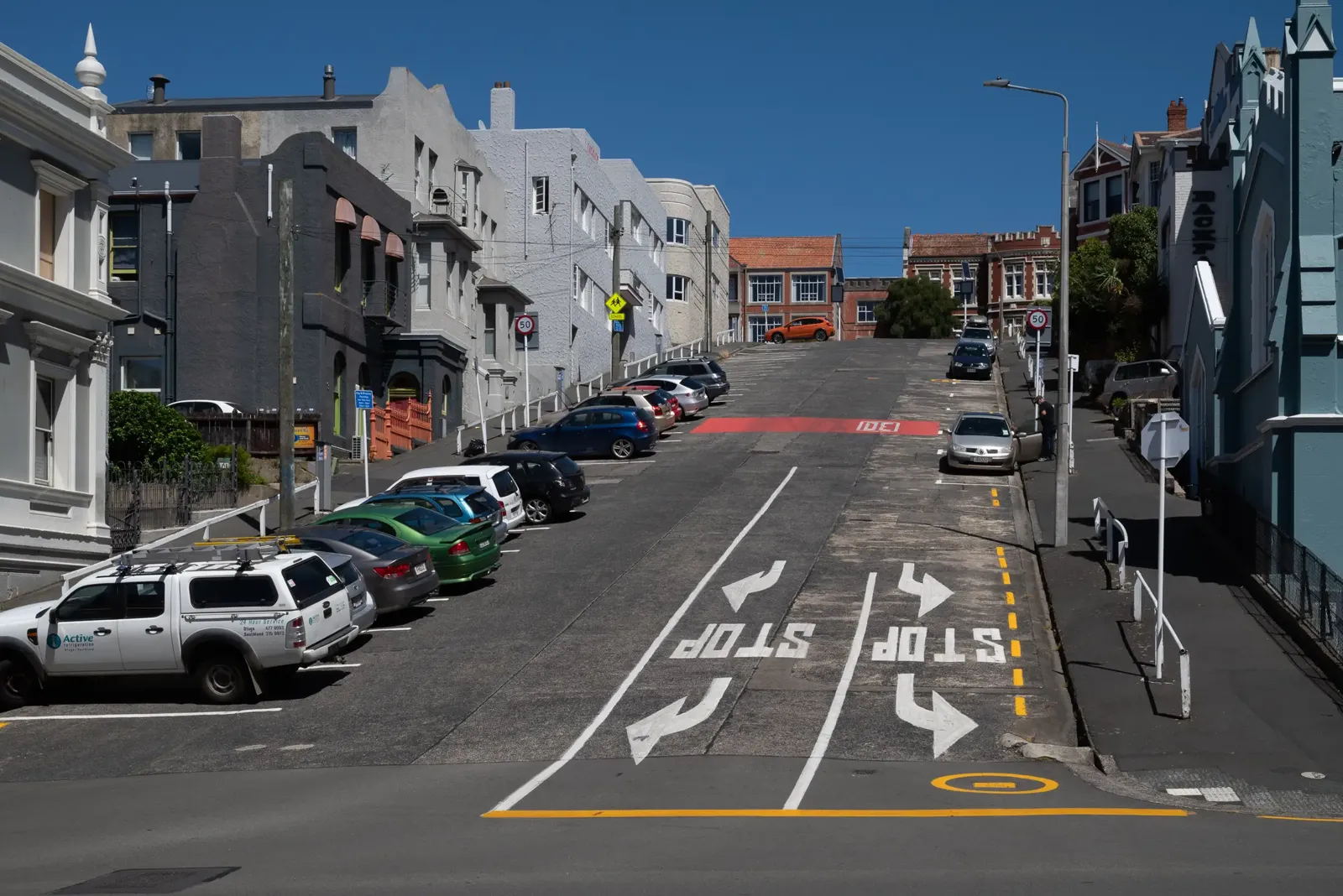
Physically it presents a contrast to Christchurch. It is about hills, rising steeply around the almost fjord-like bay of Otago Harbour. The land rises up as you head up from the harbourside to the Octagon, the city’s main square and even more steeply thereafter. Coming into the city by road you drop down into the bowl where the main part of the city sits whilst the residential suburbs swoop up and down the hills and valleys that converge at the harbour. The streets can be steep; indeed it is proudly announced that in Baldwin Street, one of these residential valley-climbing roads, Dunedin has the steepest street in the world recognised by the Guinness Book of Records.
Places Visited and Activities
Walking the CBD
So, although the CBD is quite small, walking around is more physically challenging than in Christchurch. Lacking the same exposure to the vagaries of the earth’s movements, the buildings crowd together a little more, with many restored buildings dating from the goldrush boom of the 1860s and the subsequent years. Provided you can manage the slopes there is much to engage you in the wanderable streets, with the Octagon and its eclectic architecture and tree-filled central area at the heart. There are plenty of eateries for stops, with outdoor seating on the Octagon’s wide pavements available at most of them. Down the slope along Stuart Street brings you out to flatter ground. The seafront is dominated by the industrial facilities of a modern port but the ground between slope and port contains several architectural gems. At the bottom of Stuart Street sits the resplendent railway station building opened in 1906. This building was undergoing restoration, smothered in Christo-like wrappings, during our visit but some of the interior design and internal architecture made a visit very worthwhile.
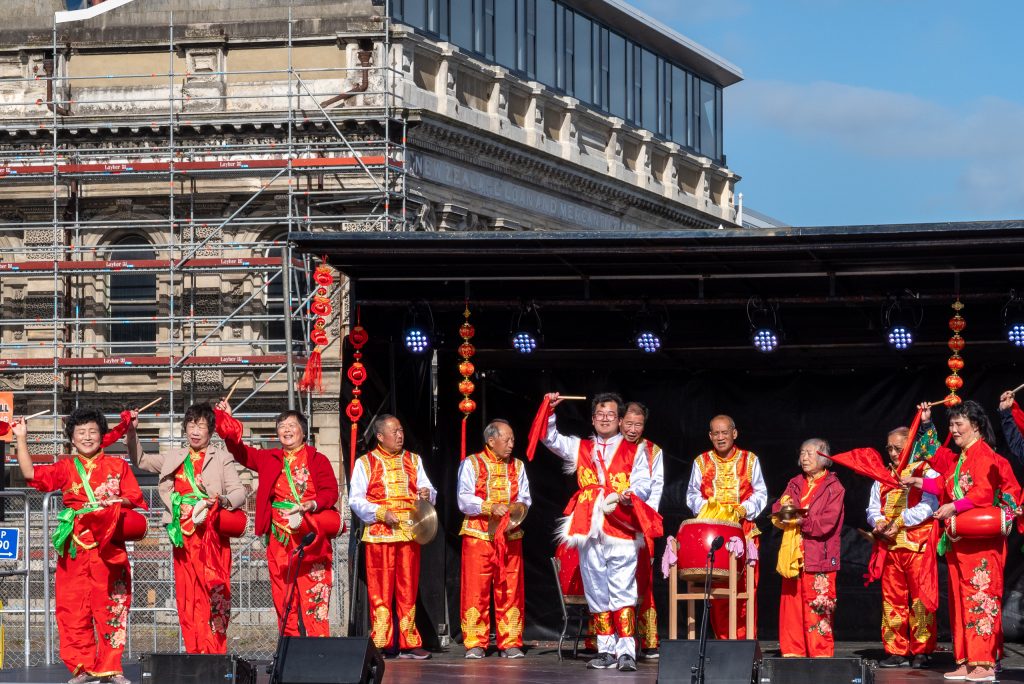
A short walk (200 metres) south west along Cumberland Street brings you to some architectural gems from different ages in a single complex. This is Toitū Otago Settlers Museum. The new (2012) entrance foyer thrusts an arrowhead shape out into the sky and then, alongside, the original museum building, built in red brick and with decoration that gives it a vaguely Palladian air, comes from a time more than a century earlier. A step further along the street brings you to a middle point timewise as the restored former bus station (from the 1930s) is a wonderful art deco insertion in the cityscape. From here you can take in the small park of Queens Gardens and towering above it on the bluff, the Presbyterian First Church of Otago. Make it to the corner of the art deco section of Toitū and tucked in behind it is Lan Yuan, the only ‘authentic Chinese Scholar’s Garden in the Southern Hemisphere’, to quote the Garden’s own website. Designed and built in conjunction with the city council and that of Dunedin’s sister city, Shanghai, it recognises the Chinese community which arrived as part of the influx of people during the 1860s gold rush to settle in Dunedin – https://www.dunedinchinesegarden.com/history/about-the-garden#.
Mobility Access:
Although the slope up Stuart Street feels manageable, the streets beyond leading up the hill quickly take on a limb-sapping steepness. The area of flat ground between slope and port contains no obvious problems for the constrained stroller. There are few cafes or restaurants in the flat area around the station and Toitū, but both those have cafes and there is, of course, a tea house at Lan Yuan. Conversely there are plenty of eating and coffee stops in the shopping area of Stuart Street and the surrounding streets and around the Octagon which also has some public seating. Most distances are too short to contemplate using buses or taxis to move around this area.
The Botanic Gardens
Like the CBD, for the gentle stroller the Gardens come in two parts. At the eastern side lies the lower garden, a flat area criss-crossed by paved paths and dotted with formal gardens, a small lake, a greenhouse, café and information centre. It is a green and peaceful place with benches for resting. To the west the slopes of Dunedin assert themselves and the packed gravel paths of the larger upper garden climb steeply up through areas taken up by woodland, more formal gardens, a lookout and the aviary. For more information see https://dunedinbotanicgarden.co.nz/about.
Mobility Access:
Lower garden only. The upper garden would warrant a ‘red’ for those with mobility constraints. We had the car so we drove from our hotel and parked in the street. Parking charges apply here, as they do throughout Dunedin. As we did not use buses in Dunedin, I cannot helpfully comment on proximate bus stops.
Waitati on ‘The Seasider’
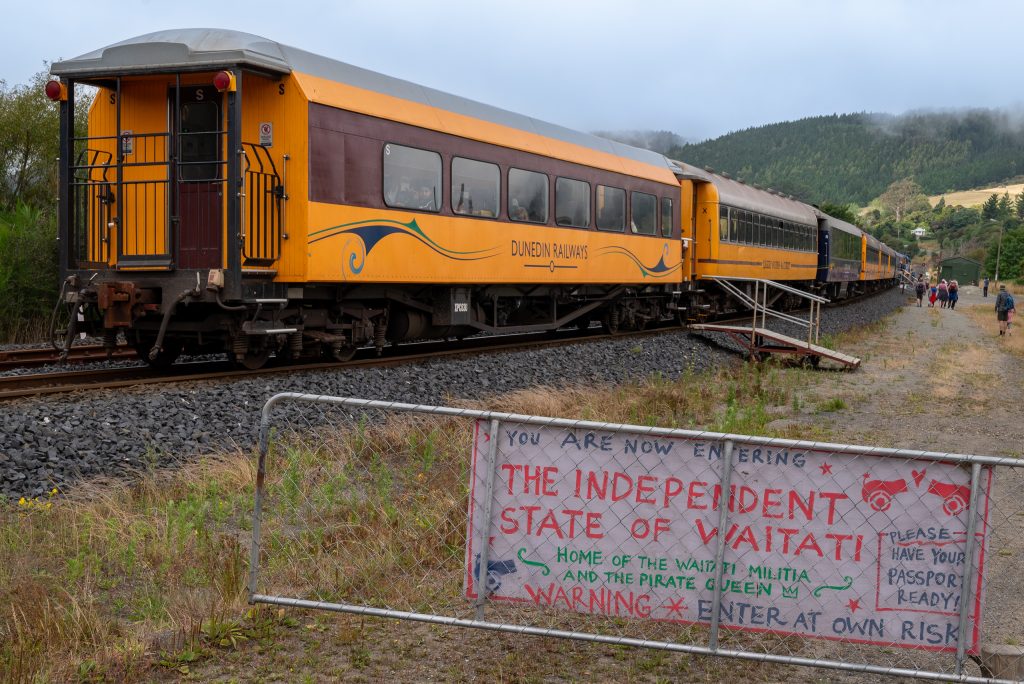
When I wandered into Dunedin’s huge station I assumed its only continuing rail-borne function was to usher the freight trains running down from Christchurch on into, or out of, the port facilities. It was unexpected to walk onto the wide platform to find passengers piling off a train of vintage carriages. This was one of the excursion trains run by Dunedin Railways, a private commercial enterprise – https://www.dunedinrailways.co.nz/journeys. We took the Seasider, an afternoon excursion that provides a trip along the seashore of Otago Harbour before rising up through the hills and then descending to the sea at Waititi. The train run is about 30-40 minutes in one direction with a stop of about two hours in Waititi before the return. (It now seems to have a second stop at Arc Brewery which was not an option when we travelled). In good weather the views are splendid but I did not feel there was much at Waitati to make it a destination worth a trip. The travelling rather than the destination is a good reason to take this gentle tour. The company’s better known ‘Inlander’ train up Taieri Gorge was not available to us on a last minute booking. As will be apparent from the website, the trains only operate from six to ten days in each month.
Waitati has a history as an alternative community with continuing strong eco-credentials but, once off the train the options are quite limited. On opposite sides of the road by the gate leading to the station sit a pub/restaurant and a garden centre. On a sunny afternoon when we were there, the pub/restaurant had a barbecue and live music in a garden with a small play area for children. The garden centre has a good café with outdoor seating. Both fill up quickly when the train arrives for there is little else to act as a draw. Although it is on the sea, Waitati is on an estuary (think mud flats not beach) with the railway line running close to the water’s edge curtailing any waterside walks.
Mobility Access:
These are vintage carriages which means a few steps up from the platform at Dunedin but with supporting handrails and staff assistance if needed. However there is no station at Waitati or, rather, the station is an open field. This means getting down without assistance is more of a clamber, although ramps are positioned to assist those who have difficulties. The field is flat but there is a gravelly surface where passengers disembark and then a farm track about 100 metres long before you reach the gate onto the tarmac road.
The Otago Peninsula
This is a lovely day’s excursion out of town. The peninsula sits off to the east of the city running along the south side of Otago Harbour, with a high ridge of hills running along its length that drops away steeply to the sea on both sides. It is just a forty minute drive from the CBD to the Royal Albatross Centre at the tip of the peninsula. Having a car we drove ourselves but there is a wide selection of tours (day, half-day etc.) that can be booked usually centred on the main attractions of Larnach Castle, the Albatross Centre or visiting the rare yellow-eyed penguins. There is a wealth of other places to see and visit – sandy ocean-facing coves, seal-strewn rocks, the waterside communities and sheltered beaches of Otago Harbour – but you can just meander, take in the scenery which is epitomised by the views from the Highcliff Road that runs along the spine of the peninsula. We chose not to take a tour to see the wildlife and I have dealt with Larnach Castle below. The tours at the Royal Albatross Centre (https://albatross.org.nz) and to see the penguins must be booked as they ensure numbers are controlled to protect the birds’ habitats.
Although we drove up to the Albatross Centre, pulled by nothing more than an emotional tug to reach the end of the peninsula, we turned around in the car park. Pummelled by the wind that rips over the saddle here, we emerged from the car briefly to take in the terns that litter the car park, not only with their presence but with their guano and its pungent fishy smell. For the more mobile there are myriad walking opportunities along cliffside tracks and down to hidden coves. We drove back along the attractive shoreline of Otago Harbour and stopped at Macandrew Bay where, sat on one of the many waterside benches, we ate our picnic in the sun. This shoreline is sheltered from the prevailing winds by the hills of the peninsula.
Mobility Access:
You need a car or an appropriate tour. That said, there is so much to be enjoyed even if you only leave your car to take in the scenic delights at the stopping points (there are few on the ridge road). The roads are narrow and winding so taking it slow is a given. The Otago Harbour shore has plenty of stopping points in the communities with flat esplanade areas that can be used to stretch limbs and watch the leisure of others being taken on the small beaches. I have no personal experience of the tours at the Royal Albatross Centre and to see the yellow-eyed penguins. My limited understanding is that they may be problematic for those with limited mobility as they involve walks that take in uneven ground and changes of height.
Larnach Castle & Gardens
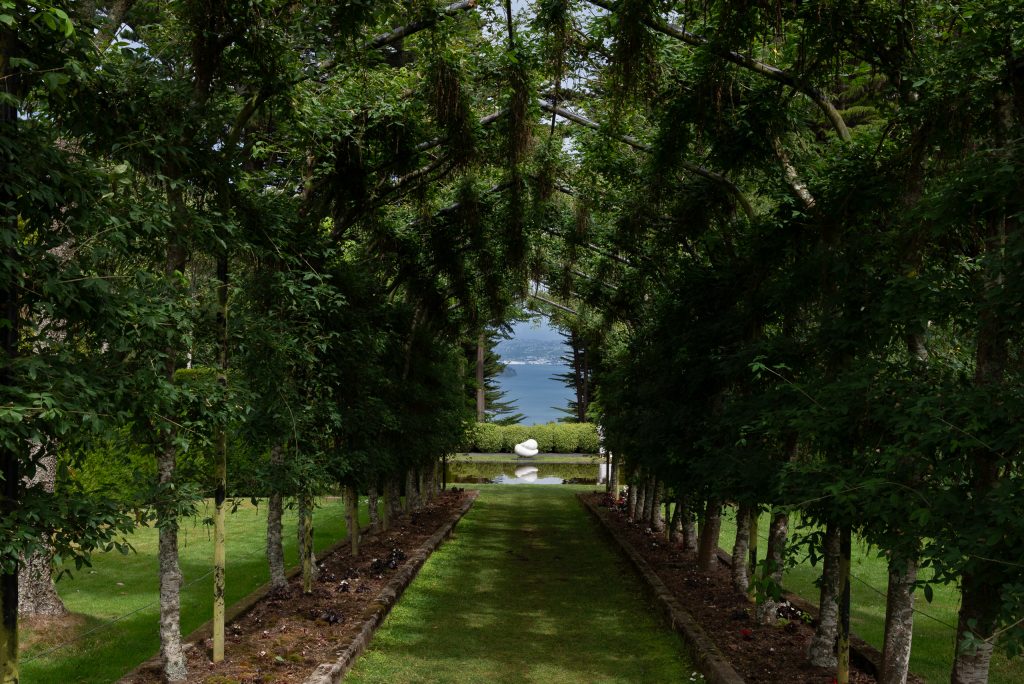
This Scottish-style Gothic Revival house and its renowned gardens (https://www.larnachcastle.co.nz) in its hilltop location on the Otago Peninsula looks down to the water of Otago Harbour. We did not visit the house interiors. It was a beautiful sunny day, ideal for a ramble round the attractive gardens and some time just sitting on the shaded tables of the café that dot the lawns in front of the house, being serenaded by a be-kilted man who popped out of the house at regular intervals to give us ten-minute skirls on the bagpipes.
Mobility Access:
To repeat you need a car to get here. The Larnach Castle website has some useful information for those without cars – https://www.larnachcastle.co.nz/Plan-your-visit-to-Larnach-Castle/How-to-find-Larnach-Castle. Once here there are wheelchairs available and we used one to potter round the gardens. The gardens are set on a steep hill, so some elements are inaccessible for the wheelchair, and you might have to push over gravel and grass paths at certain points but that just means a little more care and oomph from the pusher.
Hotel
The Chamberson (https://thechamberson.co.nz) had a great location in the heart of the CBD but it is very much more serviced rooms/apartments rather than a full service hotel. So no dining at all (including breakfast) but a basic kitchen in the room. An unmanned reception desk (except for an hour or so in the morning) which proved slightly problematic when the instructions you are meant to be given to get in the building and access your room do not appear in your inbox and access had to be sorted by phone (there was a contact number at the reception desk) once another guest had let us into the building.
We also had a hiatus with parking. They have a small car park which we thought we had booked for our stay (charges apply) but they had no record of our booking of that element. So on our first night it was full and we had to park in the street. It was not the hotel’s fault that my frustration was compounded by a parking meter outside the hotel where the credit card function had been disabled and then the coins I had got from The Scottish Shop (thank you, kind staff) would not stay in the machine. Finally I had to download the parking app to pay in order to ensure the car would not disappear off to the pound. The next morning we had to catch the person manning reception to see if we could sort out parking for the next two nights. Thankfully, yes.
Having navigated those early issues I repeat the convenience of the location and say that the room was fine for our purposes with a sitting/cooking area separate from the bed area and an en-suite (shower only). Outside Stuart Street is lined with eating places, as is the Octagon at its west end. So we breakfasted at The Corner Store (https://www.thecornerstorecafe.co.nz/menu), a café just 100 metres up Stuart Street where we could get a full range of dishes, vegetarian included, and take-away salads for our picnics. There was a large Countdown supermarket in Cumberland Street that was equally close.
Mobility Access:
The room had a walk-in shower. There is a lift in the entrance foyer that serves the hotel and the basement car park. Many eating options nearby along pavements that are flat, albeit sloping slightly uphill as you walk towards the Octagon. Having the car, we did not look into its accessibility for the buses that provide Dunedin’s public transport. Buses run on the cross streets but not on Stuart Street and the Dunedin Bus Hub is only 250 metres away in Great King Street.
Food and Drink
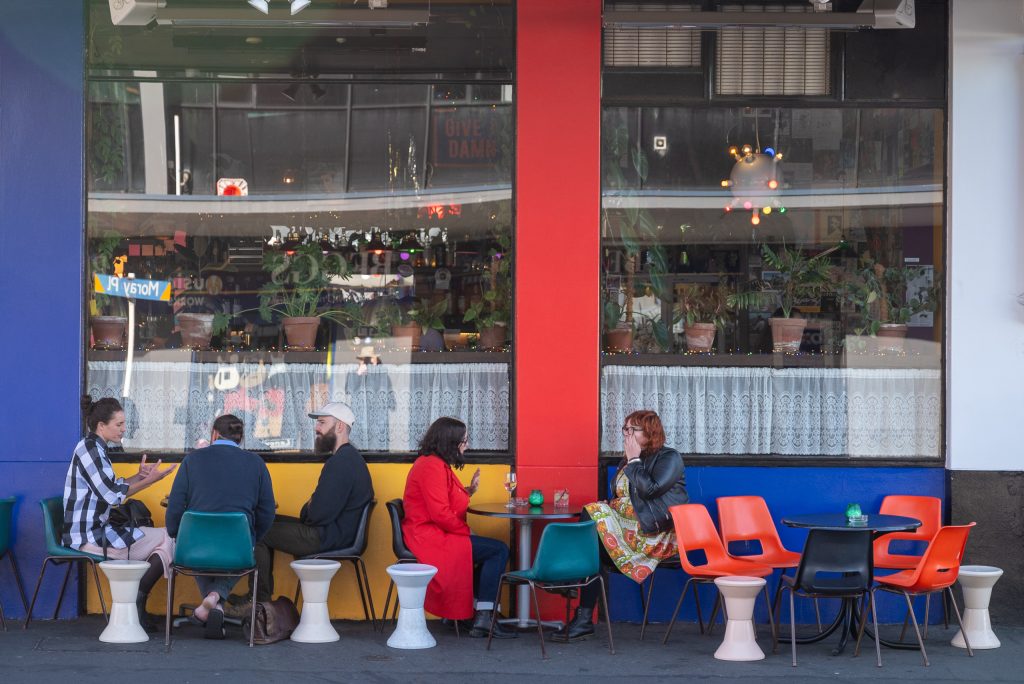
100 metres up Stuart Street from the hotel was Two Chefs Bistro (https://www.twochefsbistro.com), a quiet restaurant with a traditional feel, the décor subdued with dark wood bar and floors and cream walls. The menu is a mix of French classics and more modern-style New Zealand dishes with drinks to match. Although the vegetarian options do feel a bit like afterthoughts, the food is good and it was a peaceful place for us after a long day’s driving and the slightly fraught arrival at the hotel.
Mobility Access:
This is straight from street level to the main part of the restaurant. There are a few steps up to the rear section and the toilets.
Vault 21 (https://www.vault21.co.nz/story) was one of the cheek-by-jowl places on The Octagon and a wholly different proposition to the night before. On a busy Saturday night we had found it difficult to get into a couple of other places and this large, industrial-chic design restaurant seemed a bit ‘buzzy’ for our taste, but it actually worked very well. Like other eating places on The Octagon, it runs in a long room from the frontage which, on a warm summer evening, is open to the elements. There are outside tables on the wide pavement. The Asian fusion food comes from a sensibly-sized menu of options (including some vegan), is freshly prepared and tasty. As you might expect from such a place, a wide range of beers, wines and cocktails alongside the usual softies.
Mobility Access:
The building is at street level. There are some outdoor tables. Inside there is a front section with some tables at pavement level and then there is a short slope up to the level of the bar and the bulk of the tables.
Dunedin: Getting Around
We used Shanks’s Pony and the car, so I cannot comment on the public bus system in the city, except to offer the relevant website – https://www.orc.govt.nz/public-transport/dunedin-buses.