Prelude
We had not been before. Revealing our next destination to friends led to a string of comments, variations on “you’ll love it”, “the scenery is wonderful” and the simple “amazing”. Reading about the place in some guidebooks gave the impression that the real excitement was to be found on unsealed roads negotiable by 4X4 or hiking into the wild interior. All of which left me worrying Iceland would be anti-climactic for a couple of ‘slow’ travellers negotiating the ‘safe’ part of the country in a standard rental car. It wasn’t.
This geologically young land is ever-changing. Not only does it change physically (the volcanic outpourings, the glacial retreats, the slow separation of tectonic plates) but also, as you move around the country, it changes visually. Thus, this was a trip focused on the natural landscape with a nod to the inhabitants of that landscape – the flora, the fauna and the human. Culture did figure but only in our Reykjavik coda and, briefly and surprisingly, in Hveragerði.
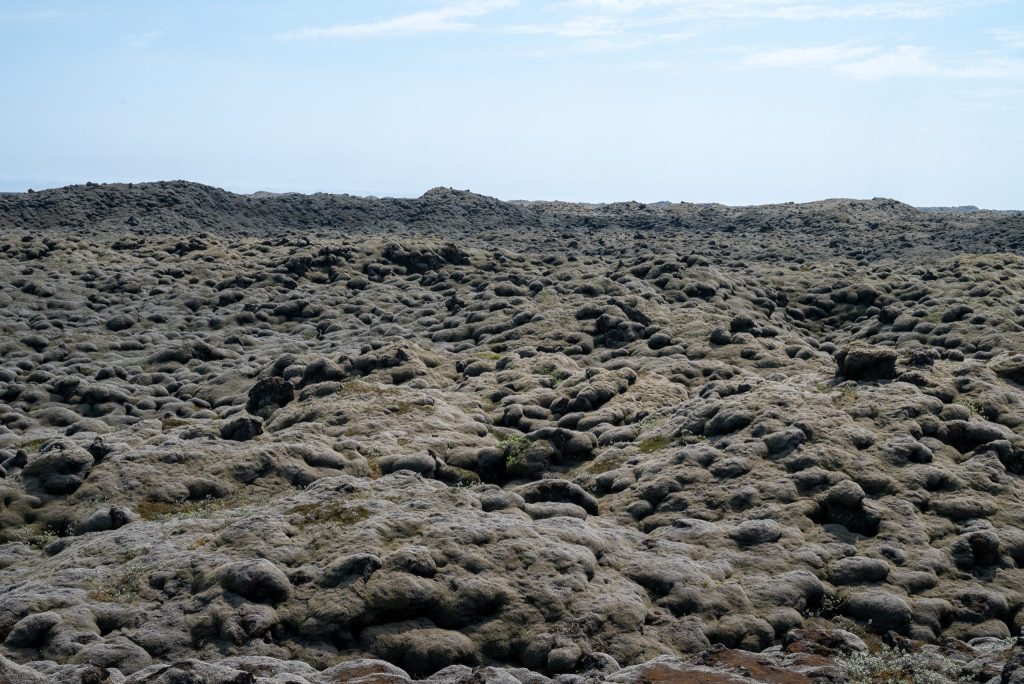
I find it difficult to describe landscapes. I often fall back on drawing comparisons with places I have already been. In this land such comparisons came to mind, but they always had a unique Icelandic twist. So it was a landscape that kept giving; unusual and always changing. Described so often as a land of fire and ice, to me it was more a land of water and rock: high mountains, scree, lava fields, pools, waterfalls, outpourings of ice, rain, geothermal steam, rivers that sprawl across plains out of glacial heights, sea. For me it was not the grand sights, the towering waterfalls and the sparkling glaciers but the lesser ones that surprised – the fields of moss-covered lava mounds, the solitary flower amidst the seemingly lifeless black sands, the lone volcanic cone standing proud of the coastal plain.
It is a land of endless geological fascination. It is also a quiet land of few people, except where they crowd over the tourist sights. There seemed to be relatively little traffic on the roads. With a population of just over 375,000, it is an island about the same size as the state of Kentucky and no more than 80% of the size of England. Just because I like these sorts of stats, but also because they do say something about the land we are travelling, the comparative population densities of these territories (expressed in people per square kilometre) are England 434, Kentucky 43 and Iceland 3.5.
The Trip Structure: How, When and Weather
Travel Adviser or Self-Organised?
Because it was a country we did not know, we decided to use our travel advisers, Audley Travel (https://www.audleytravel.com), to create a bespoke, self-drive itinerary. With some research I can imagine it would be possible to make all the same arrangements independently but, as our travel advisers only use people who have visited the country and the hotels, it was, on this occasion, easier to let them guide us (and do the heavy lifting on booking hotels, flights and activities). Our input involved ensuring the appropriateness of the accommodation (given our particular needs), that any activities were workable for us and that we were not over-committing ourselves on the distances to be driven.
Itinerary
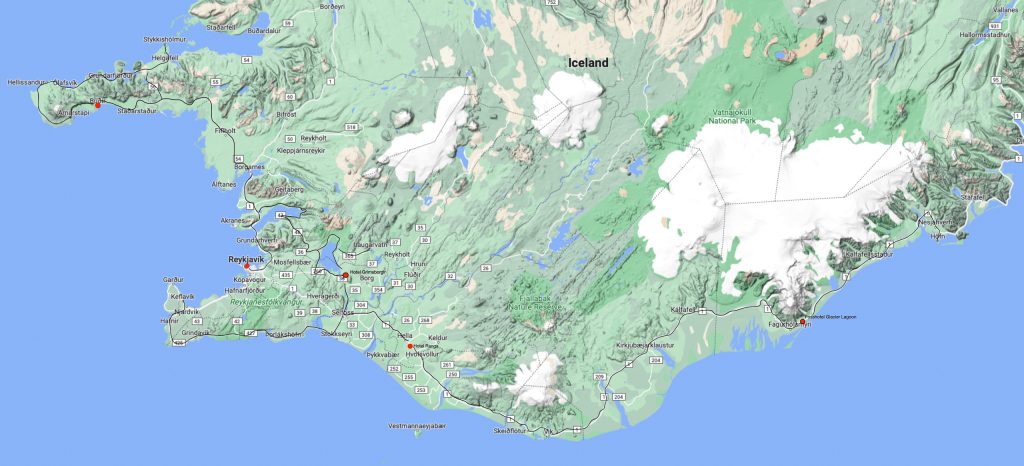
The trip was 15 nights. Our original thought was to circumnavigate the island, but it soon became clear that was going to be incompatible with our ‘slow’ travel approach. We dislike giving any one place less than three nights to give us a proper sense of its scope and to allow time for seeing, doing and resting. We came round to a ‘there and back’ itinerary that took us round the Reykjanes peninsula and along the south coast, with the town of Höfn as its most easterly point, before retracing our steps to ‘do’ the Golden Circle. From there a westward drive led us out along the Snæfellsnes peninsula before our coda in Reykjavik.
When
The trip was taken in June 2023. It ran across the summer solstice, which meant the sun set just after midnight and rose again at around 03.00 and….it never became fully dark. The key benefit is that, with so much daylight, and if you can get yourself up early enough or go late enough, you can see some of the most popular sights almost bereft of the voluminous crowds that descend during the hours of 08.00 to 18.00. Just bear in mind that, if light disturbs your sleep, you should ensure the places you are staying have effective blackout blinds.
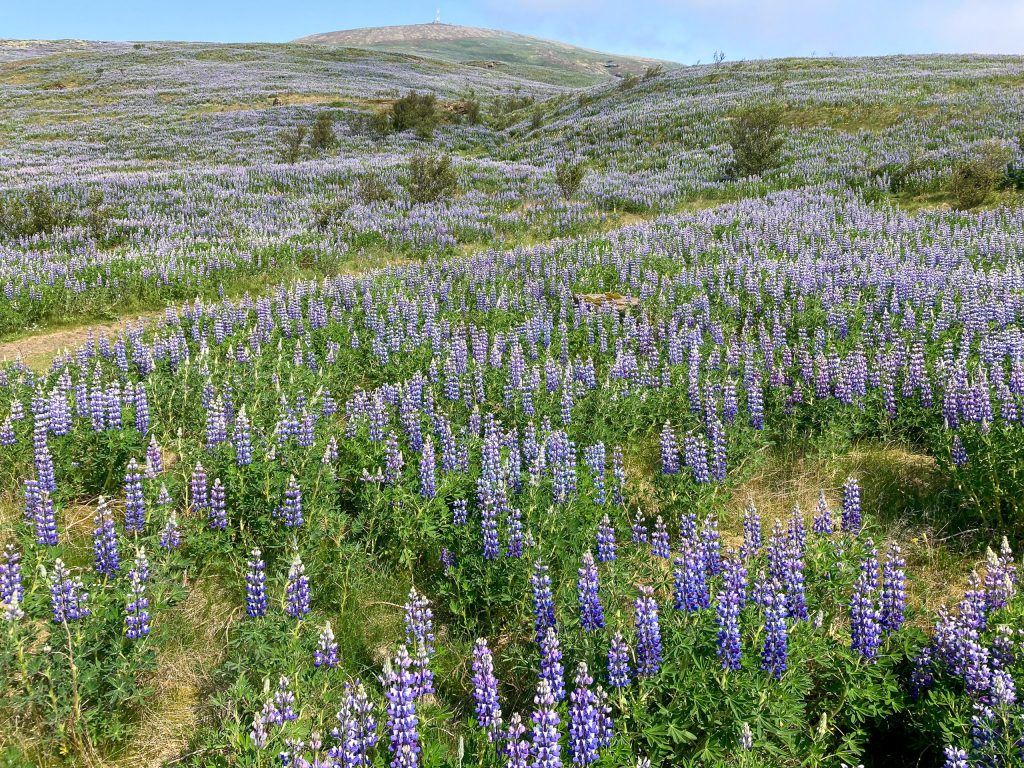
June is also when the lupins are in full bloom, creating seas of purple and green colour in many parts of the land. These non-native plants divide opinion. Some support their introduction (from North America in the late 1970s) as they provide effective fertilisation of the barren laval soils and over-grazed farmland, paving the way for other plant growth. The difficulty is that they are so effective that many now regard them as an unwanted invasive species. For more on this topic see https://www.nytimes.com/2018/09/11/world/europe/iceland-lupine.html.
Weather
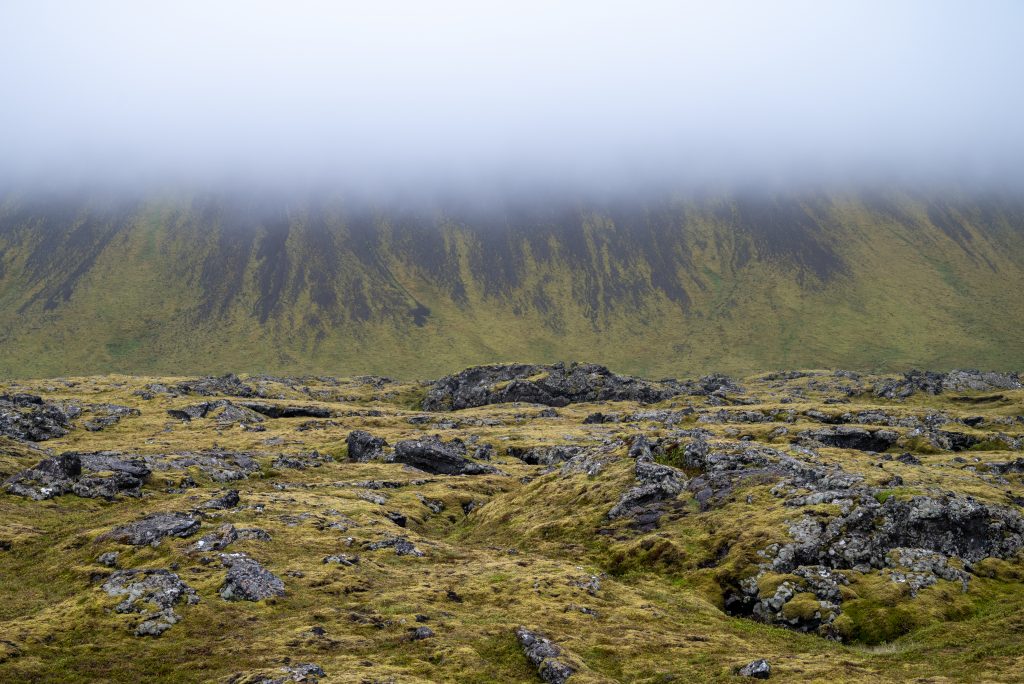
As a resident of the United Kingdom you get used to the unpredictability of the weather. This is useful preparation for Iceland. In our June trip we had days of sun, often with scoops of cumulus cloud, days of heavy cloud cover with occasional rain. There were infrequent morning fogs and one mizzle-ridden day that would be all too familiar to those who travel to Scotland’s west coast. The one thing we expected, but did not have, was wind. Breezes yes, rarely rising to brisk, but none of the wind that the car rental companies warn you will rip car doors off their hinges, if not opened with circumspection. The temperature generally ran between about a maximum of 20°C (68°F) and a minimum of 10°C (50°F).
The advice is to pack accordingly….well, for most eventualities, except for T-shirt, shorts and flip flops weather. At this time of year you only very rarely need to wrap up really warm. My beanie and gloves only came out once, on a Zodiac ride across a glacial lagoon in a chilly fog. On the other hand if you, like me, turn angry pink of skin at a touch of sun, be prepared and bring that sunscreen and hat. The air is clear and the sun can penetrate even a seemingly thick cloud layer, as I discovered on a three hour walk across laval sand and gravel.
A Note on Hotels
We stayed in five. For us, the quality was good. These were not five star, full bells and whistles places but they worked well for us in the context of this holiday. All, bar the one in Reykjavik, were set in the open Icelandic countryside. They were, to a greater or lesser degree, home to tourists; self-drivers like us, smaller groups on minibus tours and the coach parties. Our insistence when setting up the itinerary on staying at least three nights in any one place gave us the sense we were often in the hotels a little longer than most others.
Odd Matters Icelandic
Language
Icelandic, I understand, is related to Scandinavian languages but its remote island location means that it has developed more slowly than the languages of that region; it is an older form of those languages. To a linguistic ignoramus such as me, it is difficult to pronounce, which makes even saying a few words to show willing is far from easy (and I normally try to educate myself with the correct words for ‘thank you’ and ‘please’ in any country). Of course, in a country where its own government describe tourism as “one of the main pillars of the Icelandic economy”, that lazy English-speaking person’s crutch for travel, the language, comes to our aid. We found English was spoken, and usually spoken well, by everyone we interacted with. Signage, menus and information were so often dual language that I cannot ever recall being flummoxed by my lack of Icelandic.
That said I found it useful to be aware of Icelandic’s more exotic letters, ð and þ. They are described in such a way online and in guidebooks that leaves me unable to distinguish their pronunciation. To me they were both ‘th‘. Thus the famous site of what Icelanders assert is the world‘s first parliament is Þingvellir, which you frequently see transcibed as Thingvellir, whilst the town of Hveragerði is Hvaragerthi in pronunciation (sort of). If you then add in the plethora of acute accents, the frequent use of ‘æ’, a vaguely Welsh-sounding ‘ll’, the umlaut and then couple them all with the Germanic practice of place names that are one word derived from several (Kirkjubæjarklaustur anyone?), you are grateful for their excellence with your language.
A number of place names incorporate the Icelandic word for the relevant physical feature at the end, thus ‘jökull’ means glacier, ‘lón’ means lagoon, ‘foss’ means waterfall and ‘nes’ means promontory or peninsula. For clarity, English texts tend to use what amounts to tautological language (e.g the Reykjanes peninsula, the Jökulsárlón glacial lagoon, the Svartifoss waterfall). I have tried to avoid this but….
Towns
Outside the Reykjavik conurbation and one or two larger coastal towns the settlements in Iceland are pretty small. When you are driving around, what looks like a town on the map is often a place with no more than a few hundred inhabitants. Some have a range of facilities; others are little more than what our American friends would call a truck stop. In some places tourism regularly swells the local population more than twice over. (The total number of tourists who arrive in Iceland each year is over three times greater than the resident population.) The practical consequence is that a town like Vik, the centre of a thriving tourist service for central southern Iceland, has a full set of shops, cafes, restaurants, lodging and petrol stations, even though Vik has a resident population of only 300. On the other hand, some, like Hvolsvöllur, veer more towards the truck stop in terms of the extent of facilities. Bear this in mind when thinking about that stop for a meal.
Reading
In keeping with our wish to try and engage in a place in part through our reading, we packed and read:
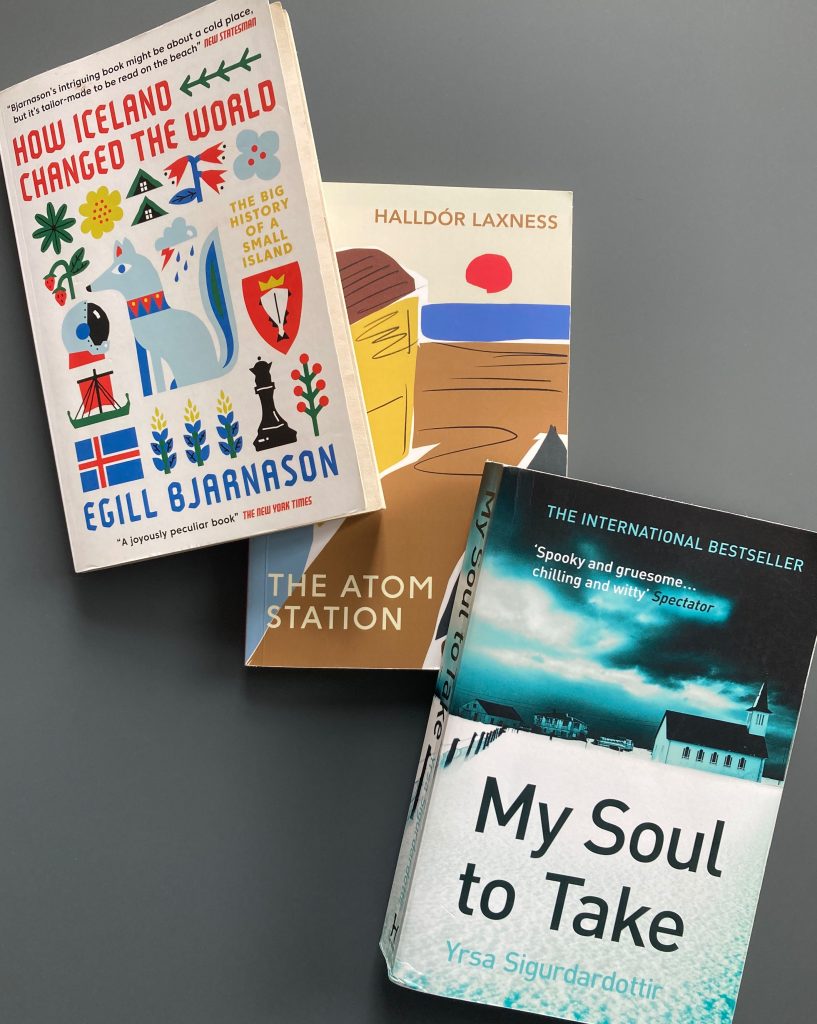
How Iceland Changed the World – Egill Bjarnason (https://dauntbooks.co.uk/shop/books/how-iceland-changed-the-world/)
Bjarnason is a journalist and this Bryson-esque history, subtitled ‘The Big History of a Small Island’, is an entertaining introduction to some of the key elements in Icelandic history. Only 250 pages in paperback, it weaves the country’s history into key time periods from Viking exploration and settlement westwards across the Atlantic to modern gender equality personified through the presidency of Vigdís Finnbogadóttir, the world’s first, directly elected, female head of state.
The Thóra Godmundsdóttir Series – Yrsa Sigurðardóttir (https://en.wikipedia.org/wiki/Yrsa_Sigurðardóttir)
There is no shortage of Nordic noir crime fiction by Icelanders set in Iceland. We plumped for this series about a single mother lawyer-cum-investigator. The first in the series, Last Rituals, was a good start, but I particularly enjoyed My Soul to Take, the second book. It helped that it was set in a health resort being established on a remote location on the Snæfellsnes and that I was reading it on a grey, wet day whilst sat in our remote hotel on that very peninsula.
The Atom Station – Halldór Laxness (https://dauntbooks.co.uk/shop/books/the-atom-station/)
The most well-known novel by Iceland´s Nobel laureate is Independent People, but that looked too long and bleak a read for this trip. We opted for this shorter novel, described as a black comedy of social mores of a north Iceland servant woman working for a prominent family from the south of the country. It linked to a controversial element in Icelandic history – the decision whether to allow a NATO base on the island after the Second World War. My partner read it and did not particularly take to the style, so I chickened out.
Reykjanes and the South Coast
Reykjanes (A Sightseeing Drive)
Currently (Autumn 2024) much of what we saw on this drive is now inaccessible because of the prevailing volcanic conditions in the peninsula. Gunnuhver and the ‘Bridge between the Continents’ fall in this category although Grænavatn still seems to be beside an open road. Check on the Icelandic Road Administration’s website for the latest position (https://umferdin.is/en/region/southwest).
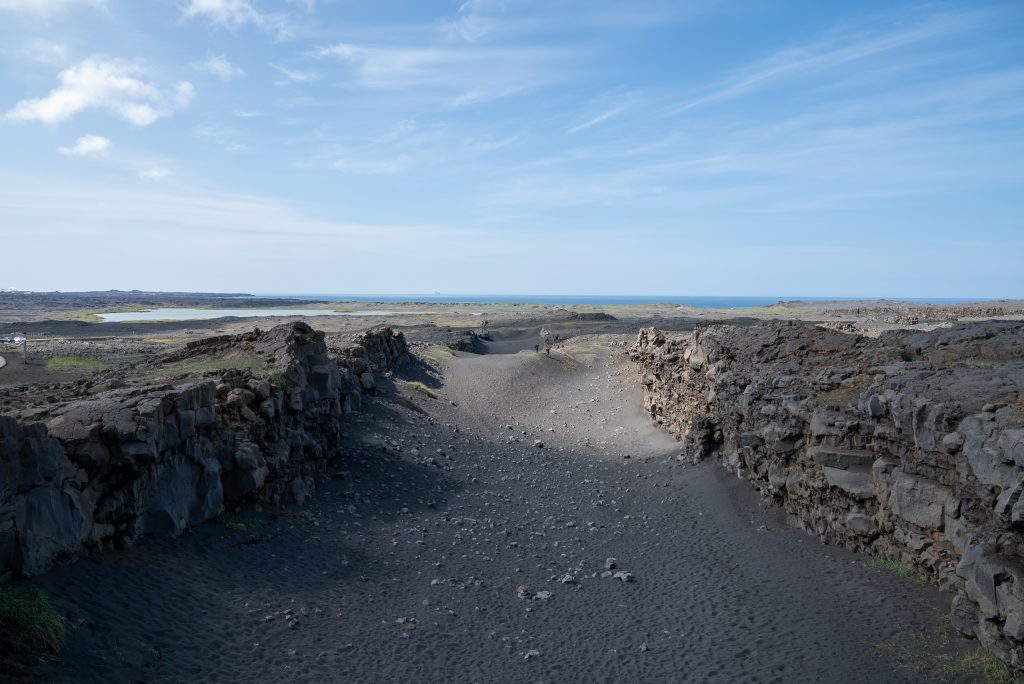
As we arrived at Keflavik Airport in mid-morning and our first night’s stop was near the southern town of Hella, this gave us time to spend some time pottering through this peninsula, curling round the west coast on Route 425 then joining Route 427 as it heads east along the south coast. This enabled us to have a gentle introduction to some of the diversity of the Icelandic landscape: the seemingly flat but moss-covered lava fields spreading across our horizon, the spouts of steam from the geothermal exhalations at Gunnuhver, the green-shaded water of Grænavatn and the bridge between the continents. The last of these is a seemingly innocuous footbridge set over a gap (about 15 metres wide and no more than about 10 deep) filled with laval gravel set between two walls of basalt. Here, even more than in better-known location at Þingvellir, you are brought up short by the fact that Iceland is growing (by about 2 centimetres a year) as the Eurasian and North American tectonic plates move apart. For us it set the underlying tone of wonder at the geological marvels of Iceland.
Leaving the peninsula we turned onto Route 34 and drove along the dune barrier that separates the sea from the Ölfusá River lagoons. In need of a comfort break we stopped at the Hafið Blaá Restaurant atop the dunes. You can’t miss this place, not only because it is the only building on the dune barrier, but also because of the giant model crayfish that sits in the car park. From the car park there are 360° views of the scenery and the restaurant can serve up coffee/tea to be taken on the wooden platforms that sit giving views across the empty white sand beach and the sea. There are also steps down to the beach.
Mobility Access:
All these sights are accessible easily from the road with car parking and boardwalk paths. For those whose walking is constrained, the walks are no more than 300-400 metres, although you can do more.
The South Coast to Höfn
We spent six nights on this part of the trip. Somewhere along the line I picked up the South Iceland Official Tourist Map. This leaflet was really helpful as it sets out the location of over 30 visitable places along this dramatic coastal area. I found that it pointed us at lesser locations we might have missed, as well as the ‘big’ sights. All the locations had car parks, some quite small. At the better-known sights there are also toilets or marshals to provide guidance and other help. The larger car parks had applicable charges, usually payable online. For this get the relevant parking apps. I found I was able to download them and pay then and there.
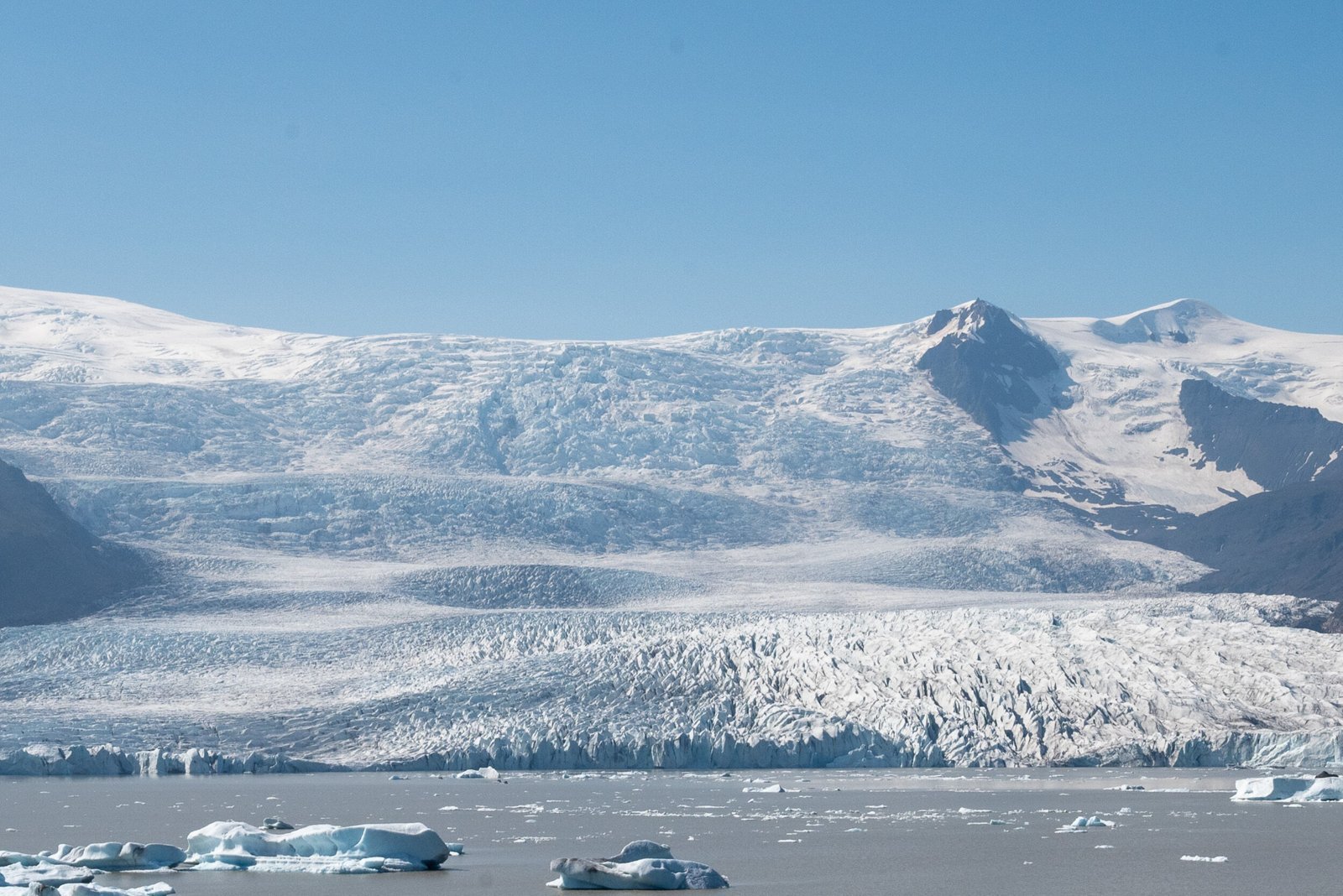
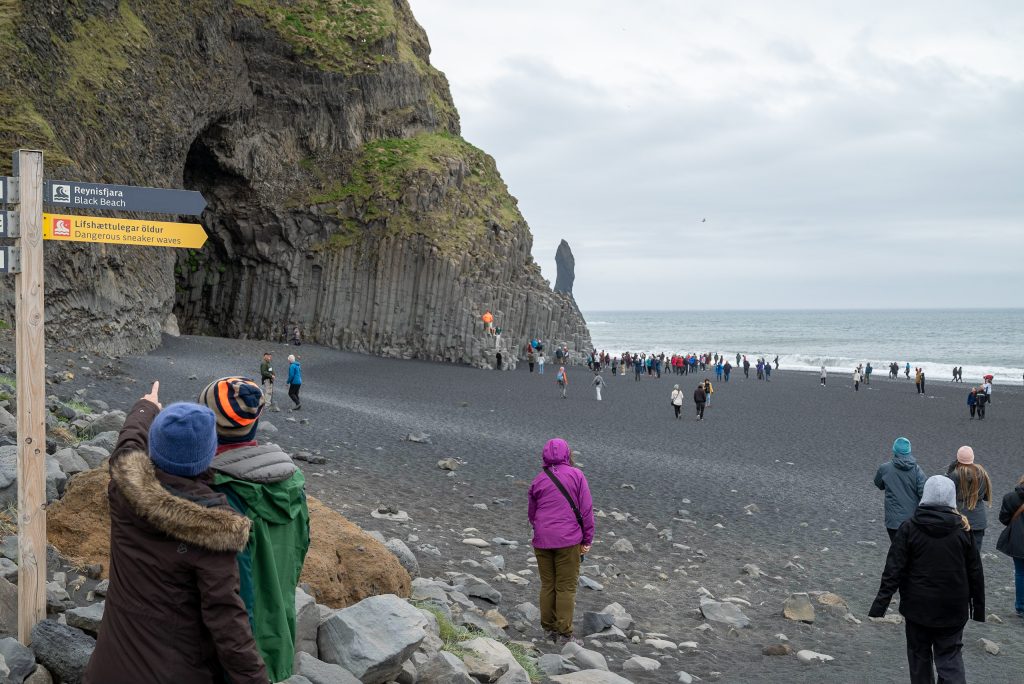
We stopped at lesser and greater waterfalls: Skogafoss (amazing, despite the hordes), Drifandifoss and the unmarked but achingly photogenic rapids of Fossalar. We gawked at the other-worldly Eldhraun lava field, the unexpected carved gorge at Fjaðrárgljúfur, the lupin fields of Myrdalssandur, the black sand beach and basalt cliffs of Reynisfjara (home to the dangerous ‘sneaker‘ wave of which more below) and the glaciers and lagoons of Vatnajökull. Oddly, the black sand beach and plane wreck at Sólheimasandur are not in the leaflet. All the other waterfalls, glaciers, rapids, gorges, cliffs and beaches are there. It also covers the Golden Circle.
Mobility Access:
In our experience all the locations we visited could be seen to some degree from the car or in a short walk from the car park. Of course, longer walks could take you further into, or closer to, particular sights but constraints on mobility did not prevent us enjoying the landscape to the full.
Sneaker Waves
The beach at Reynisfjara, home to a black sand beach and columnar basalt cliffs (also a café and the inevitable large number of tourists), is an astonishing if busy place. It is also one of the places in the world where there are ‘sneaker’ waves. These beasts sound far more anodyne than the reality. There are warning signs at the beach, but there is no real sense of the danger posed by these natural phenomena. And we tourists are left to wander on a beach that has seen two tourists die in the last two years as a result of being engulfed by these killers. So be careful and read (and watch) how seriously the locals take the waves – https://guidetoiceland.is/connect-with-locals/regina/extremely-dangerous-waves-by-reynisfjara-and-kirkjufjara-in-south-iceland.
South Coast Activities
Ice Cave Walk
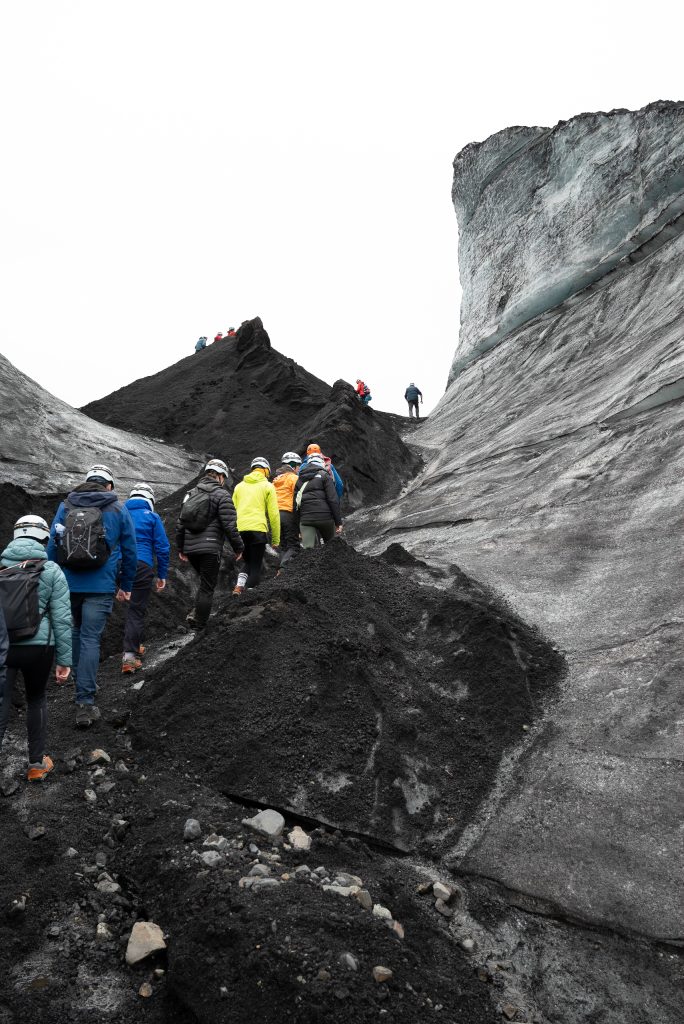
In Vik there are three companies that organise the basic three hour ice cave walk trip (one hour drive to the glacier, 15 minutes kitting up and safety briefing, 45 minutes clambering around the ice cave and an hour’s drive back to Vik). The trip goes east along Route 1 before cutting inland across uneven dirt roads to an ice cave in the Mýrdalsjökull. The tour foregathers in a modern facility in Vik complete with café and shop. You are divided into groups of 10-12 and taken to the vehicles for the drive out to the glacier. The vehicles are a bit like a minibus on steroids with tyres to match. You need to be able to climb up into the interior using the retractable steps. Your driver acts as guide. Our group was led by a local who was informative, entertaining and with a penchant for ‘Dad’ rock, about which he would quiz the group as we drove along.
Mobility Access:
In the format that I took, this tour is definitely not one for those who have mobility concerns, including trouble with steps, slopes and balance.
Kit needed? Dress up warm they suggest. You will need waterproof boots or shoes as, tramping across ice, it is inevitable you will have to put your feet in shallow pools and streams at some point. I didn’t have them, my usual walking shoes inadequate to the task. Thankfully they have walking boots for hire for fools like me who aren’t prepared. Helmets and crampons are provided. I had never worn the latter. They proved very straightforward to fit and easy to walk in. In the event the physical activity involved meant that I was over-dressed and by the end was sweating into my base layer.
Was it worth it? Yes, indeed. The landscape near the glacier was other-worldly. On a grey, overcast day it was as if I had walked into a black and white photograph. Used to glaciers being largely white with shots of blue and morainic grey black streaks, the sight of a predominantly black-grey wall of ice was disorientating and disconcerting at first. The glacier sits atop Katla, one of Iceland’s most volatile volcanos, so it contains a high content of volcanic rock as sand and gravel. The walk scrambles up an ice-slope to the ice cave with ropes attached to the ice walls to assist the scramble, then runs into the ice cave (actually an ice tunnel) with temporary wooden board bridges to criss-cross the stream rushing through it) and out into a large depression in the heart of the glacier where you are encircled by ice walls.
My camera was restless in my hands and I kept having to scramble to keep up with the group. For me, it was a visual experience like no other. And it is an experience that cannot be repeated for, next year, the glacier will have retreated and the current ice cave melted into non-existence. Part of the work the three tour companies do is to identify next year’s potential cave and during the winter months, scout and prepare a new location. It is not only in this way that the three tour companies act as a co-operative. They work together to ensure the safety of the walk. Early each day a team goes out to check the ropes and bridges are secure for the day’s tours. They also stagger their tour times so that not too many people are on the glacier at any one time.
Our tour adviser organised our trip through Katlatrak (https://katlatrack.is/tours/ice-cave-glacier-tours-in-iceland/fasttrack-ice-cave-tour/).
The Lava Show
So what could my partner do whilst I was tramping over ice? Well, one great option for the less mobile is the Lava Show (https://icelandiclavashow.com) in Vik. Here they demonstrate how lava flows and cools by superheating laval rock in a controlled environment. Each show, with timed tickets bookable in advance online, lasts just under an hour. In summer they run five shows a day, reducing to two a day outside the summer season. With good seats it was fascinating for her, engaged as she is by geological phenomena, and another very unusual, very Iceland experience. And a point to note, obvious maybe, but it gets quite warm in the auditorium (from the heat from the lava).
Another bonus is The Soup Company, a café which shares space in the building with the lava show, where she could feast on their excellent soups and bread and then sit and read.
Glacial Lagoon – Zodiac Boat Trip
I have now done a few trips on glacial lagoons in different parts of the world. This one was on the Jökulsárlón, Iceland’s largest and deepest. Several companies run such tours from the lagoon shore near its mouth to the sea, just off Route 1. There are also tours by amphibious vehicles. Which is best for you?
The advantage of the 1 hour Zodiac tour is that you cover far more ground than on the 35 minute amphibian tour. The boats are a good bit speedier, so you can get up to the glacier frontage (which lies over 7 kilometres from the boat launch sites) and right up to the icebergs (and the birdlife and seals that may be on them). The disadvantage, especially for less mobile and stable bodies, is that you sit on the inflatable sides of the boat (facing inwards) with no support and just ropes to hang onto. In the large amphibians, passengers sit on benches around the sides (also facing inwards) but with solid metal railings providing support. Of course, most people spend most of that trip on their feet to be able to take their snapshots. The amphibians move too slowly to reach the front of the glacier in the time available.
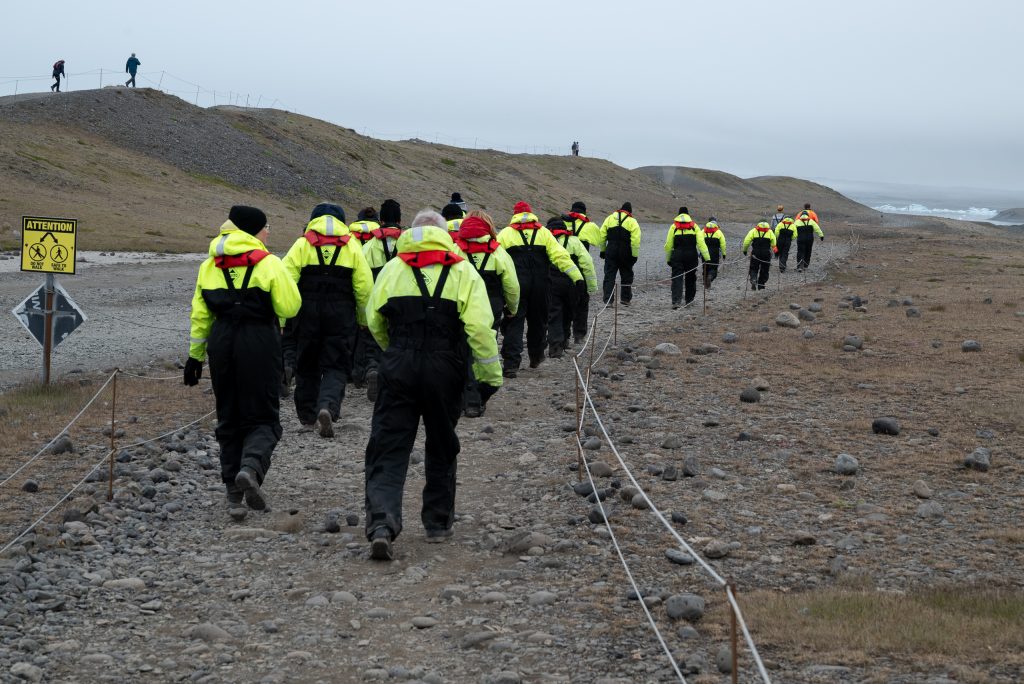
For the Zodiacs, you have to be fitted with thick flotation suits and lifejackets. After being kitted out at the car park facility you trudge across 400 metres of rough gravel path to the jetties. However you soon discover the thick suits are pretty necessary, because they help keep out the piercing cold of the wind rushing at you when the boat is scooting across the flat surface of the lagoon at speeds up to 40+kph (30mph). This is also when you need that beanie, those gloves. All these factors militated against my partner undertaking the Zodiac trip. She also decided against the amphibian, a decision reinforced when she saw other tourists standing patiently in a queue to board the vehicles that circulate about every fifteen minutes or so.
She felt she could wait at the lagoon car park, taking in the icebergs jostling near the mouth of the lagoon and spending time in the café. Unfortunately we had not reckoned on the advertised café being rudimentary, with no seats or even stools inside, just a hip-high ledge to stand at. Outside are a few wooden tables but this was a dank, foggy morning and not at all conducive to sitting outdoors. With me long gone she had to sit in the car. So if you visit the glacial lagoons of this region, I suggest you stop and look around Jökulsárlón and then go back onto Route 1 and head ten kilometres west towards Reykjavik and turn into Fjallsárlón. This glacial lagoon is much smaller than Jökulsárlón, but it has a spanking new set of facilities, including a pleasant indoor café.
Mobility Access:
Difficult, made more so for anyone waiting at the car park viewing area by the lack of indoor café seating. Drop the less mobile members of any party at Fjallsárlón first.
And a dank foggy morning, with visibility down to about 100 metres at times, would not seem a good time to be out on a glacial lagoon. In fact it was dramatically atmospheric and the sight of the glacier frontage looming up out of the mist had its own visual splendour.
South Coast Walks
Sólheimasandur – Black Sand Beach and the Plane Wreck
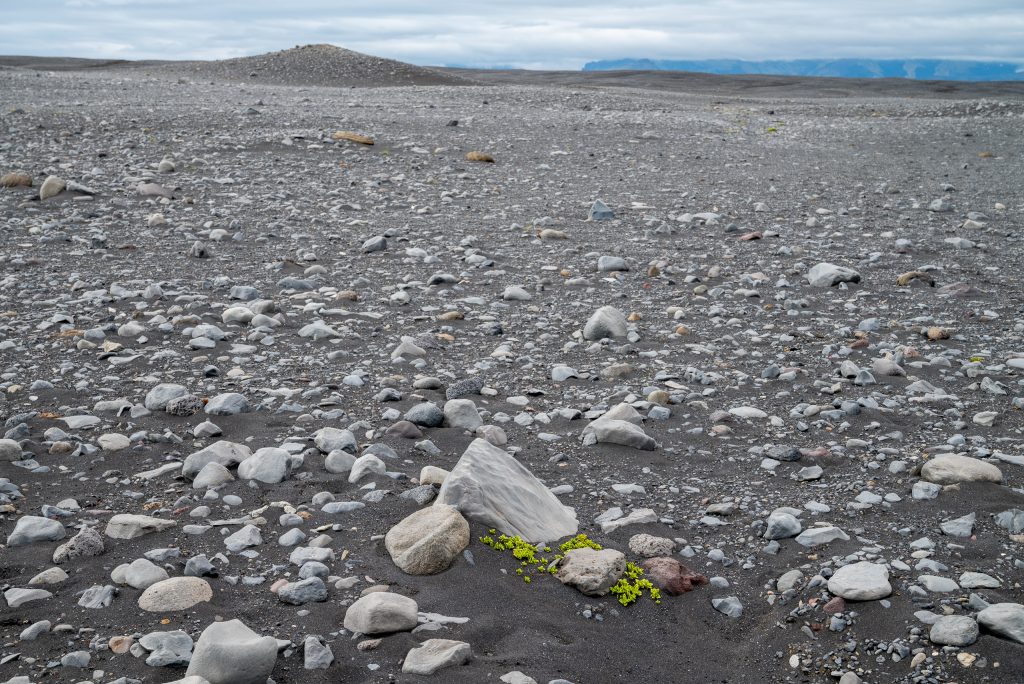
Off the south side of Route 1 (20 minutes’ drive west of Vik and 10 minutes’ drive east of Skógarfoss), in the middle of an empty flat black laval sand plain, is a gravel car park. This is the starting point for the walk south across that plain to the sea. From the car park it is nearly an hour’s walk down to the sea (and 45 minutes to the plane wreck that seems to be the main draw for the tourists who stop here). There is a charge for using the car park, which I paid by downloading the parka.is app there and then. Most of the larger natural sights in Iceland require payment to use the car parks and this app seems to cover most of them, as well as covering parking in the larger towns such as Reykjavik.
Mobility Access
For those less mobile or those who want to forego the walk, a shuttle bus runs to and fro across the plain to a stopping point about 300 metres from the plane wreck (with Icelandic practicality it is called the ‘Plane Wreck Shuttle’). You still have to walk down a gravel slope to reach the plane wreck but, for those with mobility constraints, it and the sea can be seen plainly from the drop off point. There is nowhere to sit at the drop off point.
A warning: if you walk, make sure you are upwind from the shuttle bus when it rumbles past otherwise you will be enveloped in a gritty dust that gets into eyes and clothing. To some this walk will seem like a trudge across a flat, grey-black plain devoid of life. I actually liked the bleakness of the plain and I found this grey-black, seeming desert under an carpet of grey cloud, one of the features that make the natural landscape in Iceland so different from elsewhere I have been. The more so if you walk the next 400 metres beyond the plane wreck down to the sea and the black sand beach. There are, at any one time, between five and twenty people meandering around the plane wreck (and climbing on to it, despite the signs asking you not to do so) but not many seem to go beyond that. Because, at the point the shuttle bus stops, the land drops away in a series of gently rolling dunes once you reach the beach, the plane wreck is hidden from sight and I saw no-one else. I could imagine myself alone in this dramatic scene, with the beach stretching far into the distance. It had a sublime beauty.
Svínafellsjökull – The lesser glacier
One of the key sights of the vast Vatnajökull ice field which is easily accessed from Route 1 is the Skaftafell Nature Reserve, home to Svartifoss and two glaciers, the eponymous Skaftafell and Svínafellsjökull. It is also the location of a very large, modern Visitor Centre, with acres of accompanying car parks (parking charges again).
The waterfall and Skaftafell glacier are reached by comfortable walks from the Visitor Centre. Put off by the crowds, I plumped for the walk up to Svínafellsjökull. That is reached from a smaller car park (parking charges again) off to the left of Route 1 along a dirt track (perfectly usable by our standard hatchback). It is about ten minutes’ drive west of the Visitor Centre. There were, on a sunny afternoon, still plenty of visitors on the track leading over the glacial moraine to the lagoon. It is only a ten minute walk up the track to the viewpoint atop the moraine and that is as far as most people go. But walk further, for the views of this glacier with its ice shaded from blue through white to a dirty brown (from glacial soils) are well worth it. The glacier itself seems quite compact, rising steeply into the cirque below the encircling mountains. A scramble (and it is just a bit of a scramble with care being needed on the rocky ground) to your left brings you down and round to the end of the lagoon where, once again, I was left with the sense of being alone in the wilderness. I could see none of my fellow tourists. A further scramble back around the lagoon brings you to where the fields of brown-capped ice meet and heap up against the slope of the terminal moraine. Grist to the mill for the camera and another seductive natural landscape.
Mobility Access:
A bit of a non-starter for those wishing to avoid rough ground or slopes. Just enjoy the views from the roads and car parks.
South Coast Hotels
Hotel Ranga, near Hella, South Coast
Set on the flat coastal plain, this motel style hotel was a wonderful introduction. Motel style sounds derogatory but is simply a design description – a central double height building with two wings: one of one storey, the other of two. All the rooms have a balcony or patio facing south across the riverine plain. The log-cabin style facing of the buildings gives a deceptively rustic appearance. The service was friendly and helpful and the food excellent. And there was an outdoor hot tub only a few steps from our patio.
Mobility Access:
No lift to the upper floor, but with most rooms and the dining area and bar on the ground floor, this was no problem for us.
We really liked this place and it was well located for our forays east to Vik (a drive of 1 hour 15 minutes) and the many sights en-route – the waterfalls of Seljalandsfoss and Svartifoss, the black sand beaches of Sólheimasandur and Reynisfjara and the gorge at Fjaðrárgljúfur. It is also quite well-placed for access to The Golden Circle, whose many sights lie a drive of about an hour and a half to the north-west. We were to return to a more-conveniently located hotel for our visit there.
Fosshotel Glacier Lagoon, near Jökulsárlón
https://www.islandshotel.is/hotels-in-iceland/fosshotel-glacier-lagoon/
Fosshotel is one in a local chain. This was a much larger hotel with a greater preponderance of tour groups. Set on the hillside above Route 1 between the ‘big’ sights of the Vatnajökull, Skaftafell Nature Reserve to the west and Jökulsárlón to the east, it is a modern Scandi-Icelandic design, all angular shapes, dark wood and glass. Rooms look down across the flat coastal plain (towards a sea about 4 kilometres away) or back up to the mountains behind (and the large car park) and they are very spacious with large glass windows (carefully blacked out against the late-night sun when needed).
The staff were a mix of helpful and perfunctory, with a sense of some being fresh to their roles. This is not surprising. Post COVID-19 it seems that, like many places, Iceland is struggling to find staff in the hospitality industry. The ever-helpful Michal, receptionist at Hotel Ranga, explained that many staff are from overseas. Of Iceland’s population, 56,000 are non-Icelanders. He told us that in some places the reliance on imported staff is such that local Icelanders cannot be understood in some of their own restaurants; Icelandic being a less than straightforward language to learn and these imported staff being competent in (at least) two languages – their own and English.
The hot tub here had to be booked but, during the day, was reasonably free, because the tourist to Iceland tends to be out of the hotel all day doing things. Food here was very good, only suffering slightly by comparison with Hotel Ranga. The restaurant spaces were very busy and we could not get our favoured booking time on the first night. They also have a chair problem in one of the spaces (I will get round to a grumble blog on the inadequacy of so much restaurant seating sooner or later). We ate in the other, which just happened to be the space where they placed the tour groups. This made it a little noisy as the evening progressed. One local tour guide, leading a group from the USA, produced a guitar at one point. Fortunately, after a rather reedy rendition of ‘You are My Sunshine’, he was done.
Mobility Access:
Set over three floors, the building had lifts to all levels, thus any mobility concerns were negated.
It was a well-located, well-serviced hotel for accessing the glacial ice-field sights of Vatnajökull. We were able to take the 2 hour drive east to Höfn, take in the superb coastal scenery at a leisurely pace and return during one afternoon.
South Coast Café
Kjarr, Kirkjubæjarklaustur
This is a great little place for a lunch break on Route 1 between Vik and Skaftafell. It is on the upper floor of an unobtrusive building with tables on an outdoor terrace accessed direct from the ground level car park because the building is built into a slope.. There is a tranquil view out to the small waterfall of Systrafoss (accessible by means of a short walk on uneven ground through the woods). The freshly prepared pasta we had from the open kitchen was very good and the menu was worthy of a quality gastropub in the UK. It might seem a little difficult to find, being at the end of the road through the village and off the main road, but when you turn off at the roundabout on Route 1, there is only the one road, so keep going.
https://www.kjarrrestaurant.is/contact-1
The Golden Circle
This area is home to Þingvellir, Geysir and Gulfoss and a host of smaller sights. We gave ourselves three nights in the area and visited all three sights and had time for some other wanderings and activities around the area. We had seen how large the crowds can get at the larger sights in South Iceland and this area is so close to Reykjavik that we reckoned that the day trips to visit the sights could only add to the numbers visiting. Our travel advisers had recommended that we go early, so we did. We left the hotel before 06.30 and drove to Þingvellir one morning and to Geysir and Gulfoss the next. We were still able to be back at the hotel in time for breakfast.
We arrived at the vast car parks and Visitor Centre at Þingvellir to find…. nobody there. We were able to wander in peaceful isolation down the broad walkways of the crevice between the continental tectonic plates. Then after a short drive around this historic site, I was able to take a longer walk along the boardwalks that lead to the Lögberg, the presumed location of the rock from which the laws of the fledgling nation were proclaimed in the years from 930 to 1262, and on across the streams of the Öxará River to the tiny Þingvellir church and the summer residence of Iceland´s prime minister. My partner was able to sit in the car or step out to take in the atmosphere of a location steeped in history and geology. It was only as we were leaving that we started to see a few others arriving to visit. Þingvellir has a reasonably good website – https://www.thingvellir.is/en/.
And a bonus is the road that runs to the west and south around the waters of Þingvallavatn, the lake that lies off to the south of the Þingvellir. Routes 36 and the winding Route 360 bring a kaleidoscope of excellent views across this landscape.
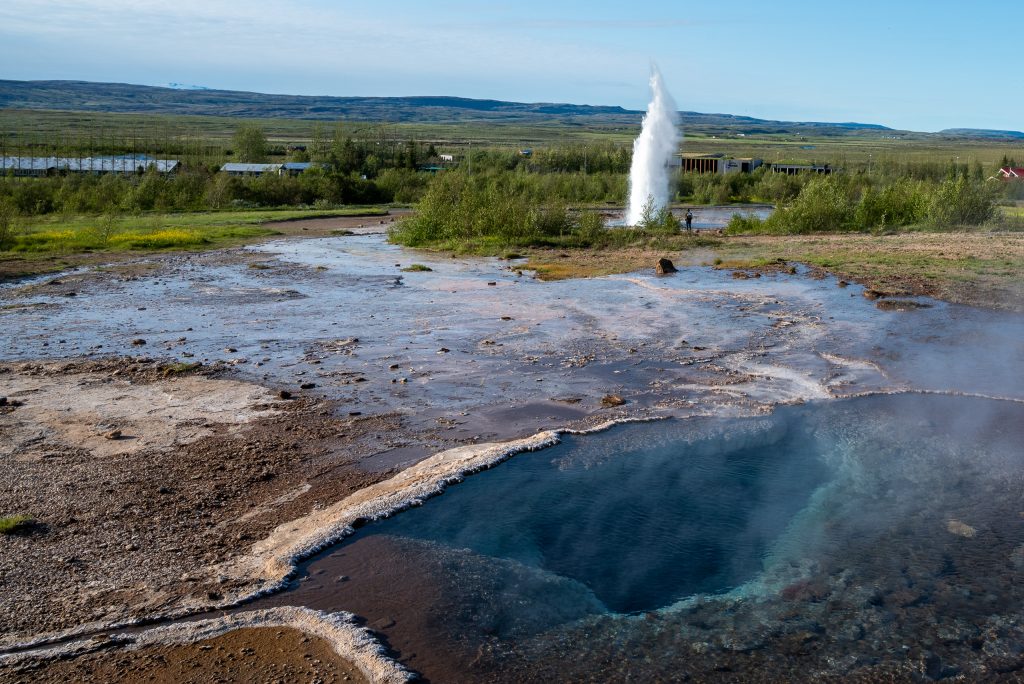
The next morning a similar story to the day before There were three other people in the Geysir geothermal park and we were able to take pictures of the regular eruptions of the Strokkur geyser bereft of human presence. Further on at Gulfoss our only companions were a team of scientists from an Icelandic government agency unpacking their gear and dressing up for the soaking they would get from working close to this stupendous waterfall. The morning light cutting through the spray only added to the almost mystical quality of the waters.
So our travel advisers recommendation is one we strongly endorse. Go early!
We could then use the rest of the day for other activities. These included our visits to the geothermal spas and a drive out to the pretty coastal village of Eyarrbakki, where many of the well-kept buildings date from the ninteenth century. We also made a stop in the town of Hveragerði, site of more geothermal exhalations (the golf course seems to have additional hazards to the norm in the form of steam spouting from the hillsides). It is also the site of a charming little art museum, the LÁ Art Museum (https://listasafnarnesinga.is/hveragerdi/art-museum-south-iceland-english/). They have changing exhibitions of the 500 works of art from their collection, most of Icelandic painting, sculptural and conceptual art from the last 125 years. A peaceful place with a small cafe and shop.
Of Geothermal Spas and Hot Tubs
So it seems to me that the geothermal spa is to Iceland as the afternoon tea is to England; an institution. You feel you cannot allow your trip to go by without at least one visit. We did not go to the iconic Blue Lagoon on the Reykjanes. Our first day’s drive was from Keflavik Airport to beyond Hella and we wanted to take other sights on the way. So it was not until we drove back to the Golden Circle that we sampled Laugarvatn Fontana (https://www.fontana.is), a geothermal spa and wellness centre in the village of Laugarvatn about halfway between Þingvellir and Geysir.
My confession is that I am not a fan of hot baths or similar immersions of any type. I dislike saunas, get a psychological sense of suffocation in steam baths and, however relaxing or therapeutic they may be, acquire an early sense of ‘so what’ in hot tubs and jacuzzis. My partner is a big fan. She had already tried the hot tubs that are a feature of many Icelandic hotels and found they helped her relax back and muscles after time journeying round in the car. The many outdoor pools at Laugarvatn Fontana, with their slightly differing temperatures, were an ideal introduction to this Icelandic ritual. Especially so because access was very straightforward, as the site is all on one level and the pools either very shallow or with proper steps and handrails (not the ‘ladder’ steps that require greater upper body muscle strength to negotiate). None of the pools were more than chest deep, most much less. You are supposed to end with a dip in the adjacent lake which maintains a temperature of 13-15°C (55-59°F). We left that one to hardier souls.
I partook here, so I could have the experience, but I left the next visit to my partner.
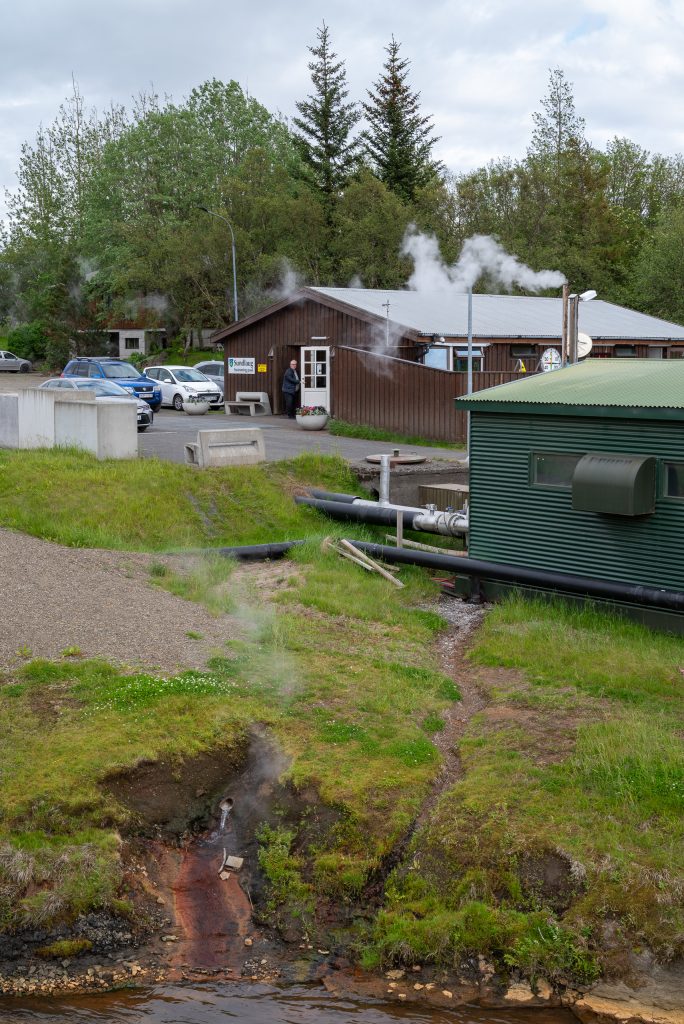
That was at the Secret Lagoon in Fluðir (https://secretlagoon.is), a village south of Geysir that seems to sit on a bed of geothermal steam. It oozes out of meadows, wafts out of pipes and valves that have a flavour of the steampunk about them and it supplies two geothermal pools. One is off the tourist radar being a prosaic local pool and the other is the Secret Lagoon. My partner liked this one so much more than that at Laugarvatn. It felt more friendly, more natural, more local (although it had its fair share of tourists). Just one pool, waist deep and about the size of a basketball court, sits alongside the geothermal stream that runs through the village. It too was all on one level, with a broad set of steps (with handrail) leading into the pool. There were people of all ages in the pool. Had we the time, she would have returned.
The pools all seem to operate through booking a fixed time online. Towels, robes even swimsuits are available for rental. Cold drinks can be taken into the pool area. Cafés are part of the small complexes and, at Laugarvatn Fontana, you can even partake in a tour of the geothermal bakery and sample the bread fresh out of the hot black sand in which it has been baked for 24 hours.
Mobility Access:
Even for those with very limited walking capability these two spas were easy to use and the heat has a beneficial effect on aching joints. Car parks are right next to the entrances.
Hotel Grimsborgir
This is a relatively newly-opened hotel on the south fringes of the Golden Circle area. Its design was novel to us, being constructed as a sort of private estate of low (one storey for the most part) buildings in a predominantly white finish, styled like wooden ranch buildings. These were set round a circular estate road. The setting is amongst the scrubland of the Sogið river plain with individual hills standing proud of the lower lying land. Here, closer to Reykjavik, the landscape is dotted with what I assume to be the holiday homes of city dwellers amidst those of the locals. Like so much Icelandic domestic architecture most are relatively small, simply-designed, single-storey dwellings.
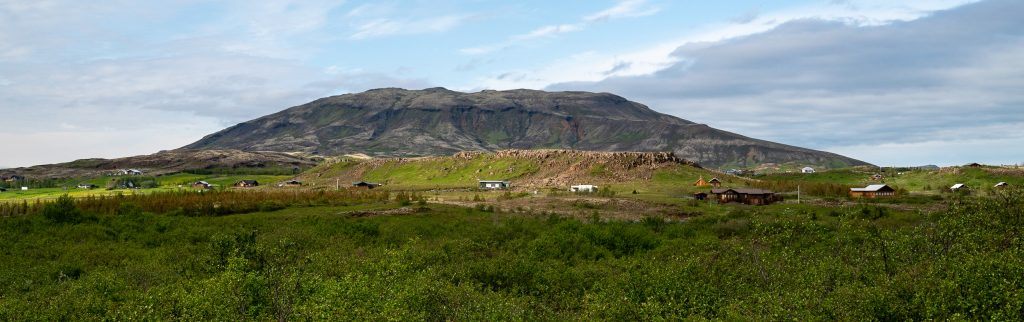
Some of the buildings came with standard hotel rooms, sporting patios or balconies, and others with accommodation for families, etc. in single storey dwellings. Some were still being built when we were there. The very limited construction noise was too far away from our room to be at all disturbing. To me there was a slight sense of the tract home estate you find in the states of the American Southwest; again this is a comment on the layout and design, not a comment on the quality of the hotel itself. Indeed, we found it suited us very well.
The room had all we needed, although this was the one place that we felt the blackout arrangements could have been a bit better. There were two hot tubs in a small courtyard at the end of our building, very convenient but you did have to ask for them to be filled before use; a process which could take around 45 minutes.
The staff were generally helpful with an occasional sense that some were better trained than others. The food was, again, uniformly good with a wide selection for the buffet breakfast. The bar was a cosy alcove, with two fires. A good place to sit, read, relax and have a quiet drink. They had a live pianist every night playing pop and rock standards. If you have a restaurant table near the piano, it can be a shade intrusive.
Mobility Access:
Smooth pavements and estate roads on one level made it easy for my partner to move around, but we were glad that our standard room (on the ground floor) was in the building closest to the reception building (which incorporated the bar and restaurant).
It is self-advertised as a five-star establishment. I would have thought four-star was a better description of the service, facilities and ambience but it was none the less effective for our purposes. It was an ideal base for us to visit the sites of the Golden Circle with Gulfoss 50 minutes’ drive away, Geysir 45 minutes and Þingvellir 35 minutes.
Snaefellsnes (Peninsula)
The Road to Snæfellsnes
We drove from the Golden Circle area to our next stop on Snæfellsnes by taking Route 48 north down the Laxá í Kjós River valley before circling around Hvalfjördur. This is a truly beautiful, quiet drive. Most of the traffic heading out of Reykjavik to Snæfellsnes, Westfjords and Akureyri zips up Route 1 and through the Hvalfjördur Tunnel, cutting off the loop around the fjord. This reduces traffic to a few locals and tourists on the road down the valley and around the fjord. The former is a wide, empty glacial valley with framing mountains and carpeted with lush green farmlands. The latter has the feel of one of the more spectacular Scottish sea lochs. From the junction of Route 48 with the main road between Reykjavik and Þingvellir to the point where Route 47 (around the fjord) re-joins Route 1, driving this road takes no more than 1 hour 30 minutes, except that, so frequent will be your stops to enjoy the scenery, you should allow a good bit longer. Just be aware that there are no places to buy food nor any petrol stations along the route. Take a picnic, instead.
Visiting Snæfellsnes
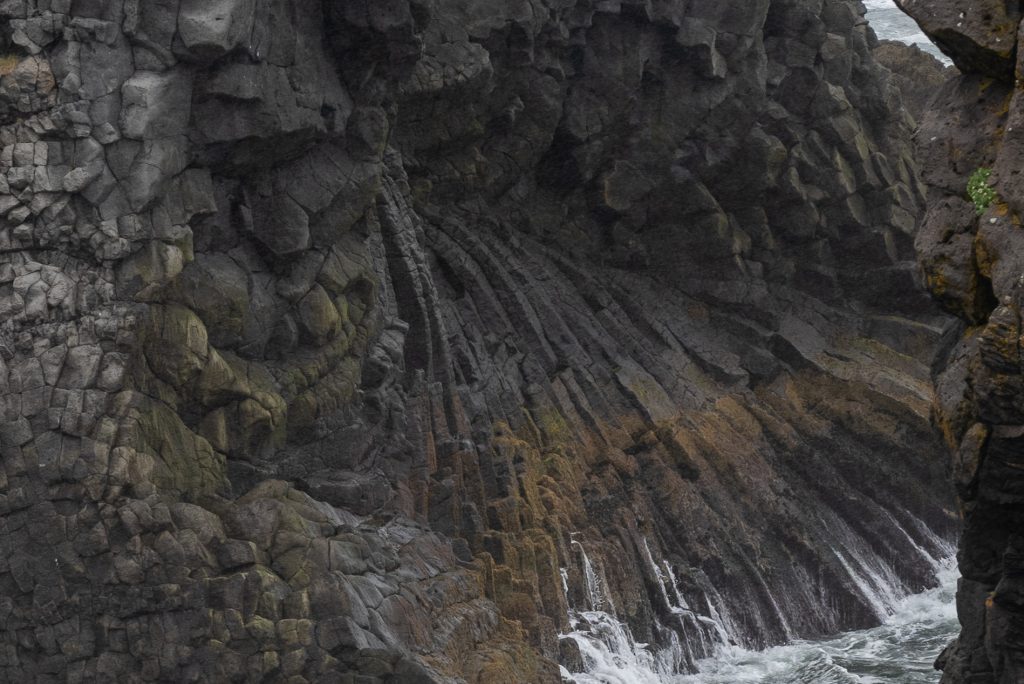
Apparently this peninsula, north and west of Reykjavik, is less visited than some of the other southern parts of the country, although there were plenty of visitors when we were there, but without the depth of crowds on the sites of the Golden Circle and the south coast. Go, for it is another stretch of land and sea with a wealth of vistas and sights that will repay your time spent. We had three nights here, which gave us a reasonable time for a drive around the peninsula and to see many of the sights.
Here be columnar basalt rock faces, seabird strewn cliffs, rocky beaches with basking seals, rock arches, waterfalls of course, the striking knob of Kirkufjell, the volcanic cone of Saxhöll, the coves of black sand and the sprightly seaport of Stykkisholmur. And brooding over it all the Snæfellsjökull, the ice-covered volcanic heights that are at the end of the mountain ridge that runs along the spine of the peninsula.
First, however, gather breath and, on the drive up from the south, stop at the Visitor Centre for the peninsula. Despite its location in the middle of an otherwise empty landscape and despite it having the feel of a local village hall, complete with trestle tables piled with local knitwear and other crafts, here the helpful desk-person introduced me to his touch screen website. This gives details of all the locations to visit around the peninsula, and is one well worth keeping to hand as you explore the peninsula (https://www.west.is/en/destinations/towns-regions/visit-snaefellsnes). And don’t forget to try the pylsur at Agnið Street Food, a wagon in the Visitor Centre car park.
Our two days were somewhat different. Day one was mizzle day. We drove west along Route 574, through the lava fields (atmospheric even in the grey weather) to Arnarstapi to find some lunch. This once fishing community is now a small collection of hotels, cafés, holiday lets and car parks serving a coastal landscape of cliffs, including the Gatklettur, a striking rock arch where the sky is whirling with seabirds. A simple, but good, lunchtime soup, was had at Stapinn, a busy little restaurant/café opposite the car parks. We retreated to the hotel for the rest of the day.
Mobility Access:
The coast (both a cliff viewpoint and the rock arch) is only a five minute walk from the car parks across an essentially flat, prepared path which meant my partner could enjoy the views without difficulty. More extensive walks along the cliff tops can be had if you are so inclined.
Day two was a contrast; bright sun and high cumulus cloud. We took a drive along Route 574 that circled round the end of the peninsula and the Snaefellsjökull taking in several stops for coastal and volcanic scenery.
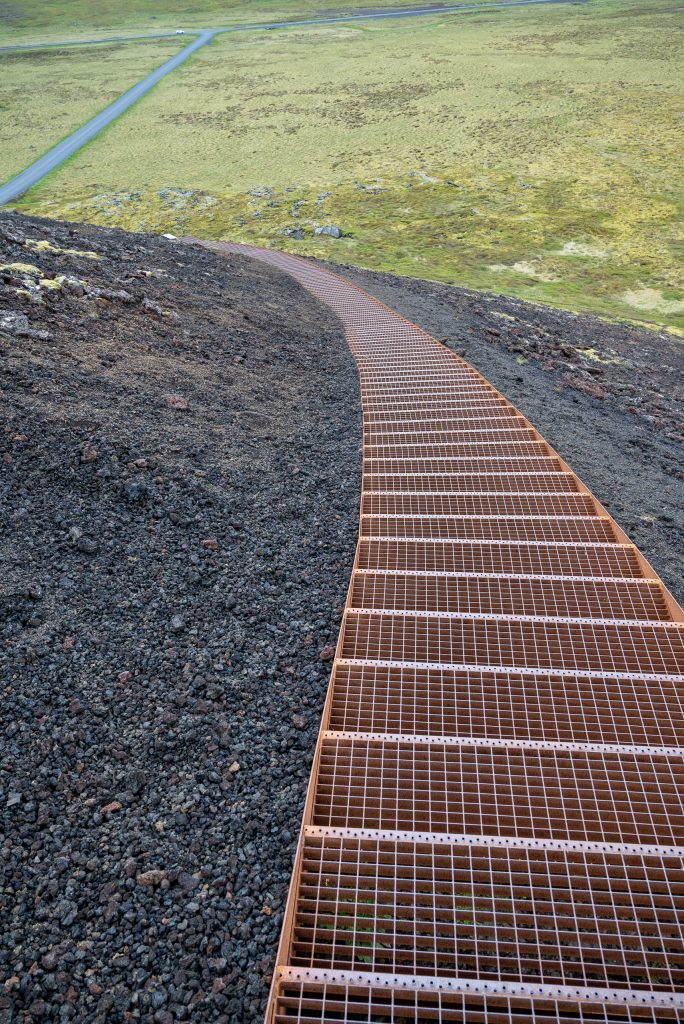
One is Saxhóll, a volcanic cone with crater, standing proud from the flat plain around. There is a small car park (no charges) and a very robust set of metal stairs that curl round the cone to the summit. At the top there were strong winds, dramatic views all around and an underwhelming crater, now little more than a grassy hollow.
Mobility Access:
The climb is definitely not for those with mobility constraints. However the cone can be seen from afar and the car park sits right beside its base.
We took a break in Grundarfjörður and then on to Stykkishólmur, a busy ferry and fishing port. A circle back south and west to Buðir was a full, but a very manageable, and memorable, day’s drive.
If you have the time in your trip, I really would consider spending some time in this more remote but appealing part of Iceland.
Snæfellsnes Activity: Puffin Tour
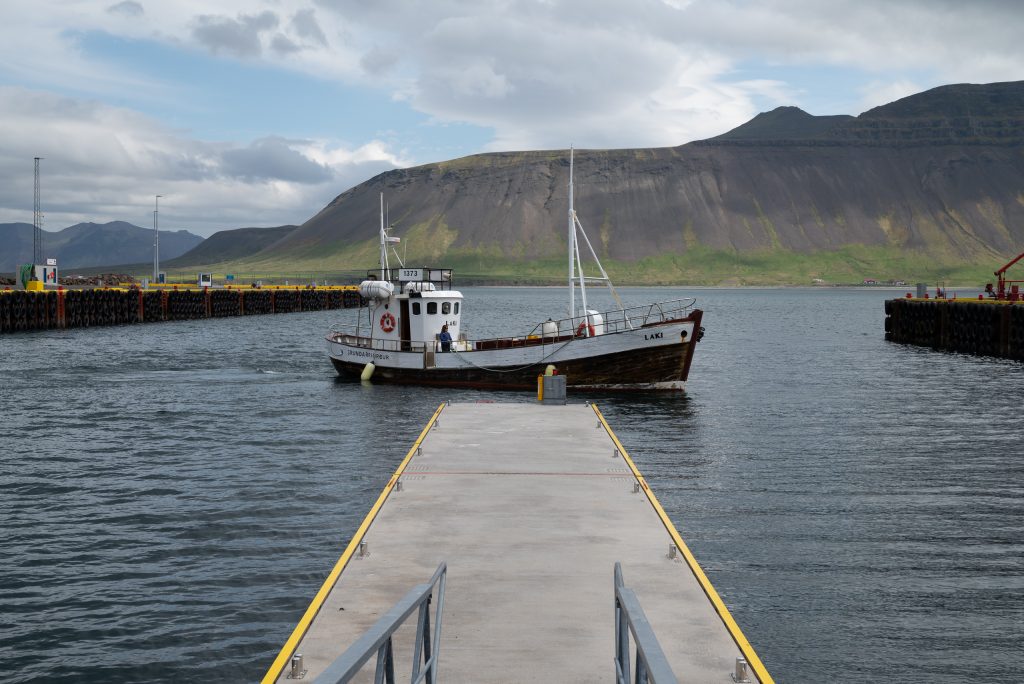
The puffin tour seems to be almost de rigeur for visitors to Iceland. They are available from many ports around the island and my trip left from the spectacularly-located small port of Grundarfjörður on the north coast of Snæfellsnes. This was a two hour trip aboard an old fishing smack out to and around Melrakkaey, a small, flat topped islet festooned with seabirds. We saw puffins on cliff tops, on rocks and in the sea and a wealth of other bird life. On a calm sea, on a clear sunny day the chugging wooden boat was a lovely mode of transport and our guide, a young Breton, shared her wide knowledge carefully around the 25 or so people on the tour. You don’t get really close to the puffins, certainly not close enough for a decent picture with a smartphone. My 24-70mm zoom lens certainly could not make the birds anything more than blots on an expanse of sea. The difficulty is that, quite sensibly, the puffins scatter if the boat edges within about 30 metres, diving down or flying away in a frantic flap of wingbeats.
Mobility Access:
Getting on and off the boat is relatively easy, just a couple of steps over the gunwale, and the two person crew (guide and pilot) are on hand to help. On board there are wooden benches built around the sides and one or two other perching spots. There is no inside cabin space but the trip is unlikely to be running if the weather is adverse. The harbour car park is adjacent to the jetty and there is just a short walk (30 metres) along that jetty to the boat.
Snæfellsnes Hotel
Hotel Buðir
Probably the smartest accommodation on the peninsula is this cosy hotel set on an exposed area of land on a small estuary with a long, empty beach stretching away to the east (https://hotelbudir.is). It sits alone in the landscape apart from the tiny black church (Buðirjirkja) on the nearby crest, itself a draw for the tourists who are driving around the peninsula. The location is very atmospheric, even in the overcast weather that accompanied our visit to this part of the island. The architecture and décor of the hotel is very much the spare style that reflects the atmosphere of Iceland’s life with wooden floors and straightforward furniture. Our room had all the necessary comforts of a quality hotel but, decoratively, felt slightly spartan. The common areas contain a couple of quiet nooks for reading and writing and the high-ceilinged bar area, with its picture windows out along the coast and over to the spine of the mountain ridge a place to sit and watch the eider ducks swirl around on the tidal flats. The hotel had only just re-opened because of works to create a new wing. The works remained unfinished which did the hotel no favours on first acquaintance because, in the low cloud and drizzle, the crushed black laval gravel car park had a faint air of building site. This is misleading and, of course, only temporary. Likewise, the recency of the re-opening meant a slight green-ness in the staff, some of whom were still feeling their way into their roles. There were occasional times when getting something at the bar or seeking assistance took longer than needed. The staff were, with the unfortunate exception of the reception person at our arrival, caring and friendly and the reception person who was there for the remainder of our stay was amazingly helpful, fetching things (like extra clothes-hangers) when no-one else available. Dinners are taken in-house, unless you feel like taking the car over to the other hotels and café-style restaurants of Anarstapi, twenty minutes drive away. The food aims to be a cut above the run-of-the-mill. Whilst we were there, it sometimes felt it did not quite hit the mark. The small tour groups who do use the place are fed in separate room so the dining room is quiet, relaxing space.
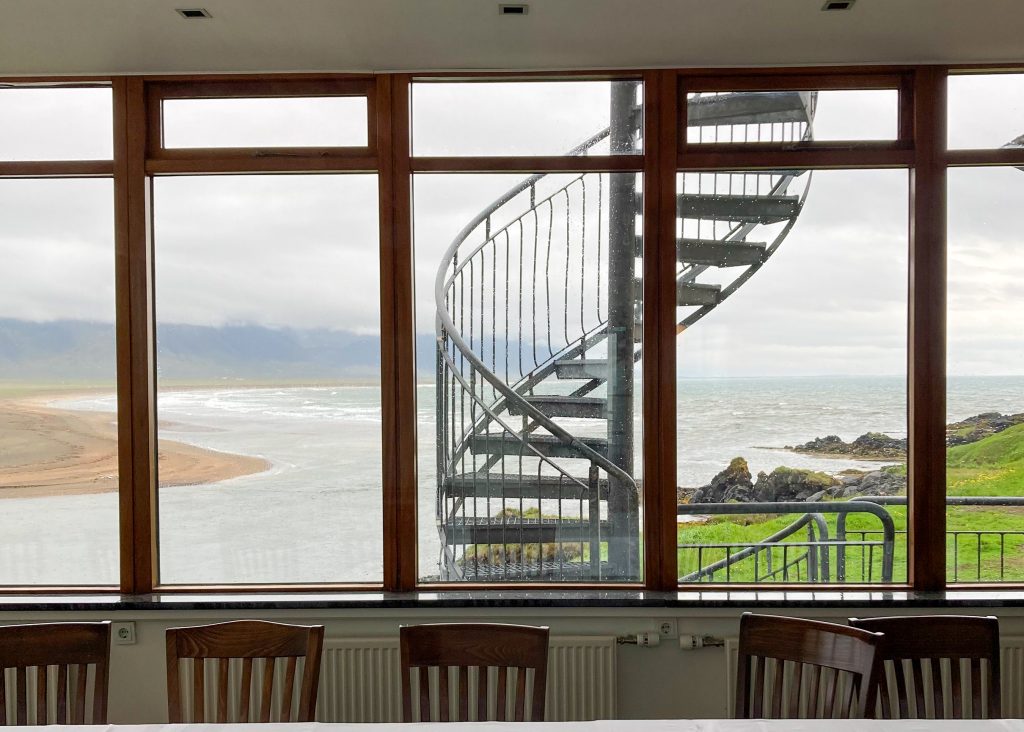
All-in-all this is a peaceful, extremely comfortable place in a special location and the completion of the works for the extension should iron out the wrinkles that I have touched on here.
Mobility Access:
I have not given this one a colour coding because, although the three-storey building lacked a lift (elevator) at the time of our visit (so we faced a stair climb to our first floor room), I understand a lift is being installed as part of the extension works so this point may be irrelevant now. There are a few steps up and down between some sections of the common areas but nothing that should not be manageable.
Snæfellsnes Cafés
Kaffi Kyrrð, Borgarnes
We stopped here (https://blomasetrid.is/kaffi-kyrrd-the-coffee-shop/) en route to Snaæfellsnes, and on the way back, for a coffee/tea break from the drive. Set up a street in the older part of town, it is a charmingly cluttered shop (for local groceries and knick-knacks) and café with an eclectic selection of sofas, chairs and tables and, outside, more tables and chairs on a wooden platform festooned with plants and gnomic garden statues. It is open every day from 09.00, so it was ideal for our early coffee on the Sunday morning of our drive to Reykjavik. We did not try the food, which is served through the day with plenty of vegetarian/vegan options available.
Mobility Access:
All on one level, including the rear platform, with direct access without steps to the wooden deck from the road.
Green Company (Græna kompaníið), Grundarfjörður
The town of Grundarfjörður on the north coast of Snæfellnes is a fishing port and the point of departure for my puffin trip. This shopfront bookshop and cafe sits a short walk away from the harbour where my trip departed. My partner used it for a peaceful read and sit (and lunch) whilst I took the trip. The town is very open, the buildings low and set far apart, so you can fully appreciate the splendid location, surrounded on three sides by the mountains, snow-topped even in June, and the solitary peak of Kirkjufell to the north. The latter, a former nunatak, is said to be the most photographed mountain in Iceland. A full-on cake selection and soups and light lunches are on the menu. No website but there is a Facebook page.
Mobility Access:
Level with the street outside so no issues here.
Reykjavik
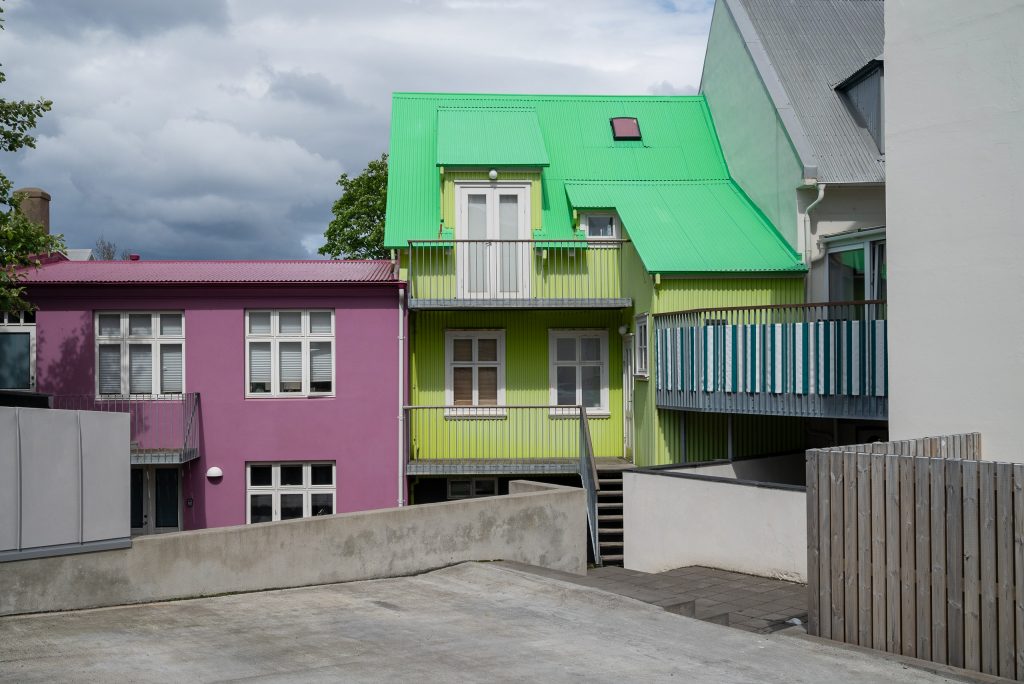
Approaching Reykjavik for the first time feels like the approach to the urban sprawl of many a northern European city, all retail warehouses, distribution units, motorways and blocks of flats. In the centre the real difference is apparent, for this is a place that is still allowed to breathe. Few buildings are over three storeys high, government buildings are modest, truly striking buildings are few and pleasure is to be had just wandering around the residential streets that are lined with unassuming houses in colourful pastel shades.
Getting About
We did not have enough time to do more than scratch the surface, but the city is one of those places that allows easy walking for the more mobile and, for the less mobile, a reasonably good bus network with an easily downloadable app – Klappið. We used it to do our own exploratory tour round parts of the city, just going where the bus lines took us. For bus tickets, we found it easiest to buy a Reykjavik City Card (https://visitreykjavik.is/reykjavik-city-card) as it also gave access to several of the museums and galleries. For us, this sort of card, in use by many European cities these days, is an easy way to overcome the administrative hassles of working out how to get transport tickets and to get access to cultural sights.
I found it an enjoyable city to wander around and, over the day-and-a-half we were there, we seemed to cram quite a bit in, whilst still having time for breaks in the many excellent coffee shops.
Things to See and Do
There are plenty of good guides to the city, so I just mention my own highlights.
The huge three-dimensional map of the country is a fun diversion for map nerds like me. It sits in the Town Hall, itself one of the few modern governmental buildings in the city, which is pleasantly located on Tjörnin, the town lake. If the evening sun is shining down on you, try a drink on the lakefront terrace of Iðnó, a cafe/bar/venue (dating from 1897) adjacent to the Town Hall.
We had visits to the art galleries at the House of Collections, a collection of contemporary art with an environmental theme alongside informative displays about the impact of climate change on the country, and the National Art Gallery, a landmark building on Tjörnin lake with a mix of contemporary and twentieth century Icelandic art. A feature of the public art galleries is that the usual cafe is replaced by quiet rooms with serve yourself free tea and coffee. Both museums had work by Icelandic artist Ásgrímur Jónsson, including some wonderful drawings of trolls from folk tales that had a Goya-esque sensibility. This pioneer of Icelandic visual art worked from the turn of the ninetenth/twentieth century and into the first half of the latter. My partner visited his modest home with its own collection of works – a fascinating insight into an artist unknown to us. We also took in the Museum of Photography which has a regularly-changing collection of Icelandic photography, much of it focused on documenting Iceland‘s life and culture.
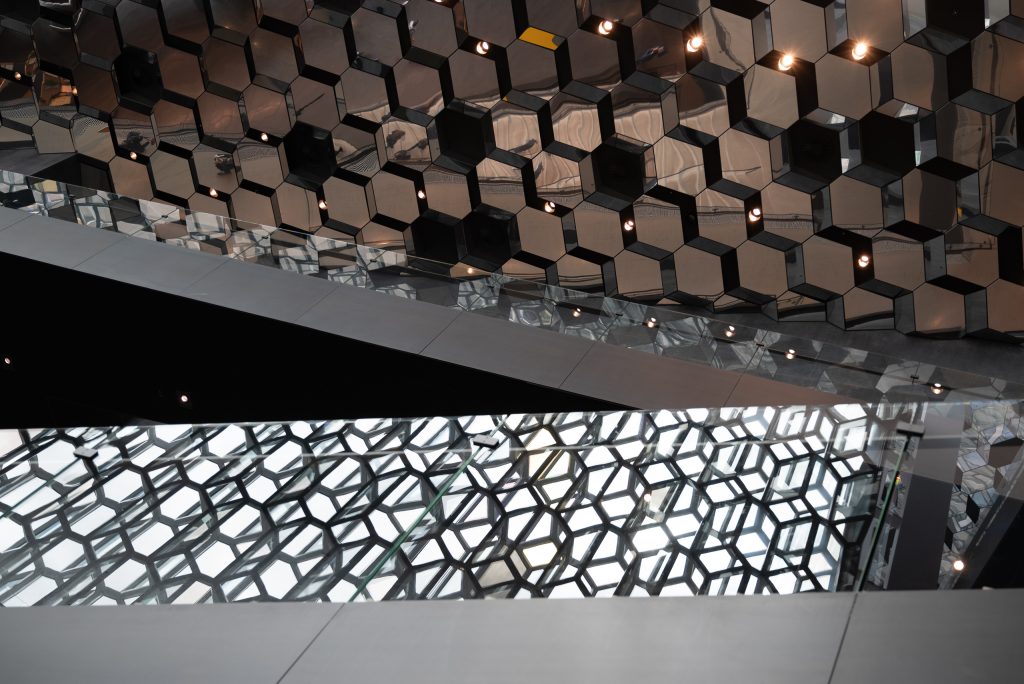
Whether you walk around the revamped Old Harbour or along the Sæbraut promenade (past the Sun Voyager sculpture and selfie spot) you are drawn to the photogenic edifice of Harpa. I enjoyed just ambling around this, to my eyes, stunning concert hall and conference centre (opened in 2011) happily snapping away. My partner was able to get a ticket online for a concert of Icelandic songs and music that afternoon.
Mobility Access:
As you would expect from a twenty-first century building, Harpa has excellent access facilities with escalators and lifts inside and bus stopping points on the concert hall plaza.
The other out-of-scale sight in Reykjavik is the Hallgrimskirkja. This architecturally-striking church sits atop a hill rising gently to the east of the main centre. Whilst not quite matching the gestation of Sagrada Familia in Barcelona, it was 41 years from its conception to its opening in 1986. I did not go inside but enjoyed just walking up the streets from the city centre, meandering around the large open plaza where the church sits (trying to find places to take images that are not a repetition of many that already exist) watching the many other tourists coming and going overlooked by the organ pipe wings of the church flowing down from the lofty steeple. There is the ability to visit the tower with views across the city.
Mobility Access:
Unfortunately the church’s own website does not mention whether there is a lift up the tower. The plaza itself is flat ground at the front but with steps down at the back as the hill slopes away. There are no buses directly to the plaza, although there is a road accessible by a taxi. The nearest bus stops are on Routes 5 and 15 at Heilsuverndarstöðin, from where it is a 3 minute walk up the slopes to the back of the church and the main plaza. From the town centre it is a 15 minute walk up the long avenue of Skólavörðustígur to the plaza.
Apotek Hotel, Central Reykjavik
https://www.keahotels.is/apotek-hotel
Part of the same hotel group as Hotel Grimsborgir, this place was a very different proposition – in the heart of the city, in a building dating from the 1910s with five storeys it is part of a terrace with others around the main square, Austurvöllur – and with a very different vibe in the public areas.
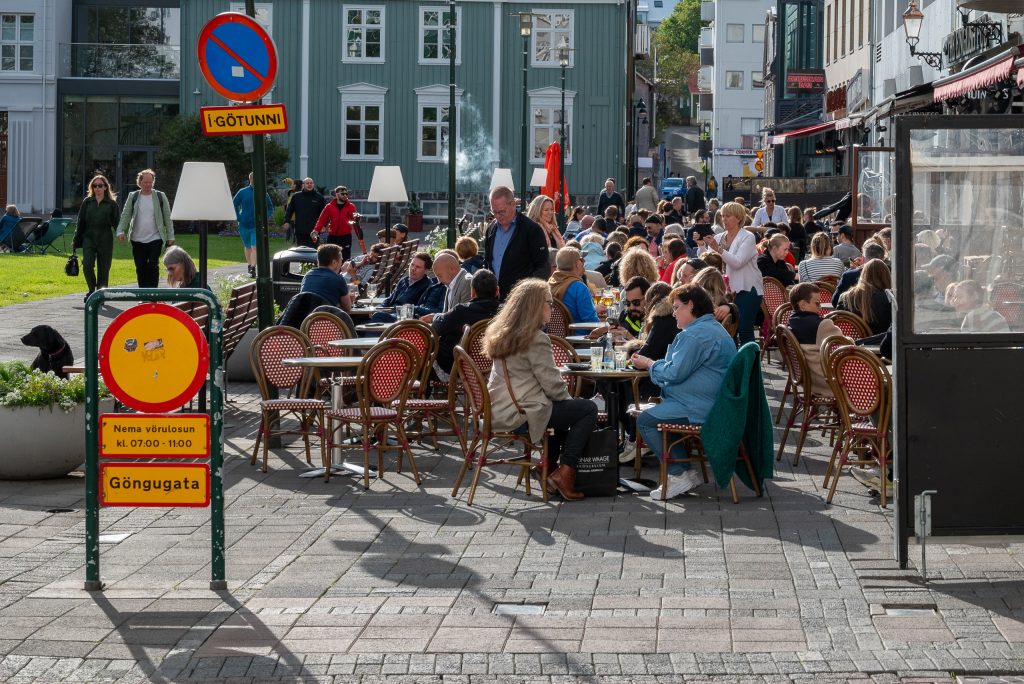
The room is fine, with all we need given we are only here for two nights, effectively only a day and a half in the city. Not enough for us slow travellers but ‘needs must’ on this occasion. The room looks out over the square and, apart from the bells of the Dómkirkjan tolling each quarter hour, it was quiet for a city centre location.
Staff were helpful enough at reception (we only needed them for check-in and check-out and luggage storage). The adjacent restaurant/bar/café was a city centre meeting point in the evening and became noisier as the evening progressed; somewhat nosier than we would have wished.
Mobility Access:
A lift, a must, is present if small, and the modestly-sized lobby tends to be a congestion site at group check-in and check-out times. A road up to the front entrance is accessible by taxi. It was also conveniently located for the city’s bus services.
Restaurant: Messinn
https://www.messinn.com/en/messinn-reykjavik
This gave me a chance to try Icelandic comfort food in the form of plokkfiskur, traditionally a way to use up leftovers but now a chance to mash up cod and potatoes in a white wine cream sauce. My partner elected to have the vegan chickpea and carrot fritters with chili, ginger and cashews and a tomato hummous sauce. Set in a ground floor street front place (with a few steps down from street level) with wooden floors, I am sure this was a bit touristy, but it was an excellent last evening culinary coda to our trip.
Practicalities
Eating Out and Buying Food
We were given some wildly conflicting views about the food from acquaintances before we went. The one who said she enjoyed the food was spot on as far as we were concerned. All the places we stayed had interesting menus, the majority of which included at least two inventive vegetarian/vegan mains and starters. Fish held pride of place and, not surprisingly, was cheaper than the meat. Cod, ling and Atlantic char (the last of these somewhat akin to sea trout in colour, texture and flavour) sat alongside shellfish such as lobster, crayfish and prawn. On the meat side, beef (the most expensive meat) and lamb held sway. Interestingly there were no chicken dishes on the menus we saw, although eggs were aplenty at breakfasts.
We had read that whale meat and puffin were found on menus, but we did not see whale at all and puffin only as a starter at Messinn in Reyjavik. Our wider reading had warned us off both the former (Iceland has refused to support the UN-sponsored moratorium on whaling) and the latter, although the environmental basis for objecting to the latter was not entirely clear to me. Hunting both whales and puffin is a source of controversy within Iceland itself.
Iceland, like so much of Europe has enthusiastically adopted café culture and every tourist town had quality places serving good coffee and food, although the latter is slanted towards extensive bakery products. In the comments for each area I cover those we thought were ‘worthy of mention’.
We enjoy visiting supermarkets when we travel as they give us another insight into the food priorities in a country. For us they are also a source of travel food for our drives (fruit, nuts, bars) and, occasionally, of picnic food. We went into the three main chains – Konsam, N1 and Bonus – and, seeking a simplistic comparison, they were more Tesco than Waitrose with everything available that we needed.
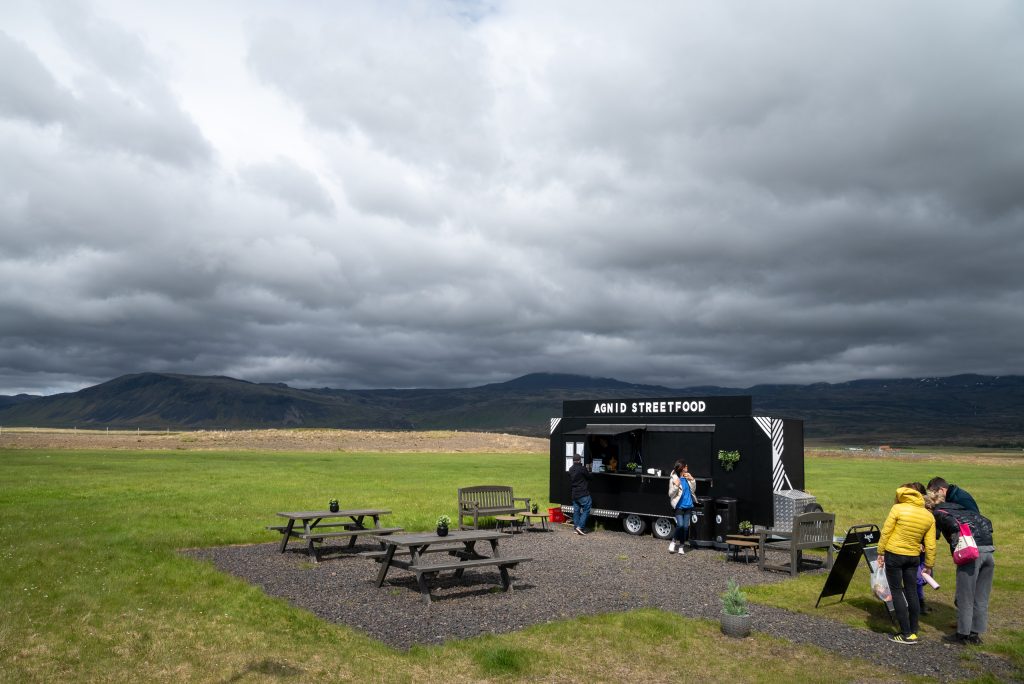
Food cannot end without mention of that Icelandic culinary institution: the pylsur. This is a hot dog but Icelandic style so it is lamb-based with additional pork and beef and the best ones will use organic, free range, grass fed, hormone-free meat to which are added the bun and a wide variety of toppings and sauces. For a love letter to pylsur see https://www.thefooddictator.com/the-icelandic-hot-dog-pylsur/. We tried ours in the unlikeliest of places, Agnið Street Food, a wonderful street food wagon set in the middle of nowhere (actually only a couple of minutes drive east from the junctions of Routes 54 and 56 on the Snæfellsnes). We had stopped to go to the adjacent Visitor Centre but, it being lunch time and, with the sun out, having a pylsur in the cradle of the fabulous vistas was a temptation beyond resistance. The serving team seemed so full of joy that it only added to the experience.
Car Rental
As so often these days, the car rental pick up and return at the airports was very quick and straightforward (organised by Audley Travel, we used Avis). Our car was a standard 5-door hatchback, which was all we needed given we had no intention of going on difficult roads.
Driving in Iceland
I felt driving in Iceland was, generally, a straightforward and not too stressful experience. The roads are relatively quiet. So, even on the main Route 1 that circles the island, other vehicles can be few and far between and the sealed roads that made up the bulk of our driving were in good condition. Speed limits are low by UK standards with a 90kph (56kph) maximum on all roads and, in the built-up areas, speed limits down to 30kph (19mph).
The guidebooks carry some dire warnings about going off those sealed roads and the car rental companies have images on the screens above their desks at the airport showing cars with their front half, nose down, in stream that was much deeper than expected when fording. Those same companies also give out leaflets on some of the nuances of driving with care in Iceland. My advice is to take the time to read it. The one thing that I never quite got to grips with was how to manage priorities when it came to using one-way bridges. Route 1 along the south coast has several of these and some can be a couple of hundred metres long. Here a judicious following of what the locals do, and the relative dearth of traffic, helped me negotiate them.
A key point that is not in the leaflets or guidebooks is the lack of signage for upcoming tourist sites or before junctions. Except in the busiest areas the only signage is (a) quite small and (b) often only seen at the relevant junction or turnoff, but not before it. The result was, even using a GPS navigator, we would find ourselves overshooting junctions or turnoffs. Some sights had no signage at all and we could only identify them because, in most places, there was a collection of cars parked more or less where we expected the sight to be. The same lack of signage applies to lay-bys. Some are marked, others not.
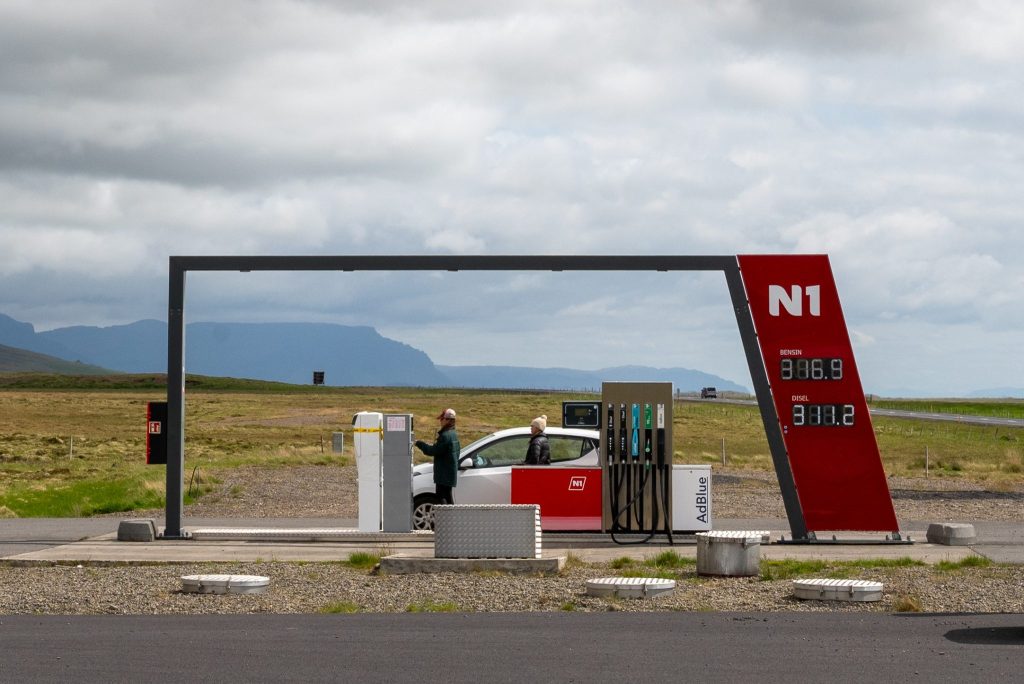
Keeping a judicious eye on your petrol gauge is good practice. There are more petrol stations available than some of the scaremongering would have you think and, on the sealed roads, the driving distances between them are not so great.
We only went onto unsealed roads on a very few occasions and then only for short distances of a few kilometres. We did not feel constrained in our travels by not being able to take the roads only usable by 4×4 vehicles. GPS maps did not always have a very clear coverage of the smaller side roads but the hard-copy road atlas I took helped me when the GPS was unclear. I used a Kortabók Road Atlas bought from Stanfords travel bookshop in London (https://www.stanfords.co.uk/Iceland-Mal-og-menning-Road-Atlas-2021-2023_9789979344131). This shows which roads are manageable in a standard 2-wheel drive car and so is very useful in planning drives and side trips.
Finally a brief word about overtaking. The Icelander behind you, although slightly kamikaze about braking distances on occasion, seems to need an open stretch of road the length of the Northern Runway at Heathrow in order to overtake. Be patient and move over when you can.
Flight + Time Zone
Reykjavik is only one hour behind London time (and four hours ahead of Eastern Time in the USA). It is a three-hour flight from London. Icelandair did the needful and were very efficient in the provision of the wheelchair service at Keflavik.
Money and credit cards
The currency is the Icelandic kroner, shortened to ISK. For checking exchange rates, the advice is to download a currency converter app. We use XE but I am sure there are many others out there. We took some cash with us, ‘just in case’. But, as so often on trips to European destinations, we ended up trying to find ways to use it in the last few days. I still suggest you have an emergency cash float, but we found our standard Mastercard paid for everything, once I had worked out how to use it in Icelandic petrol stations.
Wi-Fi and Mobile Signals
Soon this will cease to be worthwhile of mention because it will become an assumption that you can access free Wi-Fi in most service industry locations. Certainly that was the case for us wherever we stopped in hotels, in cafes, in restaurants. With the mobile signal a little more care is needed. It was usually very good but, understandably, in some of the more remote locations it can disappear altogether.