Prelude
Special occasions can be used to justify the occasional full-on indulgence. Thus, in order to mark a key event, in late November we boarded the Eurostar for a sojourn to cities we had not spent any meaningful time in before and to spend four nights at a retreat in the Bavarian Alps in between those city visits. November sees the early days of the Christmas markets in the Germanic cities, a distinct chill to the weather and, in our case, a romantic dusting of snow that did not interfere with our travels but made our stays even more atmospheric. And each of those sojourns was enhanced by choosing to stay in four top bracket hotels. Expensive, yes, but in this month a little less so than they become closer to Christmas. Moving from one pampering hotel to another was done by train. Having waxed lyrical before about our preference for train travel over short-haul flights (in Europe at least), the added bonus here was the often-iconic scenery of regions like the valley of the Rhine and the stunning forest and mountain scenery of the Alps seen through the big screen of a train window. Catching the Christmas markets also taught us a little about the timing of visits to these perennially popular happenings, especially as November had bled into December when we reached Cologne (Köln). Be ready for the fact that, for the rest of this piece, I intend to refer to Germany’s fourth largest city by the name that its inhabitants would give it.

Structure of the Trip
This is western Europe and so we arranged the travel ourselves: trains, hotels, and, with some help from hotel concierges, restaurants and events. The main tool, as always, is the internet search engine and, for the hotels, the various sources covered in Travel Planning: Planning and Researching. That piece touches on our perceptions of the advantages of booking direct with the hotels and, in this case, the direct contact with the hotels allowed us to ensure specific needs were met and questions answered. The centrepiece of the trip was the classical music festival taking place at our chosen retreat in the Bavarian Alps and, having fixed on our stay there, fitting suitable stopping points around that stay. The bare bones of the trip were these: train to Frankfurt for one night, train to Salzburg for four nights, train to the Alpine retreat for another four nights and train to Köln for three nights before a return to London.
Getting Around – Travelling by Train
The section on European train travel in the Travel Planning: Our Means of Travel, covers the basics of how we go about the booking process. Here the train travel timings were developed using the English language version of Deutsche Bahn’s journey planner (https://int.bahn.de/en)and the tickets then booked with the relevant train operators: Eurostar, Deutsche Bahn (DB), OBB (the Austrian national rail company) and, because they provided a better timed train from Munich to Salzburg, WESTbahn, a privately-owned Austrian rail operator. The bulk of the tickets could be bought through DB, so downloading their app made sense because, once bought, tickets were easily accessed through that app. You also receive detailed information about the journey, its progress and notifications of any potential hiccups. If you are uncomfortable about diving in to the website without a bit of knowledge of types of tickets, classes of train and ticket buying processes, as always, The Man in Seat 61 website offers you the best starting place (https://www.seat61.com/train-travel-in-germany).

From me, just a few practical points about booking and travel with DB. First when booking a particular trip check you are buying tickets and not just a seat reservation. A failure to take sufficient care when going through the booking process meant for one trip, I had booked seats but no train ticket. A mistake quickly rectified on the website. Secondly, unlike most other train tickets I know, where each traveller has their own ticket, there is a single ticket (and barcode) covering everyone in your party. Thirdly your ticket will be in German (of course) and if, like me, you suffer from having no German at all, you will need to have some help, particularly to work out which coach and which seats your tickets are in. The only website I found that offers a full interpretation and translation (see https://help.raileurope.com/article/41258-understanding-your-deutsche-bahn-ticket) has one or two foibles. Under the section ‘Translation Notes’ the numbering has got out of sync, so the critical section on the specimen ticket which is marked 5 (with train times, platform numbers, train numbers and reservation details) is actually covered in their note 6. Anyway it is helpful to know that, in that section of your ticket, Wg. refers to the carriage number and Pl. to the seat number for your reservation. A final tip that arises from the workings of the DB journey planner is that the intervals it suggests between changes can be a little short. If a journey is offered with a change less than thirty minutes I tend to change to a longer interval. This often means we may be waiting a little longer at interchange stations but, to us, this seems preferable to getting stressed when the train is running late and then we are trying to rush to reach a connecting train with suitcases and additional travelling paraphernalia in tow. The interchange stations often have more than adequate facilities in the concourse, or just outside it, for a seat in a coffee/tea stop, as was the case in Munich-Pasing, Frankfurt Flughafen, Innsbruck and Aachen on our trip.
Weather
November and early December in these parts of Europe can get cold and chilly. The compensation for the occasional gloomy overcast day is its aftermath, often being the beauty of a city or landscape dappled or blanketed with snow. Throw in the occasional day of crystalline light under bright sun and blue skies and we found that the time of year worked well for a mix of city activities and R&R in the mountains. Temperatures hopped around between a high of 14° C (57° F) and a low of -1°C (30° F), so clothes for full-on layering up are the order of the day, especially when the wind is gusting enough to drop the ‘feels-like’ temperature to around -4° C (25°F), as was the case one day in Salzburg.

Time Zone
For us only one hour ahead of London so, for all practical purposes, no difference other than making your Eurostar trip out of London seem somewhat long and the return journey somewhat short. From North America a rather different dynamic applies with the east coast six hours behind and the west coast a truly jet-lag inducing nine hours behind.
Reading
We took in just one trip-orientated book to join our other reading. Salzburg is a enjoyable companion to a stay in the city. Written by Austrian journalist and broadcaster, Hubert Nowak, it mixes his love of the city with dashes of history, culture and its politics in a readable 150 pages. For the flâneur, the shortish chapters are ideal for those rest stops in the cafés between the sightseeing and people-watching. See https://www.hauspublishing.com/product/salzburg/.
FRANKFURT (1 NIGHT)
Theoretically you can reach Salzburg without breaking your journey, indeed it can be done in one day (with three train changes) in just under twelve hours. We were looking for something a little more civilised for slow travellers that also gave us a night where we could take the time for a celebratory dinner. We were going to be spending time on our return in Köln, one potential stopping point, and staying there would have made for a longer second day of travel. We found a more equal split in time travelled over the two days by heading for Frankfurt and it is a journey that can be done comfortably in one day. We were only in Frankfurt for 14 hours so the hotel was the key driver of location, which was why we ended up in the small satellite town of Kronberg.
Getting There
Eurostar to Brussel-Zuid/Bruxelles-Midi (you will rarely see reference to this station by its Anglicised name of Brussels South and certainly not on the Eurostar website). From there a DB high speed train direct to Frankfurt Flughafen (Airport) then a 30 minute taxi ride to the hotel. An early departure from London saw us in the hotel by mid-afternoon, allowing a relaxing lead into our evening meal.
The very name of Brussels main railway station can be confusing to first timers travelling to that city, especially as the city has two other large stations, including one called Brussel Centraal/Bruxelles-Central. If you are just interchanging to travel onward to the Netherlands, Germany and beyond there is no need to be troubled by this as Brussel-Zuid/Bruxelles-Midi is the station used by all the international high speed lines. Also changing trains for such travel in Brussels is much, much easier than in Paris, where you have the palaver of getting from Gare du Nord to one of the other Paris stations (taxi or Metro usually needed). DB suggests a transfer time for onward trains to Germany of about 20 minutes because the change is just a matter of walking between platforms at Brussel-Zuid/Bruxelles-Midi. That timing being a little tight for us, especially if our Eurostar is running even a few minutes late, we booked on the next available train, giving us a good hour’s margin for error, and allowing us time to buy a coffee and some lunch (to eat later on the Frankfurt train) at outlets within the station.

DB’s high speed trains (ICE) are very comfortable. We were in reserved seats in 1st class to give ourselves the extra space. You get a food and drink ordering service at your seat, but you pay for what you consume. If you want a choice more to your liking, then it is best to bring your own food onto the train. We found that here, in Germany and in Austria, the station-based supermarkets all had a good selection of options including, in many cases, a serve-yourself salad bar which, for us, is ideal.
Mobility Access
For those who can walk but may have difficulty with steps or longer distances, I have written about using the Eurostar in other pieces on Paris. As far as changing trains at Brussel-Zuid/Bruxelles-Midi goes there are lifts from the arrival and departure platforms down to the station concourse where the shops and eating places also live. All the surfaces are smooth and flat for easy walking. Your only hazard is the constant to-and-fro flow of people. Depending on which platform your connecting train departs from there may be a distance of 200 metres or so to walk as the Eurostar section of the station is at the very end of the concourse, but the situation is little different from any other large city station.
If you have a reserved seat on your DB ICE train (and it is a recommended option as many routes get very busy) then give yourself time on the platform to work out where you need to be to get on the right carriage (Wg. on your ticket), especially if you are hauling luggage. DB’s ICE trains do not hang around at stops and it helps to be close to your boarding point, unless you enjoy struggling through the train with that luggage to find your seat. The electronic departure boards on the platforms show where your coach will be on the incoming train and the relevant zone will be marked on the platform. There are some seats available on the platforms. The DB ICE trains have a couple of steps up into the carriage.
Frankfurt Flughafen (Airport) station is a swooping futuristic structure, fully enclosed, which means it is extremely well set up with facilities for those who have difficulty with stairs and steps and other uneven surfaces. There is a mystifying lack of clear signage to the concourse level taxi rank when you arrive (we had to ask in a shop) but that taxi rank is right there once you reach ground level.
The Luxuriating Location: Schlosshotel Kronberg
The celebratory dinner and the need to move on the next morning meant looking for a place that offered a romantic tinge but was accessible to the train. Initially we considered a station hotel and a suitable restaurant in central Frankfurt but, with Frankfurt Hbf hotels seeming to veer towards the functional and the realisation that that the trains passing through that station also stopped at the airport, we hit on the idea of the Germanic equivalent of a country house hotel. Small Luxury Hotels (SLH) came up trumps with this one (https://schlosshotel-kronberg.com/en). Set in a large, tree-filled park in the hills just outside the city, this place has echoes of a Scottish neo-Gothic ‘castle’ of the Victorian era. Not so much a surprise when we read that it was built for the Dowager Empress Victoria (of Prussia), Queen Victoria’s eldest daughter who, in a strange mirroring of her mother’s situation, found herself widowed relatively young and had this place built for her. Its fascinating history is recounted with Germanic depth on the website.
So it had all the features of a grand Victorian-era residence, well-suited to its subsequent transition into a grand hotel complete with wood panelling, huge high-ceilinged public rooms with similarly-sized fireplaces and extraordinary art from the Dowager Empress’ own collection. It was only after we were sitting in the bar having a pre-prandial drink and found the wall above our heads the subject of intense scrutiny by two men who came and stood by our table, that we realised we were sitting under a small landscape by Turner (and elsewhere in the bar there were portraits by Reynolds and Gainsborough). The room was a near suite with full bathroom (that means separate shower and toilet cubicles, as well as a tub). Nothing that would have been material to us seemed to be lacking, even though the shortness of our stay militated against all but the briefest of acquaintances.
Dinner was in the Restaurant Victoria (https://schlosshotel-kronberg.com/en/restaurant/victoria) where the wood panelling, double-height ceilings, grand fireplace and family portraits added up to a sumptuous setting for an elegant dinner thankfully matched by food and service. The offer mixes à la carte with fixed menus which gave us the scope to make our own choices. When we woke the next morning to find the woods outside our window dusted with snow it simply added to a thoroughly enjoyable start to our trip of indulgence.

Mobility Access
Only one, quite small lift (elevator) ferries guests to all floors (except the turret rooms). Having asked in advance for a room close to that lift, any potential concerns about walking long corridors was obviated. There are just two steps up from the front portico to the hotel’s main lobby/lounge and within there are no hazardous steps or changes of level to contend with unless you want to walk up the one spiral stone staircase to the small minstrel gallery overlooking the lounge.
SALZBURG (4 NIGHTS)
What a wonderful city for a winter escape. Salzburg is small and, almost, perfectly formed and has so much to offer in the historic centre, even if the twin peaks of Salzburg tourism (Mozart and The Sound of Music) are not necessarily your bag. The architecture spanning centuries, the location (tucked between the bluffs on the Salzach river), the variety of museums and sights and the ever-present musical culture combine in these winter months with the elegant Christmas markets to make a place to be savoured by the slow traveller. We had so much to see (taking our usual care for time to relax and absorb Austrian café culture) that we left so much undone. Even under grey skies and with a biting wind gusting over the Kapuzinerberg, the north-eastern of the bluffs, the snow-covered roof tops and Baroque church towers and domes seen from the top of the steep stairs (that climb up that bluff) are still a sight to relish – just wrap up warm!

Getting There
A late morning departure on DB’s ICE high speed train from Frankfurt Flughafen to Munich Hbf and a change onto WESTbahn’s double decker train saw us in Salzburg just before 18.00; a journey time of six hours with 35 minutes allowed to change trains in Munich.
Mobility Access (Frankfurt)
At Frankfurt Flughafen station shops (including a REWE supermarket with full-on salad bar for the on-train lunch) and eating places are on the spacious concourse level with platforms below reachable by lift (elevator) and stair. The taxis drop you by the concourse and walking distances are not too great. The same points about finding the right position on the platform and access onto the DB ICE trains made above in the Frankfurt ‘Getting There’ section apply here.
Mobility Access (Munich)
I have orange-flagged this one only because of the potential distances involved in a change of trains at Munich. Munich’s main station (München Hbf), where we changed trains for our onward journey, is one of Europe’s largest and is a terminus station all on one level. That means there are no slopes or stairs to negotiate and smooth, flat surfaces are the norm. The only issue for those with walking limitations is that there could be some distance between the various parts of the station, as we found in moving from arrival to departure platform. The WESTbahn trains have been banished to platforms (5-10) set about 400 metres along platform 11 on the south side of the station concourse. If, as we did, you arrive at platforms 20-26 you could find you are having to walk over 800 metres from train to train, a fact very much to be borne in mind if your changeover time is tight or your walking capacity is constrained.
Mobility Access (WESTbahn Trains)
These trains, run by a private Austrian company, are double decker and first class is on the upper deck. This means a climb of about ten steps from the entry door. Bizarrely there is no luggage space on the upper deck, only the lower; not good for its security nor your peace of mind. Fortunately the train was quiet and, having dragged the luggage up the steps, we left it on the floor of the upper deck, half tucked under seats.
Mobility Access (Salzburg)
Salzburg Hbf’s main entrance on the west side of the station sports a grand 19th century façade and ticket hall that hides a fully-refurbished, modern station (another swooping 21st century structure) and a concourse stocked with shops and eating places. Platforms sit above the concourse. Access to taxi ranks is at each end of the concourse. Smooth, paved, flat surfaces, lifts (elevators) and escalators with taxi ranks very close to the exit and entry points at both west and east entrances mean there are no material issues here. Taxis seemed plentiful at both ranks.
Places Visited and Activities
Walking the Old City

Strictly Salzburg’s old city is the part of the city tucked onto the south bank of the Salzach river in the lee of the Mönchsberg bluff. Here the pattern of largely pedestrianised streets are laid out around the imposing Dom (cathedral). However, the historical beauties of Salzburg also stretch across the river into the areas around the Makartplatz, a square that shares its striking architecture with its role as a busy transport interchange. The sights are manifold and there is no point in my reciting each and every one. The Salzburg tourist information website (one of the better ones that I have used in planning and undertaking travels) has an excellent section on walks around the city (https://www.salzburg.info/en/hotels-offers/guided-tours/city-walks). If you wanted to see all the key sights in one walk the one to follow is their UNESCO World Heritage walk, but the reality is that, for us, the best time is had just wandering the streets, picking up the key sights as you go, taking regular breaks in the city’s many, often very busy, cafés (see below for more on that subject). So, we spread our walks across the four full days we spent in the city, taking it slow and being engaged by the small as well as the grand, by the people as well as the physical sights. And when you want you can find your way to the river, cross one of the two footbridges (one the Art Nouveau Mozartsteg, the other a modernistic padlock-ridden structure, the Makartsteg, now re-named Marko-Feingold-Steg) and just stroll along the wide riverside paths on the northern bank.

Mobility Access
For the most part the city, on both sides of the river, is pretty flat with changes of level being quite gentle. The streets and squares are a mix of the flat, paved variety and some of those brick-shaped, dark grey cobbles that just need some care if you have joint stability concerns. Most distances are quite short (the old city is only about 1,000 metres from east to west and only about 400 metres or so from the riverside south to the foot of the Mönchsberg cliffs). Buses run along the river and circle the old city at its west end before diving through a tunnel under the Mönchsberg. We found them useful when walking capacity was running short. Likewise on the north bank of the river distances between the main sights are shortish walks. Thus the Mirabelgarten and its 17th century palace is only about 600 metres walk from the peaceful St Sebastien cemetery and the Mozart family grave. The latter does not harbour the body of the composer himself, whose bones may or may not be languishing somewhere beneath a memorial in the cemetery of St Marx in Vienna (https://www.visitingvienna.com/footsteps/mozarts-grave/).
The UNESCO walk also takes in the, to my eyes, forbidding Festung (Fortress) Hohensalzburg and its modern twin west across the Mönchsberg bluff, the Museum der Moderne (Modern Art Museum), the art gallery. These structures are separated by the lower saddle of the bluff and a period of several centuries. Be warned that the climb up to these points can be seriously puff-inducing (step-stairs and steep roads ahead). The alternatives are the funicular up to the fortress and the modern lifts that climb through the rock to the Modern Art Museum from Museumplatz in the old city. That said the views on the walk up are never less than engrossing either as you walk past clustered residential buildings (where you cannot avoid seeing into the rooms of the denizens so close do they come to the steps in many places) or take in the sweeping views across the rooftops and spires from the various terraces. If both the quotidian and the grand of Salzburg are your thing, don’t miss out on an equally steep walk up the Kapuzinerberg bluff on the other side of the river. Here, after you have found the almost hidden steps of Imbergstiege rising like a tunnel through various buildings from the street (Steingasse), you emerge on the terrace below the monastery and find there are far fewer people than those thronging the terraces on the Mönchsberg.

Mobility Access
If you have walking constraints then climbing the bluffs either side of the city is a non-starter. We did not try the funicular (or visit the fortress itself) but, as you can imagine, it gets pretty busy. I have covered the lifts (elevators) up to the Museum der Moderne in the Food and Drink section below.
The Fiaker
And then there is the option of a tour round the old city by fiaker, the open horse-drawn carriages whose design dates back to the nineteenth century and even earlier (https://www.salzburg.info/en/hotels-offers/guided-tours/explore-salzburg/hackney-coaches). Okay it is cheesy and okay it is costly (around €210-230 for a fifty minute tour at the time of writing) but it is such a peaceful and leisurely way to see some of the sights, provided you prepare for the cold! Ours was booked by the hotel concierge so I cannot tell you which company they used. Whichever company it was, the coachman (and it was a man, although many are now women) either had a limited English vocabulary or was just naturally terse. There was little by way of commentary other than what were, to us, statements of the seemingly obvious – “This is the Dom” might be a typical sentence. It did not interfere with our enjoyment (we had been in the city for two full days by that stage and knew many of the sights), indeed the relative silence and the lulling motion of the carriage with its 360° view made for a slow experience to delight in.
Mobility Access
The only issue with the fiaker tour is getting into the carriage from the street. You will need the upper body strength and lower limb leverage to haul yourself up a metre or so with only one small step and any helping hands to assist you.
The Dom (Cathedral)
The double towers and the dome of this edifice loom over the skyline of the old city, cradling two Christmas markets in two of the three large squares at its feet, a layout that, with no tall buildings in the old city beyond other church towers, allows the building to be seen in all its Baroque splendour. Getting inside involves paying a smallish fee either online (https://www.salzburger-dom.at/ticket which seems only to be in German) or at a kiosk in the vestibule. For a few euros more you can attend a lunchtime concert of organ music (it lasts an hour) sitting in the pews beneath those gloriously over-the-top Baroque ceilings and décor and then have a wander around afterwards. The concert was played by two organists on all the cathedrals organs (I think they said there were seven). This meant shortish pieces played by either one or two organists which were punctuated by explanations (in German and English) about each organ whilst the organists, shoes squeaking on the stone floor, marched rapidly to the next organ to be played. An aural and a visual treat.

Mobility Access
Three steps up to the floor level from the street level of the Domplatz and, thereafter, all is flat, smooth stone. Pews are plentiful (some are cushioned) for rest stops. The nearest bus stop (with several city buses) is near the Mozartsteg footbridge on the riverside road around 400 metres from the cathedral entrance.
Mozart’s Birthplace and Mozart’s House
These two places are separated by the river but only 400 metres apart. Visited on different days they offered, for us, differing experiences. The former an interesting museum and building, the latter a somewhat bland cornucopia.
Mobility Access
Steps have to be negotiated between the various floors in both places. The Birthplace in the old city is spaced over a few floors, whilst the House on Markatplatz has three floors. Given their age and heritage status, not surprisingly there is no lift (elevator) in either. There are no steps to access the buildings from the street. Public transport is close by for both, with the Birthplace being only around 100 metres from several stops on the riverside roads and the House an even shorter walking distance from the Markatplatz bus stops.

Museum of the Lost Generation (Das Museum Kunst der Verlorenen Generation)
This private, not-for-profit gallery (https://verlorene-generation.com/en/museum-index/) is a compelling place to visit, both for artistic and historical reasons. The lost generation, in this case, were those artists at the core of Central European contemporary art in the 1920s and early 1930s who were subsequently completely proscribed by the Nazi Regime. As a consequence, their names disappeared from European art narratives. The express aim of this once-private collection is to raise awareness of those artists, who studied with, and worked alongside, known names like Henri Matisse, Max Beckmann and Otto Dix. With only two floors of galleries in a traditional Salzburgian house in the old city, only a proportion of the artworks can be displayed at any one time, usually in rotating themed exhibitions.
Mobility Access
Even though this is a historical building there is a lift available. The gallery rooms are not large and, on our visit, one of the galleries contained a table and chairs, the table laid out with materials related to the exhibition. No portable stools or wheelchairs seemed to be available. There is no-step access from the pedestrian street and the entrance is about 250 metres from the bus stops on the riverside road to the north.
The Bus Tour
As readers of other posts about European cities will know we are fans of just getting on public transport and seeing where it takes us – often a fascinating insight into the local ensues which is every bit as interesting as other aspects of a city. So here a trolley bus, part of a network whose wires create a spider’s web of lines across the sky, was boarded in the city centre and it took us to – Europark, a 21st century, all glass and steel shopping mall in west in the city. En route we passed through lesser shopping and residential streets that evinced an overall harmony and neatness. And at the end of the route the bus turned round and came back without any sort of break for the driver. In the interests of experiment, we changed routes at one point near a residential park sporting an unused playground, Spielplatz Kleßheimer Allee. It was distinctly chilly and we were glad to get back to the Makartplatz and reacquaint ourselves with our fingers and toes in our hotel.

We bought a Salzburg card (https://www.salzburg.info/en/hotels-offers/salzburg-card) covering three days, which gave us free public transport (as well as free or discounted access to a number of sights). If you don’t need help with your mobility I am not sure there is a real need to use the buses very much at all, unless you are venturing beyond that part of the city that straddles the river between the two bluffs, as the elements of that part are all easily walkable.
Mobility Access
Because you have to walk around the old city, we found the buses very useful for the times when joints ran out of power and it was easier to hop onto the bus, even if it was just taking us a couple of stops back across the river. There is the step up to get on the bus and the buses can get very busy, putting a premium on seats. We were there over a weekend when the Christmas markets drew in quite a crowd of locals and tourists.
Christmas Markets
Salzburg’s markets had opened just the day before our arrival. They spread across the squares to the front and sides of the cathedral (Domplatz and Residenzplatz). For those not familiar with the much-touted northern European concept of the Christmas market, these are altogether more substantive and, in some senses more elegant, than the Christmas markets that adorn some towns in the United Kingdom. The goods that are for sale also seem, to me, to have a calibre that lacks tackiness, so not only are there pleasant Christmas decorations and accoutrements but stalls with quality winter clothing, crafts and fashion accessories. The drink offer is a traditional mix of warmed wines (glogg or glühwein – https://www.austria.info/en-uk/recipes/mulled-wine/), cocktails and beers with food focused on the bratwurst (here the bosna), the Germanic hot-dog. The combination of solid wooden stalls, decorative lighting, tall Christmas trees and, here at least, the dusting of snow do make for a thoroughly enjoyable place to wander around. A more Mammonic touch is offered by the temporary ATMs that are dotted around, for the markets are cash only.

Alongside the two markets is a temporary ice-rink in the Mozartplatz, presided over by the statue of the man himself. Also worth a look is the everyday market, the Grünmarkt (https://www.salzburg.info/en/dining-shopping/markets/gruenmarkt). Here the focus is on foodstuffs (fruit and vegetable stalls, butchers, stalls with cheese and other delicacies) as well as the fast food stalls and occasional crafts. This one is not seasonal so, if you are a market fiend, you can go any day except Sundays. It, too, sits under the lee of a grand church, in this case another Baroque glory, Kollegienkirche in Universitätsplatz.
Mobility Access
So there is only a walk around option available but, because the ice rink and markets are in three adjacent squares and there are plenty of coffee shops and other watering holes in the old city, breaks can be taken easily. Surfaces are either paved stone or packed gravel. No seats are on offer within the markets. Those familiar with such markets will know that the only tables around the food and drink stalls are waist high ones designed for standees. There is a walk of between 350 and 450 metres from the nearest bus stops to the cathedral, but the ground is flat and step free. You may be able to get closer using taxis that seem to edge into the corner of the Residenzplatz. The only potential hazard for those with stability concerns (and those without) are the patches of ice that come with wintry temperatures.

The Grünmarkt is only about 200 metres from the bus stops both on the riverside street of Griesgasse and also those at Herbert-von-Karajan-Platz near the historical horse bath (Hofmarstallschwemme) under the cliffs of the Möncshberg. Taxis seem to be able to get you closer if needed.
Food and Drink
Salzburg Café Culture
Rather like afternoon tea in England sampling the delights of Austrian cafés is almost a ‘must do’ for tourists. In Salzburg there are many to choose from ranging from the venerable to the more up-to-date in style. There are fewer coffee shops (that focus just on selling hot drinks and a few bakery items). The Salzburg café will serve breakfasts, lunches and, sometimes, dinner as well as providing a place to go and sit and work your way through Austria’s many variations on a cup of coffee (or hot chocolate), most of which seem to involve alcohol or cream as an additive – https://www.tasteofaustria.org/coffee. Tea is plentiful too as, of course, are those artery-clogging cakes and pastries that tempt locals and tourists alike. And for those concerned about language, most menus come in English. We used three such places.
Café Bazar
This bustling place on the riverfront (https://www.cafe-bazar.at/en/) was a recommendation from a friend who knows the city well. It sits in a building that dates from the nineteenth century years of the Austro-Hungarian empire. Inside the large high-ceilinged rooms décor is surprisingly functional, reflecting its birth in the 1920s era of Art Deco rather than the ornateness of the Baroque that is a signature of the city. Closed in the evenings, during the day (certainly over the weekend when we were there) it draws in both locals and visitors and the former treat it as a place to take one’s time. They are greeted with familiarity by staff and are coming to meet friends for a chat or just to sit with their drink and read the papers (which are provided on site), unfazed by the little queue of tourists craning in, hopefully waiting for a seat to become free. Having said that we never had to queue and joined the reading locals, but with book rather than newspaper. Staff were plentiful and service efficient for the non-locals. A wide range of breakfast dishes are available and we partook of the enjoyable lunch offer of comfort foods (soups, frankfurter and their own range of toasted sandwiches). It drew us back a few times as an ideal spot for sustenance, a rest and a read.
Mobility Access
The café is at street level with an entrance, without steps, through the modern glass conservatory extension on the side of the building. Inside floors are wood and smooth. However the only toilets are on the upper floor with a lengthy flight of 27 steps.

Café Sacher
This place is also one of the grand cafés of Salzburg (https://www.sacher.com/en/restaurants/cafe-sacher-salzburg/), situated in the hotel of the same name (where we were staying). The fare is of the same ilk as the adjacent Café Bazar but here there has been a more recent refurbishment but in a style that harks back to the nineteenth, rather than the twentieth, century – all red carpets and red upholstered chairs and banquettes. It is quite a bit smaller than the Café Bazar which meant there was often a short queue of tourists waiting for tables during the day although hotel residents were given priority. It opened for dinner and drinks in the evenings and, at that time, we found it quite a good place for a pre-dinner drink and a write. We were disappointed by the service which was surprisingly weak for a five-star hotel. Staff seemed not to be attuned to the potential needs of customers and we found we had to wait to catch a waiter’s eye more often than ought to have been the case. Nonetheless we used it for those drinks, for one dinner and for an indulgence in a shared slice of apfelstrudel with a mountain of whipped cream.
Mobility Access
Whether you come in through the hotel’s main entrance or the café’s street entrance (only a few steps from the entrance to the Café Bazar), there a is a short flight of about seven or eight steps up to negotiate. I never unearthed whether there was a lift or hoist for those that might need it. Once in the café all surfaces are flat and carpeted, with toilets on the same level.
NYT
There is a singularly uninformative website (https://www.nyt-salzburg.at) for this café, which is tucked in the pedestrian street of Sigmund-Haffner-Gasse (in the old city) under the high walls of the Franciscan church. We came across it when we were looking out for somewhere to take a break from our stroll around the Christmas markets near the Cathedral. There is no shortage of café stopping points in the old city, many with long histories but, on the first Friday after the opening of the city’s Christmas markets, finding one that is not already full can be a tad difficult. And this one was a stylistic contrast with the other two; the décor is modern but neat (i.e. not in the coffee shop vogue for distressed interiors) but it was cosy and warm on a winter’s morning with a menu that shares all the usual Salzburg café characteristics.
Mobility Access
Access from the street outside without steps but within there are a few steps down to the section which has most of the tables.

Restaurants
I have covered the Hotel Sacher’s dinner options in the section on the hotel below. The other restaurants were two very different experiences.
The Green Garden
If you want to escape meat in the land of the schnitzel and bratwurst, there are a couple of options in the city. This one (https://thegreengarden.at/en/), set right under the east end of Mönchsberg bluff (known as the Nonnberg), sits in the well-to-do suburb of Nonntal only a kilometre or so from the city centre. It has positive write-ups and excellent vegan dishes served in an informal setting. It is quite small and we were warned to book (and we had as it was Friday night). Bizarre then to arrive at our appointed time be greeted by a locked glass door, especially when we could see others were already dining within. After a short period of gesticulating and knocking the single person on waiting duties let us in – without apology. It was only half-full. This may have been a reflection of the service provided by that single person who seemed to ignore some of her customers altogether to spend lengthy periods gassing with a group of acquaintances dining in an alcove. One other diner had to come and hunt her down in order to pay his bill and we were only able to do so by going up to the till and waiting. A shame, because if you need a break from carnivorousness the food really makes it worthwhile.

Mobility Access
Flat, smooth surfaces with direct access from the street. From the city centre several buses run along Petersbrunnstraße to bus stops that leave a walk of about 150 metres to the restaurant.
M32 at the Museum der Moderne
This rather oddly-named restaurant gave us the best meal we had in the city (https://m32.at). It is set in a large rectangular room that reflects the rectangularity of the building of which it forms part (which some locals unkindly call the ‘Shoebox’) that also houses the Modern Art Museum. Inside it is anything but as mundane as that nickname suggests; clean-lined and modern with well-spaced tables and lighting and décor that gives it just the right atmosphere for a quiet dinner à deux. From its perch high up on the Mönchsberg bluff, ceiling height picture windows give out onto a view across the old city where the churches and fortress are all lit up at night. The food is modern European with good vegetarian options and a selection of wines by the glass. Service matches the ambience – quietly effective.
Mobility Access
The rectangularity of the restaurant means all floors are flat and smooth. When they built the museum, they created a lift (elevator) that runs from the level of the old city (in Museumplatz) up through the cliff straight into the museum. The lift lobby at Museumplatz is large, a cave in fact, but well-lit and with staff on hand to guide your journey. The cave entrance is only steps away from bus stops that are served by several buses. You can walk but climbing the distance of 1,200 or so metres up the hill in your glad rags, in the dark and with ice on some roads, is not an option to be recommended.
The Bosna

Processed, carby, with fried onions and slathered in sauces at request, this street food, alleged to have been created in Salzburg, is a guilty pleasure. In simplistic terms, it is a hot dog but given a twist by the twin pork sausages and the ‘secret’ spices – (https://www.salzburg.info/en/magazin/scenes/balkan-grill-salzburg-home-of-the-original-salzburger-bosna_a_10952136). Authenticity dictates you should buy the bosna at its point of origin, the Balkan-Grill in the old city, but celebrity rather defeats the object of ‘fast’ food when you have to queue with many others to enjoy it and, naturally, there are plenty of other stalls in the markets all too ready to provide you with their version. So I bought mine for a lunch on the go from one of the other stalls in Universitätsplatz. It was indeed a guilty pleasure savoured.
The Luxuriating Location: Hotel Sacher
This offshoot of its more famous sibling in Vienna (https://www.sacher.com/en/salzburg/) is in a nineteenth century building which was built as the grand hotel it remains, sitting alongside the Salzach river just across the Marko-Feingold-Steg footbridge from the old city. It seems to have been recently refurbished and the décor reflects both its status and its history. And this is a true grand city hotel with polished staff, a proper concierge service and a small gym plus bars, restaurants and rooms that are very comfortable with all the accoutrements you would expect. There are one or two glitches. I have mentioned the service in the Café Sacher above and that at breakfast just didn’t seem to work well, despite there seeming to be plentiful staff. At busy times several people were queuing to be given tables and, during that time, service felt rushed and inattentive. For us these were minor irritations. This too was a place to luxuriate in, providing a haven with all the facilities we could reasonably want from a city hotel.
Staying four nights we were able to book a package of four nights for the price of three (a considerable saving). Our room looked out north over the elegant buildings around Makartplatz (the opera, Mozart’s Residence and the domed and towered church, Dreifaltigkeitskirche) and up the rising bluff of Kapuzinerberg to the Capuchin Monastery perched on a terrace on the hill. It was a very comfortable room with another large en suite and plenty of cupboard space and hangers, a coffee machine, a TV that was hardly ever switched on and speedy room service whenever we needed to add something we needed.

We ate one night in the Café Sacher and on our first night at their Zorbelzimmer restaurant where, in a wood panelled room decked out like an Alpine hunting lodge (lots of antlers), we succumbed to a sneaking wish for Wiener Schnitzel and very good it was too. As so often on this trip, the restaurant carried a goodly selection of wines by the glass.
Mobility Access
Within the hotel, lifts (elevators) do the business between the galleried corridors giving access to the rooms and the public areas of the hotel. Floors are flat and hazard-free. I have already mentioned the fact there is a broad set of six steps up from street level to the hotel’s lobby. There may be other ways to access the hotel that I did not know about. The door attendant is on hand to assist.
THE BAVARIAN ALPS (4 NIGHTS)
Actually this section is just about one place, well, one hotel. Picked for the mountain location, for its offer of luxurious rest and relaxation and, most of all, for the classical music offered up as part of the package, Schloss Elmau fulfilled all our expectations and then some. The place is self-described with a Germanic thoroughness as a ‘luxury spa resort and cultural hideaway’ (https://www.schloss-elmau.de/en/). Set in its own Alpine valley at over 1,000 metres (3,900 feet) with forest and meadows for company and the high peaks of the Alps that form the border between Germany and Austria forming a dramatic backdrop to the south, there was no need to leave at all during our stay except to take a walk through the forests on one sunlit day. It proved to be one of the very few places where you want to return just for the hotel itself. The full scope of the offer at the hotel is set out on the website, but what does not come through is the sense of peace attached to the place. Yes it is a large complex, but with only 120 or so rooms spread over the two buildings (each with their own spas and restaurants) it never feels busy nor do the extensive, enthusiastic staff ever feel rushed or absent.

Getting There
We came in by train from Salzburg and left heading north through Germany also by train. The nearest stations are Klais, reachable by what we thought was a direct train from Innsbruck (more on that anon), and Garmisch- Partenkirchen, which has direct trains to Munich. The last step of the way is by car. The hotel shuttle will collect you from Klais (a ten minute drive) but a taxi is needed to get to Garmisch-Partenkirchen about 25-30 minutes away. The total journey time is a few minutes under four hours.
Our journey from Salzburg to Innsbruck was on Austrian Railways (ÖBB) Railjet (their high speed train service) and the tickets were booked through the company’s own website (https://www.oebb.at/en/tickets-kundenkarten). We travelled first class and it was very comfortable and with plenty of luggage storage. If you want more information about the service, as before, I just point you at the detailed coverage in The Man at Seat 61 website (https://www.seat61.com/trains-and-routes/railjet.htm). To be safe we gave ourselves an hour at Innsbruck to change trains and, within the concourse, there are the usual style of eating places you find in stations throughout northern Europe including a supermarket with another good salad bar.
Mobility Access (Innsbruck)

The modern concourse runs beneath the ground level platforms with a full service of lifts (elevators) available. It is not a huge station so walking distances between changes are not too great. There are three steps up into the Railjet trains.
Our train to Klais was a local, one class service that was clean and well kept. Luggage storage is not something I recall having a problem with, but I cannot now dredge a memory to distinguish this aspect of the local train from those others we took, so apologies for that. What I do remember is the journey and the scenery. The latter is stunning. It would be worth taking the train just to goggle at it as you wind up the side of the mountains that divide Austria from Germany and then as the land flattens out into the high Alpine valleys. If you are staying in Innsbruck (and the weather is in your favour) taking a return from Innsbruck to Mittenwald would be a delightful half-day sightseeing trip as the direct train only takes one hour.
For those carrying on beyond Mittenwald; enter the quirk. The train appears on all the signboards and on the in-train information (and on your ticket) as a through train from Innsbruck to Garmisch-Partenkirchen. It isn’t. If it had not been for the guidance from some locals at Mittenwald (the first stop in Germany) we would have sat and watched our connecting train disappear. Here you switch from an ÖBB to a DB local train, which just shuttles one more stop to Klais, then carries on, with only one further stop, into Garmisch-Partenkirchen. There must be some inter-nation logic going on, but it did not make for the most stress-free arrival.
Mobility Access (Mittenwald and Klais)
Thankfully the change of trains in Mittenwald was a simple matter of crossing a platform to a waiting train. Klais is such a small station (no more than a halt really) that to get to the exit you simply walk across the tracks. There is a level crossing so no stepping over rails.
A Luxuriating Location: Schloss Elmau

Five swimming pools (and I mean pools big enough for lap swimming), three spas, several restaurants, plentiful lounges and bar areas (one with late night jazz piano), shops with upmarket home accessories and clothing, a Sports and Kids concierge area (with all you could need by way of guidance for winter and summer outdoor activities) and a bookshop: a serious bookshop not just some sop to holiday reading. I could go on… and will. A library (called the Silentium) replete with books where you could go and read and write in almost total silence and gawk at the view outside the windows. And the concert hall: a 300 seat hall where we could go to chamber and orchestral music played by world class professional musicians. During our stay there were two concerts a day, at 11.00 and 17.30 (they lasted between an hour and an hour and a half depending on the number of encores). This timing ensured the guests could get to lunch or dinner after the concerts. Seats in the concert hall are guaranteed for hotel guests and are at no extra cost, which makes the seemingly expensive pricing look much more of a relative bargain for the luxuriating traveller. The ‘cultural hideaway’ programme covers classical music (we were there during the week-long Verbier Festival that happens every year) and jazz concerts but also literature talks by authors (such as Ian McEwen) and cultural commentators. The core language of the resort is German, but every piece of information is also available in English and every member of the staff was near-fluent in that same international language of tourism. Then there were the gym facilities and the free classes in the spas, including daily yoga and Pilates. For a not-inconsiderable fee, many other treatments and structured retreats were also available.
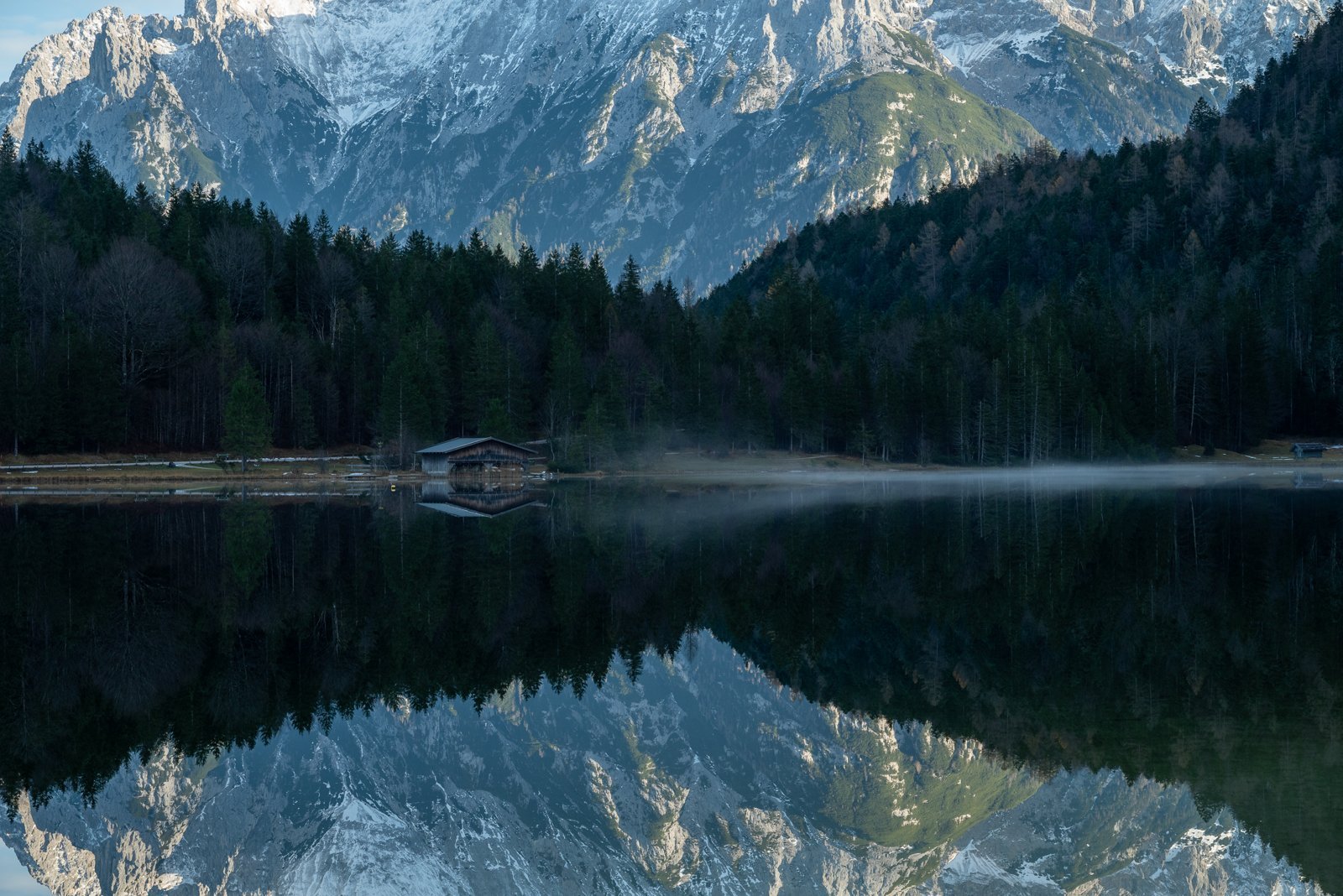
So we swam, we took time out in the spas (complete with hammams, saunas and steam rooms) and the gyms, we ate, we sat and read and wrote, we did free classes, we gazed at the scenery and photographed it both in sun and in its blanket of snow and, after a consultation with the Sports concierge, a walk was taken through the snow and forest to the silent mirror lake of Ferchensee. For this three hour walk the hotel kitted me out with water bottle, rucksack-style bag and walking poles and provided a leaflet with directions that included QR links to detailed online maps. And this was just the gentlest walk available. Other walks, in the hotel’s own walks guide, extended into all-day hikes far up into the mountains.

The restaurants covered a range of cuisines. Both service and food were high-quality. If you felt over-fed one day, it was easy to switch to a lighter meal another day. As you would expect, a range of vegetarian options were available. We ate in a different restaurant every night.
I could go on. Suffice it to say that this was as near an ideal place for those looking for a mix of culture and relaxation as you could hope to find (and explains why we sought out only the one brief concert in Salzburg).
Oh, our room. We stayed in the Hideaway (the other building, only 100 metres away across the grounds is called the Retreat), because careful enquiries of the very helpful team at the hotel in advance had shown the concert hall to be in The Hideaway and, therefore, more easily accessible. Large, fully equipped and in a soothing simple decorative style, it was all we could have wanted and the view out to the forests and mountains in the snow was unbeatable.
Mobility Access
It is difficult to find fault with this. A relatively recent refurbishment meant that slopes and lifts (elevators) to all areas were available, floors in the common areas were stone and smooth. At first the hotel seemed a maze of levels and public spaces but that fell into place very quickly after a guided ‘tour’ by one of the reception staff, so long walks along corridors could be minimised.

The 100 metre walk outside between The Retreat and The Hideaway required a little care to be taken in the frosty snow covering during our stay. Paths and roads were cleared and salted to minimise risk.
Mobility Access (Ferchensee)
The walk to (and around) the Ferchensee is a non-starter for those with mobility issues. Although up at the lake there are occasional bench seats and a seasonally-opening gasthaus, the roads are gravel and I found both they and paths through the woods were covered in packed snow that was icy in many places. I was thankful for the stabilising walking poles. You could take a car up the packed gravel road.
COLOGNE/KÖLN (3 NIGHTS)
We were returning here after an all-too-brief overnight stop in 2018, wanting to see more of the city and its Christmas market (in Domplatz) of which we had brief, fond memories. It was unfortunate that our stay coincided with the opening weekend of the city’s Christmas markets and a Saturday home game for 1 FC Köln, the city’s leading soccer team. The city was rammed with people, the restaurants and bars heaving and the Christmas markets so packed as to reduce movement around them to a slow shuffle. However, this did open up other opportunities for us, as other places were almost preternaturally quiet.

Getting There
We left Schloss Elmau around 11.30 and arrived in Köln seven hours later, after a regional train from Garmisch-Partenkirchen to Munich-Pasing and then a direct DB ICE train to Köln Hbf. Garmisch-Partenkirchen, being a major winter resort, has a reasonably sizable station with accessible platforms. The regional trains do not always have the best spaces for those with luggage, especially if they are busy. Our cases had to sit in the overhead racks, not an easy shift from floor to above head height. The DB journey planner proposed a change to the ICE at München-Pasing (Munich-Pasing), obviating the need to go on into Munich’s large terminus (which has more platforms, at 34, than any other in Europe except Roma Termini) in order to change trains. This western suburb of Munich has a smaller (but still substantive) through-platform station that meant shorter distances to walk between connecting platforms. Having given ourselves our usual healthy margin for any hiatus with train times, we had time to spare to have coffees and buy our usual salad lunch for the train. The station doesn’t have a supermarket nor does it have the best coffee stop options but immediately outside the main station entrance (to the right as you exit the concourse) is a new shopping mall with both.
Köln Hbf is slap-bang in the centre of the city, indeed the stunning twin spires of the cathedral tower above the station’s partially glassed roof (and can be seen through it). With the tracks running on a viaduct and a modern concourse below there is almost direct access to Domplatz in front of the cathedral.

Mobility Access
With a modern concourse running below the platforms added onto the original station main entrance building, München-Pasing has flat, smooth walking surfaces and a full set of lifts (elevators) to access the platforms. The shopping mall is only 50 metres from the exit across a paved plaza. As with other German stations that we used there are electronic indicators to point you in the right place for boarding at your reserved carriage and there are some seats at platform level.
As to Köln Hbf I just repeat the positive wording for every other large station we have passed through in Germany: lifts to platforms – tick, extensive concourse facilities – tick, flat, paved surfaces – tick, limited seating on the platforms – tick, and electronic signage with carriage locations – tick. The taxi rank is right outside the main entrance and seems to have a constant supply of taxis available. The interchange with the Köln light rail service, which feel like a cross between a metro (subway) and a tram, is outside the main station and has stops across the plazas from both the north entrance (Breslauer Platz) and the south entrance (Dom).
Getting Around
Taxis are around and about but subject to the same strictures as in any big city – they seem to disappear when the city gets busy. There are many ranks around the centre and taxis do loiter around venues close to the finishing time for activities. The public transport is, at first, a confusing mix of routes for buses, light rail (which I will call trams) and rail rapid transit (which are, in effect, local train services). First the buses where, in my very limited experience, Köln falls short of my usual expectations given the size of the city. The stops close to the Domplatz and the main station seem to be in more out of the way locations and the buses much more infrequent than services in other cities (a contrast with Salzburg) with some routes only having two buses an hour. That is, I think, because most people seem to use the tram system; the trams are both frequent and often very busy. These became our primary means of moving around the city. Tickets can be bought from easy-to-use, multi-lingual machines at the individual tram stops either for specific journeys or by way of day passes. The Köln public transport company, KVB, has a thorough website (https://www.kvb.koeln/en/index.html).
Given our penchant for unstructured ‘tours’ using buses and trams, Köln seemed to offer much. However, for once, the system turned out not to offer our usual level of engagement, not only because of the apparent paucity of buses but also because so much of the tram system runs in tunnels. Trams offer some brief stints of interest above ground (crossing the River Rhine on the Deutzer Brücke, for example) but the travel and stop-starts in the darkness of tunnels rather diluted the experience. Nonetheless it is often a good way to get from A to B in the city if the walk is too far.

Mobility Access
My perception of the inadequacy of the bus network, bolstered by a very dismissive remark from our hotel concierge, meant we never used it.
Because quite a lot of the tram system runs underground in the city centre, it has a mix of street level platforms and those below ground. They are all level with the tram, giving step-free access and the KVB website even has a map designed for those with reduced mobility (https://www.kvb.koeln/en/plans.html). Stops at street level are often in the middle of roads, so beware traffic. You may have to cross tracks, but these are set flush to the ground so provide no trip hazards. These stops at street level have platforms reached by gentle slopes. The below ground stops are reached by steps and lifts. The only difficulty with the latter is that you may find they are not necessarily at the obvious station exits and you have to hunt them out at ground level and within the station stops. The final point is that there are a relatively limited number of seats in the trams and at times they can rapidly reach standing room only.
The Luxuriating Location: Excelsior Hotel Ernst
We had stayed here for one night six years ago on the last night of our long trip around eastern Europe. We returned both because of its convenience, the hotel is a bare 150 metres walk from the main entrance to the train station across the paved plaza, and because of our memory of the air of opulence after the less luxurious (but no less enjoyable) accommodation in the Balkans; a memory bolstered by the recollection of a welcome cocktail in the Charles Bar. The hotel, which lived up to most of our expectations and its five-star designation (https://www.excelsiorhotelernst.com/en/the-hotel/), is also right next to the cathedral with easy access to the Dom tram stop. Dating from the third quarter of the nineteenth century it has a real sense of a grand city hotel and the décor, like that at the Hotel Sacher, takes its style cues from that era. The staff have a can-do approach, going to some trouble to find us an alternative room (on a night when they were fully booked) when we found our allocated room did not have a bath tub. We had asked in advance for a room near the lifts but that request did not seem to have filtered through to the allocation team. The hotel also had a concierge service that was properly advisory as well as helpful. There are no spa or gym facilities.
Our room, quiet because it looked over the internal courtyard so we could not even hear the cathedral bells, followed the slightly ornate nineteenth century cues in its décor but had a full en-suite with separate shower and bath, albeit the shower was configured alongside the bath which meant you could not realistically use both at the same time. For some reason the hotel suffered some similar issues to the Hotel Sacher at breakfast. We found ourselves having to queue each weekend morning for several minutes for a table, although, once seated the staffing concerns we had at the Hotel Sacher were not repeated. The breakfast itself, like that at the Hotel Sacher, is a prodigious buffet with cooked options available on request.

The Charles Bar is a classic old-style cocktail bar with banquettes , bar stools, wood-panels and a short food menu to complement the alcoholic offer. It is not huge and we found it quickly filled up on our weekend nights there.
Mobility Access
No real difficulties to report here. Floors are flat, although there are two steps up to the room that houses the main restaurant (that also serves breakfast). Lifts (elevators) feed all floors. The rectangular shape of the floors means that you might find your room is a bit of a distance from the lifts (there is only one set). Taxis draw up to the small lay-by outside and the lifts that feed down to the Dom tram stop are only 50 metres along the street from the main entrance.
Places Visited and Activities
The city has a comprehensive tourist information service – see https://www.cologne-tourism.com. Most of the practical information you need to know about the city can be unearthed from that site.

Christmas Markets
Köln has six and the Tourist Information service publish a leaflet (in German and English) that shows their location. The hotel concierge gave us ours. There is a ‘toy train’ that provides hop-on, hop-off service around those markets – https://bimmelbahnen.com/christmas-market-express/?lang=en. We did not try it out. We ended up visiting two markets. Ease of access sent us to the one that sits under the cathedral’s south façade and, when the hotel concierge explained the differences between each market, we also decided to try that in the Stadtgarten because, being a little away from the centre and in a park, we felt there might be more room to breathe. What we had not reckoned with was the popularity of the markets for tourists and locals alike on a weekend that straddled the first day of December. We approached the entrance to the Dom market one afternoon to find that there seemed to be the equivalent of five rugby scrums trying to get in and out. We retreated and a subsequent later visit saw us edge slowly into and around a corner of the market before deciding that this was the equivalent of being in the crowds leaving a sports or entertainment venue. Even getting within a sensible distance of the stalls was an effort. We retreated again.
The Stadtgarten market proved to be tucked into quite a small corner of the park and the stalls were close together. A late afternoon visit, just after dark, showed this too to be a very crowded place. The two entrances were where the food and drink stalls were placed creating blockages of people and the corridors of space within were narrow. We did not linger. The contrast with Salzburg’s more relaxed markets was telling. Of course all depends on your preferences. Some like busy places for a social get-together revelling in the ‘buzz’. Our preference is for a more laid back experience where we have time and space to wander and browse. Mobility issues are part of the consideration. Our conclusion was that, for people like us, visiting such markets may be best taken during the week – and certainly not on a Saturday when the city centre crowds are swollen with soccer fans whose sheer numbers make visiting hostelries (with their TV screens showing the match) a less easy proposition when you need a break from being on your feet.
Mobility Access
The Domplatz market is in the large plaza area around the cathedral. The plaza is set above street level but there are slopes as well as steps and, where the Dom tram stop lurks beneath the plaza, a lift runs up to the plaza stopping at street level as well. As mentioned in relation to Salzburg’s markets, there are no viable seats within the market, but this is the city centre and there are a wealth of options for a break, but they can get very busy.
At Stadtgarten the market, in the south-west corner of the park, is only 100 metres or so from the stop at Hans-Böckler-Platz/West Banhof which is served by three tram lines with lift access available. The same concern about seating within the market except that here the market is grafted onto a permanent beer garden-style restaurant that does offer some seating – again it gets very busy and was full during our visit.
The Cathedral (Dom)

There is no getting away from the fact that Köln’s cathedral is an awesome structure whose twin spires dominate the central part of the city. Just wandering around the plaza at its feet, night or day, is to risk cricks in the neck as you gaze up, and up. During our stay access to the interior was constrained, in part by the fact that, whilst the cathedral is in use for services and other canonical activities, tourist access is limited to the small area at the west end of the nave next to the entrance, although you can also access the tower whose observation gallery can be reached by a 533 step stairway. Your view within is limited to gazing at the distant altar and along the nave, a sight that makes you wonder if it was from here that Alan Lee took some of his inspiration for the design of the Dwarrowdelf for Peter Jackson’s Lord of the Rings – https://www.tumblr.com/tolkienillustrations/610977433478381568/. The cathedral’s own website gives details of service timings (masses occur five or more times a day) and has FAQs about accessing the tower (and its observation gallery) and the Cathedral Treasury – https://www.koelner-dom.de/en. There is no entry fee to the cathedral itself, but tickets for the observation gallery and Cathedral Treasury are purchased from the cathedral kiosk.
Mobility Access (Main Interior)
As you would expect the cathedral floor is stone – flat and pretty smooth. Access from the plaza does not involve any steps. If you are there outside mass times (which I never was despite two visits) I assume the pews are there for rest stops if needed.
Mobility Access (Tower)
Of course, accessing the tower and its observation gallery is impractical for those with mobility constraints. There is no lift. I cannot speak for the Treasury as I did not visit it, nor ask any questions about it.

Museum Ludwig
This modern museum (the building opened in 2001) is in the shadow, both literally and architecturally, of the cathedral. It is built into the east end of the pedestrian plaza that surrounds the cathedral. It has a startlingly good collection of twentieth century art covering all the art movements from Cubism and Expressionism through Conceptual and Pop Art to the latest contemporary artworks, taking in a one of the largest collections of Picassos in Europe along the way. There are gallery spaces for rotating exhibitions, a substantive photography collection (rather relegated, by way of changing displays, to a couple of out-of-the-way rooms), a roof terrace with views up to the cathedral and around the city centre, and all the other usual accoutrements of a purpose-designed art facility (restaurant, shop, audioguides, lockers for bags and, inevitably, English-speaking local staff). And, on this busy Christmas weekend, it was blissfully quiet, allowing a peaceful and uninterrupted viewing of the artworks across the three floors. The ticketing and other exhibition information is on the website – https://www.museum-ludwig.de/en/home.

Mobility Access
What is not on the website is any information about accessibility which seems to me a rather serious omission for any modern facility open to the public. Inside there are, as you would expect, the full quota of lifts (elevators) and slopes as well as steps between levels. There are some bench-style seats in some of the galleries and I did see portable stools and wheelchairs in the main entrance space. Outside, access to the main entrance requires a walk across the plaza and, for those who prefer to avoid steps, I think the only lift (elevator) from street to plaza level is the one at the Dom tram stop which means a walk of about 250 metres around the cathedral (and don’t go the wrong way or you will treble the length of your walk). An entrance from the street level that did not require going up a substantive flight of steps is less obvious and, on a very brief walk around, I never found it, so you should aim for the plaza entrance.
A City Wandering
Like all cities there is, for me, always interest in a wander around the centre with no particular aim in mind. Here the centre, with its blend of old and new in the architectural mix and its position alongside one of Europe’s main commercial highways, the River Rhine, make for a visually engaging stroll. This is no UNESCO protected centre crafted in a former age; the first so-called 1,000 bomber raid by the Royal Air Force in World War II saw to that – https://www.worldhistory.org/article/2410/the-thousand-bomber-raid-on-cologne-in-1942/. The walkable area between the station at the north end and Heumarkt, the site of yet another Christmas market, at the south end is a melange of older (many refurbished or restored) and post-war structures and can include a walk along a stretch of the broad riverside pedestrian and cycle way.

Mobility Access
There are changes of level within the area but, by and large, pavements (sidewalks) and plazas are paved and well-kept and slopes are relatively gentle. A word of caution; some of the pedestrianised streets have been ‘updated’ in that grey-brick cobble style that looks good but which is less than helpful to those with limb stability issues. The transition from cathedral plaza to riverside also requires a little thought if you want to avoid the several flights of steps; go south and then walk down a pedestrianised street like Mülhengasse. There are plenty of coffee shops and eating places in this area for rest stops, although finding one that is less crowded on a Christmas markets’ weekend may require a little patience.
A Night at the Opera
Wikipedia tells you that the Oper Köln is based in the opera house on Offenbachplatz in the city centre. This location is undergoing renovation and the opera company is now based in the Rheinpark, in a purpose-built auditorium on the east bank of the river. We bought tickets only a few days before our visit (for an opera based on Virginia Woolf’s book Orlando but with Handel’s music), online of course – https://www.oper.koeln/en. Comparatively, the tickets were modestly priced.
Mobility Access
There are no steps to access the main foyer area where there are chairs and tables (and food and drink) available. Once you are inside the auditorium accessing most seats requires climbing or descending steps.
This is not the best for public transport access. There is a bus stop outside but a superficial examination of the timetable showed a service only twice an hour (with a terminus stop in the city centre a fair distance north through the main station). Trams drop around a kilometre (1,100 yards), away at Deutz/Messe. If you are travelling the one stop from the main station, Deutz/Messe Bf is also Köln’s second rail station and is ostensibly a little closer (650 metres), except there are all the ups-and-downs in the stations to reach platforms and exits. This is one of those occasions when a taxi is probably your best bet. There are a few taxis waiting outside after the performance, but a quick exit is suggested if you do not want a longer wait.
Die Photographische Sammlung/SK Stiftung Kultur

This is one for the photography people. A specialist photography gallery with rotating exhibitions, rather like a version of The Photographers’ Gallery in London and MEP in Paris (see Late Autumn in Paris), they were showing two contrasting displays: an extensive selection of old prints and original books by Karl Blossfeldt of his functional but astonishing photographic close ups of plants made at the turn of the 19th/20th century and later and a contemporary prize-winning display by Johanna Lagenhoff of a photographic series musing on the discovery of her non-binary identity. It was, for me, a real find tucked into a modern office and cultural complex (if multiplexes count towards culture) of buildings, plazas, green spaces and lake known as the Mediapark which is off to the north-west of the city centre. It has limited opening hours and days so do check the website where online tickets can be purchased (https://photographie-sk-kultur.de/en/). I just turned up and there were, on a Sunday afternoon, only a few others in the galleries. Wall texts are in German but there were laminated texts in English available in each gallery.
The gallery is rather hidden away in a modern glass building not all that different from its neighbours and there is little obvious directional signage. Google Maps can highlight the location of the building, but you still need to work out where the gallery is within.
Mobility Access
The gallery is on an upper floor but the modern building has lifts (elevators). I failed to check if they had stools or wheelchairs available. The galleries do have some bench seats.
The Mediapark is a large plaza-cum-park. The nearest tram stop is Christophstaße/Mediapark which has lifts and escalators but, from there, it is a walk of around 500 metres that includes crossing the pedestrian bridge over the lake. You could get a lot closer by taxi, although there may still be a walk of 100 metres or more across the plaza to be negotiated.
Food and Drink
We should have booked our evening meals before we arrived. A busy, busy weekend was not the time to try impromptu dining. Even attempts to try out old-style German food in a Brauhaus (literally a brewery but better known as beer halls) stumbled up against the weekend crowds. For those unfamiliar with this German phenomenon, the Brauhaus is a sprawling no-frills drinking and eating place which majors on beer (in Köln, the local brew, Kölsch) and offers traditional German food with a bias towards heavy meat dishes, often served at communal tables. We never tried one. On Saturday night, with the concierge’s warning that we needed to be there before 18.30 to stand a chance of a table, we wandered from the Gaffel am Dom, next door to the hotel, to Fruh “Em Veedel” just beyond the cathedral plaza (see https://auslanderblog.com/best-cologne-beer-halls/ for both). Raucous mayhem fairly described the atmosphere in both which, coupled with queues (in the outside chill) of around 20-30 people waiting for tables, meant we ended up back in the Charles Bar at our hotel. Here the solid but unexceptional menu was our default choice for a second night in a row.
On our final night, hunting for somewhere that had space and was offering food that did not seem too heavy nor too fancy, we alighted on Grissini (https://www.grissini-restaurant.de/en-EN/). Set in a high-ceilinged modernist glass box on the east riverfront, this Italian restaurant has stunning views across to the cathedral and the older part of the city. Unfortunately neither service nor food matched the location (or our expectation), both being of the sort you expect to find in British Italian restaurant chains like Zizzi or Strada. The food is fine; the service a bit hit-and-miss. Perhaps a place for a straightforward Italian lunch on a sunny, warm day when the outside terrace is open.

Mobility Access
The riverside pedestrian area (Rheinpromenade) is modern paving and the restaurant is at the same level with flat solid floors. Accessing it was, for us, another necessary taxi to the door. It is 750 metres from the nearest tram stop (Deutz/Messe) with the only other option the fiddle of a train one stop from the central station to Köln Deutz/Messe Bf and a walk of about 450 metres.
Heading Home
Köln to London in one day is a straightforward four to five hour journey by train with a change at Brussel Midi/Bruxelles Zuid – or it should be. About an hour before we left Köln a message in my DB app informed me our train had been cancelled and offering a later connection that would have meant missing our Eurostar connection in Brussels. We headed for the DB centre within the station concourse where, not surprisingly, there was a bit of a queue of slightly harassed-looking travellers. The impressive part then followed. There were about ten desks open at the centre. The queue moved quickly. Our problem was dealt with equally quickly. After only fifteen minutes of queuing and discussion and at no extra cost we had tickets on a DB ICE train to Aachen, a regional train from there to Brussels and a new ticket for the Eurostar on the next available train to London. This was, we felt, very commendable given the difficulties we have often had in similar situations in the United Kingdom with its occasional ‘not our problem, different train company’ approach to rail travel delays.
So, apart from an additional hour-long stop in Aachen used for a coffee break, we were still back at St Pancras by early evening after a midday departure.
This blog is outstanding! I plan to follow in your footsteps in planning a trip to these regions.
That is very kind. I am glad that inspiration for travels was provided!