Prelude
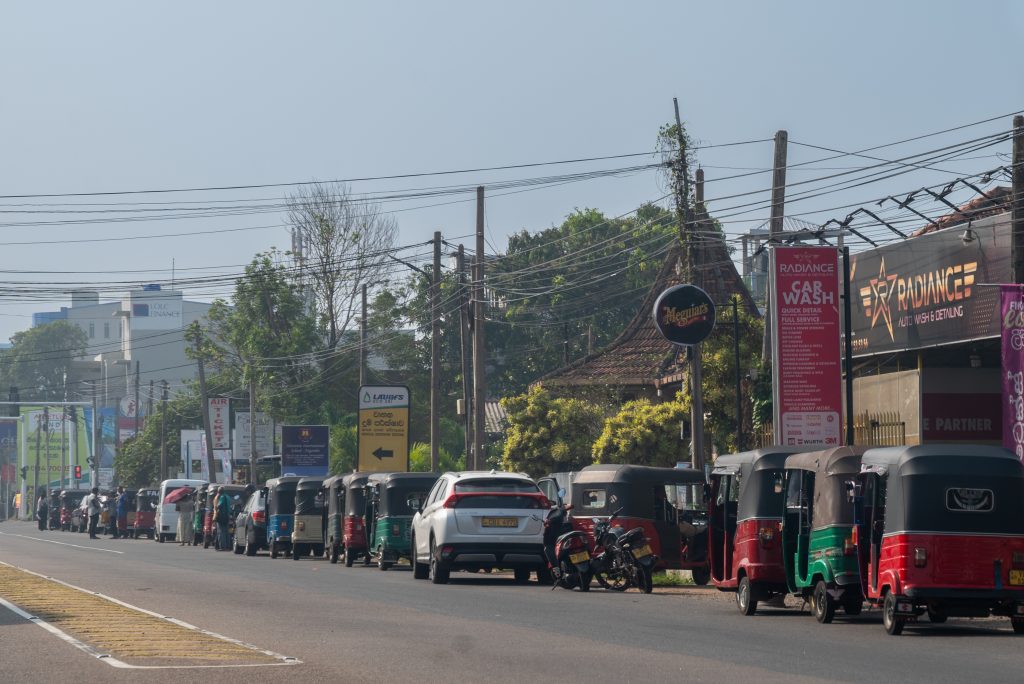
I write this some time after a return from this island nation when the conflict in the Gulf still shadows my thoughts. We were fortunate that our trip was not disrupted by the sudden onset of the conflict but one of many consequences, the closure of the key hub airports in the region, had an immediate knock-on effect on tourism in Sri Lanka (many flights to Sri Lanka transit through those hubs). Our guide had clients due to arrive the day after we left but their flight through Dubai (the world’s busiest airport for international flights) was cancelled and he was left uncertain as to whether his work would be available. For us the only impacts on our direct homeward flight were a preternaturally quiet check-in hall at Colombo and additional time in the air as the flight had to thread a path westwards between the conflict zones in the Gulf and Ukraine. On a more human level, many Sri Lankans, including our guide, have family members working in the Gulf, and besides fears for their safety there was the simple fact of people suddenly not being able to return home to visit family. Also, in a country that relies wholly on imported oil to power its vehicles, on our last weekend immediately after the attacks started, every petrol station we passed had lengthy queues of cars, motorbikes and the ubiquitous tuk-tuks. So when I wax lyrical about the joys of travelling in Sri Lanka, as I shall, I could not in fairness pretend to do that in isolation from global events affecting that land and travel to and within it.
The beauty of my title is not just the physical beauty of the landscape but also the beauty inherent in a land that has a rich history dating back well over two thousand years, a history that is reflected in the extraordinary sights of the Cultural Triangle and the colonial era architecture from the periods of Dutch and British control in Galle and the Hill Country. Apart from one brush with the beauty of Sri Lanka’s astounding variety of wildlife, we did not spend any time in the game-orientated parks nor did we visit the beauty of the tropical beaches of the southern coast that offer a multitude of resorts. However there was the beauty of the people, not a physical beauty but an inner one that seems to give them a relaxed quietness and friendliness that comes across, and not only in the service we tourists receive but in simple things like the tidiness of the streets and a wholly less hectic feel to the country than is the case in their vast neighbour just across Palk Strait.
The Piece comes in two parts with the Part 2 covering our time in the city of Kandy, the high hills of the tea country and the city of Galle.
Structure: How and Where, When and Weather
How and Where
I had never been before and my partner once, over four decades ago when the country was still in the midst of the civil war that ripped it apart, so we relied, as oft before, on working with our long-term travel advisers, Audley, on a bespoke itinerary (https://www.audleytravel.com/sri-lanka). Based on our own researches and discussions with them (and relying on them for hotel options that we then reviewed), we ended with a route that circled first into the area known as the Cultural Triangle before heading south to the second city of Kandy and on into the high hill country, the land of tea. The final few days were spent on the south coast imbibing colonial-era architecture and a relaxed urban-vibe in Galle Fort before heading back to Colombo. As is our wont, we spent at least three nights in each place, longer in some, to allow us relaxation time alongside activity time. The exceptions were our first and last nights, based within reasonable driving distance of Bandaranaike International Airport just north of Colombo. The totality was a 22-night tour.
We did not cover the north and east of the country. This area, centred on the cities of Jaffna and Trincomalee, is the principal Tamil region and has taken longer to recover from the ravages of the civil war that in physical terms only lightly affected some areas to the south. Travel there is both possible (we met some fellow travellers who had ventured to Jaffna) and offers a different perspective but we understand the infrastructure and services are less well-developed, so we stuck to the more obvious tourist path. We had a car and driver at our disposal as is standard for upper market travels here. Unlike in India, your driver, with pretty good if not necessarily conversationally fluent, English, also acts as your guide. For us we tended to use our driver as guide as much or as little as we wanted. In some places we sought explanations of history and culture alongside the guidance that deals with tickets and the other small details of visiting a site, as was the case for the historic sights around the Cultural Triangle. In others we were happy to find our own around, as was the case for our three days within the Galle Fort area.
When and Weather
February is in what the tourist industry regards as the high season that runs, more-or-less, from December through March. Outside that time the monsoon moves into the south of the country in April and works its way north and east over the ensuing months before the levels of rainfall gradually reduce through the autumn months. You can find endless detail online about weather patterns, but this is a wet, tropical country with double the rainfall of the United Kingdom. What it shares with my home country is a certain unpredictability so that we found that, in the hills, we had the odd day when showers would share time with the sun and one or two grey days of cloud cover. Sun predominated in the lower lying areas but cloudier periods were always a possibility.
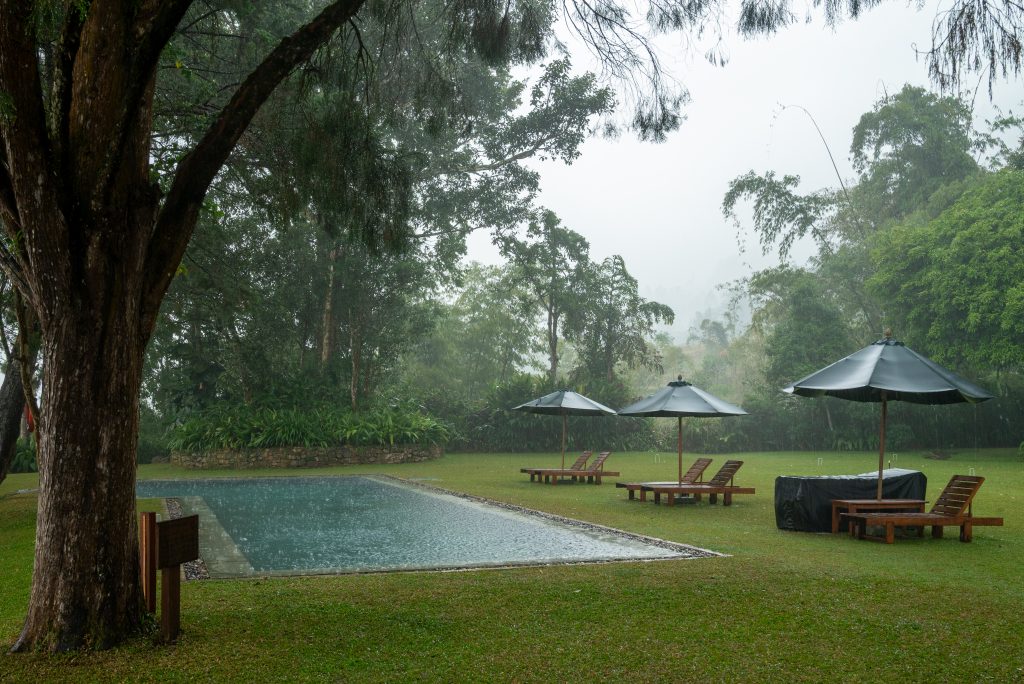
As to temperatures the key differentiator is altitude. In the lowlands to the north and west of the Hill Country and to their south on the coast in Galle the temperatures are higher. In these areas, and in Colombo, daily temperatures would reach 27-30°C (80-86°F) with nights only dropping to the low 20s Centigrade (low 70s Fahrenheit). Humidity is high meaning, for us, regular breaks for cooling and hydration were the order of the day. Up in the hill country the temperatures dropped by several degrees as the altitude rose. In the high tea country (over 1,550 metres or nearly 5,000 feet) the daytime temperatures dropped to just over 20°C (68°F) and in the evenings it could drop to a relatively chill 12-13°C (53-55°F) definitively requiring a second layer of clothing for dinners. Humidity is not so noticeable there but is still a factor to be borne in mind if venturing out for any physical activities.
Reading
Two recent fiction books written by Sri Lankan authors have graced the shortlist of the prestigious Booker Prize, one winning the prize in 2022. They are different in style but both are excellent.
Passage North by Anuk Arudpragasam (https://dauntbooks.co.uk/shop/books/a-passage-north-2/) might, glibly, be included in the stream-of-consciousness style of fiction as it focuses on the inner reflections of the protagonist. His thoughts and memories flow out as a result of receiving a telephone call about the death of the woman who cared for his grandmother. What follows is his musings both on his own life choices and the situation of, and between, the Sinhalese and Tamil communities in the aftermath of the civil war. It is extraordinarily well-written and draws you into a perspective of Sri Lankan history in a telling and effective way.
The Seven Moons of Maali Almeida by Shehan Karunatilaka (https://dauntbooks.co.uk/shop/books/the-seven-moons-of-maali-almeida/) might, equally glibly, be seen as falling within the magical-realist style. In very simplistic terms the protagonist finds himself in a sort-of limbo after his death and, within the context of understanding what choices he has for existence through eternity, he revisits the circumstances of his death. It transpires he had a place within the opposition to the brutal regime ruling Sri Lanka in the civil war and the novel becomes, in part, an unravelling of the reasons and context for his own death. It is, to follow one blurb writer, ‘comic, macabre, angry’ but is also a thoroughly engaging read.
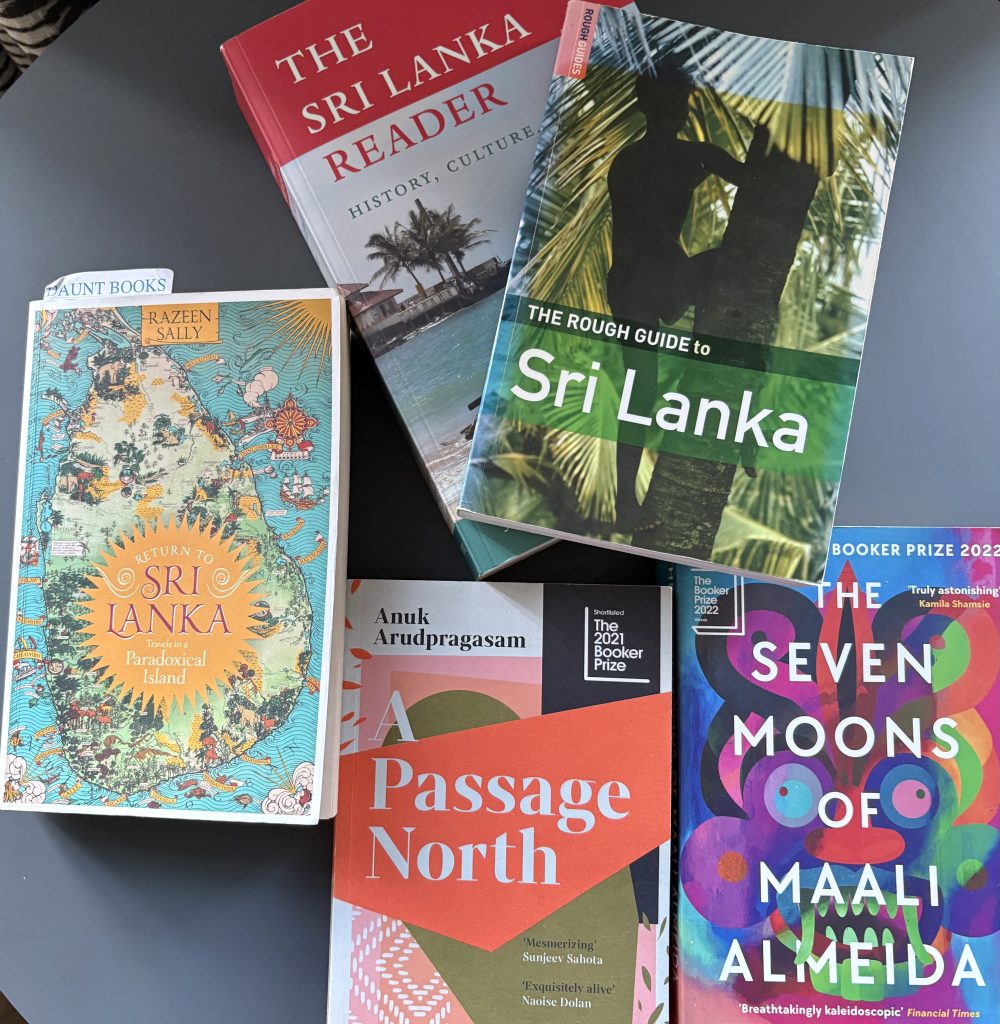
On the non-fiction side, I had tried to find a history of Sri Lanka but my choice, after research, The Sri Lanka Reader: History, Culture, Politics turned out to be too fractured to meet my needs. Edited by John Clifford Holt it is a series of pieces drawn from religious texts, travellers’ writings over centuries and academic commentaries and is probably of more use to someone studying Sri Lanka in real depth. I fell back on simpler writings such as the history section in our Rough Guide to Sri Lanka but by far the most engaging source was Return to Sri Lanka: Travels in a Paradoxical island by Razeen Sally (https://dauntbooks.co.uk/shop/books/return-to-sri-lanka/). This part memoir, part travel writing, part history is authored by an academic economist of Anglo-Sinhala Muslim heritage. Having spent his formative years on the island, he moved to Wales and then through London academia before becoming an economy professor in Singapore and, for a short period (2015-18), economic adviser to the Sri Lankan government. For a decade he took extended trips within the island and the result, both well-written and straightforward, is a really great way for the more casual reader to understand about the ‘history, culture, politics’ of his ‘paradoxical island’.
Some Practicalities
Language
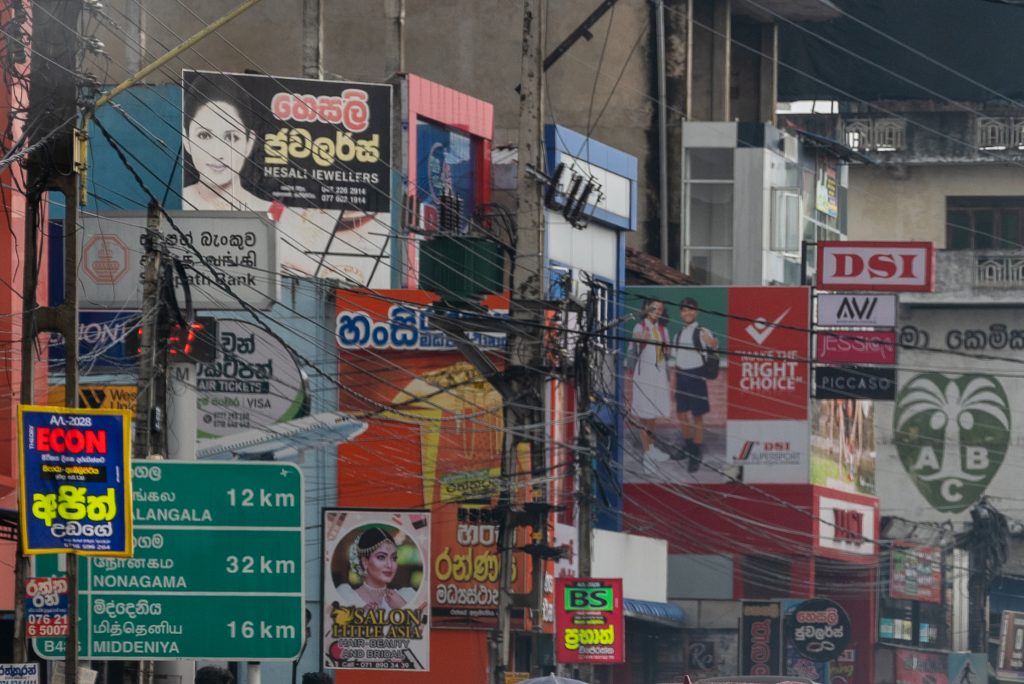
With English standing alongside Sinhala and Tamil as one of the country’s official languages there are few difficulties here. Road signs, menus, advertising (and there are a lot of billboards to be seen along the roads), museum texts and more are in all three or, in the more tourist-orientated locations, just in English. The bulk of those folk that you interact with in tourist and service locations will speak passable to excellent English; just give yourself time to attune to the accenting.
Payment and Tipping
Sri Lanka’s currency (the rupee) is a closed currency but you do not need much for day-to-day tourist use. The card reader is as much in use as in many another country, so we found money was only needed for tipping and for the most part used our credit card. Hotels have tip boxes and prefer you to use those rather than indulging in individual tipping. Those tips can be left in dollars or sterling (or rupees). If your travels are structured around those services you might need a decent chunk of cash to pay those tips in the hotels and those of your guide. We used dollars for this. As to how much to tip, there is plenty of guidance around and Audley provided us with that information as part of our travel pack.
Dollars were also changed at the airport for our small amounts of rupees. Unlike India, the recommendation is that you do use the exchange facilities (or ATMs) in the arrivals hall and don’t use other, more informal, sources. Corruption and economic mismanagement in the earlier decades of the 21st century (including a declaration of state bankruptcy in 2022) have done the currency no favours so, at around 8,500 rupees for $100 dollars at the time of writing, you do end up with lots of paper if you want notes small enough for everyday use for tuk-tuk drivers, the occasional purchase from small shops and stall holders or for site entrance tickets. Given you cannot take out money, any you have left can be used as part of the tip to your guide or at your last hotel.
Driving
Easy because it gets done for you. Easy because most main roads are in pretty good condition, the only hazard being the damage caused by landslides as a result of the cyclone that swept through in November 2025. Easy because, road users are less aggressive, less hair-raising than their Indian counterparts so your stress levels whilst being driven are much lower even if the traffic moves to rules that seem, to European eyes, governed by some unknown logic. Traffic in cities is pretty heavy, which keeps speeds low. In the countryside the road speeds are constrained by the legal limit of 70kph (43mph) and by the fact that roads are single carriageway. An added factor in the hill country is the sheer windiness of those roads. The exception is the toll expressway which curls from the airport past Colombo to Galle and then along part of the south coast, but it has a speed limit of 100kph (62mph) and, outside the immediate environs of Colombo, is very quiet, certainly by UK standards.
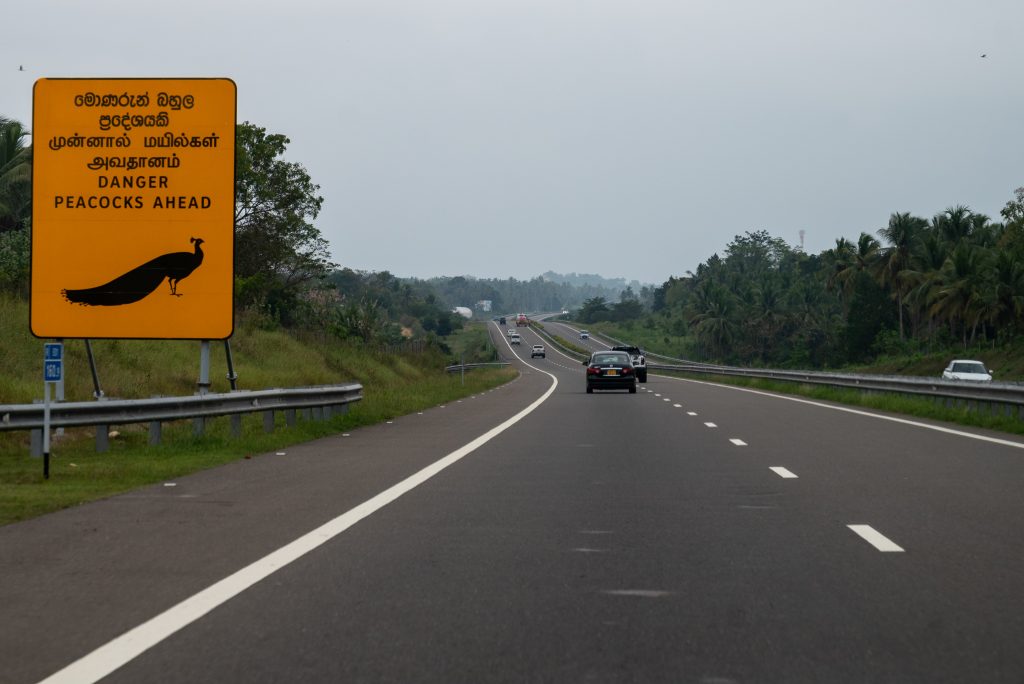
This preponderance of single carriageway roads does mean that, despite being an island more or less the same size as Ireland, drives that seem relatively short in distance terms can take longer than you might expect, particularly when you need to build in the sort of stretch, sustenance and toilet breaks that we need. We found that the times proposed by our travel adviser to drive between hotels were much shorter than our reality of time needed. Our car was a small Toyota compact that had inadequate space in the back seat for me. I was more comfortable when the guide ousted his bits and pieces to allow me to take over the front seat. We saw other tourists being driven round in larger SUVs, so make sure you specify a larger car if your needs require it. I understand there is a much greater cost (a consequence of Sri Lanka’s strict controls on car imports) but you may find it is worth it.
Sri Lankan Menus
We dined almost exclusively at the hotels we stayed at. Usually this was no more than a reflection of reality in that there were often no other restaurants within any sensible walking distance or, sometimes, driving distance but also the simple fact of convenience and the quality on offer. There was a certain ubiquity to these menus. That is not to denigrate them, far from it, we had mostly excellent food but there is enough ubiquity for me to say that the bulk of the dishes on menus had a Western slant with a protein and vegetables and sauces all cooked in a modern style. The protein would be the excellent local fish (barramundi, tuna, seer) or seafood (prawns and crabs) or meats (chicken, pork, beef) some of it imported. There would be a pasta dish or two and vegetarian options.
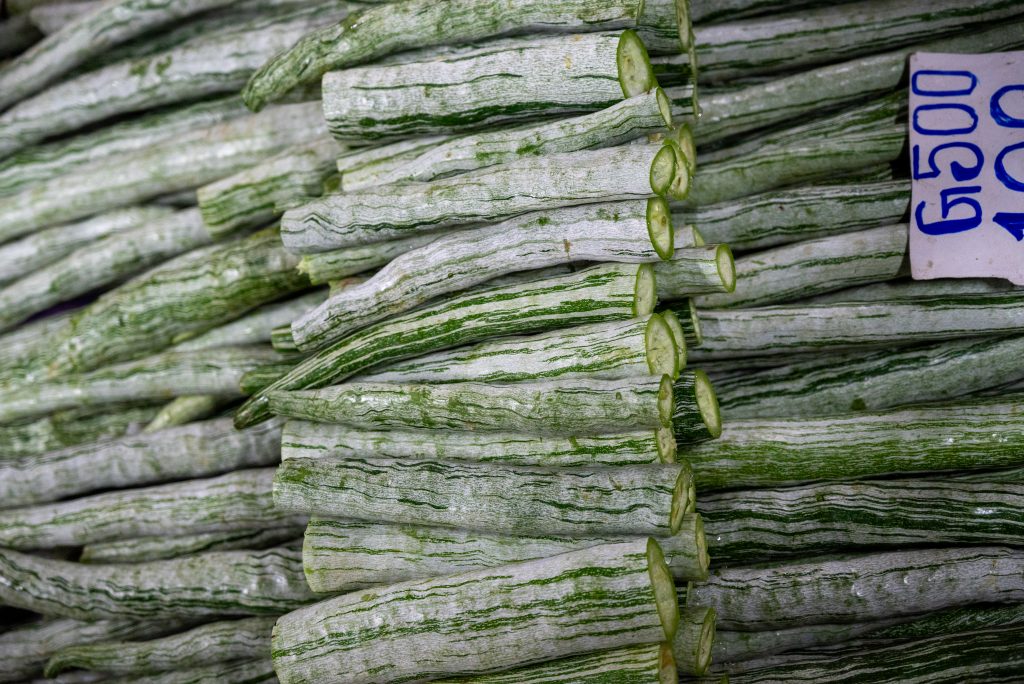
Then there would be an entry that said ‘Sri Lankan Curry (Fish, Chicken, Pork, Beef)’. This seemingly uninteresting description hid, for me, what was often the best food on the menu. The other food could be excellent but this dish, varying the protein and sometimes going vegetarian, became my ‘go to’ dish. It has certain similarity to the southern Indian thali as what would arrive would be a small bowl of the protein curry, a large portion of rice, and, in quite small bowls, portions of coconut sambal, dhal and five or six different vegetarian curries using some of the plethora of vegetables we saw growing in the many parts of the hills where tea did not fill the landscape. Okra, aubergines, carrots, beets, peas, green beans, mushroom, potato and even loofah all figured at one meal or another. All with a small chapati or poppadum on the side.
Breakfast was either Sri Lankan or ‘English’. The former we did not try because we simply do not feel like curry/spiced food at that time of day. From what I saw such breakfasts are kissing cousins of South Indian dishes like dosas: rice-based crepe style bases (known as hoppers) with a fried egg and small bowls of vegetarian curry and sauce. We went ‘English’ which, in the standard of hotels we were staying at, meant a small feast of juice, fresh tropical fruit platter, bakery basket, yoghurt (or curd) and granola and a classic full English fry-up (or omelette or eggs). To wash it all down, coffee or tea. Little wonder that with dinner to follow we often eschewed lunch altogether.
Drink
In the hotels, bars and restaurants in the tourist places we stayed there were plentiful choices. Wines and sprits from across the globe supplemented by the local beers and local variants on gin, whisky and rum and the local spirit, arrack. The latter is actually a good alternative to the imported spirits and is usually around half the price, although there are premium variants. In our Galle hotel arrack tastings were offered. The imported drinks are, inevitably, more expensive, but prices seemed to me marginally lower than in London.
Hotel Characteristics
There are some characteristics of all the hotels we stayed at that are quite similar and to write them up repeatedly seems silly. However in writing such a general section about hotels it can seem that I am damning them with a level of standardisation that could be levelled at chain hotels. Nothing could be further from the reality. All the hotels we stayed in were really very good, indeed excellent in some cases, often with highly personal and attentive service. All, bar the Water Garden in Sigiriya, made use of former colonial buildings as the core of boutique accommodation with a maximum of ten rooms, often less. All were set in elegantly kept grounds setting off the beauty of the Sri Lankan landscape, with the obvious exception of the Galle Fort Hotel set in the centre of the old fort area of the city. All were full-service offerings with breakfast and dinner as part of the package, except Sigiriya and Galle. All had staff that, for the most part, were careful with a friendly but not intrusive manner and, seemingly, with high staff-to-guest ratios. The dining was usually outdoors on peaceful verandas or, in the cooler evenings in the high hill country, indoors. The food offer I have talked about above. All had air-heated pools, not huge but long enough, from 10 to 20 metres, to allow some lap swimming. Their air-heated nature meant that in the lowland areas the water felt like a warm bath but had a distinctly chilly edge in the hills.
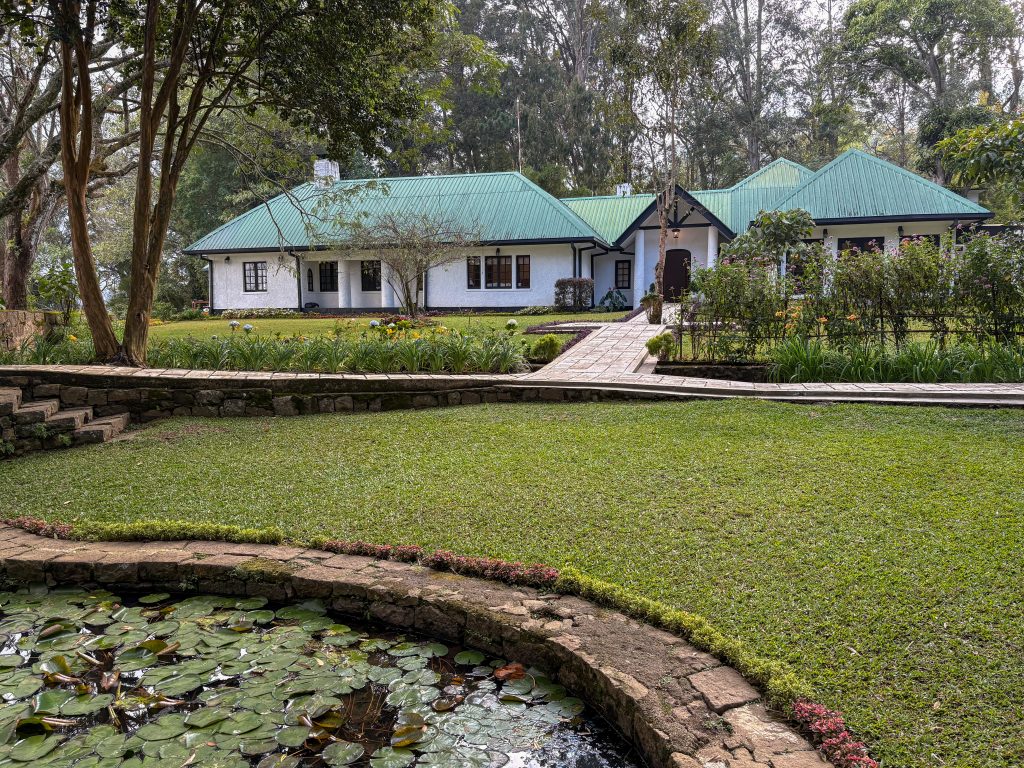
The rooms were all large, near or actual suites, with a full complement of places to sit, store clothes, tea and coffee making facilities, fridge, TV, Wi-Fi and with bathrooms of a size that would do duty as a cosy hotel room in Paris. All, bar one, had tubs as well as walk-in showers. All those in colonial buildings had furniture and a décor style that was in keeping with the overall colonial-era ambience, with dark woods an underlying feature. There was air conditioning in all but the high country places where effective ceiling fans were in place, if cooling was needed. And, for us, they all had king-size (or larger) beds as, given my height, this is something of a necessity for me. Most, if not all, had those multi-purpose sockets that take the main types of plug (including UK, US and European). In a couple of hotels we needed the adapters with Type D round pin plugs (https://www.electricalsafetyfirst.org.uk/guidance/advice-for-you/when-travelling/travel-adaptor-for-sri-lanka/) that we had brought with us.
Time Zone
Sri Lanka is one of those places where a quirky 30 minute differential exists from the usual one hour time zones so London is 5.5 hours, New York 10.5 and the US West Coast a full 13.5 hours behind the time on the island.
Mobile Coverage
Wi-Fi is now ubiquitous in tourist locations and our driver/guide even had Wi-Fi in the car (although the signal was not always the best) so mobile coverage is only needed when out walking or when wandering the city streets. As has become our practice in countries where our UK mobile providers only make a service available at a cost, we used a separate e-sim package (see my brief discussion of this in the Practicalities section of my post An American Road Trip (Part 1)) in this case from Airalo. Mobile coverage really only ceases in the high peaks of the hill country, in my case on Lipton’s Seat nearly 2,000 metres (6,500 feet) into the sky.
Bugs
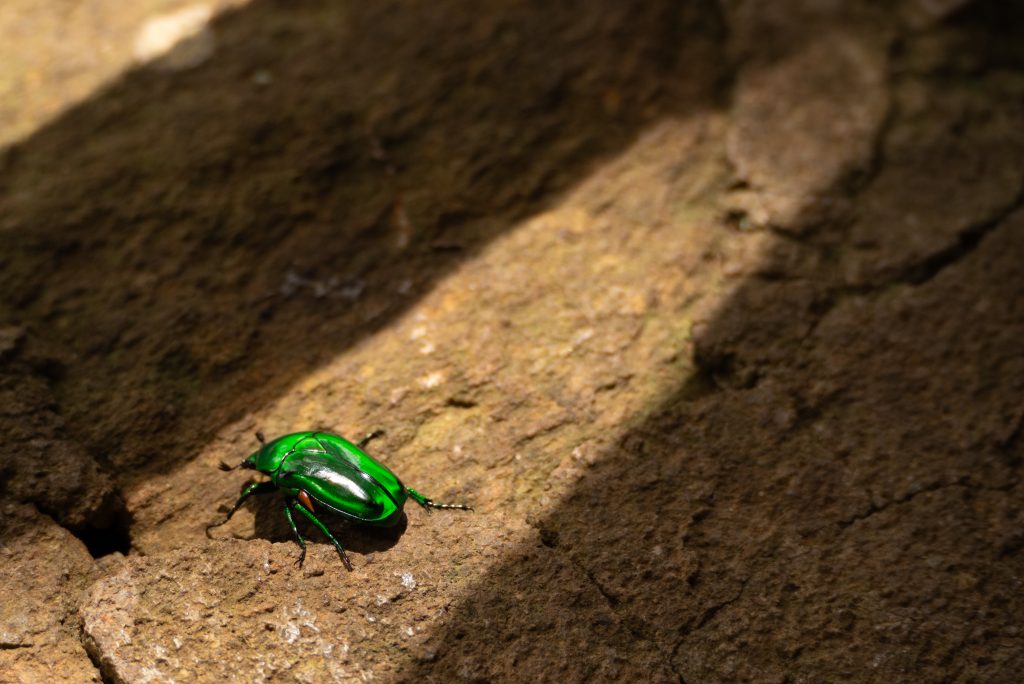
Generally you do not need to worry about the presence of flying insects. At dusk they can be an annoying presence felt in bites for those who are more susceptible, so do take appropriate precautions – covering up and Deet spray in our case. Even then some people may find they are getting bitten through thin clothing. There is said to be no malarial risk – see https://travelhealthpro.org.uk/country/204/sri-lanka#Malaria, a UK Government approved site that has full health information for travellers.
Flights/Airport
Leaving aside the conflict-induced issues I mentioned in the Prelude, the Sri Lankan Airlines overnight flight from Heathrow’s Terminal 3 was a very straightforward 10½ hours. Of a length where we now feel business class comfort trumps the extra cost, it was remarkably similar in offer and service to many of the larger carriers. A minor quibble was that the staff were not as proactive as on some other carriers but the flat beds were, for me, slightly better than the current norms as they gave just that little bit more room at the narrow (feet) end than some we have used in recent times. Emirates provide an alternative service of higher quality but that involves a change of planes in Dubai which we find pretty disruptive in the middle of the ‘night’ and, of course, now comes with a hazard of a whole different order.
Mobility Access
At Heathrow we used their self-push wheelchairs for the first time. These are stacked a bit like supermarket trolleys at the entrance doors to the terminal. You then take one, confirm your mobility assistance needs at the check-in desk as usual, and use it to go all the way to the entry door of the plane. Very useful as it means you can use it in the arrivals hall and it frees us up to use it in the public areas of the airport and be in control of the time you reach the departure gate. Colombo is a full-service international airport with all that implies for distances to be walked and mobility assistance provided. Mobility assistance services seem well-organised and, even with our plane having an apron disembarkation onto buses rather than a jetway, the airline organised a scissors lift vehicle to take off those who had pre-requested mobility assistance. Wheelchairs then ferried us through the arrivals process and out to our waiting driver/guide in the arrivals hall.
First Night: Horthapola Coconut Estate
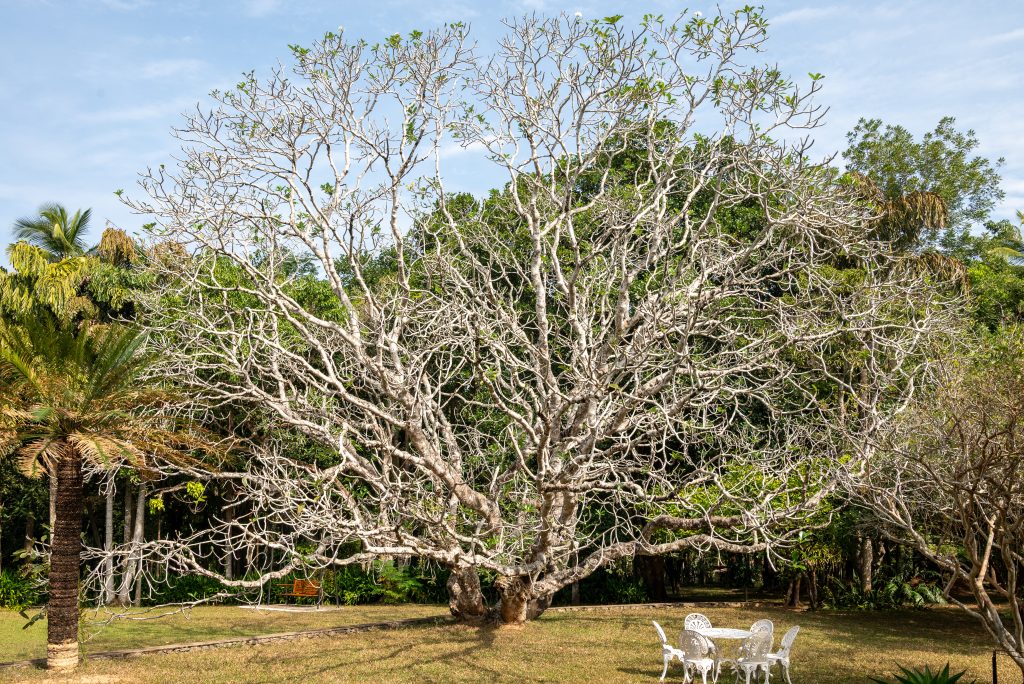
This was the place that Audley had suggested for a first night (https://horathapola.com), to allow a touch of recovery from our flight before moving on to the touristic rigours of the Cultural Triangle. Deep in the lowland countryside north of Colombo about an hour’s drive from the airport and set amongst coconut groves, it was our introduction to the tourist world of British colonial-era houses re-purposed as boutique hotels. A peaceful haven nestled in the woods, it was a delightful first stop. The handful of rooms were in a straightforward colonial style and ours opened, with a couple of steps down, onto the tidy gardens and pool and was a few paces from the main building. Both breakfast and dinner can be taken in the main public area, all open windows and doors to let the air flow through to aid the overhead fans. However our room had a little patio and the staff suggested we could have our dinner there – delightful in concept and outcome. This dinner was our first introduction to Sri Lankan rice-and-curry. It may have been that the difference between our expectation of those simple words and the feast that was laid before us that made this version such a treat. We thought it was the best one that we had. It came as part of a three-course dinner offer. Orders from a limited choice have to be made a few hours beforehand to allow time for preparation.
Mobility Access
There are no issues but some of the rooms are on an upper floor reached by a wooden staircase, so care may be needed in selecting a room. In our room care also had to be taken in the dark as there was a step down into the en-suite from the bedroom.
THE CULTURAL TRIANGLE
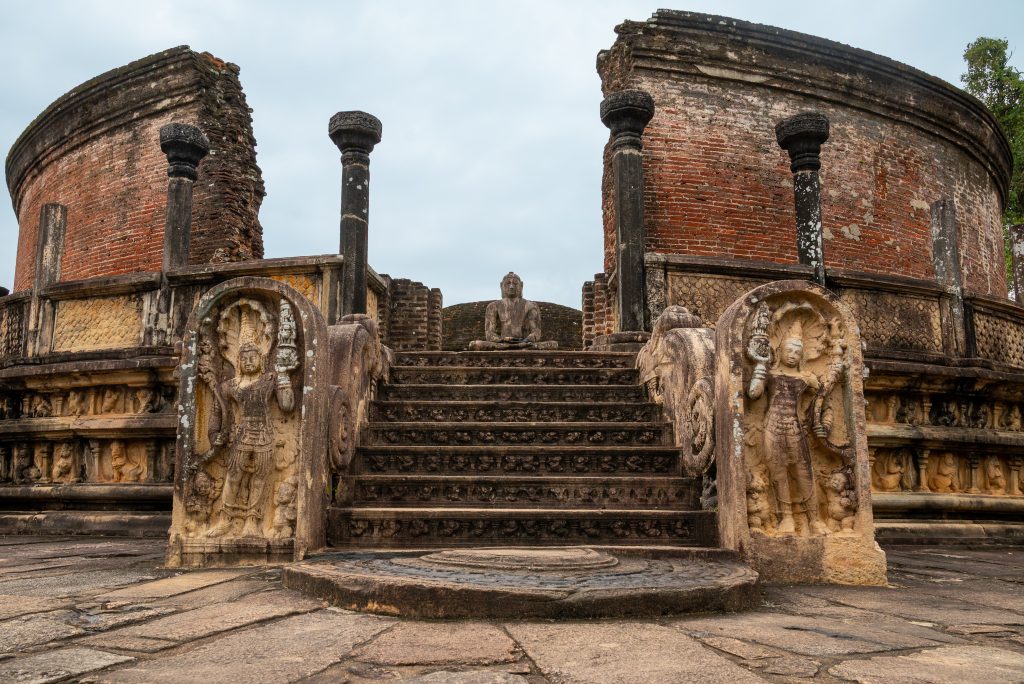
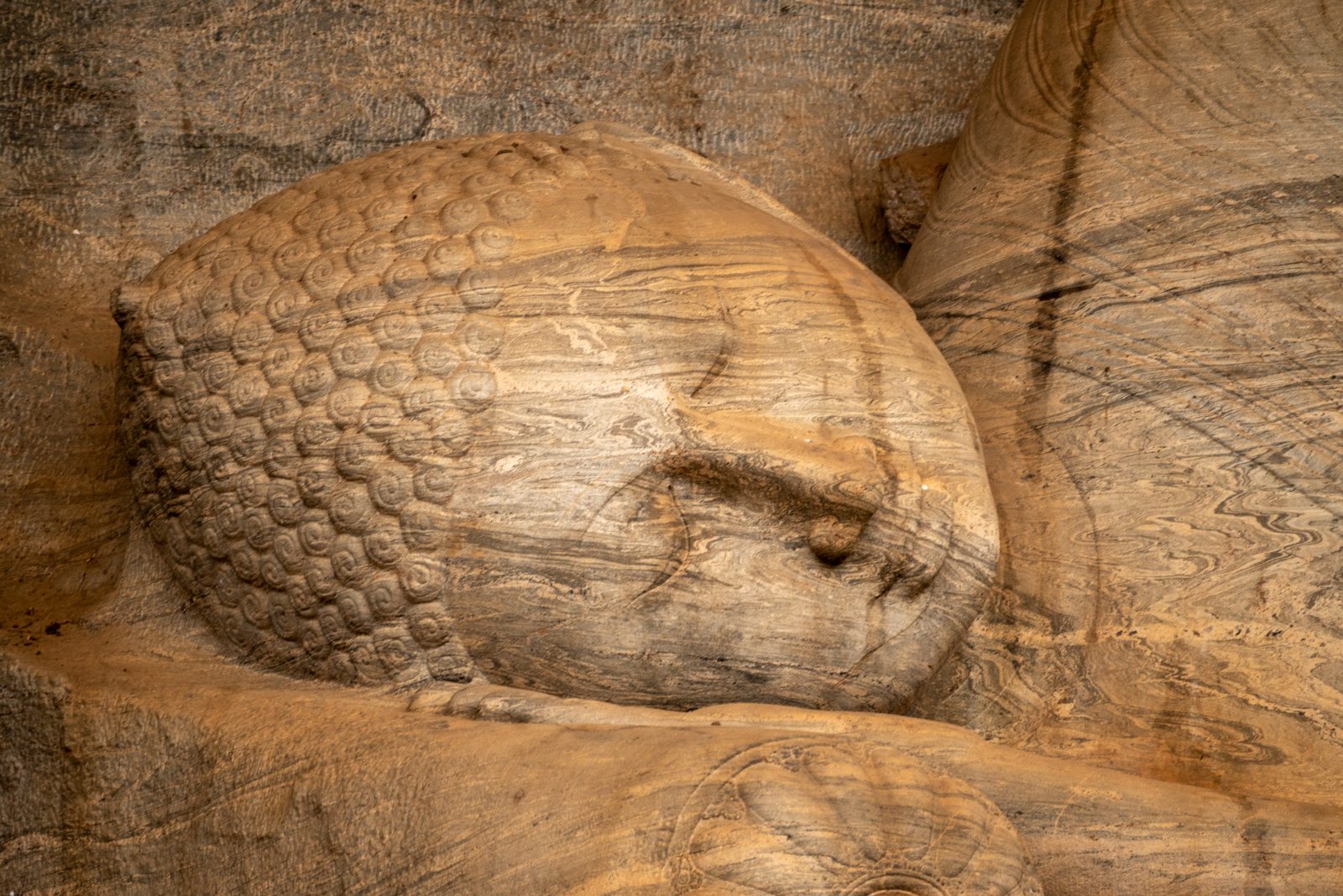
This, the first area we visited on our trip, offers a fascinating insight into the deep history of Sri Lanka through a range of sites of the ruins and relics of the Sinhala kingdoms that date from around 330 BCE to the early 1200s CE. These were centred on the kingdom’s highly developed cities of first Anuradhapura and then Polonnaruwa (with an interlude in the monstrous folly at Sigiriya). The culture was anchored by a sophisticated irrigation system, an astonishing technical achievement that enabled population-supporting rice cultivation. The legacy of this system still exists in the ‘tanks’, vast reservoirs that, with some modern tweaks, still provide the water that supports that self-same rice cultivation nearly two millennia later. Here, too, was the cradle of the religion that still dominates the country, Theravada Buddhism. As well as the living shrines that pepper the old city sites, the heritage is evident in the glorious carved rock statues at Aukana and Polonnaruwa (and some lesser places) and in the vibrant rock shrine of Dambulla. We visited all three ancient cities as well as Aukana and Dambulla and had an aborted attempt to visit the lesser site of Sasseruwa. I am not going to try and describe the treasures that you find at each site. If you are going there are pages and pages, online and in print, covering nearly every aspect of all these sights. Everyone will have their own preferences as to what will engage them. In this section I intend to focus on one or two personal impressions and the mobility issues you face at each sight.
Because we were piggy-backing on our driver/guide who bought all our tickets as part of our guiding package, I can tell you nothing of how to go about getting them, where to get them (although that was usually from an obvious ticket desk) or how much they are.
Mobility Access
Two general mobility access issues need to be made when visiting this area. First you cannot do it without your own car and, preferably, a driver who knows the roads, can negotiate access issues for you and can move you easily around the sites themselves. They are all separated by distances that require a car, unless you are a devoted cyclist. The site at Polonnaruwa is an approximate rectangle about 1 km by 2 km and that at Anuradhapura far more extensive. For those with mobility constraints moving around all the ruins within a site is not realistic without a vehicle.
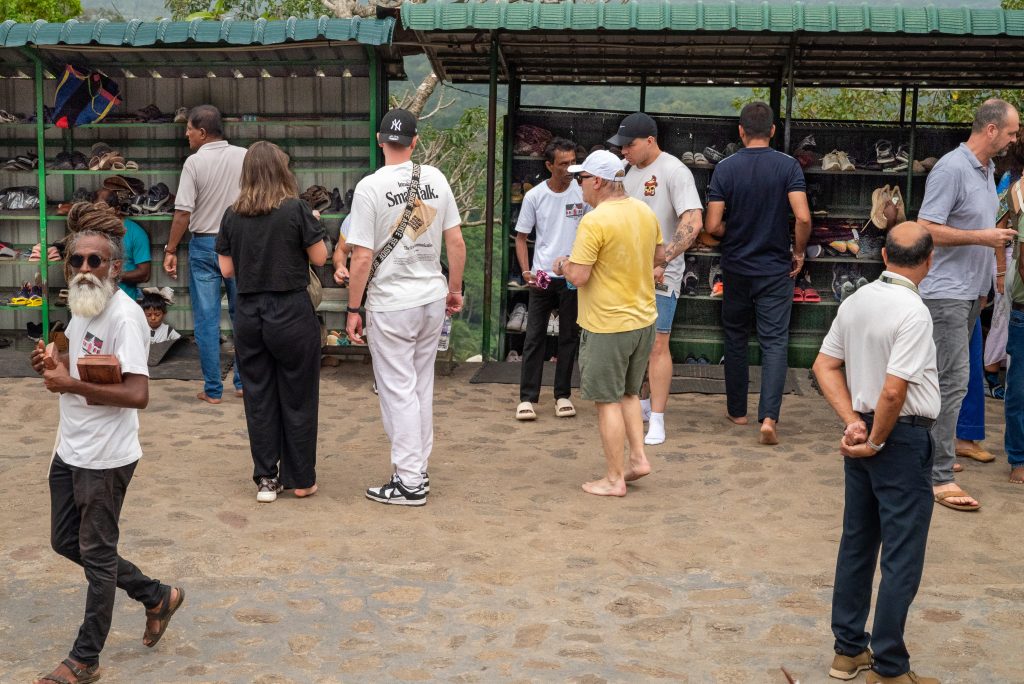
The other consideration is that accessing Buddhist sites means removing your shoes and uncovering your head (as well as the need to cover limbs beyond just wearing shorts and t-shirts). At all the sites there is a facility for leaving your shoes (kept in racks sheltered from any rain). For a soft-footed wimp like me the subsequent walks across tile stone and packed gravel surfaces are occasionally wince-inducing. More importantly for those who rely on footwear for stability and to remain pain-free, it can make close access to certain places impractical. A secondary consideration for me, as a fair-skinned Celt, is that to walk around hatless in direct sun for more than a short time is not something to be undertaken lightly.
Each site also raises other mobility issues to be negotiated.
Anuradhapura
Of the two sprawling sites of capital cities, I found Anuradhapura the less interesting. The ruins are less impressive and the dagobas (more commonly known to me as stupas) have been so restored and upgraded over the centuries (to ensure they remain as pristine Buddhist shrines) that they lack the atmospheric intensity of the ruins at Polonnaruwa. The religious heart of the site is the Mahavana area where both the most monumental dagoba (Ruhanweli Maha Seya) and the bodhi tree shrine (Jaya Sri Maha Bodhi) are found, as well as other dagobas and ruins. The latter is at least 2,500 years old and was said to have grown from a cutting from the original bodhi tree under which the Buddha gained enlightenment. To my eyes as a non-believer, it is an oddity with the lower section of the tree wholly lost within the large rectangular platforms that surround it and the upper limbs supported by metal pillars encrusted with gold leaf. I most enjoyed the short walk along the path alongside one of the oldest shrines, Isurmmuniya Vihara, up to the banks of Tissa Wara, one of the ‘tanks’ (reservoirs), and just gazing out at the vast expanse of water. We did not visit other sites or shrines which are dotted around this sprawling sight. The whole area has a parkland feel with trees and lawns covering much of the ground between the sights and those sights spread out well beyond the central Mahavana area. To be fair you would need considerably more than the half day we spent in the area to do it justice.
Mobility Access
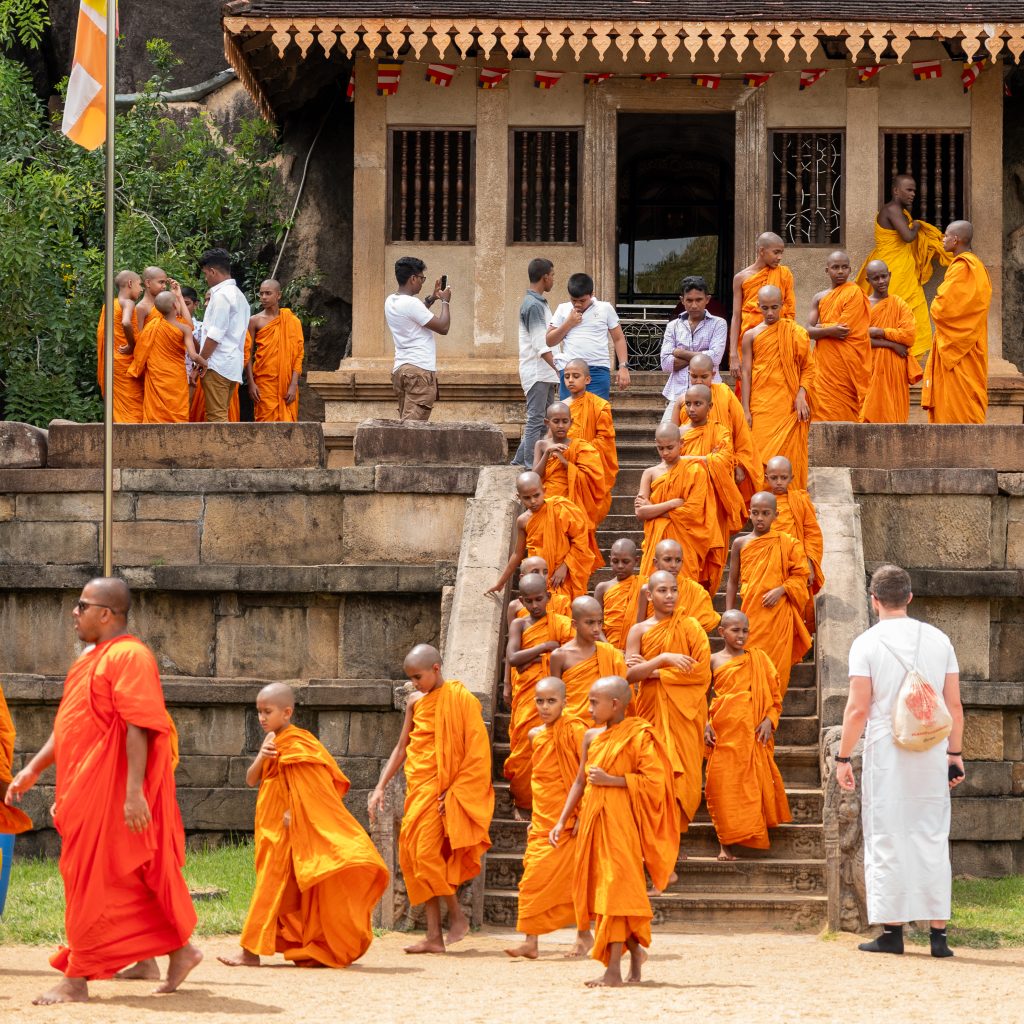
The whole of the Mahavana area, about 1 km by 2km in size, is pedestrianised which means walking to reach either of the sights that we visited. From the main southern entrance the dagoba is over 750 metres walk and the bodhi tree shrine just over 250 metres. All the surfaces are paved or tarmac roads and the land is flat. Once you reach the sights it is hats off and shoes off to access them. At the bodhi tree shrine the area is quite small. There are paved paths around but much of the compound is sandy gravel. To access the upper platform of the structure around the tree involves climbing a flight of nearly twenty steps. The Ruhanweli Maha Seya (dagoba) is about 75 metres walk up a wide paved path from your shoe drop off point and, after a flight of about fifteen steps, you reach the platform on which the dagoba sits. As it is nearly 300 metres in circumference, a walk around on the paved platform, adds more potential distance. The Isurmmuniya Vihara compound is quite small. Inside there are only a sandy gravel surfaces to walk over. Accessing the shrines or the top of the rock requires a clamber up several stone and metal stairs. For the ‘tank’ at Tissa Wara there are fifty or so stone steps to climb the bund which encloses it. Those with mobility constraints can see other ‘tanks’ that are more easily accessed (by car) at Polonnaruwa.
Polonnaruwa
The advantage of the structures at the Polonnaruwa site is their relative completeness compared to those at the older capital to the north-west. This enables me to appreciate and envisage the original buildings more easily. The site is a fenced parkland area where you find the three main sights, The Royal Palace group, the Quadrangle group (both with a number of interesting structures) and the glorious carved statues of the Buddha at the Gal Viharaya. All are close to the roads that run through the site. I suggest that you visit them in that order, for what appears before you becomes more fascinating with each stop. There are many other lesser ruins set in the park but, in our available time, these were the key sights we were taken to. We had started at the Archaeological Museum complex just south of the park alongside another lake-sized ‘tank’, Parakrama Samudra. The former has some useful exhibits including a 3-D model of the whole site (very helpful in getting your bearings) and information on the historical development of the site as well as artefacts and sculptures.
Mobility Access
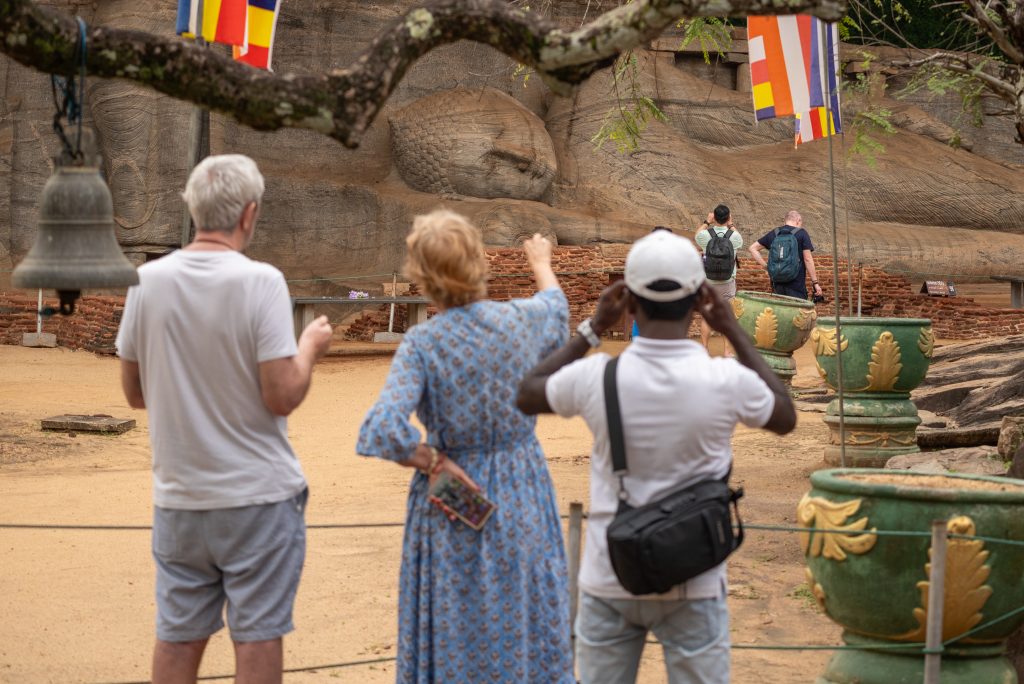
The museum is all on one level and not too large. They have wheelchairs that you can use. The ‘tank’ has a road running along the top of the bund, which means easy viewing out across the expanse of water. Within the fenced site, the Royal Palace group is all at the same level as the car park and the paths are flat, packed gravel or the paved stone paths of the ancient city, so it is easy to wander around with only the occasional step up or down to negotiate. The Quadrangle sits on a raised platform of land which means access is up stone steps (about 25). Once you have reached the platform, the whole quadrangle is grass or packed gravel and flat so moving around is straightforward. With the Gil Viharaya there is a wide, smooth concrete path that slopes gently down about 100 metres to the site where a flat, packed gravel area allows you to see the four monumental statues carved out of the rock. If you want to get closer to the statues then, because they are a shrine, it is shoes and headgear off to enter a roped area. It is only about twenty metres from that point to the base of the statues.
Sigiriya
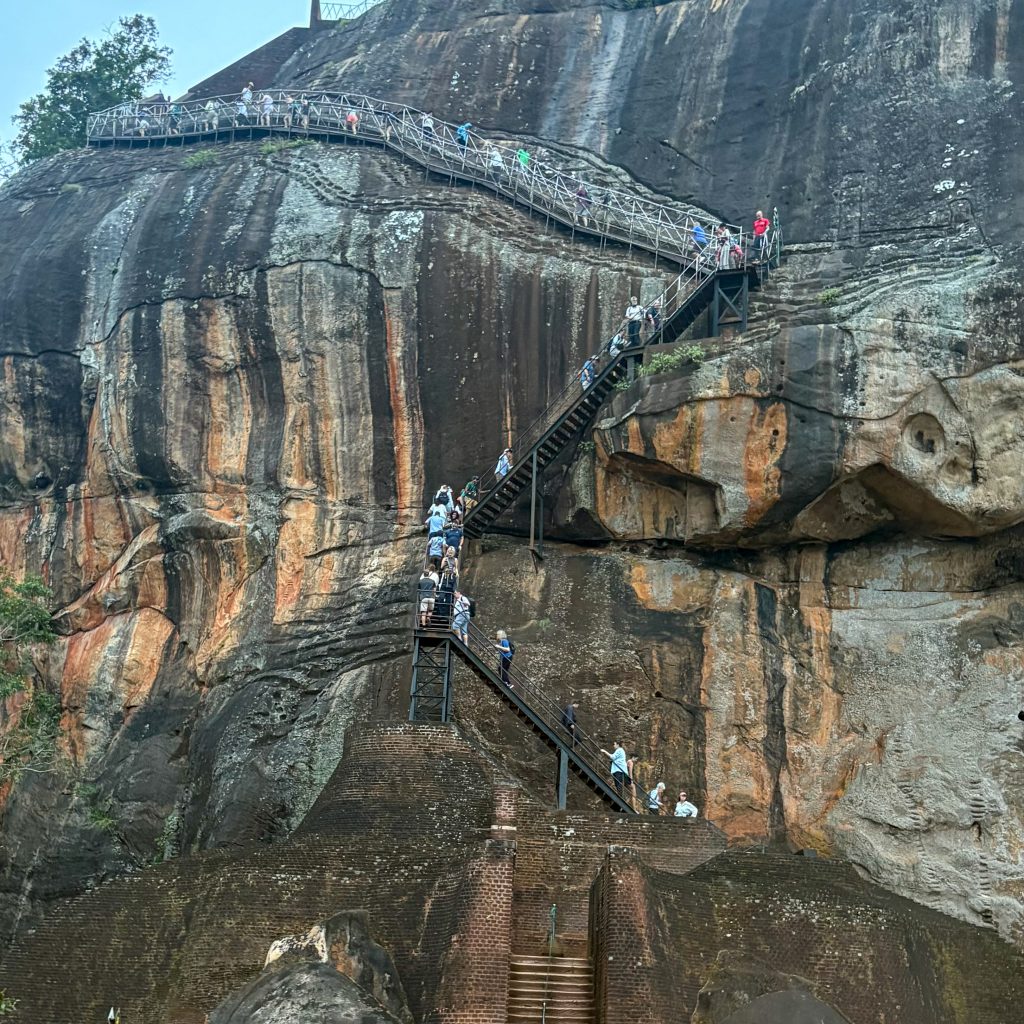
This is probably the most iconic, most familiar site in all Sri Lanka. So detached from the surrounding flat landscape of woods and rice fields does this 200 metre (650 foot) high rock look, it is as if someone had dropped a vast gneiss cuboid from the sky. Although it was only the Sinhala kingdom’s capital for a couple of decades in the fifth century CE, an extraordinary city was built around the rock with a fortress-cum-pleasure palace created atop the rock. There are various elements to the structures. A formal (ruined) water garden laid out at the foot of the rock, through which the visitor walks to reach the base of the stairs that climb the rock, and the rock art caves that can be seen on a climb up the rock. Atop sit the palace ruins which are now no more than a few lines of stones amidst the vegetation. Or so I am told. I did not make it to the top. Vertigo intervened and I turned back just above the Lion Platform. Even from this platform, about one third of the way up, you get some spectacular views across the surrounding lands and the Water Garden laid out below.
Being so iconic the site gets busy, very busy. At the suggestion of our travel advisers, the tour started in the pre-dawn hours, reaching the site access point just as the sky was beginning to lighten. This, we were told, was the best way to avoid the worst of the crowds and the heat. If that is correct then I would hate to see what it was like later in the day. The steps and stairs up are quite narrow, especially the metal stairs that zig-zag, like some scaffolded structure, up the final section where you have to climb in single file – one up and one down. This weight of people means that it grinds to a halt quite often, even at this early hour. It was on the first small platform on this section that my vertigo got the better of me – the thought of coming down this open metal stair as well as up was too much. I joined the downward file. Nonetheless this climb is something every tourist who steps beyond the beach resorts will do – if they can.
For vertigo sufferers the climb up to the Lion platform is still a worthwhile exercise allowing you to take in the monumental carved lion’s feet, the views from it and, on the descent, the Mirror Wall and carved rock temples near the foot of the rock. Whilst that section of the climb still has sections of narrow stone stair they didn’t feel anything like as scary to me as the open metal stairway.
Mobility Access
This is the non-starter to end all non-starters (with the vertigo and hornets’ nests added barriers to upward access). The general consensus is that the climb is around 1,200 steps and there are plentiful websites that have the detail. I simply offer the Fortress’ own website that has most of what you need by way of information – https://sigiriyafortress.com.
Aukana and Sasseruwa
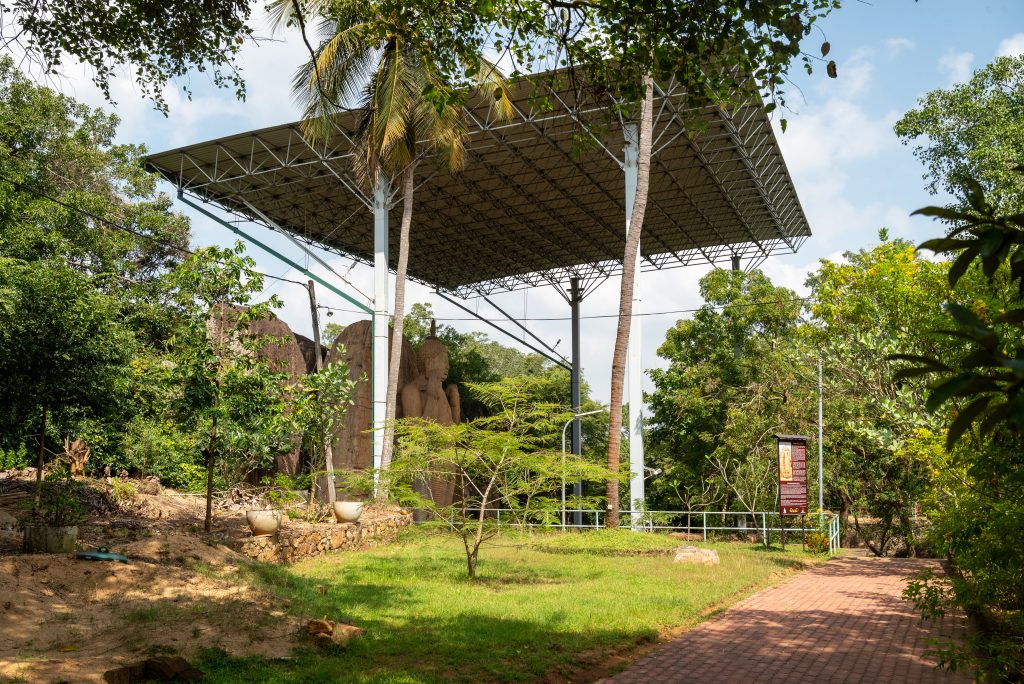
These sit deep in the countryside about halfway between Anradhapura and Dambulla. That means they are peaceful and quiet compared to the tourist bustle of the three locations above and Dambulla. The Aukana standing statue of the Buddha carved out of the rock is an impressive sight and, as they say, well worth a visit. To see the Aukana statue close up also requires the head and foot disrobing but the area around the shrine is quite small. The only feature that detracts from the grandeur of the figure at Aukana is a substantial metal-framed structure supporting a metal roof. Clearly such protection from the rain was felt to be needed but I do feel it diminishes, somehow tames, the original artwork. A similar structure protected the statues at Gil Vaharaya.
The Sasseruwa statue (apparently less well-preserved and impressive) I did not visit. As I discovered when we reached the site there are 300 stone steps up through the trees to the shrine and a little sign that indicated hats and shoes off – before the climb. Climbing those steps in the sun with no hat and no more than stockinged feet was rather unattractive knowing that we had already seen two excellent sites with such statues. We wandered around the rather scruffy plot of land near a small lake at the bottom of the steps which is home to a small monastery building where child monks were being taught and the concrete skeleton of what is planned to be a large meditation centre.
Mobility Access
Sasseruwa alone would be red but Aukana, whilst it requires a walk from the access road of about 75 metres up the slope of a tarmac road to the base of the steps (about 20+) where you climb up to the ticket office, may be manageable for some. Once up at the level of the ticket office the ground is flat, paved stone to the place close by where you have to leave your shoes. You can see the statue perfectly well from this vantage point but, to get up close you have to clamber down about 20 steps into the large shrine area at its base where the surface is packed gravel.
Dambulla
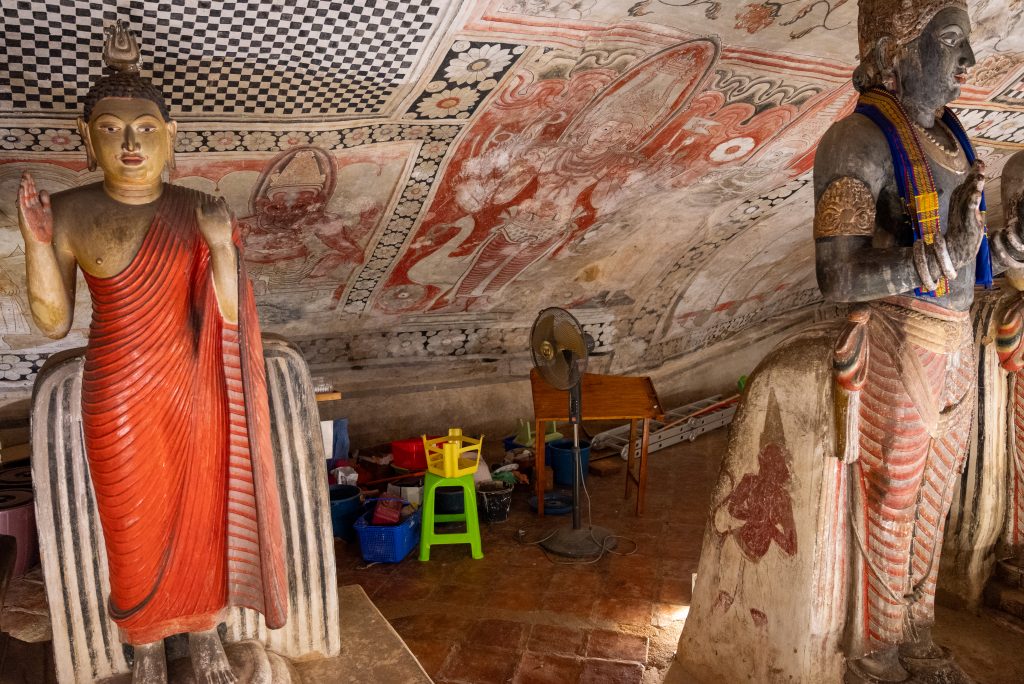
The last of the ‘biggies’ of the Cultural Triangle, this series of five cave temples sat on our route south from Sigiriya to Kandy, our next stop, so we took it in as part of our drive. Another UNESCO World Heritage Site, its caves and astonishingly colourful artwork (much restored) create a different experience for the secular visitor from the remains, dagobas, temples and monumental carvings of the former capital cities. This is another very popular site both with international and local tourists and also with Buddhists visiting the shrines. So be prepared for it to be busy in and around the temples and, with each cave temple only having a narrow doorway entrance, be patient and prepared for queues to get into the caves, the first cave in particular. The caves sit on an undulating rock platform about 100 metres (300 feet) above the level of the road. That means a climb up around 350 steps to reach the platform. These are wide stone steps. In the 1930s an arcade was built along the cave frontage creating a covered vestibule that came in very handy when the tropical downpour hit whilst we were visiting, not only providing shelter but also still allowing you to move from cave to cave. Inside there are myriad statues of the buddha and some of the Sinhalese kings but I was drawn more to the rock painting where the religious scenes were encompassed within a wonderful abstract patterning of colour – all the cave walls and ceilings were covered within this vibrant artwork. If you can manage it then this is another ‘must do’ on your meanderings around this cornucopia of historical wealth.
Mobility Access
But, unfortunately, this could not be managed by someone with the sort of mobility limitations I seek to cover. The steps are the barrier. There are no vertigo worries here but negotiating the 350 or so steps (and their minor hazards such as the acquisitive macaques and the trinket sellers) will be impractical for most. For those who have a mixed party some of whom want to venture to the cave temples, then there are a couple of serviceable cafés around the busy tourist car park below the ticket office.
Hotel: The Water Garden (4 nights)
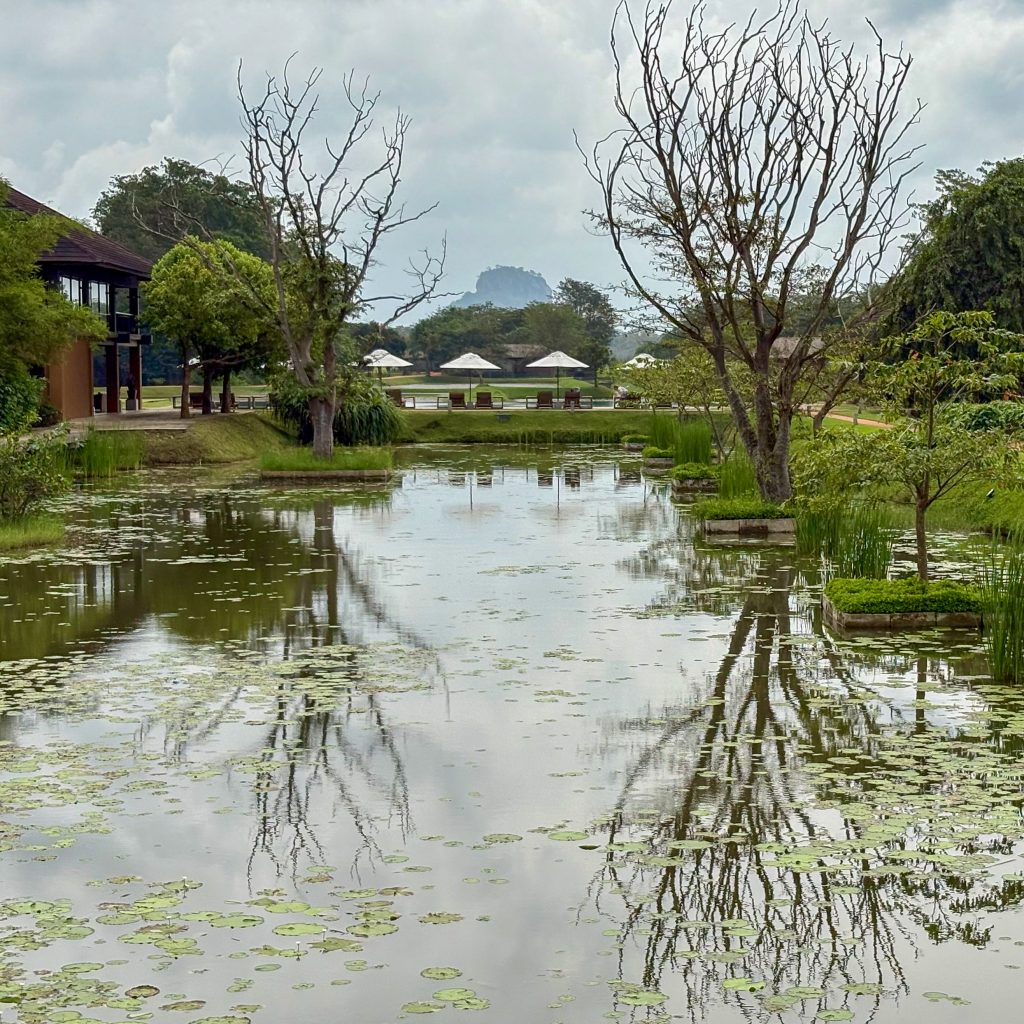
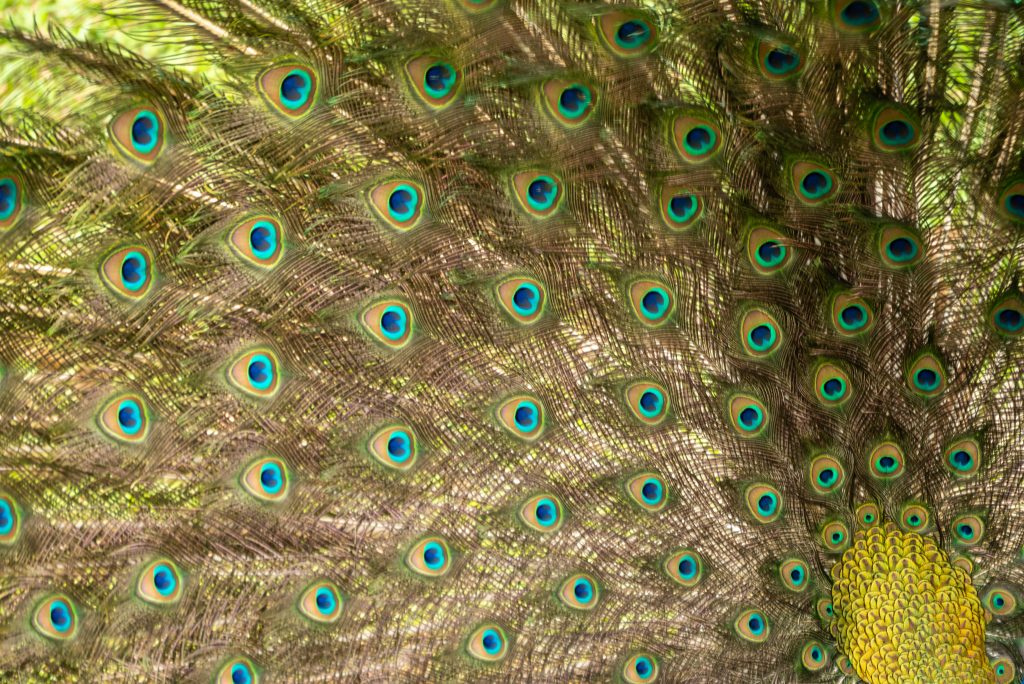
This is an impressive resort hotel (https://www.watergardensigiriya.com) laid out across a large water garden park whose rectangular water tanks (aping the water garden at the base of the rock) are a key feature. The rooms, in a clean-lined and modern style, are individual villas laid out in the park whose central hub is the restaurant, bar, spa and pool area. It is awash with water birds living around the fish-filled tanks. It is oriented so that, from that central hub you look towards Sigiriya rock in the middle distance. It is also home to several pea fowl and the peacocks seem to be in on permanent standby to perform for us guests. One afternoon, relaxing in the bar area, one showman peacock spent two hours strutting its stuff on a small lawn in front of me. The villas are huge with two large rooms on one level, all mod cons (including the heat respite provided by air-conditioning) a room-sized en-suite and a little terrace. Packed gravel paths link the elements of the hotel and they also have golf carts on call if the walking distances feel a bit too much on occasion (the furthest villas are 300+ metres from the main facilities). The land is flat, with farms and rice fields as your neighbours. This was an excellent place with a sense of comfort and luxury and an attentive staff. It is conveniently placed in a central location between the various sites covered above. Quality breakfasts and dinners were the order of the day (there are no other realistic options with a fifteen-minute drive along a rather potholed dirt road to the less then tempting offer of the local village).
Mobility Access
The availability of the golf-carts and the flat ground of the site make this a suitable option for those whose mobility is constrained. We found a villa closer to the facilities (ours was about 150 metres from them) gave us a little more flexibility to use the paths if we felt able to do so. There is a step or two up to the villa but inside all is stepless.