This is the second of two parts on our trip to Sri Lanka. Part 1 contains my prelude and covers various practicalities and the historical highlights of the Cultural Triangle.
KANDY
Kandy is Sri Lanka’s second city but has a very different sensibility from the capital. As we discovered, Colombo feels like a sprawling modern city whereas Kandy feels like a much smaller place because it is squeezed into the bottom and up the sides of a network of steep-sided valleys. We are now on the northern side of the hill country where the landscape could not be more different from the lowland to the north. Trees cover the upper slopes of the hills with the city gradually merging its buildings into that greenery along a series of steep roads. The heart of the city surrounds the Kiri Muhuda (or Sea of Milk), an artificial lake built at the behest of the last Sinhala king early in the nineteenth century. On its north shore sits the city’s biggest draw, The Temple of the Tooth, one of Theravada Buddhism’s most important shrines to which tourists and devotees flock in numbers. Around the temple is a vibrant city that was, for us, an engaging one to be in and walk around.
Kandy Activities
Market Tour
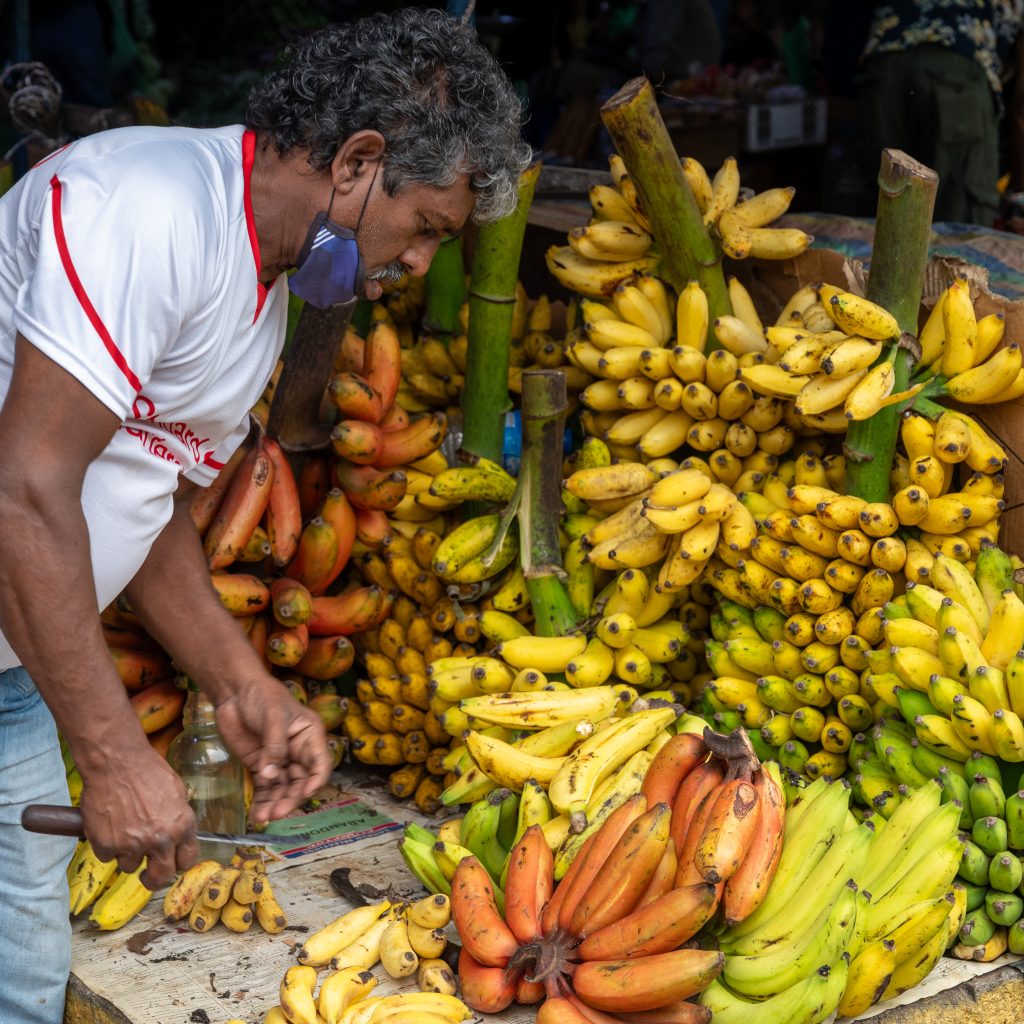
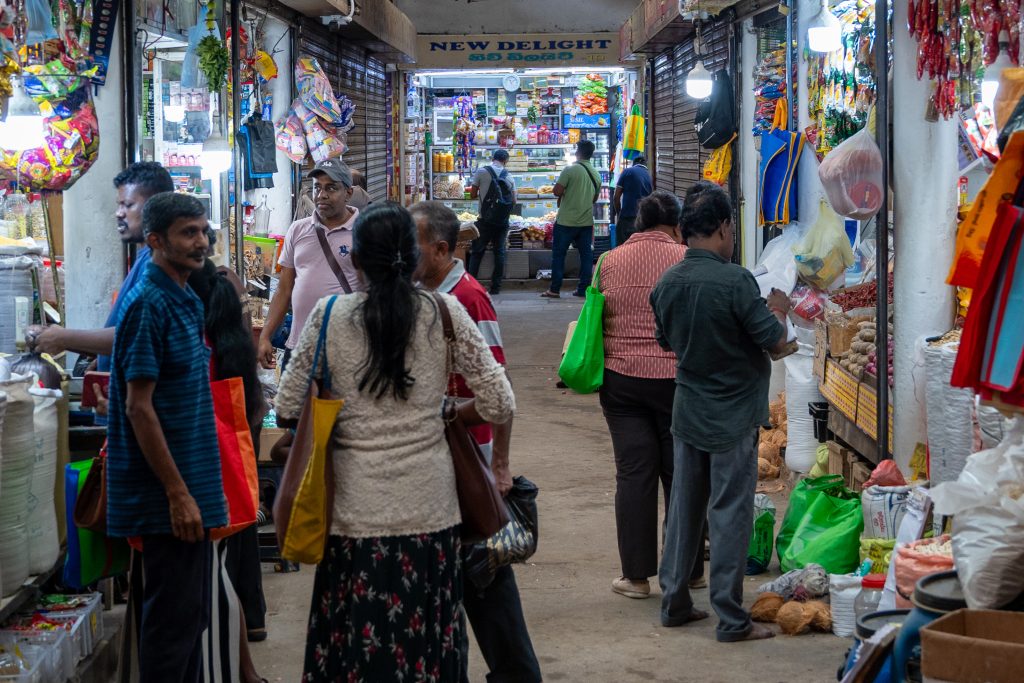
Arranged through Audley, this two-hour tour was a delight. The market is all you would want from an Asian market: a vibrant vegetable section, fish, shipped from the east coast ports, laid out on tarpaulins, meat stalls with hunks of all imaginable parts of beef and chicken hanging from metal hooks, stalls of sweetmeats and sweets items including hunks of the local jaggery (https://www.srilankabusiness.com/blog/jaggery-palm-from-sri-lanka.html), more stalls with every imaginable tropical fruit and some that were new to me (wood apples, jackfruit) and the more prosaic stalls selling household goods. It is more a jumble of concrete stalls, arcades and platforms than an elegant European-style market building, but the dynamism that is all around is the key to enjoying it. I confess to being surprised by the huge variety and seeming quality of the vegetables with the enormous quantities of orange-style fruits the only import (from China). Anji, our guide, is obviously well-known to the stall holders and we are fed with some of the intriguing fresh fruit at one stall, including trying three of the seventy varieties of banana available in Sri Lanka (my less-than-nuanced taste cannot really differentiate between them despite Anji’s explanation). Then at the sweets stall we are given sugar-rush inducing quantities of jaggery products, including hunks cut off a block of what is essentially pure sugar.
The coda to our tour is a visit to Balaji Dosai (https://balajidosai.com/about), a sort of vegetarian fast-food restaurant crowded with locals and tourists buying freshly cooked dosas, idlis and hoppers to eat in and eat out. The menu has a short explanation of what a dosa is and carries the injunction ‘Fingers recommended, flatware available’. Armed with our flatware filled with fresh dosas, Anji instructs us on how to eat our dosa, Sri Lankan style. Fingers (right hand only) are brought into play with varying degrees of competence. There is Western-style cutlery as a fallback for those too wary of their own finger skills or their own hygiene (there is a basin with hot water and hand soap set strategically at the centre of the restaurant). Filtered or bottled water comes to wash down the undeniably tasty food. A fun end to the tour.
Mobility Access
Apart from the odd step up and down within the body of the market and the short flight of steps from street level into the body of the market, this is all moving around fairly level ground just taking a little care to watch where you put your feet. As often before, we found the portable three-legged stool an invaluable tool to enable resting of legs at appropriate junctures, which enabled us to manage through the time that would otherwise have been spent on our feet.
Lakeside Strolling
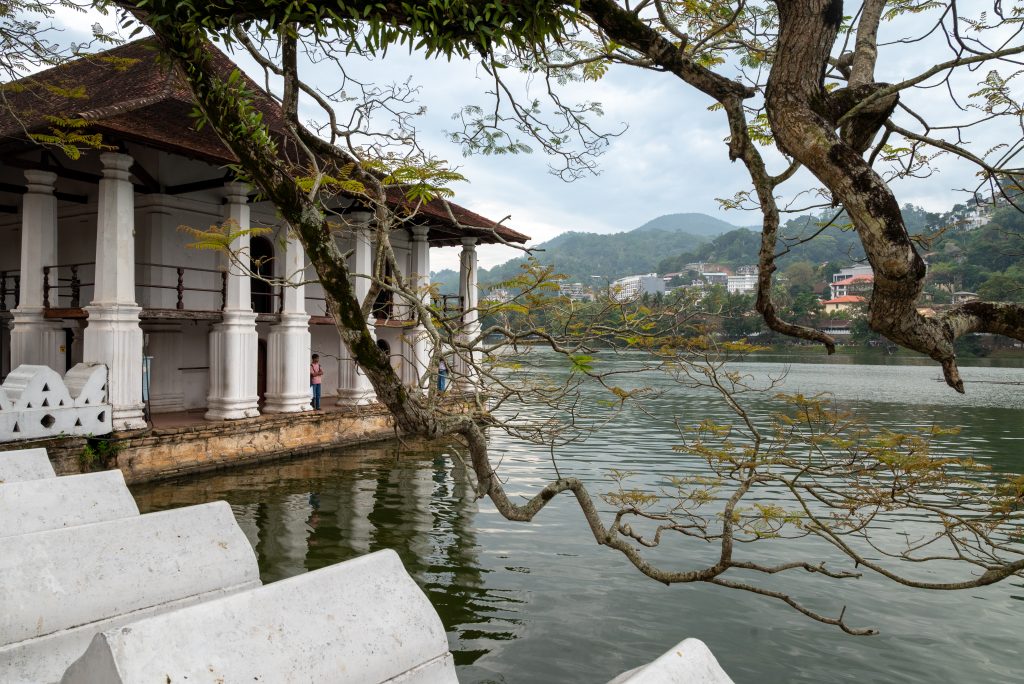
A walk that circumnavigates the Kiri Muhuda (often just called Kandy Lake) is just under three kilometres (3,200 yards) and offers a delightful mix of activities, buildings, lake views, birdlife and people-watching all encompassed within the valleys that climb away from the lake. We took the Hotel Suisse on the south shore as our start point and had our driver/guide drop us on the lakeshore road below the hotel. Even on an overcast day seeing the life of an Asian city, both bustling and relaxing, was the heart of this as an experience. As a bonus the walkway takes you past various fascinating buildings. These include Royal Palace complex wherein lies the Temple of the Tooth, so you can drop in if you wish (we didn’t, having done enough shrine visiting in the Cultural Triangle). In addition there is the Queen’s Bathing Pavilion, another structure built under that last Sri Lankan king which, unlike the adjacent Royal Palace complex, requires no entrance fee to wander through. Then you can stroll on along the north shore to the Queens Hotel (https://queenshotel.lk), originally built by that self-same monarch in the early nineteenth century and, once the British had ousted him, re-purposed as the residence for their Governor of Ceylon. It began life as a hotel in the 1840s, a life that continues as a colonial-style throwback whose Queen’s Bar provided an ideal stopping place around half-way, enabling us to avoid the shower that dampened the city for half-an-hour or so. We ended our walk back at the city’s other ‘grande dame’ hotel, the Hotel Suisse (https://hotelsuisse.lk). Although alterations and extensions have all but obliterated the original seventeenth century structure, it still has many of the old-style colonial era features, especially in the grandeur of its public rooms. It acquired status, as Lord Mountbatten’s HQ for Britain’s South East Asia Command during World War Two, and then celebrity, when it hosted crew and cast of one of Stephen Spielberg’s ‘Indiana Jones” movies filmed in the lands around. We sat in King’s Lounge to finish our trip with a fresh lime soda and fruit smoothie.
Mobility Access
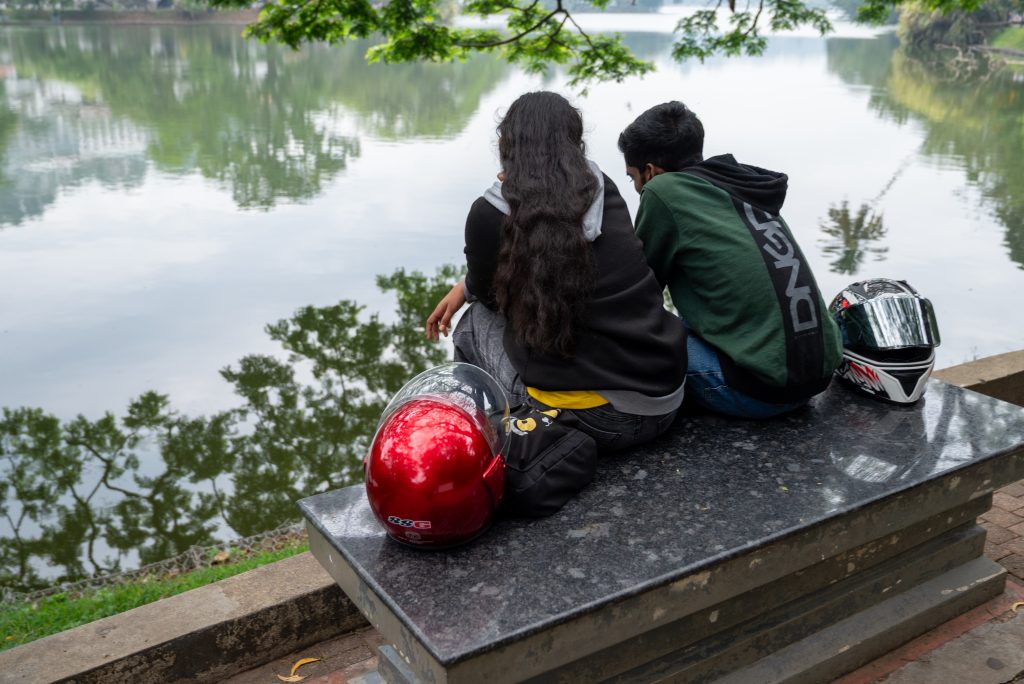
Well it is a reasonably long walk, but we took it slowly and there is no shortage of places to rest, mostly on stone benches facing the water. Should you run out of steam there are plenty of tuk-tuk drivers easing along the road beside you, eager for your custom. The pathway is paved with only the occasional place where a broken stone requires a little care. At the east end of the lake there are two walkways over inlets that require taking a dozen or so steps down. If you just enjoy being in a city and watching its denizens at work and at play, then this is an ideal walk, with a bit of local history thrown in.
Royal Botanic Gardens, Peradeniya
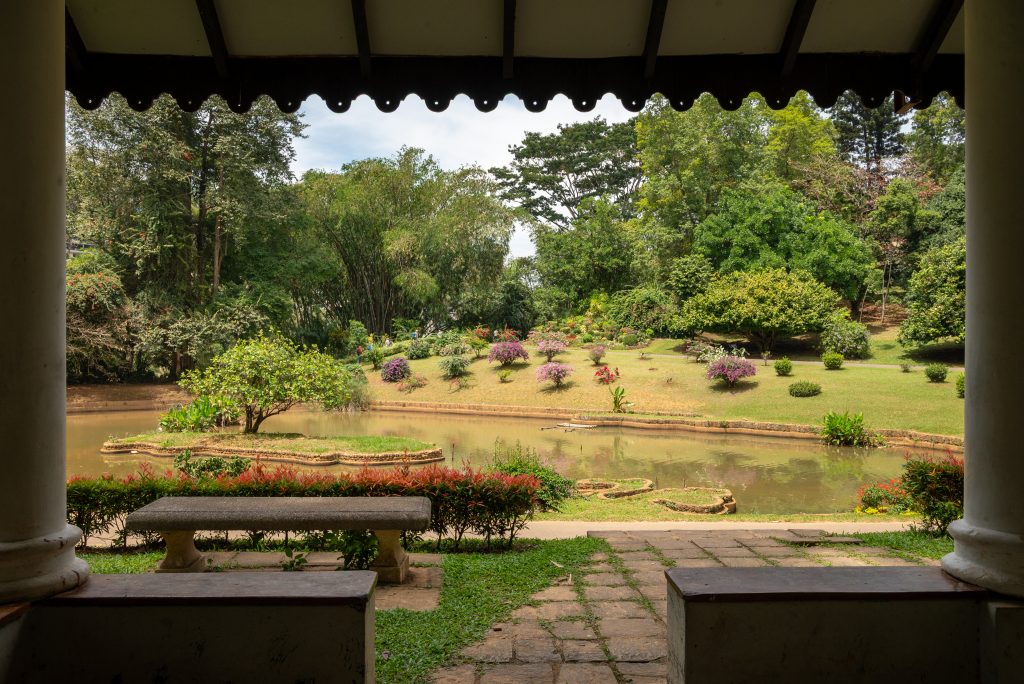
A few kilometres south-west of the city centre is this glorious place. On a clear sunny day these gardens (https://www.botanicgardens.gov.lk/service/royal-botanic-gardens-peradeniya/), caught in a loop of the Mahaweli Ganga (Sri Lanka’s longest river), are a peaceful and beautiful location to while away at least half a day. Established under British rule in the 1800s it now functions (and appears) as a place for plant life and research not dissimilar to Kew Gardens in London – it is about half the size. That means that, on a rolling landscape of parkland, avenues of trees, flowering beds, glasshouses, open lawns, ponds and borders share space with service and tourist facilities (including cafes and restaurants). It is all incredibly neatly maintained with tarmac paths running throughout and benches dotted along paths and in the trees.
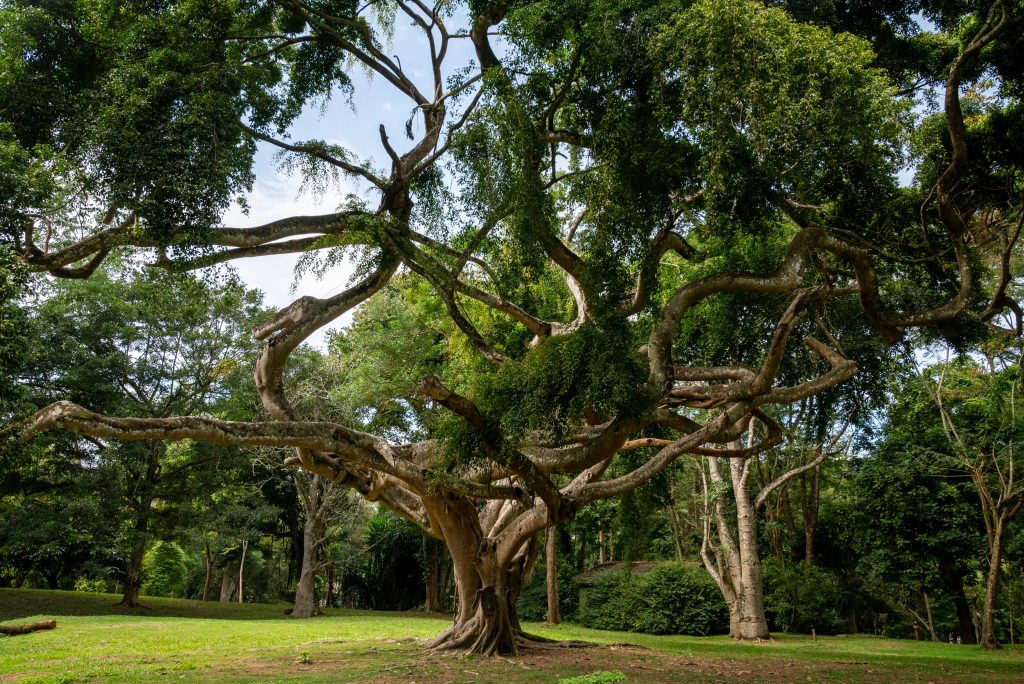
It is very popular with locals and tourists just ambling around or sitting enjoying nature in the sun. So wander we did. Here spotting the fruit bats roosting in the trees in their hundreds, looking like nothing more than some strange, large, dark fruit, at least until the familiar wings are opened up briefly. Here moving through the plantation of ‘Memorial Trees’, trees planted by esteemed visitors to the park as varied as Indira Ghandi, Yuri Gagarin and King George V. Here a lovely glasshouse brimming with orchids. Here a glorious avenue of towering palms. Here the olfactory cornucopia of a herb garden. And here a spectacular Java fig that spreads out over an area about thirty metres in diameter yet is barely ten metres high. It is a delightful place to wander and while away time.
As so often on this trip, I cannot help with entry and ticket pricing information as all was dealt with by our driver/guide.
The suburb of Peradeniya is also home to Sri Lanka’s largest university and, if you have the time, it is worth driving slowly along the road through the campus. Opened by Prince Philip in 1954 it spreads out along a river valley with a series of campus buildings set amongst woodland and parkland.
Mobility Access
As mentioned, the Gardens can be taken in bite-sized walks as the paths are smooth, the park rises and falls gently, the benches are plentiful and there are the places for refreshment and breaks. Golf carts are available for hire (with a driver) but we did not use one and there seems to be no information about this service on their website.
Kandy Hotel (4 nights)
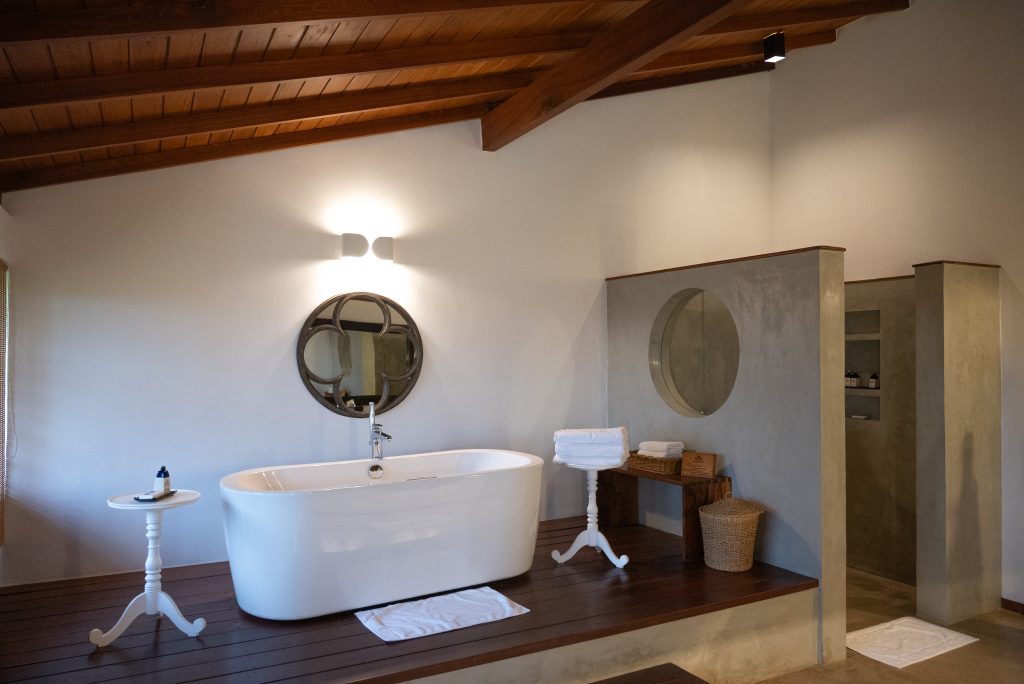
TheKing’s Pavilion was another little gem based on a re-purposed two-storey building (https://www.kingspavilion.com). It is set high up the wooded slopes of the hills just over two kilometres up some seriously steep and winding roads from the city centre. The dining veranda looks out across the lawn and pool and a view of the melange of buildings and trees that climb up the opposite slope of the valley. In the far distance are the peaks of the Knuckles Range. Our suite was vast with a bathroom even bigger than that at the Water Garden and a balcony big enough to be equipped with a table and chairs for dining and with loungers. These loungers, known as Planter’s Chairs (https://pastperfect.sg/colonial-icon-the-planters-chair/) had armrest extensions that swung out for resting your feet. Razeen Sally’s book tells me such chairs acquired the colonial nickname of Bombay Fornicators. Dining was on that lovely veranda and the food quality so very good. The staff had the same solicitous excellence, the menu the breadth and the ambience the quality that I have rather generically covered in the Practicalities section above.
Mobility Access
There is no lift in the main building and most of the rooms are on the upper floor. There is a separate building in the small grounds which has an accessible room. Our suite was on the upper floor but we were able to cope with the stairs for this stay. Floors throughout are stone or wood and smooth. There were no steps in the suite other than the step up to the bath set on a wide pedestal in that enormous bathroom.
TEA COUNTRY
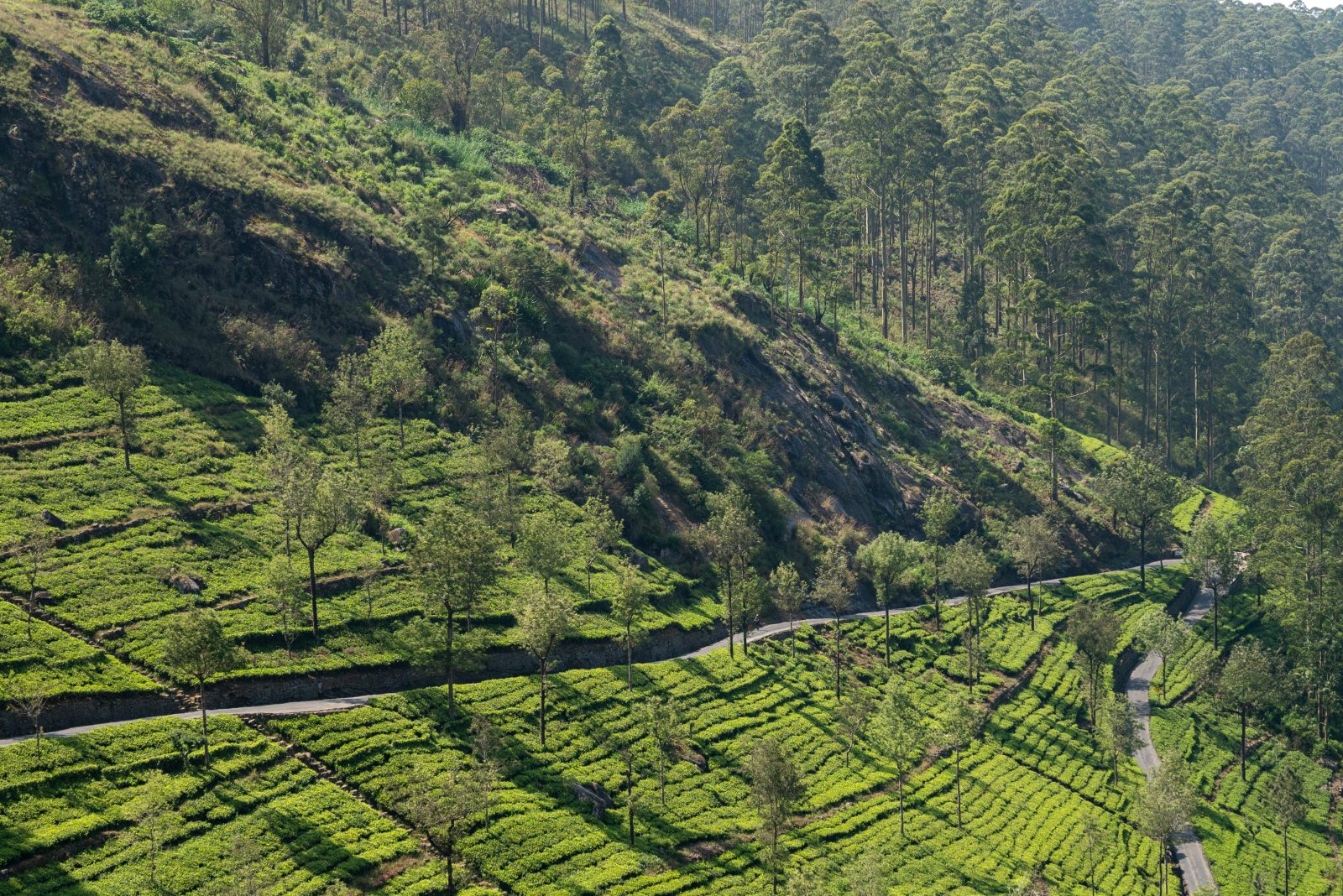
As you wind upwards on the road out of Kandy, deeper into the island’s hills, the photogenic carpets of tea bushes start to dominate the scenery. There are still plentiful woods and there are trees peppered throughout the tea plantations. There are still many vegetable plots in the valley floors and around the villages that cling to the steep slopes of the hills. There are the towns, like miniature versions of Kandy, with main streets at the lower level and the town’s buildings rising up the steep slopes. These provide the services and goods that those living in the villages and on the plantations need in the modern world. But it is the bush of camellia sinensis that is the economic and visual jewel of this landscape. We stayed in two places, both on tea estates, both in British colonial era bungalows converted into up-market accommodation.
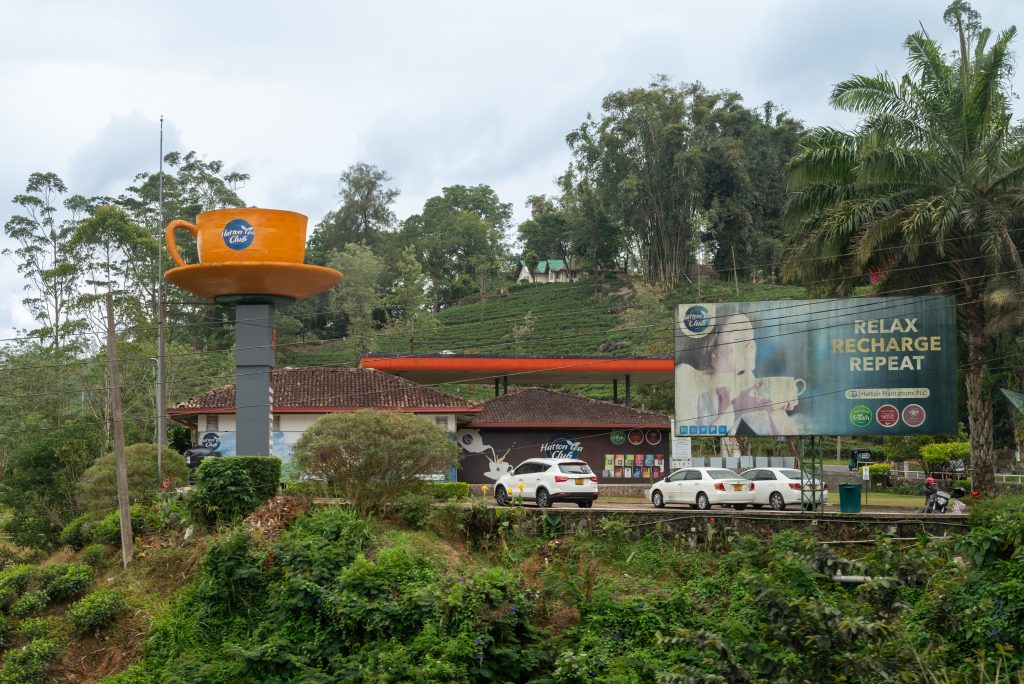
Ceylon Tea Trails, Castlereagh Reservoir (5 nights)
The reservoir, which provides the canvas for the five bungalows of Ceylon Tea Trails, was only created by damming one of the many rivers that flow through the hill country in 1965. But it adds to the glory of the location of these former tea planters’ residences set on the slopes of the hills and surrounded by the tea estates of the Dilmah tea combine. I mention them because not only are they the world’s tenth largest tea company but the Sri Lankan family-owned business also runs a small group of luxury resorts and hotels of which this is one (https://www.resplendentceylon.com/resort/ceylon-tea-trails/). All the bungalows have no more than five or six rooms, each with their own staff, who include both a full kitchen service and guides who will accompany you on many of the walks that can be taken from the bungalows. All come with their own good-sized pools with that chilly edge to the temperature. We stayed in Castlereagh Bungalow, like the others decked out in a relaxing style, reflecting the décor of their original use. Except for the sound of the wildlife and the occasional buzz of the seaplane landing on the lake as it brings guests in from coastal locations, the bungalow with its attentive, friendly staff was a place where you could while away hours in the quiet indoor spaces or the beautifully tended gardens. With each room (ours big enough to be called a suite) having its own outdoor private garden space, encircled by the profusion of tropical flowers and with cane-style chairs, table and loungers, it is a delightful location to spend some time being cosseted in style.
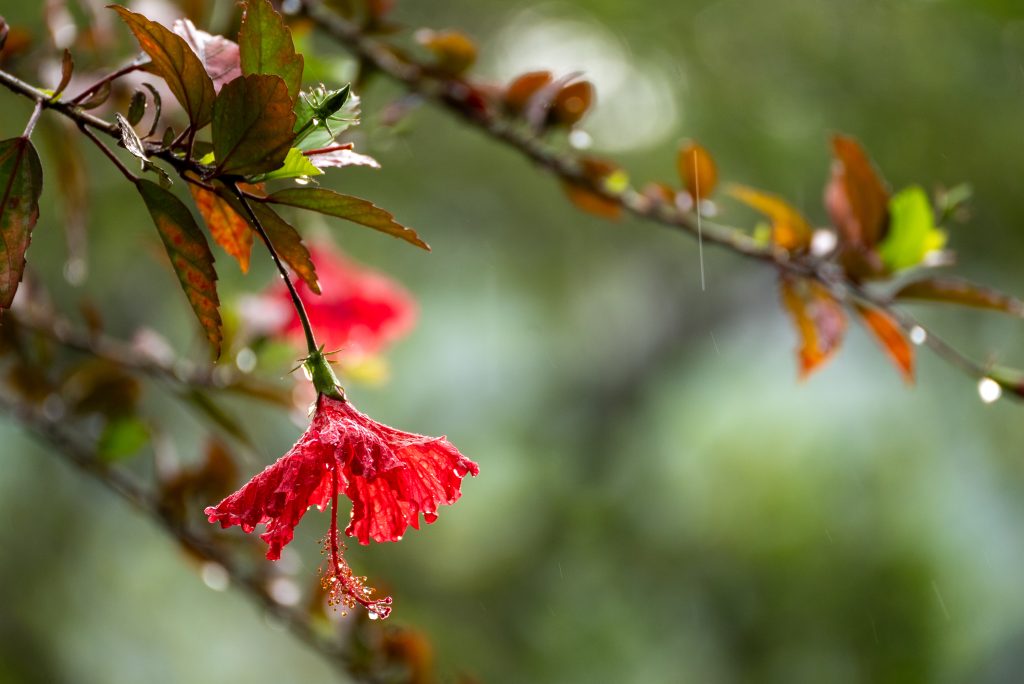
Food was first class, with a selection at all meals that reflects the general approach I outlined in the Practicalities section. There is also a good old-fashioned afternoon tea available (finger sandwiches, cakes and British-style scones with jam and cream). We passed on this, as we also did with lunch (save the occasional soup or a small salad) given the substantive quantities of food available for breakfast and dinner. On a couple of days, using the need to restore energy levels after a morning’s walk as an excuse, I succumbed to the temptation of the scones alone (with tea of course). All food is included in the price, as are the drinks (and they have a goodly selection of beers, wines and spirits). Canapés are served in the lounges before a dinner that is taken on the veranda looking out on the garden, the lake and the plantations. You can vary your routine by choosing to lunch at one of the other bungalows (being taken there by vehicle) but we didn’t.
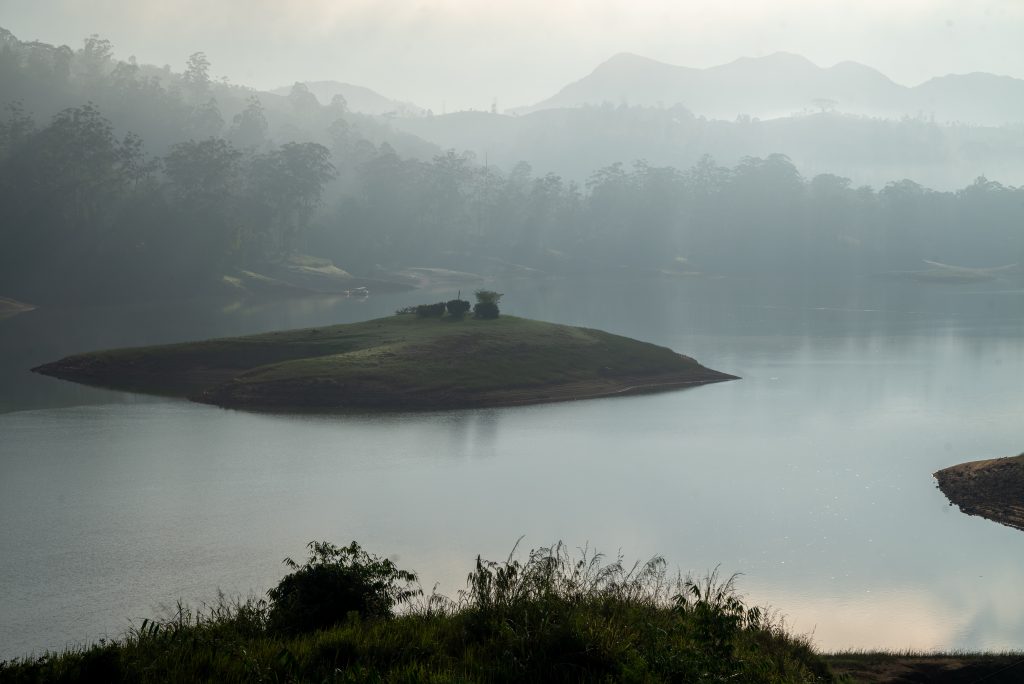
There are plentiful activities on offer at the bungalow in addition to the guided walks: tennis, spa services (massage etc.) in your room, kayaking, lake cruises and, of course, tea tastings and tea factory visits. You can venture beyond the beautiful valley to visit hill country towns, trek up into the mountains or along parts of the 300-kilometre Pekoe Trail, but we felt no need to do so. However, we did wrench ourselves out for a couple of activities.
Mobility Access
There is a flight of about 12 steps or a sloping path up from the drop-off in the drive to the bungalow’s entrance then a single step into the house, but once you are in the bungalow it is a no-step environment. There were also two steps down from the French windows that led out to our private garden space. The gardens, where the pool sits invitingly, are lawned or with paths and are, mostly, on one level with just slight slopes in the ground along the paths to the rose garden. There are about a dozen or more steps down through the trees at the end of the lawns leading to a space overlooking the lake where a couple of loungers sit alongside a jacuzzi.
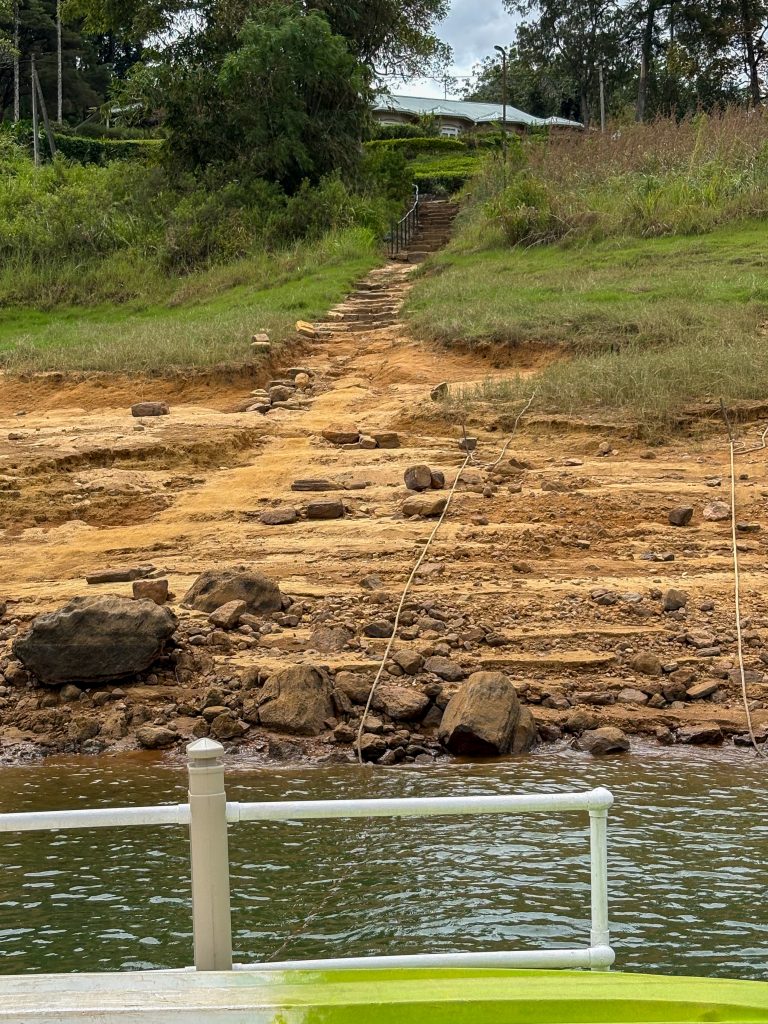
One special consideration does need to be dealt with. As part of the arrival experience for Castlreagh Bungalow you are dropped at Summerville Bungalow (because it is much closer to the main roads). From there a motorboat ferries you gently across the water to the opposite shore. The difficulty for those with mobility constraints is that you have to climb down around 150 steps and across the sloped hard-sand shore to reach the jetty and then repeat the exercise uphill at Castlereagh. Don’t. Make sure your driver (or the hotel) arranges for you to be driven to Castlereagh (about six kilometres or nearly four miles) further on along narrow, slow-going roads.
Castlereagh Activities
Tea Factory Tour
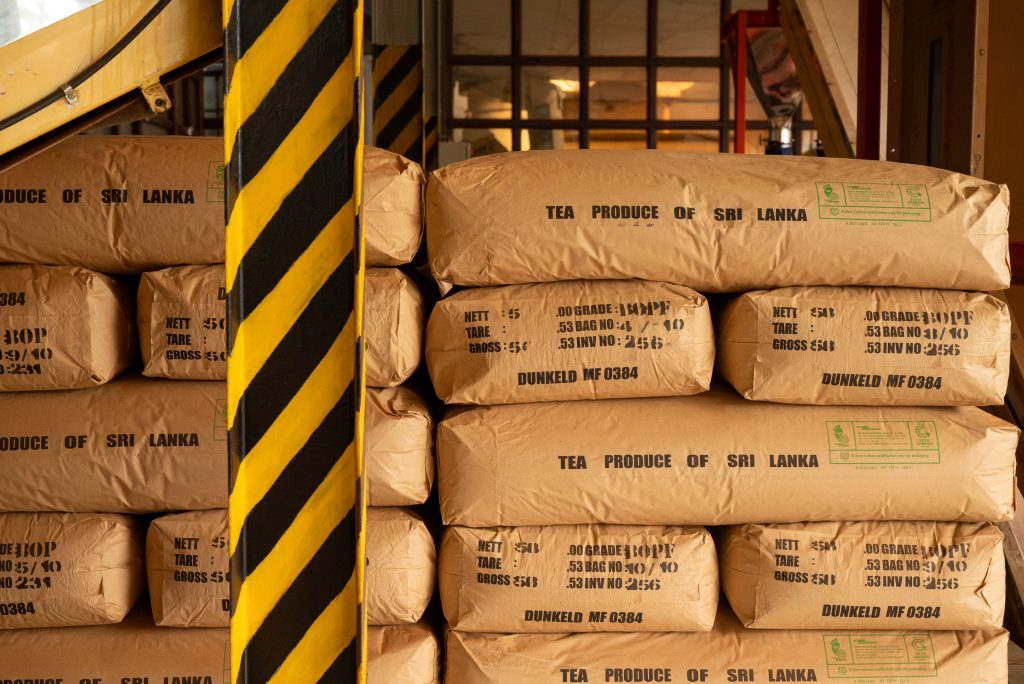
A twenty-minute walk or a short ride in the provided minibus up the tarmac road through the tea plantation is the Dunkeld Tea Factory. All the tea factory buildings in the hill country seem to follow a similar pattern. Built from the 1870s to the 1930s, they are three-storey rectangular buildings with white-painted, timber-framed structures and green corrugated iron roofs. Windows run along all the space between the frames on the upper floors. I am not going to describe the process of tea making but the (free) tour covers it in some detail in about 45 minutes or so with a tea tasting in the Dilmah shop to finish. You are part of a group of other guests (about a dozen) who have come from both your own and the other bungalows that form the hotel. The Dunkeld factory seemed less active than another we visited in Dambatenne (see below) but the tour guide was deeply knowledgeable and clear (he had worked as buyer and taster).
Mobility Access
Nearly a red designation as quite a bit of consideration is needed as to whether or not you can manage the tour. You can be brought to the door of the factory in a vehicle but the tour requires you to be on your feet the whole time (there are seats in the tasting room) and you have to climb or descend a flight of about 15-20 stairs between each floor of the factory. Judicious use of your portable stool helps with the former but not the latter.
Tea Plantation Walk
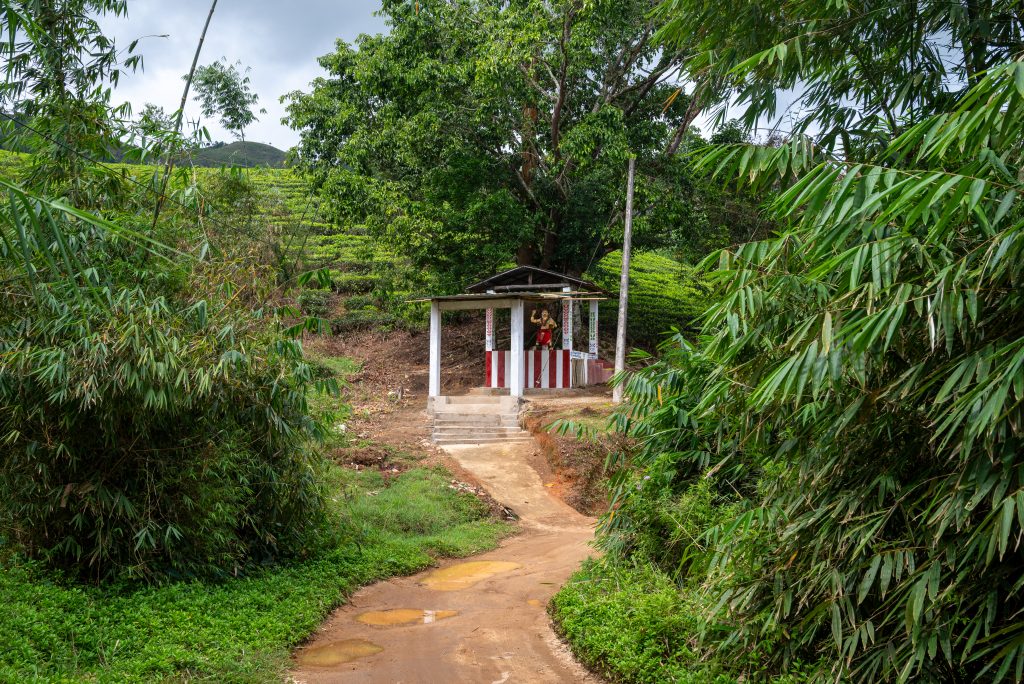
The hotel provides its own leaflets of several walks (varying from a couple of hours to over half-a day). You can have a guide with you on the walks (and they recommend that you take up the offer of guiding on the longer walks and those that venture beyond the roads into the higher wooded slopes) but I took one that could be self-guided, following the marker posts through the local village and up into the tea plantations along roads or wide tracks built for the vehicles that need access to the slopes to collect the picked tea. It was a fascinating six-kilometre (nearly four mile) walk, strenuous in parts as it climbs through the tea plantations. Whether in the village, home to the tea workers, with its small stall-like shops, tiny homes, small shrines and churches, or whether amongst the tea plantations with their superb views across the lake and valley and with the women workers moving industriously between the tea bushes, it is always so photogenic. In both village and plantation, you are met with a cheerful greeting from those you pass on the roads and tracks: the person hauling her water bucket home from the nearest standpipe and the man with the huge bundle of wood across one shoulder coming down from the woods higher up the slopes. It was hot going so water and some sustenance (bananas and Mentos are mine) are sensible, for I found the whole walk, with regular photo-stops and rests, took nearly two hours longer than the hotel’s estimate of two.
Mobility Access
Obviously, another non-starter. Not only the distance and elevation changes but the unevenness of the tracks through the tea plantations are the issues.
Nuwara Eliya (‘Little England’)
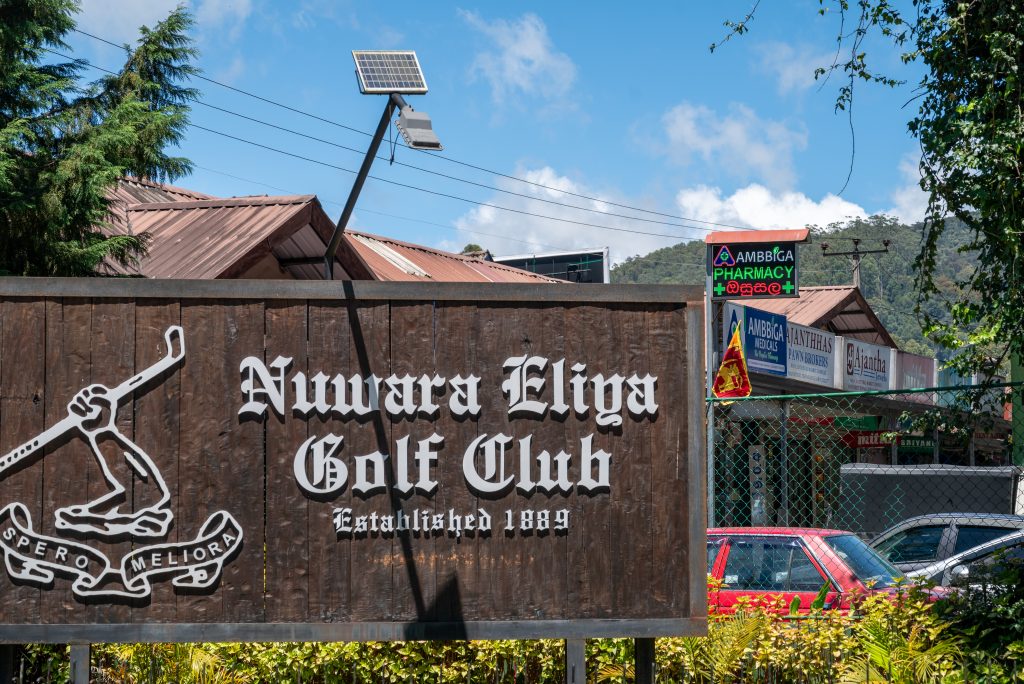
Not really an activity as such, I have included this town here because it can be visited as a day trip from the bungalow. We stopped en route to our next stop, giving it a couple of hours to visit some of the colonial buildings that give the town an almost unique feel. You have the sense that someone has plonked a small English county town (circa 1930) 1,800 metres (6,000 feet) up in a wide valley in the heart of the hill country. Established by the British in the mid-1800s it sports an 1815 Post Office, an 1828 Grand Hotel (through whose maze of wood panelled rooms and corridors we had an enjoyable wander), a racecourse still in use, a very smart golf course, Victoria Park (whose very name betrays its origins), an elegant country home now the hill retreat of Sri Lanka’s President and, of course, a former gentleman’s club that is now club-style accommodation and still is the venue for Sri Lanka’s premier tennis tournament. Part of the colonial centre of the town has been scraped out and a modern area of retail, offices and bus station bustles with some of the town’s 27,000 population.
Mobility Access
With a driver/guide and a car to move between them, stops allow short strolls to be taken very easily up to and into certain of the buildings and the park, with only the odd set of steps or short slope to negotiate to cater for changes of level.
Thotalagala, near Haputale (3 nights)
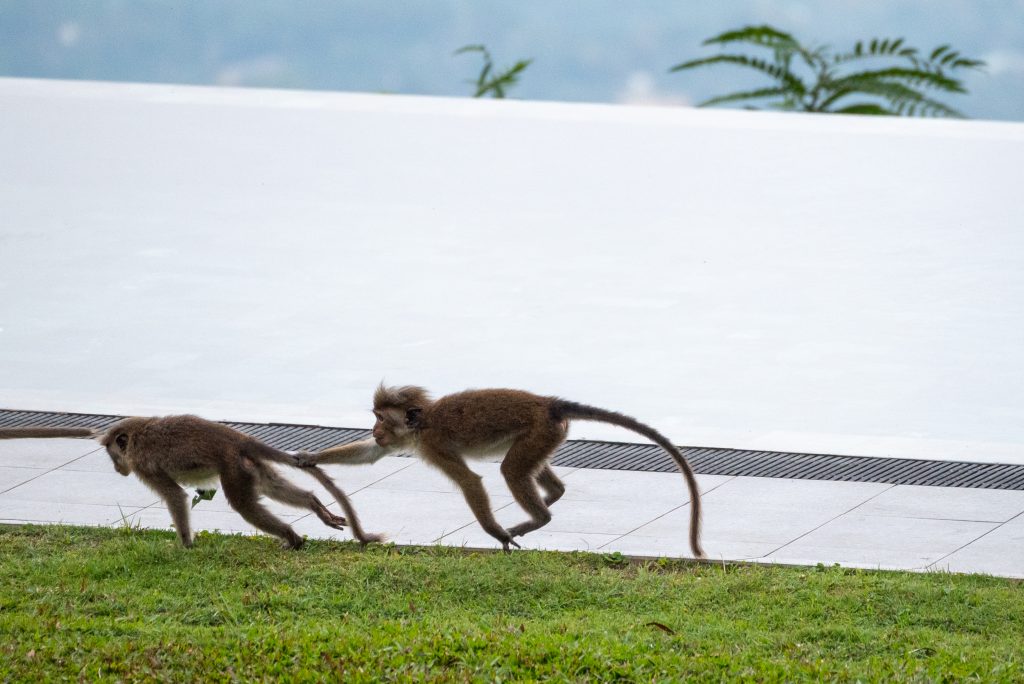
We keep to the higher elevations for our second hill country, tea plantation stay. Unlike Ceylon Tea Trails, Thotalagala (https://thotalagala.com) is a lone bungalow set in the heart of a rural village amongst the tea plantations once owned by Sir Stuart Lipton, founder of the eponymous tea brand that is now the world’s largest. In facilities, style and décor it is quite similar to Castlereagh Bungalow but that would be to suggest that it only offers more of the same. In a sense it does, but it has its own feel that can be measured in nuances not broad strokes. It is the staff, still high quality but with a marginally less refined air. It is the location with that stunning view down the dramatic slopes that bottoms out, thousands of feet far below, in the wide expanse of plain that stretches to the island’s southern coast. It is in the grounds and their denizens; a heron and a flashing blue kingfisher by the pond and the troupe of grey langurs that each day forage and play their way across the lawns, stopping to eat flowers and drink from the swimming pool. It is the communal table for evening dining. It is in the small patio outside our room, open to the lawned gardens. As with Ceylon Tea Trails it is an ‘all in’ food experience complete with that enormous afternoon tea if wanted, albeit alcoholic drinks are extra here. In its subtly different way, we found it an equally peaceful and enjoyable place to stay.
I do have to mention the weather. Not the temperature changes that I have noted in the section on Practicalities but the cloud and rain that is an inevitable part of being in the hills. It manifested itself in short, sharp downpours at Ceylon Tea Trails but here it is more apparent in the cloud that sits below you. On some days our view south is clear only in the early post-dawn hour. Cloud gradually fills the valleys below you until you appear to be floating on a grey blanket. That airborne chill in the evenings makes you glad dining is indoors with the fires lit in the lounges.
Mobility Access
You arrive at the end of their short driveway to find a paved path to the bungalow. No steps here except the one step down off the veranda onto the lawns that slope gently down to the infinity pool.
Thotalagala Activities
Dambatenne Tea Factory and The Lipton’s Seat
What? Not another tea factory. Well, yes, but the real draw here is the trip up to Lipton’s Seat. At the top of a peak at 1,970 metres (6,500 feet) is the place where, it is said, Lipton came to survey his domains. Now a tourist attraction it sports a protective wall (to stop a spiralling descent) and a bronze sculpture of the man himself upon a bench seat (an inevitable Instagram draw). The hotel offers a guide to go along on this tuk-tuk ride up a vertiginous spiralling road through the tea plantations. He provides excellent insights into the methodology, commerce and cultural context for tea production.
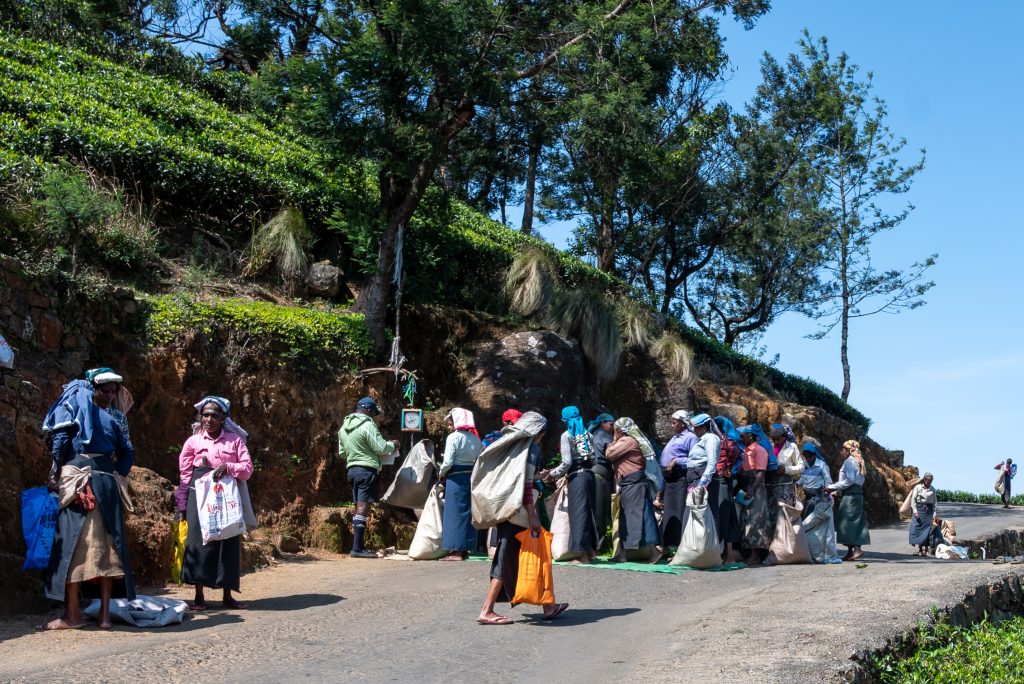
Near the Seat we come upon a group of pickers bringing their morning’s haul up to the road. All the pickers are women, a few are in their thirties but most seem older, some much older. Never good at estimating age, I may be misled by their appearance which may arise, in part, as a consequence of the effects of a life of toil in the high-altitude sun. The only man is the supervisor who has the women lay out a tarpaulin underneath his scales (no more than a hook and dial hung from a couple of branches he has embedded in the steep mud bank and secured on a tree). He weighs each haul and notes the amount in a notebook that each woman carries wrapped in a sash about her waist. From a large bag, the man produces small plastic bags of corn kernels which are handed out to the women. The women empty their sacks onto the tarpaulin then stuff the tea into larger sacks for transport to the tea factory before trickling away in small groups for their mid-morning break. The episode does bring home the physical endeavour needed. The women often have to climb up to the tea growth from their homes in the hill villages, work at their speedy plucking for around eight hours in the heat and be able to haul their sacks across and up and down steep slopes on which I would find it difficult to keep my feet. The workers are still regarded as the underclass of Sri Lankan society. They are mostly Tamils, whose forebears were shipped over from Tamil Nadu by the British to provide cheap labour for the plantations. They are looked down on both by those Tamils who have inhabited the country’s north and east for centuries and by the Sinhala majority. Being of the Hindu religion, they have lesser place in a country whose constitution still has an embedded entitlement favouring the majority Buddhist religion.
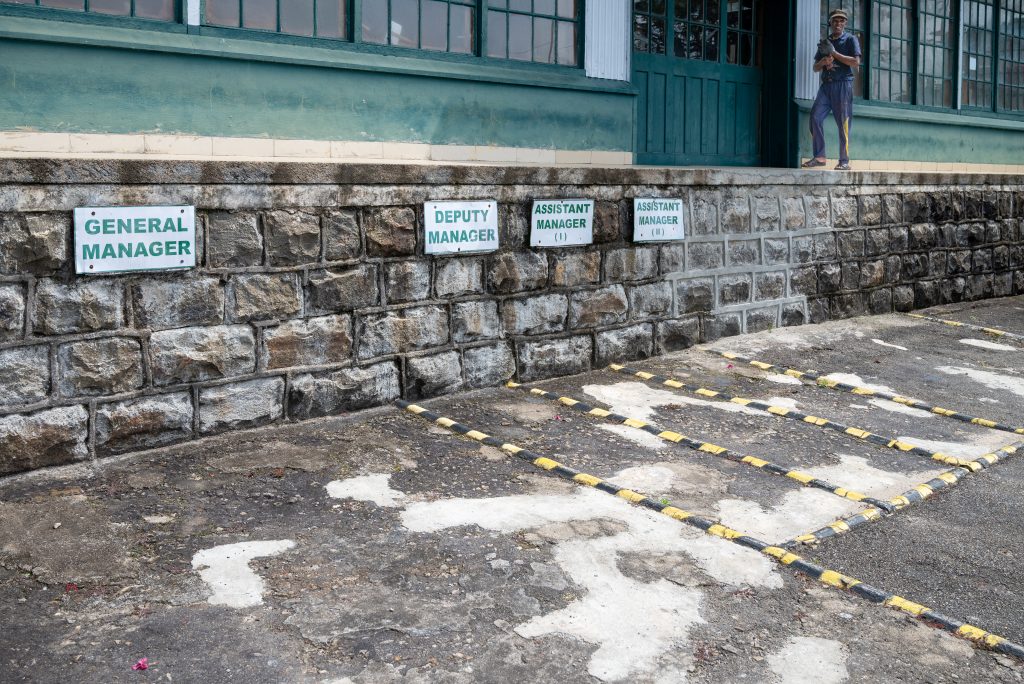
The tea factory visit just becomes a coda after this but, unlike Dunkeld, this is a factory buzzing with activity that seems to affect the enthusiastic man who leads the tour. His spiel (in English) comes out at nineteen-to-the-dozen with a strong Sri Lankan accent. I miss quite a bit of detail but what the rest of the tour group – two Germans and a Czech family – make of it I do not know. I pick up enough and it is fascinating to see the process in full swing. We end up, of course, in the tasting room and shop to try the product. For me, it was more satisfying than the Dunkeld factory tour.
Mobility Access
The trip up and down to Lipton’s Seat would have a green designation were it not for the tea factory tour. That element is taken by tuk-tuk and the area at the peak is a flat tarmac area, so little walking is needed. I do find that curling a long-limbed body in and out of a tuk-tuk has become a more laborious and less dignified process as the years have gone. The tour of the three-storey factory building has the same issues for those with mobility constraints as that at Dunkeld: time on your feet and climbing and descending steep stairs but you can always sit the tour out in their waiting room which is lined with chairs.
Tea Tasting
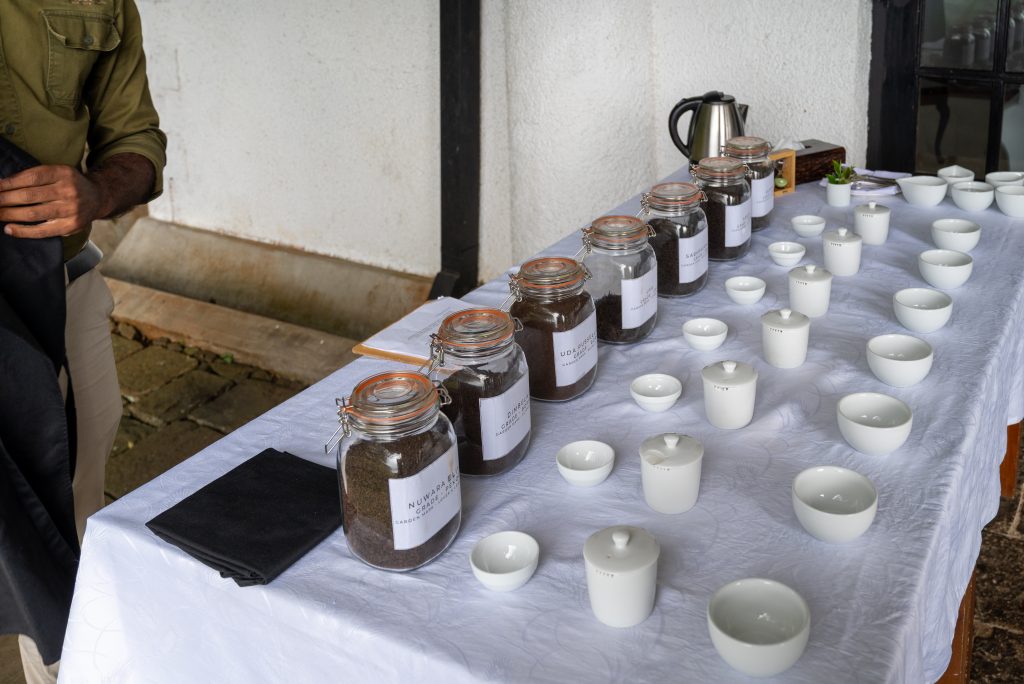
Set up on the Hotel’s veranda this mid-afternoon tasting is altogether more satisfying than that which you get at the tea factory. The explanations are clearer and more extensive. The seven different teas are clearly explained, from the ludicrously expensive white tip tea through to the black tea variations whose taste alters depending on the altitude of the relevant plantations. I cannot pretend I picked up every nuance in the teas but it did enhance my understanding still further.
Mobility Access
No issues here. Seats are there if you need them.
Self-Guided Walk (Through Vegetables and Tea)
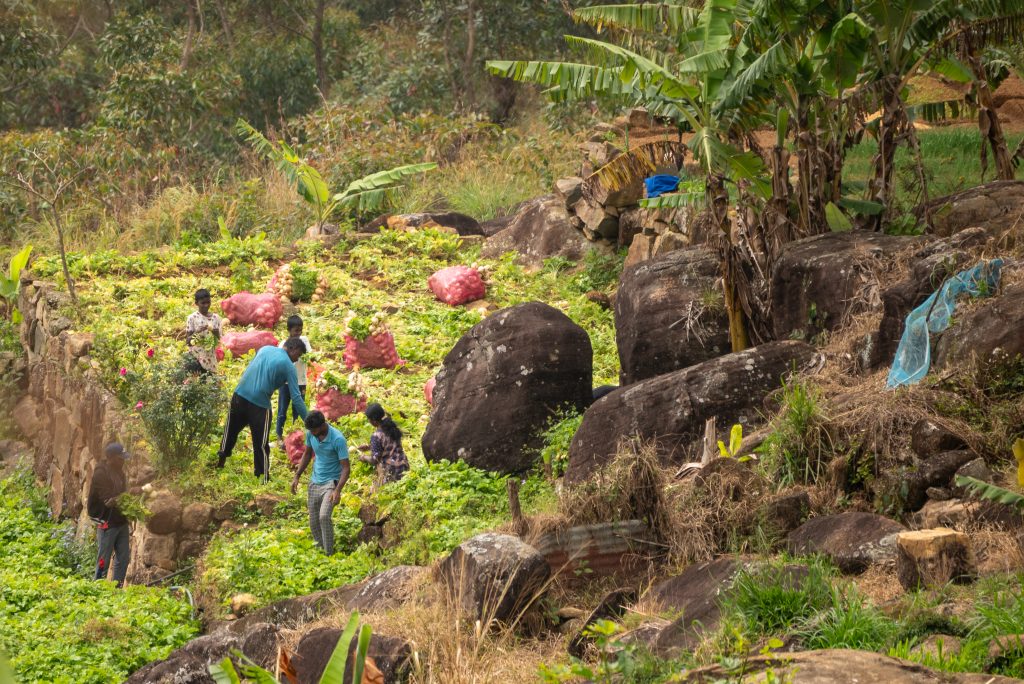
Here the instructions for the walk were simpler than at Castlereagh Bungalow. ‘Just go through the gate onto the track and keep turning right’ turned out to be all that was needed for a three hour walk along farm and tea plantation tracks circling down the slope of the hillside and back up to the road and the village. There are, again, similarities with my walk at Castlereagh Bungalow from the scenery (no lake to enhance it here) to the village life and the greetings of the local folk that I meet. The big difference is that the first part of the walk circles through the terraced fields of vegetables that sit around family homes being worked by family groups of three or four women and men together. It adds another layer to the experience, as does the glimpse into the one room building that houses the primary school where youngsters are dutifully stacking chairs away after the morning’s schooling. Sri Lankan culture values education highly and state education is free, leading to a very high adult literacy rate. I return down the narrow road to the hotel after another really engaging walk much in need of a shower and a sit down with a cold lime-soda.
Mobility Access
No, again. But the tuk-tuk up to Lipton’s Seat will let you enjoy the rural village experience as you putter through places on your 45 minute drive up to the peak.
En Route to Galle: Elephant Transit Home
As you drive past the fences that encompass the Udawalawe National Park and across the dam that holds back the water of the Udawalawe Reservoir, the safari world starts to manifest itself. The accommodation adjacent to the Park acquires the word ‘camp’ as part of the name. Cars stop by the roadside, seemingly at random, but actually because an elephant has been spotted just inside the Park fence or on the road itself. Safari trucks line the road with signs for wildlife tours, thickening in numbers as you approach the Transit Home, which is the touristic heart of the Park. Ours was a pre-arranged visit, our one concession to wildlife on this trip. The Home is set inland on the wide coastal plain, about halfway through our drive out of the hill country and on to Galle. Reachable on a day trip from Galle, this place mixes a tourist attraction with a serious purpose. It is always difficult to separate the appropriate ethical approach to take with the sort of spectacle that comes here. A viewing arena has set up to allow visitors to watch the young elephant orphans being fed milk at a fixed time each day. Commentary (https://www.hidmc.com/blog-posts/ethical-vs-unethical-elephant-tourism-in-sri-lanka is a good example) seems to fall on the side of this Home being ethical because it is part of a serious project to re-wild orphaned elephants and the complex comes with a comprehensive exhibition that goes into the world of elephants in considerable depth. And of course effective re-wilding costs money and the feeding-as-spectacle must bring in much-needed cash.
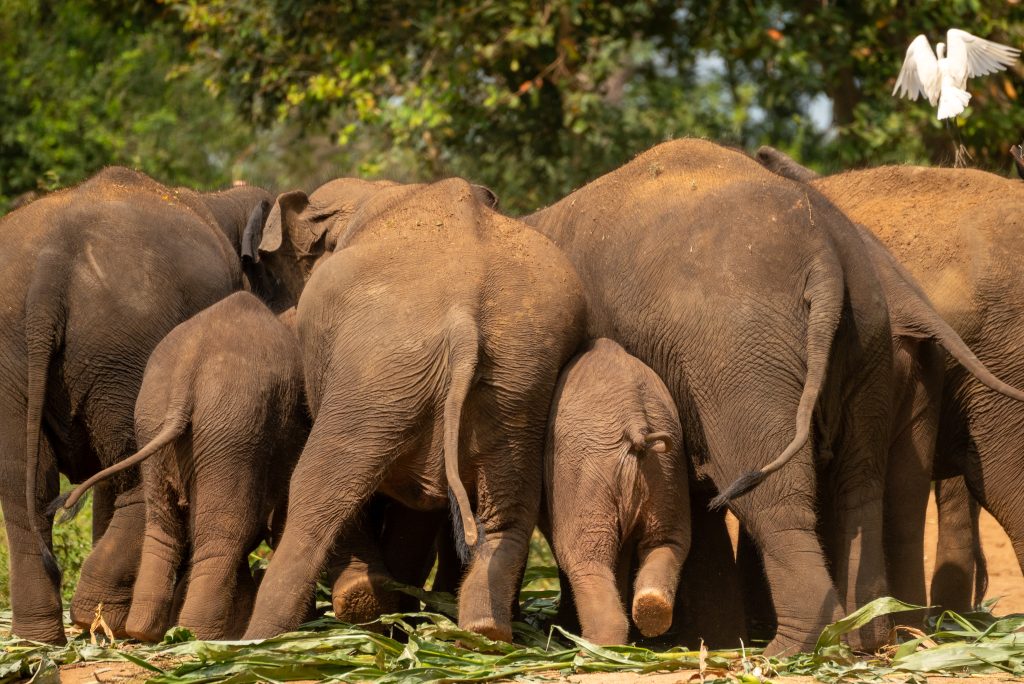
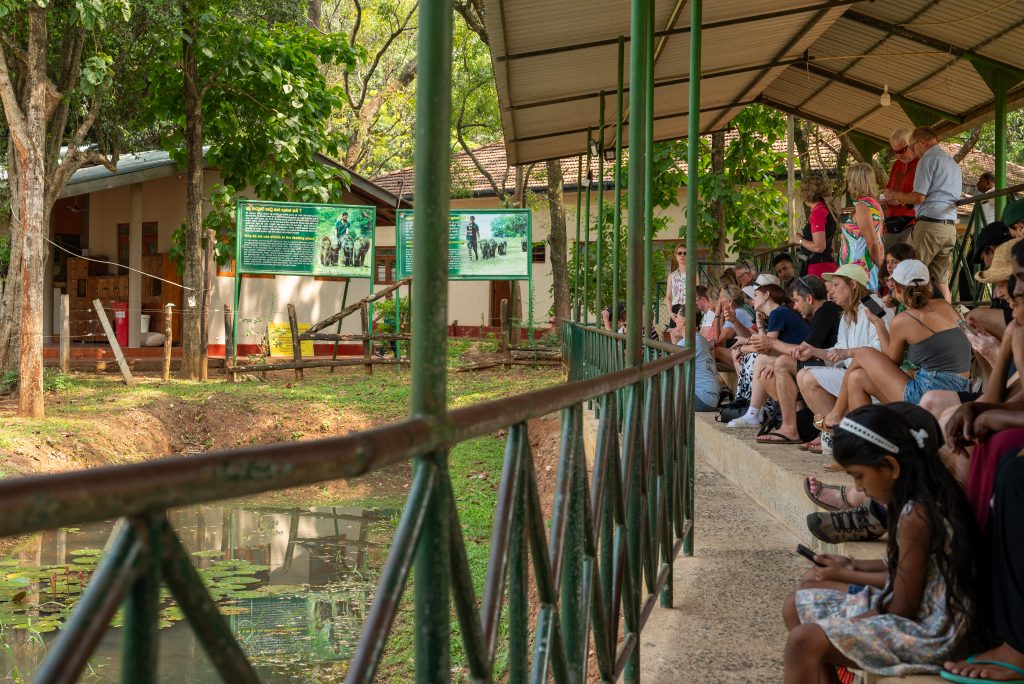
As to the orphans, they are apparently left to roam free, being let into the milk feeding compound twice a day. There are forty to fifty elephants who rush to the feeding station half-a-dozen at a time. There they gulp down their share of milk (from jugs of pre-prepared powdered milk) fed to them through funnels attached to hoses before being shooed out of the way by staff wielding sticks to make way for the next set of hungry mouths. We spectators are kept well-away, separated by a wide water-filled ditch, on our seating which is on three long rows of concrete steps, sheltered from the sun by a corrugated iron roof. The elephants range from near adults to the very small. The whole session last about an hour and it has to be said that the elephants are abominably cute, especially the youngest ones who have to be fed from super-sized baby bottles. The way in which the older females in the group are highly protective of the smaller ones is another endearing feature.
It seems to lack a website that I can find online (it is run under the auspices of the Department of Wildlife Conservation whose website seems inaccessible from my laptop). I cannot help with ticket prices but there are so many tours on offer finding an option is not going to be difficult, given you need a vehicle to get there in the first place. Within the complex are toilets and the inevitable shop. In the car park adjacent are a few restaurants and cafés, including the chain coffee shop that we used called Barista.
Mobility Access
No real issues. Vehicles can be parked right outside the entrance to the complex. Within the packed dirt paths are smooth and flat and the only steps to manage are up into and inside the spectator housing. The information centre building can mean quite a while on your feet if you read through the bulk of the exhibits. It, the spectator housing, toilets and shop are round the edges of a compound that is about 50 x 50 metres in size.
GALLE FORT
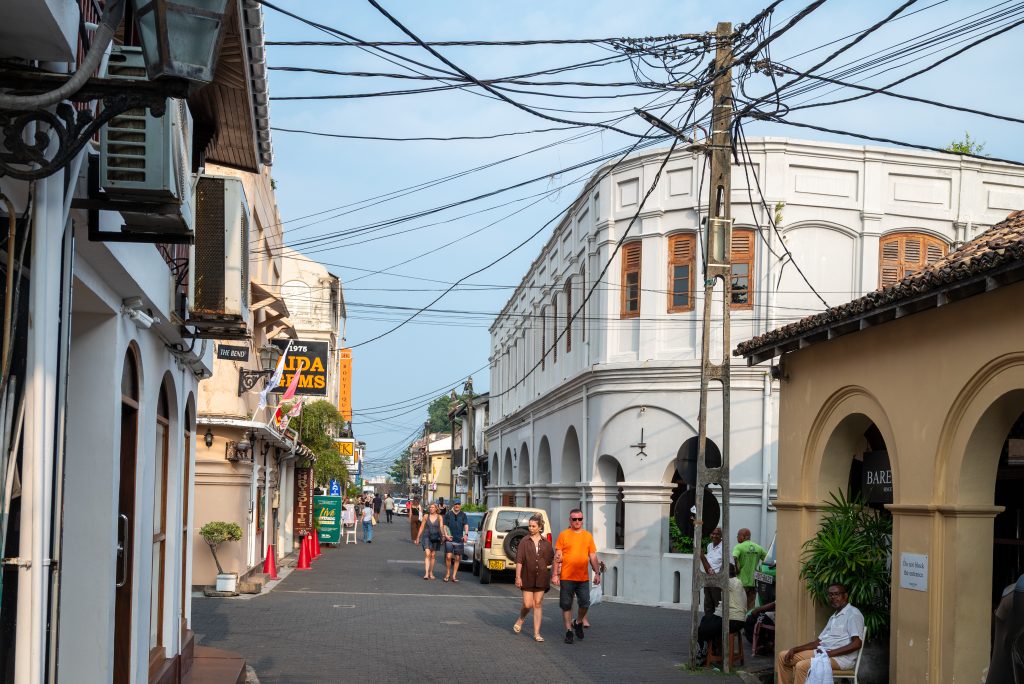
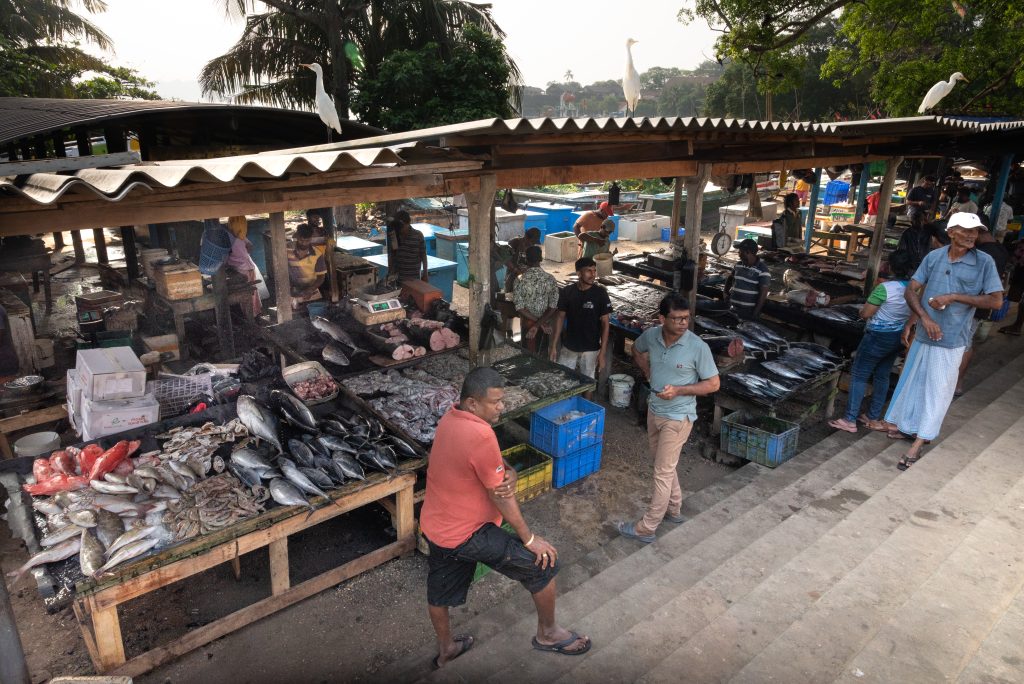
The three-kilometre ramparts of the Dutch-built fort enclose an area that is about 500 metres east-to-west and almost the same from north-to-south. This is the heart of the former colonial city first established as a base under the Portuguese but given substance by the Dutch and then the British. It is now a delightful space of grid-pattern streets lined with buildings (homes, offices, courts, schools, churches, a mosque, shops, restaurants, cafes, bars) whose structures date from the various colonial eras. It is easy to see why the whole is a UNESCO World Heritage Site. And it is easy to spend three nights there, as we did, strolling around its streets and along its ramparts with plentiful time out to cool bodies and take in sustenance, to read and write. And we did not visit its several museums at all. The only time we ventured outside the ramparts were early mornings spent strolling through the busy, entertaining fish market stalls along the shoreside street that runs for a couple of hundred metres out of the Old Gate in the north-east corner of the Fort. This is a place for walking. Cars do come in, and the ubiquitous tuk-tuks are there alongside the rented bikes of the tourists and the electric scooters of the locals, but the narrow streets are too busy with pedestrians for anything but slow movement. For there is no doubt that the tourists flood in, not just the tours but also the day-trippers taking a day out from their beach holiday, which meant my favourite time to walk the ramparts was the early morning, before breakfast, when the heat of the sun is less and it is quiet, with just a few locals taking an early morning stroll or a more serious jog.
I will not refer to sights to see or be seen except one. The exception is less a sight than an entertainment: a stroll around Court Square in the morning after the courts have opened for business. The entertainment value of the mêlée of litigants and their hangers on (and spectators) outside the wide open doors of the courts, the array of small lawyers’ offices with doors wide open to the street and the sight of the serious-looking lawyers standing around in their dark suits, white shirts and dark ties, nodding sagely into mobile phones or in earnest conversation, really warrants a half-hour of your time. Otherwise, if you visit, you will make your own choices about where and when to wander and what to focus on and there is no shortage of information, in hard copy or online, to meet your particular taste. We found that being armed with the straightforward map given to us on arrival by the hotel allowed us to keep our bearings and find our way to the things we wanted to see. Unless you are in Sri Lanka for the beach or the wildlife you will go and, unless you are a real curmudgeon, you will enjoy.
Mobility Access
I have already said, in my general section on Mobility Constraints, that an assumption is often made in guides that getting round on foot is the thing to do but that is not easy for some. Yet I have said just that very thing about Galle Fort. However, bear in mind that Galle Fort is small (a good bit smaller than the ramparted old city of Dubrovnik for example), that the streets are neatly paved and smooth, that there is only a gentle slope in the ground up from the sea wall at the south end to the Main Gate at the north and that there are so many eating and drinking places to stop and rest that walks can be as slow and as short as you like. Even if you feel you are stuck there is always a tuk-tuk all too ready to offer service to return you to where you need to be.
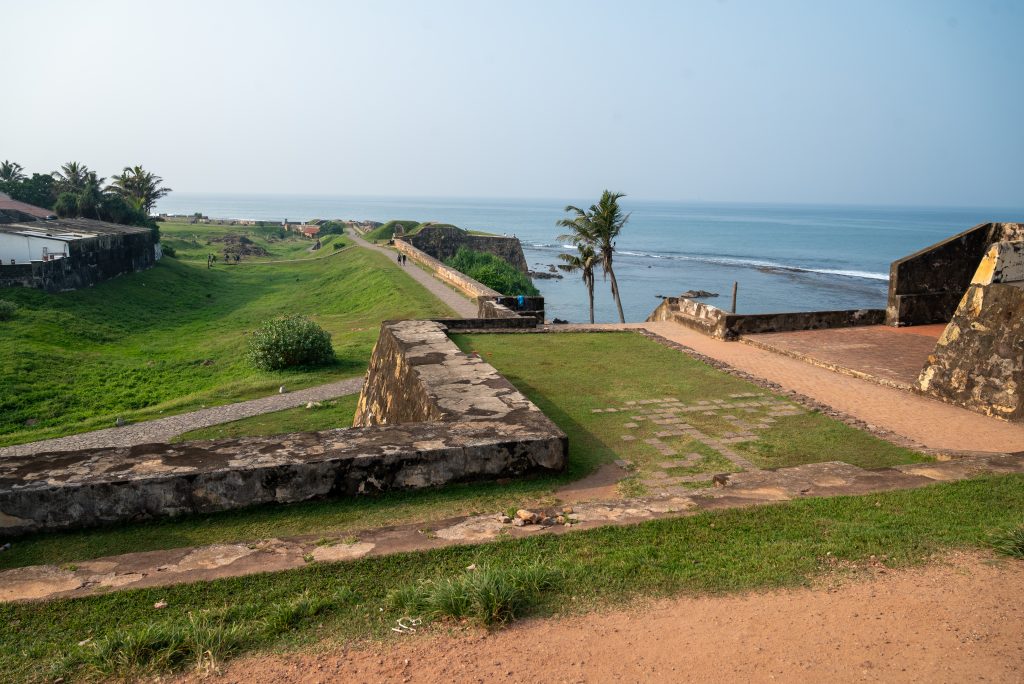
The ramparts can require quite a flight of steps up to reach the sections along the north end but, in many parts, access to the paved paths and wide grassed and packed dirt walking spaces that lie along the top of the walls involves no more than four to ten steps up to enable views up and down the coast, into the town and out across the glistening waters of the Indian Ocean. The lowest sets of steps are on the east side near the Aurora Bastion; the highest at the northern end above the Fort Entrance Tunnel. Most of the shops and restaurants are at street level or at that of a low sidewalk, although some have a few steps up to open verandas.
Hotel: Galle Fort Hotel (3 nights)
It rather follows from the way I have written about Galle Fort that the best way to enjoy it is to stay at accommodation within the bounds of the Fort. Not having to find a way into the Fort each time will make all the difference. Set in a beautifully restored Dutch colonial building, our hotel was well-placed for easy coming and going throughout the day (https://galleforthotel.com). A veranda seating area faces the street and behind are the high-ceilinged public areas, open to the through breezes, that hold lounge, bar and restaurant. The last of these is on a platform veranda above a neat courtyard where several trees from the magnolia family, full of pink-white flowers, provide a little shade around a reasonably sized pool. The rooms are set over two floors with steps both to the upper floor and down to the courtyard rooms. Staffing has that urban edge which I associate both with a touch more absence and rushed service than you find in the bungalows. It was perfectly fine for us. As was the food (we only ate out once) which follows the same lines menu-wise as the other places we had stayed, albeit with a wider ‘Western’ selection more akin to that at the Water Garden in Sigiriya. And drinks and food are extra, breakfast aside. The room itself felt very large, in part because it was a double height room in the oldest part of the hotel but it had very much the same facilities as in my overall description although, here, the free-standing bath was in the main part of the room leaving the en-suite to the toilet, basins and shower. The much-appreciated air-conditioning worked efficiently. All in all another thoroughly recommendable place in a country that seemed to have so many.
Mobility Access
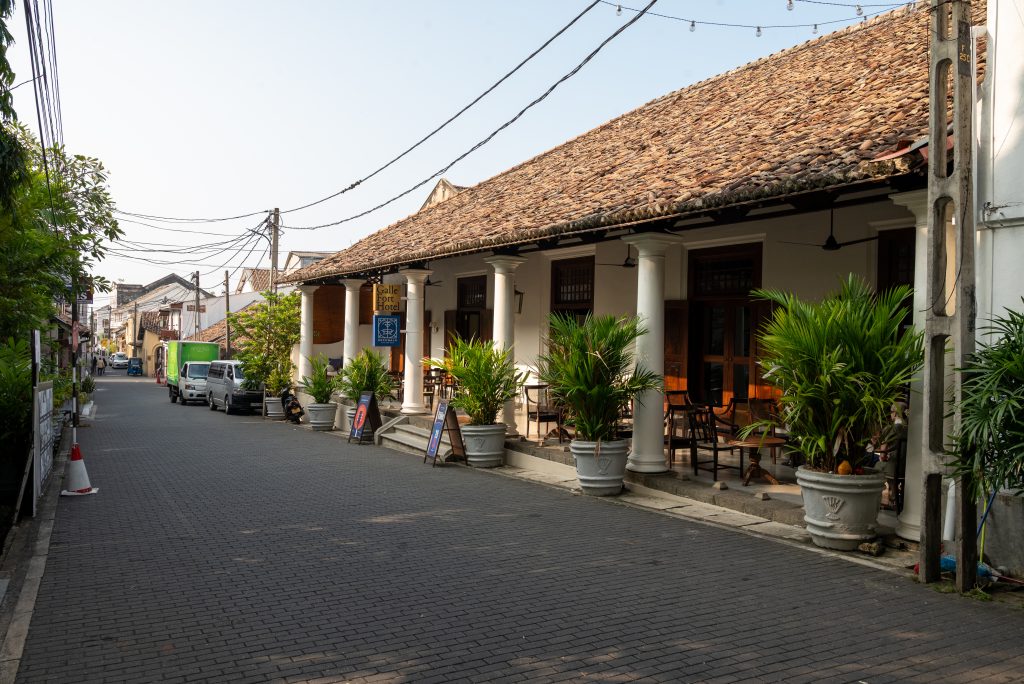
Three stone steps up to the hotel veranda from the street and from that same veranda level a further three up to our room. Choosing rooms would need a little care because most are up stairs in the upper galleries or down steps to the courtyard level. Those latter steps also meant that, for us, they had to be used to reach the pool. They have no handrail. Within the room (and the public areas) there are smooth stone or wood floors. The only potential hazard is the two steps down from the main body of our room to the en-suite which, for nocturnal visits to the toilet, requires a little care and use of a smartphone ‘torch’.
Eating Out in Galle
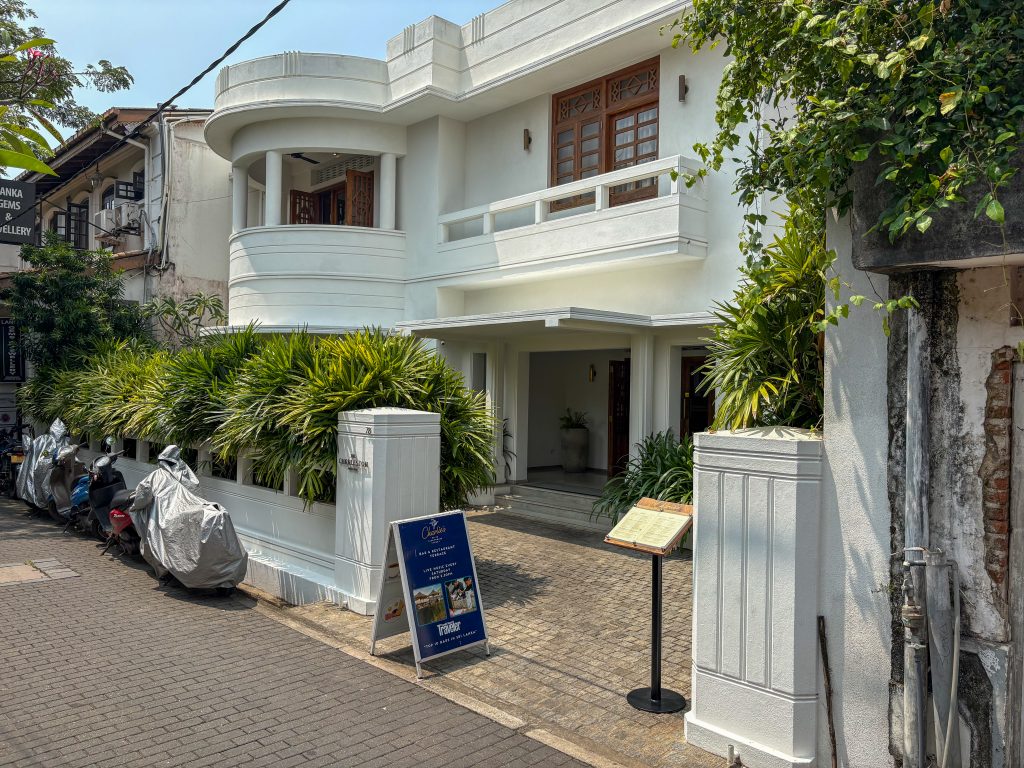
Charlie’s at The Charleston (https://www.wearecreativeleap.com/en/destinations/the-charleston/charlies).
Wandering around the Fort an architectural surprise was coming across two elegantly restored Art Deco style buildings, one of which houses this hotel and restaurant, where our travel advisers, Audley, had offered us a free dinner. The draw here is the fact the restaurant is on the roofless first floor patio that faces west out across the ramparts to the sea beyond. We went on a Saturday night and it was packed. We had to wait, briefly, for our table to be free. An aside is needed to set the scene. All the hotels and tourist restaurants in Galle Fort seem to provide live music on Friday and Saturday nights (our hotel and Charlie’s were no exception). Our limited experience was that what is on offer is Western popular music not any Sri-Lankan sub-genre or more traditional music. So at Charlie’s you had a torch singer. Unfortunately we found that the music was loud enough to inhibit our conversation. They have an indoor space to which we were more than happy to be moved and where we found ourselves the only diners. We proceeded to enjoy a very pleasant meal based on a modern menu that fed into the vibrant character of the patio location (‘small’ and ‘big’ plates, grills, flat breads and no Sri Lankan rice and curry). Staff were helpful and generally service was good, despite the fact we were set well away from the main action.
Mobility Access
There is no lift to the upper level, so a set of stairs has to be used to reach the restaurant. Otherwise no issues.
Colombo Coda
We had not intended to spend any time in Colombo. However, we had a friend doing a four-year stint out there and we met him for lunch and a chat that gave us another perspective on the country and the problems it still faces in stabilising inter-group conflict and its battered economy. As we met in the centre of the city it gave us the briefest glimpse of the feel of the place. Based on those highly superficial few hours, the city is unlike any other part of Sri Lanka. Coming into the city you pass along the main roads of several linked commuter towns all with their Sri Lankan variants on road-facing retail, then the cityscape becomes recognisably interchangeable with that of many another modern city centre, where sky-scraping office and residential blocks seem to overwhelm the older elements and the names of multi-national businesses appear against the towering glass façades. On a Sunday it was relatively quiet, except around the main transport interchange at Fort Railway Station. We were early for our appointment so, to freshen up and get a morning drink, our driver/guide dropped us at a hotel whose sheer size and vast glass-fronted lobby area could have been plucked from almost any modern city. And here we met security on a scale unseen elsewhere in this friendly island – a drive across an underbody scanner, a strange hand-held device poked through a car window (‘bomb detector’ says our guide) and, at the hotel doors, body and luggage scanners, used somewhat cursorily it has to be said.
Refreshed we headed off, still in the office/retail sector of the city, to where, almost hidden amongst the anonymity of surrounding buildings, sits The Gallery Café (https://www.paradiseroad.lk/content/7-The-Gallery-Cafe). It was originally the office of Geoffrey Bawa, the most renowned Sri Lankan architect, who fused modernist style with art and extensive use of natural elements. Here he created this single-storey building, with a series of rooms linked by open courtyards, that is now a pleasant restaurant. An lengthy menu that ranges across European, Indian, Thai and Sri Lankan cuisines provides the food.
Mobility Access
All on one level with only occasional steps up or down between courtyards and rooms.
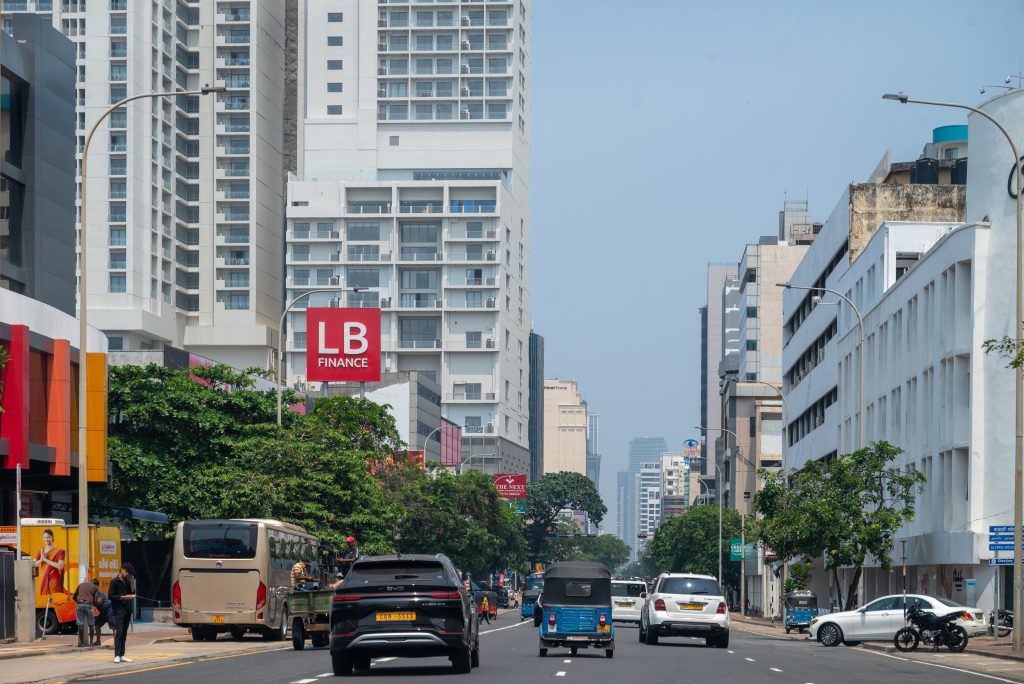
Our friend suggested coffee at the Galle Face Hotel after lunch. This is the self-declared grande dame of Colombo hotels, a sprawling edifice that has grown out of a Dutch colonial-era villa that was converted to its present use by British businessmen in the nineteenth century (https://gallefacehotel.com/). It feels loomed over by the towers around on two sides but, on the other two, presents views of a different Colombo. The terrace (The Verandah) where we take our place looks out across the sea, where the outlines of cargo vessels adorn the horizon, and on the other side of the hotel lies Galle Face Green, a large rectangular park of parched grass laid out in the nineteenth century, that sits between wave-worn rocks and the boulevard beyond. This park has remained untouched through the decades and is now a place for families to play and relax, fly kites and picnic. The Verandah was a pleasant place for a sit and a chat over our coffees and tea giving us our penultimate dose of the island’s colonial past.
Mobility Access
We only ambled through the ground floor of the hotel and any changes of level were minor and my assessment is made on that basis.
Last Night: Uga Riva, Negombo (1 Night)
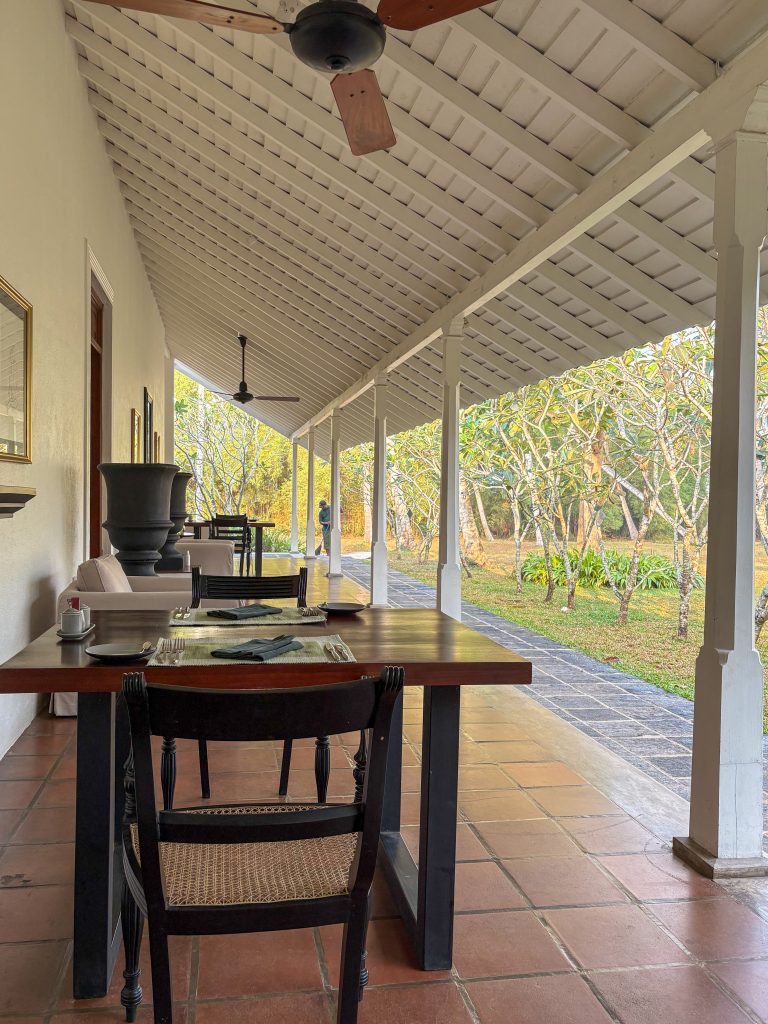
With a mid-morning departure from the airport which is just on the edge of Negombo, Audley had found this delightful ‘manor house’ (https://www.ugaresorts.com/riva/), a 25 minute drive from the airport, for our last night. Straggling out of Colombo we had run through Negombo town (known as Little Rome because of the large Roman Catholic majority population) and turned into a suburban side road. Here, quite unexpectedly given the surroundings, lay a white walled compound housing a carefully-tended garden and this well-restored, single-storey house dating back to the middle of the nineteenth century. The ambience, style and offer is similar to that of its hill country cousins. A final Sri Lankan rice and curry dinner and breakfast taken on the table set in the arcade outside our room, a final swim in the pool, a final arrack cocktail taken at their outdoor bar and a peaceful night whose only worrying aspect was our concern about the impact on our flight of the conflict unleashed on the Gulf less than 48 hours earlier. And, thankfully, that quiet airport the next morning and our flight home unaffected except for that relatively minor re-routing.
Mobility Access
No real concerns with only the odd step or two within the hotel to deal with changes in height between patios, entrance drive and public spaces. There were three steps up from the arcade outside the room but within all was flat and smooth.