Prelude
A land long on our bucket list, renowned as a land of forest and lakes, of reindeer and endless days and nights, an empty land (similar to the size of Great Britain with only fourteenth of the population), yet this was a trip of where we chose not to seek out that renowned land. Instead this was a trip that delved into the variety of urban Finland, its culture and its built environment. A delve that unlocked for us its fascinating history as a nation barely a century old emerging from the shadows of warring empires. Those empires were of Sweden and Russia, who lorded it over the landscape for several centuries and one of whom, on their eastern border, still casts a shadow on the country’s political actions.
Yet that shadow dissolves in the reality of the three cities, vibrant centres of modern urbanity with all the culture, gastronomy and life that, for us, makes cities such affirming places to spend time. The long days and brief nights of the short summer brings a human bloom to the streets as squares fill with temporary food and drink stalls and stages for live music and as urban beaches and funfairs fill with families in the sunshine. Thus this was a sojourn to the coastal centres of the new capital (Helsinki) and the old one (Turku). Sandwiched between them, Tampere, once known as the Manchester of the north because of its textile industry, now the second city of Finland set inland amongst the lakes and forest that cover vast swathes of the country.

Structure of the Trip
A country with which we were unfamiliar meant calling upon the services of a specialist to help us. Baltic Travel (https://www.baltictravelcompany.com/finland-holidays/) provided the expertise to guide us in planning a bespoke trip, undertaking all the booking of flights, hotels, inter-city transport and a private guided river trip. The benefit of using advisers came to the fore when a 24-hour strike by the staff of Finnair’s ground handling services meant a day’s delay to our homeward flight. No real hardship for us as it gave us an extra half-day and night in Helsinki. The trip was developed as a 4-4-4 visit giving us the same number of nights in each city, with that extra night tacked on the end.
Travel between cities was by train and, within the cities, the efficiency of the public transport systems and the easy availability of taxis (on the street and online) was such as to render redundant the need for our own car.
Getting Around – Planes and Trains
Flights
Helsinki is a near three hour flight from Heathrow and, as has become our practice, we flew business class. This seems to be one of Finnair’s premium routes because the wide-bodied Airbus 350 meant a business section with full-on, pod seats of the sort we normally encounter only on long-haul flights. It was one of the best we have been on in recent times.
There is a sense of repetition about saying that, for those with mobility constraints, Heathrow Terminal 3 is not the easiest one to access by public transport (the distances to be walked below ground from Heathrow Central railway station are the issue here). We chose to be delivered to the Terminal doors by taxi. Once inside, the recent welcome improvements to the Mobility Assistance service are apparent once again (see Air Travel from London) which, for us, meant a wheelchair is handed over to us to allow us to self-push from the Departure Hall facility to the door of the plane via such stops airside as we choose to make. In Helsinki our wheelchair is at the door guided by a chatty person who belies the stereotypes we have been fed that Finns are private, reserved individuals. A stereotype that is given further lie to by the garrulous, informative driver who is waiting in the arrivals hall to take us to our hotel (part of the arrangements organised by our travel advisers, arrangements that meant I can offer no guidance on other means to get from and to the airport).
Trains

As those who have read other posts will know, we like trains. Travel times between the three cities are relatively short (between 1 hour 30 minutes and 2 hours) but give us the chance to take in the scenery of the triangle of land in the south-west of the country. Trains vary. The trains we used were the double-decker ones that require a few steps down to the lower and a few more to the upper levels. There are luggage spaces and the racks above the seats are deep enough and high enough to allow full-size suitcases to be hoicked up there (we needed to do this because some trains were busy, with luggage spaces full by the time we boarded). They also have some Italian-built Pendolino trains which, anecdotally, we were told were problematic because they were not built to cater for the severe cold of Finnish winters, although I can find no hard evidence of this assertion.
They suffered the sort of issues that affect rail lines the world over: the downing of overhead cables and the need for infrastructure maintenance, to give examples that affected us. The former gave us a disrupted journey from the capital to Tampere. Information in English on departure boards and in announcements led us to take a visit to a busy ticket office on the concourse where, despite the numbers, a ticketed queuing system and five or six operating desks meant that they rattled through us waiting would-be passengers pretty quickly. A train re-booked for later in the day meant no more than we could have a peaceful lunch in the splendour of the Café Höijer in the Ateneum (see below) and an arrival in Tampere in the late afternoon. The latter meant that we knew in advance our ‘train’ from Turku back to the capital was to be by coach, a journey in a nearly new vehicle that was more comfortable than my experience of such rail replacement services in the United Kingdom. It took only a few minutes longer than the two-hour train ride. The mobility access points applicable to the individual stations is covered in the relevant city sections below.
Weather

The Finnish summer is short and our trip was at the very beginning of that summer (early July). Daytime temperatures hover around 18-25°C (64-77°F) dropping to around 10-14°C (50-57°F) at night. Sunny days are not a given, but they predominated during our stay, coupled with a few overcast ones and one or two where rain broke from those clouds. The Finns make the most of their limited sunshine and sun draws the crowds to their lakeside and seaside beaches, their city squares and parks but you need to come prepared for occasional rain and an evening chill (or a chill if you are out on the open water, even when the sun is shining). For us it was ideal for our urban activities, not too hot for the aimless strolling we enjoy but warm enough to sit out occasionally taking that drink and watching the world swirl past. When the rain came there were plentiful galleries, museums, shops and public facilities to draw us in.
Time Zone
An unproblematic two hours ahead of London time but a slightly more awkward seven hours ahead of Eastern Daylight Time in the USA.
The days are long with nearly 18 hours between sunrise and sunset which means there are less than two hours of full darkness each night. Blackouts on windows become an important consideration in hotels if your sleep can be disrupted by light.
Reading
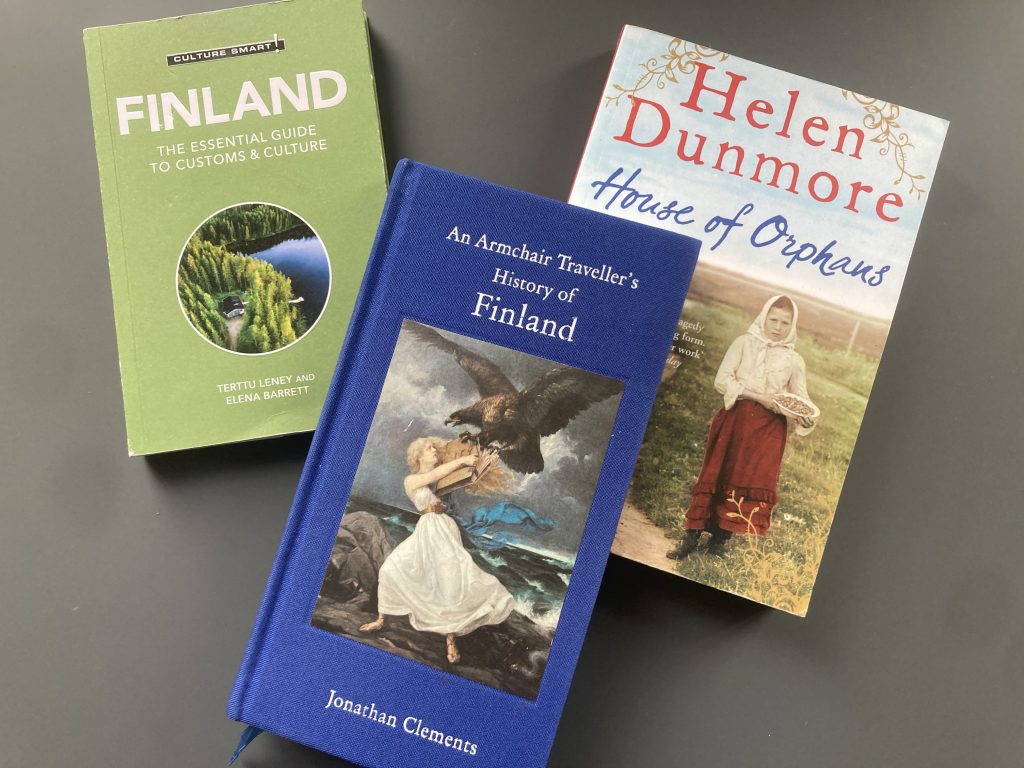
House of Orphans by Helen Dunmore ( https://www.waterstones.com/book/house-of-orphans/helen-dunmore/9780141015026)
Set in the Finland of the later years of Russian control (1902) this novel explores the societal and political dynamics of the time through the lives of two young people drawn into the fringes of the Finnish nationalism that was then starting to find a voice. It is an affecting, well-constructed narrative that does not lose sight of the emotional tensions for individuals that are at play when the guiding political philosophies of the twentieth century were starting to make themselves felt. It also helps you understand the way Swedish, as well as Russian, cultures imposed themselves on Finnish society.
Finland (The Essential Guide to Customs and Culture) by Terttu Leney and Elena Barrett (https://www.culturesmartbooks.co.uk/europe/finland.php)
Part of Culture Smart’s series that seek to give visitors an insight into a country’s culture, this fulfilled their aim of providing a straightforward and entertaining look at the Finns, their culture and their land. A small, pocket book size made it an easy traveller’s read.
An Armchair Traveller’s History of Finland by Jonathon Clements (https://www.hauspublishing.com/product/an-armchair-travellers-history-of-finland/)
This small, short (175 pages) book was an equally enjoyable and straightforward companion book to the Culture Smart one. As well as a straightforward historical introduction, it contains some useful chapters on eating and drinking, books on Finland and by Finnish authors as well as a simple gazetteer.
Finnish Quirks
Quirks is a slightly unfair word to use as what we are talking about here are features of visiting Finland that, I hope, might be useful to know something about before you arrive.

Language
I have seen it said that the stereotype of the Finnish language, as being one that is complex and difficult to learn and pronounce, is misplaced. As an English-speaker, with limited other linguistic skills, I knew this was going to be wrong when our driver from the airport in Helsinki told us that Finnish has sixteen grammatical cases (Latin has a mere six and English has, in everyday usage, only three). It is a language whose roots may be in central Asia (https://finland.fi/life-society/where-does-finnish-come-from/) but certainly has no obvious relationship with either Scandinavian and other European languages or with Russian. It also shares a propensity with Germanic languages, for words stitched together that, in English, would be separate nouns and adjectives. Add into the mix an extensive use of accents and words with a doubling up of the same vowels (‘aa’, ‘ii’ and ‘öö’ all make regular appearances) and I lost the will to begin to try using even the simplest phrases.
Swedish is also one of the country’s two official languages but is only the first language of about 5% of the population. For this reason Swedish appears, alongside Finnish, on most public notices or, more confusingly for people like me, on road signs. It takes a while to recognise that Åbo and Turku are the same city, as are Helsingfors and Helsinki. Thankfully for the linguistically-impaired traveller, all Finns are taught English from age eight and are saturated with American TV and movies. In the cities you will never have any difficulty reading menus, communicating with people you interact with at all levels, reading information and wall texts in most museums and galleries and working within Finnish websites and transport apps.
Costs
“Oh, isn’t it expensive there” is almost the first thing many people say when you mention you have been to Finland. A couple of points here. We live in London. Enough said. Yes, my perception is that it is more expensive than, say, the Baltic states just south across the Gulf of Finland and several other European cities. It is not a place you come for a cheap and cheerful weekend to drink and party (although that has not stopped a proliferation of bars, pubs and fast-food eateries), but the cost of living reflects a people that choose to pay the price for a supportive civic society where many public services that cost money in other countries are provided free by the state. Whatever you may think of the way such things are assessed, there must be a reason Finland has headed the list of the world’s happiest countries for the last eight years (https://worldpopulationreview.com/country-rankings/happiest-countries-in-the-world).
Food

I seem to be mentioning stereotyped characteristics a great deal in this piece and another one is that Finnish cuisine is bland, simple and uninteresting. Another wrong one, at least if you are eating in hotels and restaurants that have pretensions beyond fast food. I can report that there is no shortage of fast food for those who prefer to head in that culinary direction – like in so much of Europe burger places rub shoulders with pizza and kebab eateries along with a variety of other ethnic offers from around the globe. But for modern Finnish-based food there are plentiful options from straightforward more traditional dishes, both meats like beef, reindeer and pork and fish, including herring, salmon, pike-perch and Atlantic char, alongside vegetarian options (stuffed cabbage rolls is a particularly regular feature) through the delicious open sandwiches, which are a relation of the Scandinavian smorgasbord, and on to top end cuisine that bears comparison with the best.
Drinks measures
A minor quirk for us UK dwellers who are used to our small 25 ml (0.8 fl oz) measures for spirits. A requested double whisky was a whopping 80 ml (2.8 fl oz). Beware or enjoy according to your taste.
Nordic not Scandinavian
We were corrected on this one by Finnish neighbours in London before we left. It is a Nordic country not a Scandinavian one. The latter includes only Denmark, Norway and Sweden. It was one of those corrections that immediately imprinted itself in our brains; a mistake not to be repeated.
Mobility Access to Visitor Sights

This is the first time I have been able to write a separate section as a pean of praise to information about access for those with mobility constraints. It has to be said that information about accessibility on Finnish websites is so far beyond that available on many other websites that it boggles the mind that more institutions around the world have not followed their excellent example. To be fair, an increasing number of others do. In any case, just click on the relevant section on the website of a museum, gallery or attraction and, in most cases, you will find comprehensive information to assist you. This will include information both on the availability of wheelchairs and portable stools, accessibility routes and on the nearby transport links. Please take heed, those institutions whose websites do not contain such information.
Museum Card
I mention this, despite having no experience of it, simply because if you were visiting, as we were, several cities on a trip to Finland, it starts to look like a real bargain. At the time of writing it costs €86 for one year. This seems a lot but when you consider that it allows free entry to over 250 venues (churches and other sights as well as museums) and we visited nearly twenty different ones in 12 days where the entry costs ranged between €8 and €22, it starts to look like a no-brainer. Have a look – https://museot.fi/searchmuseums/.
HELSINKI

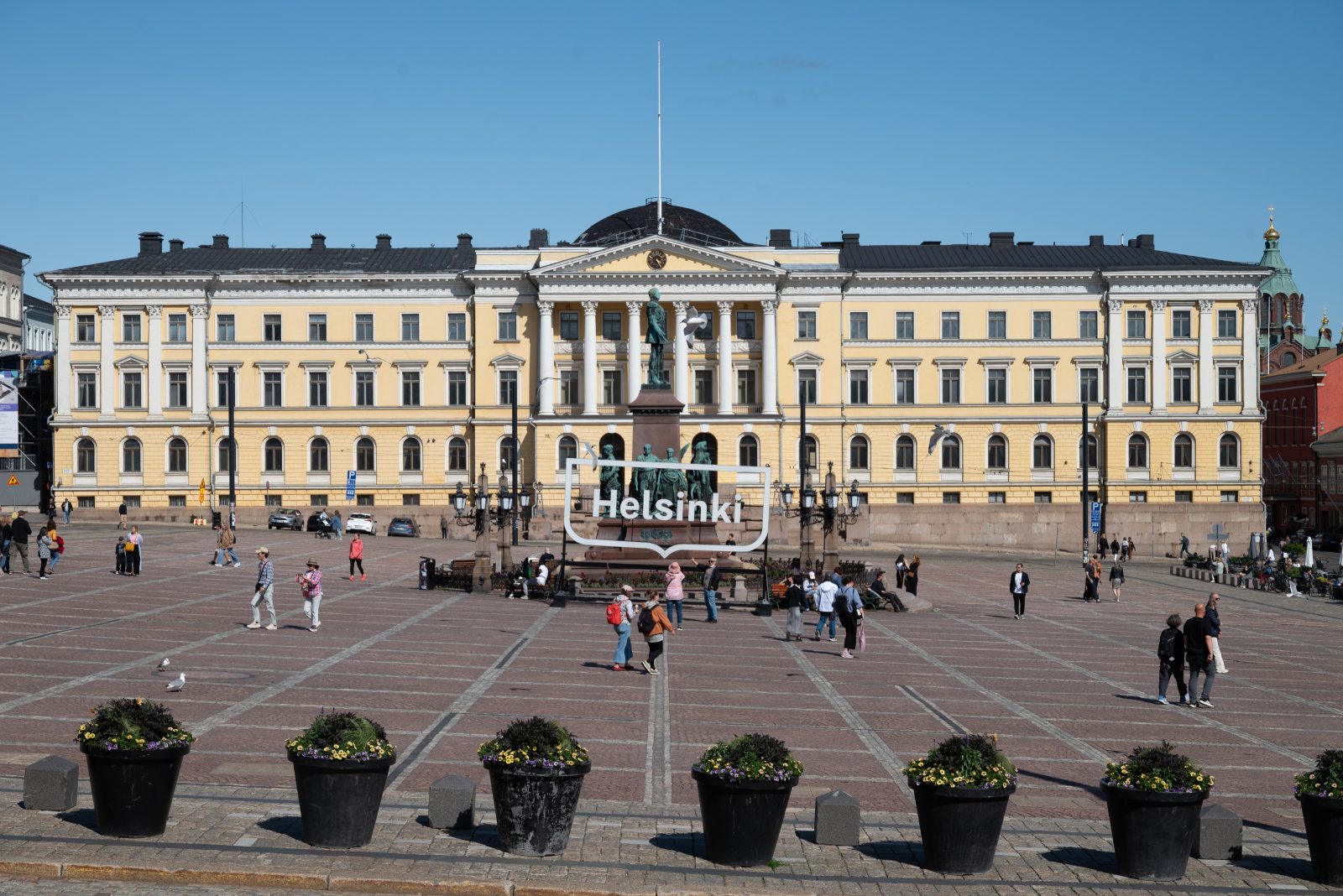
Helsinki had created in my mind an impression of a modern city, a city of clean Nordic design and of crisp air. It is these things, but the modernity has a different aspect. Until 1809 it was a small port town of around 3,000 people. Annexed after the Russian victory in yet another war with Sweden, its geographical location being closer to St Petersburg than Sweden’s designated capital of Åbo (Turku), it became the capital of the autonomous Grand Duchy of Finland within the Russian Tsarist Empire. And the transformation explains why the centre of the city feels so similar to eastern European capitals; a pair of cathedrals that nod more towards Russian Orthodoxy than classical western models, a large central square that has the same open feel of similar squares in Russian cities like Novosibirsk, Khabarovsk and Ulan Ude with, as its central point, a grand statue (here Tsar Alexander II rather than Lenin) set in the huge, paved pedestrian space. But more unexpected and fascinating was the architecture of the early twentieth century, spreading out from its central area. This is dominated by the Finnish Jugend (or Art Nouveau style). Alongside landmark buildings, such as the Central Station, there are dozens of residential buildings that house a fascinating wealth of ‘ooh, look at that’ in the detailing. Spectacular modernity, from the 1970’s Finlandia Hall to the recently completed energy-efficient Oodi (Central Library), adds another facet to a varied cityscape. Pile onto this a selection of galleries and museums that would grace any a capital city and plentiful civic engagement with culture from rock music to contemporary arts and you have a city where our planned four night stay only allowed us to scratch its fascinating surface.
Places Visted
Ateneum Art Gallery and Café Höijer
Finalnd’s National Gallery is actually in three locations (https://www.kansallisgalleria.fi/en). This section, opposite Helsinki Central Station, covers Finnish art, principally painting, from the early 18th century up to the modern era. Mostly work by Finnish artists but there are a few works by other European painters such as Van Gogh, Cézanne and Munch. Up-to-the-minute contemporary art is at Kiasma – see below. As well as these works they have changing temporary exhibitions. Whilst we were there, there was an excellent exhibition highlighting the difficulties faced by women artists in the 19th century in practising their art, let alone finding an outlet for it to the wider public. There were striking works by artists whose names were unknown to us incorporated within a curation approach which encompassed the setting out of the fascinating history of long-neglected talents.

The building itself is a striking Neo-Renaissance one completed in the 1880s. Housing both a bistro and the Café Höijer (named after the original architect), the latter is in a resplendent room that is almost worth a visit in its own right.
Mobility Access
As in so many Finnish venues, no further explanation is needed beyond that given in the accessibility section of the website – https://ateneum.fi/en/arrival-and-accessibility/ – although I would just add that the Helsinki Central Station tram stops are only 150 metres across the paved streets from the entrance. If you choose to use the main entrance (the wheelchair access is at the back of the building) then just be aware there are just seven steps up to the entrance from the street level.
Kiasma
The second gallery under the Finnish National Gallery umbrella is, to give it its full name, Museum of Contemporary Art Kiasma. It sits on the southern side of Kansalaistori, a modern, landscaped and pedestrian plaza lying just to the west of Central Station. In contrast to its sibling it is very much a contemporary structure (1990s), all curves in metal and glass housing changing exhibitions of contemporary art, much of which seems to focus on installations, mixed-media and materiality, all with wordy explanations of intention; work I do not always find it easy to engage with. On the other hand, I do engage with this sort of modern architecture and had fun just wandering through the building.

Mobility Access
Again, no more need be added beyond this link to the website – https://kiasma.fi/en/visitor-information/.
Sinebrychoff Art Museum
This third location within the National Gallery stable is quite a different beast to the other two. A 19th century building designed as residence and office for the eponymous family, it became a space for the Sinebrychoffs to house their decorative art: paintings, furniture and décor. Completely restored in 2002, it now has the sort of grand house ambience that you find in the Frick in New York or the Wallace in London. It is set at the edge of a small park that rises up behind the house to one of those rocky knolls that are a feature of the Helsinki cityscape.
Mobility Access
See the website – https://sinebrychoffintaidemuseo.fi/en/opening-hours-tickets-and-getting-here/ – enough said.
Temppeliauko Church
Embedded in one of those aforementioned rocky knolls is this striking church, carved out of the rock in the 1960s (https://www.temppeliaukionkirkko.fi/en/index/nimi.html#ticketinadvance). The sunken, circular nave is a striking space in its own right, but they also hold regular concerts (see the Events page on the website). I just happened to arrive at the church during a choral performance of gospel and popular music (included in the cost of an entry ticket) that added to the enjoyment of the visit.

Mobility Access
The main webpage includes straightforward but complete information on this insofar as the interior goes. No mobility aids available but, as you will see from the website pages there are plentiful pews for sitting. The church is in the residential area about 1 kilometre to the west of the Central Station and, although the nearest tram stops (Hanken and Sammonkatu on the 1 and 2 lines) are around 250 metres away, there is a bit of a slope up the streets that lead up the knoll to be negotiated.
Finnish Museum of Photography
https://www.valokuvataiteenmuseo.fi/en
Out in the area around Helsinki’s West Harbour, this gallery is in a small part of a huge former cable factory now repurposed as a series of cultural and other venues. It lies in an area which, like London Docklands or New York’s downtown Hudson River frontage, has been repurposed with modern residential and office blocks amongst the revamped older dock buildings and, like them has, to my senses, a faintly bleak air. Being out of the way, the gallery is a peaceful, quiet place to visit. I have called this a gallery because the Finns have a propensity to call any cultural space a museum but, whilst there is a museum element to this space, it is principally of interest for its changing exhibitions of photography. When I was there were two exhibitions of recent documentary work, one of which was a harrowing series of very recent images taken within the Gaza Strip by a collective of Palestinian and other international photographers.
Mobility Access
The only missing information on the Accessibility page of the website is that the mentioned tram stop is less than 200 metres from the gallery. There is a small kiosk type café within the courtyard/atrium but there is no other café within sensible walking distance of the gallery.
Oodi (Helsinki Central Library)

Oodi sits on the east side of the Kansalaistori plaza that also houses Kiasma. Another startling piece of modern architecture, Oodi is a wood and glass, energy-efficient structure built in the 2010s. It is, without doubt, the most interesting library we have ever visited. It might seem odd to recommend a visit to a library but this really is an unusual space that includes a café, a restaurant, meeting spaces, chess tables and a cinema on the ground floor, and on the next floor workshops, studios for photography, recording, music and video work, all manner of printers, workstations and even a sewing space alongside a musical instrument lending library. On the top floor is the book library in a glorious single space with an outside terrace looking across to the Parliament Building (dating from the 1930s) on the opposite side of the plaza and park. Alongside Finnish books, there is an English language section that would put some town libraries in Britain to shame and a whole children’s section incorporating play and games areas and story-telling rooms. The totality is buzzing with users of all ages. We wandered around for some time just to take in the building, the uses and the users. Go.
Mobility Access
Look at the Arrival section on the website. The tram stops referred to are a little walk away over relatively flat, smooth, paved surface. That outside the Central Station on Kaivokatu is 350 metres and that at Lasipalatsi is 400 metres.
Old Market Hall (Vanha kauppahalli)
https://vanhakaauppahalli.fi/en/story/
From sublime modernity to 19th century stolidity, albeit repurposed for the 21st century. This harbour front building, opened in 1889, caters to locals and tourists alike from wonderful wooden-fronted stalls within the long narrow building. This is not a market in the more traditional sense. There are no stalls selling vegetables or fruit for the focus is on comestibles – butchers and fishmongers, wine sellers and delicatessens – that sell food to be eaten in their small café-like areas or as take aways. The place hums with people, with the eateries especially busy around lunch time.

There are near replicas of this market in both Tampere and Turku, with a similar focus and in buildings that were built at a similar time and in a similar style. As the press of tourists wielding smartphone cameras testifies, they are popular and well worth a visit.
Mobility Access
Well, a website that that does not cover accessibility, presumably because they did not feel the need. For this is a ground level space with only a low lip step to be negotiated to access the smooth stone floor within. The tram stops on Line 2, that are mentioned on the Contact Information section of the website, are at Eteläranta and at Kauppatori (the main square at the east end of Esplanadi) both less than 100 metres away.
Activities
Tram Touring
Those who have dabbled in my other posts will know of our affection for trams and the way that we use them to tour around cities, not just to visit the sights but to explore the farther areas of residential, leisure and business that can be such interesting facets of cities. Helsinki’s tram system offers plentiful options on this score. We criss-crossed the city on comfortable, modern trams that only filled up in the very central areas. We rarely go with a destination in mind, we just follow a route to the end of the line and return: down to the London Docklands-style West Harbour area, north-east out past the Olympic Stadium, north-west through to the genteel seaside at Munkkiniemi.

Mobility Access
This should be straightforward for the mobility constrained traveller but see the section below on Getting Around for more detail on this.
Walking the Streets
Helsinki is another one of those cities where the mainstream guidebooks glibly say it is best enjoyed on foot. As one who can walk around taking in the cityscape by eye and lens, it is very definitely that (at least during the summer months) but for those who cannot or whose walking is limited this is not a flat city. For my part I took as my walking starting point my regular online companion for city rambling, GPS MyCity. Their Helsinki page offers a number of options that I used as a starting point for longer rambles – https://www.gpsmycity.com/gps-tour-guides/helsinki-487.html.
Walk to Temppeliauko Church, walk to and through Kaivopuisto (the large park that leads down to the sea), walk from the harbour past Senate Square into the Kruununhaka district and, in each case, the walk involves climbing or descending the various rocky knolls on which Helsinki is laid out. There are flat, paved areas: up and down Esplanadi, around the main harbour and Senate Square, the whole area around the railway station and up past the architectural splendours of Kiasma, Oodi and Finlandia Hall to the small city lake of Töölö Bay (Töölönlahti) with its sandy beach and paddleboard rental centre.

Another flat, paved area to look around is that just west of the Central Station, the two squares of Lasipalatsinaukio and Narinkkatori. Here the two large flat squares sit side-by-side, the former housing the modern art museum, Amos Rex, its entertainment for the walker provided by its rooftop domes. As the museum is underground, these street level skylights, dressed in stone tiles, combine architectural interest with practical role as a play area for child and adult alike. In the corner of the adjacent square is a wholly different but equally visually striking building, Kamppi Chapel (https://www.kampinkappeli.fi/en/index/visitus.html). To escape the city’s bustle go inside and just sit. The quiet space bans the use of any photo-taking and noise-making devices.
However, as the city’s two cathedrals are located prominently atop two of the rocky knolls, walking up to either is no easy task. The glorious edifice of Helsinki Cathedral dominating Senate Square is a steep 50 plus steps straight up from the north side of the square and the red-brick, green-roofed Uspenski Cathedral requires an equally steep ascent of slopes and stairs from the harbourside below.
Mobility Access
This is a city with a relatively small centre that, with plentiful cafés for rest stops and a quality public transport system, enables some parts to remain within the capacity of those with mobility constraints. Although most streets and pavements are well-paved, some squares and streets have those brick cobbles which can be a bit troublesome for some. Just be aware of those and the walks up and down those rocky knolls.
Harbour Cruise

Several different companies offer harbour cruises and most offer a number of different options that run throughout the day during the summer months. They run from Market Square adjacent to the Old Market Hall at the east end of Esplanadi. Baltic Travel had pre-arranged to for us to take Stromma’s I hour 30 minute Beautiful Canal Cruise (https://www.stromma.com/en-fi/helsinki/sightseeing/sightseeing-by-boat/beautiful-canal-route/) which gave us a different view of the city and an extensive wander around the islands that pepper the seascape, many of which have smart summer houses dotting the wooded shorelines. It can get quite windy on the water and, as Helsinki’s summer temperatures rarely rise above 22°C (72°F) even with the sun shining, it can get chillier than you expect. Take a jacket, or more, for warmth if you are going to sit on the open top deck. They have a bar on the lower deck for drinks and rudimentary snacks.
Mobility Access
Access from the dock is across a solid metal gangway with handrails. Once you are on the boat there are a few steps down into the well of the boat and the lower, covered cabin. Access to the upper deck does mean climbing those relatively steep metal stairs you find so often on vessels. If there is any information on the Stromma website about accessibility, I could not find it.
Food and Drink
Helsinki’s Café Culture
Every European city now sports a café culture and Helsinki is no different. There are cafés galore including in most of the larger cultural and arts venues and in some shops. Starbucks are here in force, but we tried to winkle out some more traditional places.
Our favourite was Café Engel on the south side of Senate Square which was a typical European full-service place where you could go for coffee, tea and pastries or have a more substantive lunch (an excellent selection of open sandwiches ideal for a light meal). It sits in a building that was upgraded in the mid-nineteenth century, giving it a pleasing old-fashioned feel. There are some outside tables and others in an internal courtyard. The website is only in Finnish but there are English menus in situ and, naturally, the staff all speak English. We also tried Rosaberg (https://roasberg.fi/menu/), near the Ateneum and the Central Station. Whilst it goes big on coffee on the website, it feels more like a café/bar/restaurant inside and I thought the décor was slightly wackier than the vibe projected in the images. It was, however, a peaceful place to sit and write on a sunny weekday afternoon and the coffee and food on offer is good. There is a large section of outdoor tables.

Ravintola Kolme Kruunna
https://www.kolmekruunua.fi/en
Looking for traditional Finnish cuisine on our first evening we unearthed this enjoyable place in the guide book before our departure and pre-booked it. It is just a couple of hundred metres down the street from the Hotel Maria. Set in the ground floor of a residential block, it has a faintly old-fashioned feel in keeping with its traditional Finnish menu. It is busy with both locals and tourists, many in groups, but it does not feel overly noisy and the service is cheerful and effective. For what is meant by traditional Finnish food just look at their menu. With some variations you will find this type of menu in many such restaurants in the country and, with the exception of the ubiquitous stuffed cabbage rolls, you will find vegetarian options thin on the ground. It has the same sort of feel of solid, well-cooked fare that you once got in London chop houses and still get in many Parisian brasseries. We enjoyed the whole experience as our introduction to Finnish dining.
Mobility Access
Two steps up from the street to the interior is the only level change to be considered. We walked but the nearest bus stop (16 line) is only 75 metres away. The Snellmaninkatu tram stop (lines 6 and 7) is a 350 metre walk.
Savoy
This, by way of contrast, is a place for serious haute cuisine dining. Set on the eighth floor of an office block overlooking Esplanadi, it has views across the Helsinki skyline and an ambience in keeping with the serious nature of the high-quality cuisine. It lived up to the recommendation we had from some Finnish acquaintances of ours. Serious food (and wine) equals serious splurge territory, but this was a very worthwhile one-off.
Mobility Access
Access into the building from the street is just a few broad steps. There is a lift and there are no changes of level within the restaurant. The tram stops at both the east and west ends of Esplanadi are a 300 metre walk away.
Ravintola Sea Horse
https://www.seahorse.fi/en/restaurant-sea-horse
Set in the ground floor of a Jugend building in Ullanlinna, the upmarket residential and embassy area of Helsinki, this was very similar in decor, clientele and ambience to Kolme Kuruuna with similar busy old-style room, straightforward traditional Finnish cooking and plentiful, engaged staff. It was, for us, equally enjoyable.
Mobility Access
Straight from the street into the bustling room so no issues here. It is less than 100 metres from the nearby Kapteenkatu tram stop (on the 3 line).
Hotels
The Hotel Maria
Our home for the first four nights of the trip, this recently opened hotel is positioned as Helsinki’s ‘Grand Hotel’ in the European tradition of capital city hotels that date from the late nineteenth/early twentieth century. And it is a five star establishment with all the facilities of its ilk and a staff that are plentiful and ready to help out at each stage of your stay with an air of friendliness that does not tip over into obsequiousness. Our one quibble was with their approach to our room move issue (see Mobility Access). The three-storey buildings (for there are four set around an internal courtyard), also live up to the billing. Once army administration and civil service offices, the buildings date from the 1880s which means a suitably classical interior with high-ceilinged spacious rooms and understated but luxurious decor. The hotel sits a little away from Senate Square (Senaatintori) and Railway Square (Rautatientori) in the smarter district of Kruununhaka, an area of captivating six/seven storey Jugend blocks of flats with an eclectic mix of shops, cafés and restaurants at ground level.

A word of caution; currently it is an independent hotel (owned by a Finnish Olympic gold medallist) but I see from news pieces (and the Hilton website) that it is soon to be taken within the umbrella of the Hilton group under their Waldorf Astoria brand.
Mobility Access
In common with most Finnish websites for both cultural and hospitality venues, there is a straightforward section of the hotel website that explains the limitations imposed by the historical status of the buildings. We found that accessibility from street and inside was excellent once we had sorted out our room. We had requested a room close to the elevator. It was, but it was in a building linked to the main building that contained all the hotel’s facilities and street entrance by a second-floor corridor. That would have meant a walk to another elevator in the main building to get to those areas, rather defeating the object of reducing unnecessary walking between room and facilities. We were moved. The alternative was an excellent room in the main building, but in a lower category than the original. When we came to check out no reduction was made but removal of a bar bill we had incurred was offered in recompense. We felt that the way the staff member dealt with the issue was a bit hard-headed. It was the only fly in the ointment of an excellent hotel.
A more practical consideration is that, although the website says it is ‘in close proximity to…Senate Square’, that involves a 750 metre walk down and up and down Helsinki’s surprisingly hilly cityscape (a number of rocky knolls protrude up from the surrounding land). This means those with mobility constraints would need to get a taxi or tram (with a stop 250 metres along the street) to reach the more central areas of the city to the south and west.
Hotel Haven
(https://www.hotelhaven.fi/en/)

We had to find a hotel in Helsinki for one night because of our cancelled return flight and wanted somewhere more centrally placed than the Hotel Maria. A bit of online searching led us to this place only steps from the harbour frontage, the Old Market Hall and Esplanadi. It was just a 300 metres from Senate Square across level ground. It is a good choice if you are looking for a comfortable, well-equipped hotel in the core of the city. Perhaps closer to four rather than five-star category but that meant all the necessary facilities for a city centre hotel. The full service breakfast is taken in a grand old room on the harbour side with access a bit of a step from the main reception area. The dining options are part of the same complex but somehow separate from it. We ate in Victor’s Krog (https://www.victorskrog.fi/menu-1) which involved stepping across the internal courtyard and out onto the harbourside street before entering the restaurant. This was another example of an old-style traditional restaurant, very quiet on a weekday evening but with a very amiable host and another straightforward but enjoyable meal.
Mobility Access
Access from the street to reception requires walking up about 10 steps from the street level vestibule. There is a longer, more mobility-friendly route which we used for rolling our suitcases out to the street when we left. Beyond that there are lifts that can be used to access all parts of the hotel, including the breakfast restaurant, which is in a separate building facing the seafront. Finding the lifts to access the breakfast area can be a bit fiddly, so ask the staff for guidance. The nearest tram stop in Kauppatori is just over 100 metres distant. Access to Viktor’s Krog only requires climbing four external steps from the street level.
Getting Around/Away

My advice is to download the travel app of the Greater Helsinki transport authority, HSL. You just delete it when you no longer need it. HSL’s comprehensive website has all you would need to understand, use and buy tickets for the transport system (buses, trams, metro and suburban rail) – see https://www.hsl.fi/en/tickets-and-fares. For us tourists my suggestion is to buy a Day Ticket that covers the number of days you will be in the city. Just validate once on the bus/tram/train and pootle to and fro, as you will. You can buy through the app or, as we did, in a local newsagent next to our first-use tram stop (English spoken, of course). Unless you plan on visiting the other towns that form part of the larger Helsinki urban sprawl, just buy a ticket for zones AB. This covers anywhere the short-stay tourist is likely to want to go, including all the tram lines.
We only used trams, both for our touring and to get around the city centre, and, occasionally, the buses to reach destinations where there was no nearby tram stop. We did not use the Metro (there is, in effect, only one line that runs east-west across the city). Transport is generally very punctual. Indeed there is an entertaining cartoon series (Finnish Nightmares – https://finnishnightmares.blogspot.com) poking fun at Finnish character traits, one of which ‘nightmares’ shows the cartoon figure, Matti, looking at his watch showing 12.02 when the bus was due at 12.00. The caption reads simply ‘Public transport is late’.
Helsinki Central Station is a terminus and is in a decidedly magnificent Jugend building with a soaring main concourse hall. Worth a visit even if you are not using the trains. As to those who are using the station, the guide provided by that fount of railway wisdom, The Man in Seat 61 (https://www.seat61.com/stations/helsinki.htm), sets out all I think you need to know about the station.

Mobility Access
Trams run from low platforms at stops that, generally, offer step-free access. I say generally because there are some older style trams that require hoicking yourself up two or three steps to get in and out. Inside there are seats but, like in all cities, these can be at a premium in the rush hour and around popular tourist sites in the city centre. Buses offer relatively straightforward low-step access.
At Helsinki Central Station everything bar the odd facility is at platform level and there are no awkward changes of level to negotiate.
TAMPERE

Despite its industrial heritage, Tampere, is a thoroughly enjoyable city to visit and stay in. It lacks the grandeur of Russian Empire sections of Helsinki but the revitalised factory buildings, the bustling central square (Keskustori), the many museums and the striking location between two of Finland’s many lakes supported by another efficient public transport system, makes this a very worthwhile place for a visit. Yet again we were hankering for a longer stay than our four nights to make the most of what the city had to offer. We would also have liked to have had the chance to reach beyond the city’s spread to take in more of Finland’s lakeland interior, for which it seems to offer a good base. Like the other Finnish cities, the visitor’s website offers a helpful place to start your consideration of its offer – https://visittampere.fi/en/.
Geographically the centre of the city sits on a narrow neck of land between two large lakes to north and south. The northern one is 20 metres higher than the lower and the waterway between them cuts the city in two. The rapids (Tammerkoski) tumbling down that waterway, suitably tamed, provided the initial power source for the nineteenth century textile factories whose revitalised buildings still line its banks. The textile industry led a tenfold population growth over that century, an expansion that has then increased tenfold again over the succeeding century to reach its current level of 360,000. Tampere is also the self-styled sauna capital of the world (claiming to have the greatest number of public saunas of any city). And here is a confession. We did not try a proper sauna in this country, its home country but, for many, it will be a cultural experience to enjoy, just make sure you know what you are in for – https://visittampere.fi/en/articles/how-to-sauna/.
Places Visited
Moomin Museum
https://www.muumimuseo.fi/en/etusivu

Another confession. I really knew very little about the Moomins before this trip to Finland and certainly nothing about their author, Tove Jansson. However it is impossible to miss their ubiquity once you are here. Or even flying here, for Finnair’s movie offering includes Moomin cartoons. In Helsinki tourists swarm through the Moomin stores selling all manner of Moomin paraphernalia as well as the books (in English as well as Finnish and Swedish). We fell early on for the family and their odd collection of friends and a visit to this museum became a part of our itinerary. It helped that it is housed in the modern civic centre, Tampere Talo, that was only 200 metres along the street from our hotel. It was absolutely fascinating. Set over two floors the museum focuses on the books with a display area dedicated to each one. Tove Jansson’s exquisite original drawings are on display (she trained as an artist and considered herself a painter as well as an author). These sit alongside the frankly astonishing models (re-creating scenes from the books) crafted by her lifelong partner, the graphic artist, Tuulikki Pietilä. A video about her life and work is well worth the time as well. All the display texts are in English as well as Finnish. To my eyes it worked as a museum to engage both children (judging by the numbers there) and adults.
Tampere Talo is a multi-purpose events hall, exhibition space and hotel that sits alongside a small, wooded park and lake (Sorsapuisto) slightly to the east of the city centre. It has a shop and café/restaurant looking out over the park. The Tampere Talo’s own bus stop (lines 2 and 95) is right outside.
Mobility Access
The usual comprehensive Accessibility page is part of the website. You can reserve a wheelchair for use, and we did.
Viikinsaari

A complete contrast is this small wooded island which is part nature reserve, part leisure space and is reached, during the summer months, by a 20-minute ferry trip that runs across the lake from Tampere Harbour every hour – see https://www.hopealinjat.fi/en/viikinsaari-island/. On a warm, sunny summer day it was a lovely place for a visit with picnic spaces, restaurant and separate café, open air spaces for music and plays, playgrounds, a few wooden huts which you can stay in overnight, several small sandy beaches on the lake and short circular nature trails, the longest was 1.5 km (about 1 mile). It was busy but, in Finland, busy has a different meaning and a walk around the nature trail was a peaceful delight. Your first stop when you get there should be the Information kiosk to pick up a copy of the island map which shows what is where.
Also available online, we bought our tickets for the ferry at the kiosk on the harbour front and got on the next ferry to leave.
Mobility Access
The island has gently rolling slopes along its length. Walking around is quite straightforward for the most part on packed dirt, although the trails will get muddy in damp weather. Most of the facilities are clustered at the east end of the island where the ferry docks, with just a short, asphalted slope of about 30 metres up to their level. The boat has access direct from the docks at the harbour or the island jetty onto the lower deck with the usual nautically steep stairs to reach the open upper deck.
Sara Hilden Museum
https://www.sarahildenintaidemuseo.fi/en/home/visit-us

This was our fix of art in Tampere. Finnish art, collected over the last hundred years by the self-described ‘art lover’ Sara Hilden, is displayed (in changing exhibitions) in a modernist building completed in 1979. The building has a lovely lakefront setting amongst the trees with a café that looks out across a small sculpture park to the lake. For me the setting and building (and the video film of Sara Hilden’s life) were more engaging than the collection within, but for others it will be different. It lies in the park area to the north-west of the city centre known as Särkänniemi, more popular for the massive theme park, complete with ludicrous adrenaline rides, that sits all around. It is also the location of the 168-metre-high observation tower with rotating restaurant of which more below.
Mobility Access
The usual Accessibility page on the website does not make clear that there are, in fact, stools and wheelchairs on offer nor that the modern space is fully accessible. Not so the park outside which slopes down to the lake. There are buses (lines 2 and 14) that run to the leisure park but from the stops it is a rising and falling 400 metre walk along asphalted roads and paths to the museum. You can get taxis up to the front door.
Amuri Museum of Outdoor Life
https://www.amurinmuseokortteli.fi/en/frontpage

Once the whole of this area of Tampere, just to the west of the textile factories around Tammeroski, was grid-pattern street housing blocks built for the workers from the 1860s. Now a single block has been retained as an open air museum of wooden houses built around a courtyard with communal facilities (sauna, bakery, latrines and stores). It is a surprisingly small area and the houses are of four cramped rooms that housed up to five people (often a family with lodgers) around a communal kitchen – scarily small to modern eyes. There are plentiful informative texts with English translations. There is also a more spacious café set in one of the buildings.
Mobility Access
The ground surfaces within the block are packed dirt and there is a gentle slope up across the site. To get into the various buildings requires negotiating a set of about seven or eight wooden steps (with handrails) as the lower floor is built up above ground level, so you need to be able to climb them to see the interiors. Public transport is in Pirkankatu, the extension of Tampere’s main street, Hameenkatu, a walk of about 250 metres across a small park. On that street Tampere’s two tram lines (1 and 3) and several bus routes stop.
Nootti (Museum of Finno-Russian Relations)
https://www.museonootti.fi/en/frontpage
This relatively recently opened museum sounded fascinating to us history buffs. Covering the period from Finnish independence from the Russian Empire in 1917 to the present cagey situation with Putin’s Russia, it focuses on the ambiguous relationship with the neighbour with whom it shared a 1,300 km (830 mile) border during the Cold War, the Soviet Union. In an area quite small, is a very dense museum, for me, almost too dense. It may have been my frame of mind at the time, but I did not feel like wading through the plethora of information, audio, video, imagery and objects. There is a small shop of mostly Finnish books but no café in the building. It sits on an upper floor within the Tampere Worker’s Hall, now a conference and congress centre, that dates from 1900 but was extensively re-modelled in 1930, giving its interior a Jugend sensibility that feels somewhat sepulchral (I was the only person I saw in the gloomy entrance halls and grand staircase).

Mobility Access
For once a Finnish website contains no internal access information. As I say the museum is small and all on one level, but there is nowhere to sit within nor any café to provide a respite within the building. The access inside is compromised by the fact the lift only stops at the half-landings, so reaching the museum involves climbing up a flight of stairs on that grand staircase. The website does provide detailed information about reaching the building from public transport stops.
Activities
Tram Tours
Tampere only has two tram lines but the tours through the outer reaches of the city (and its centre) made for a thoroughly enjoyable couple of tours. Line 3 took us east and then south into and past the university areas and an insight into a modern Finnish dormitory suburb. Line 1 was more entertaining, taking us west through modern light industry and warehouse areas and through a bleak-looking, open land with a solitary old factory all showing early signs of infrastructure installation and upgrading for apartments. It then curls round the lakeside to an area of new, low apartment blocks, sporting burgeoning local services, that crowd the lakefront.
Mobility Access
A nearly new system means low riding trams with no-step access to the trams and shallow platforms at the stops with gentle slopes for access.
Walking the Streets

Like Helsinki, Tampere’s recent development as a city means that the cityscape has evolved over a relatively short period, which is reflected in its cityscape. Thus the centre is a melange of nineteenth century architectural styles and the changing styles of the twentieth century with its focus being the civic and religious buildings around the main square, Keskustori. It is, like Helsinki, an ideal place to wander around, not necessarily with any destination in mind. On these walks I just wandered from sight to sight. On one day there was a stroll up and down the walkways along Tammeroski (the rapids), nosing into the now-restored factory buildings of Finlayson (a mix of shopping mall, museums, apartments and offices within the precincts of the largest of the former textile factories) and, on the opposite bank, Vaprikki (now home to natural history, postal & mineral museums and the (Ice) Hockey Hall of Fame and a few eateries) before heading past the grand Finlayson manor house and onto Tallipiha, the Finlayson stable yards, now repurposed as a rather twee set of wooden buildings housing gift shops and eateries. Keskustori, the main square, is all set up for the summer with an open seating area, a stage at one end and kiosks serving food around the fringes, was the starting point for a stroll up a small hill to elegant Tampere Old Church with its separate belfry and then along the main street to the Old Market Hall, a sibling to its Helsinki counterpart, before heading down to the town harbour.
If churches are your thing there is an engaging wealth in Tampere – https://tampereenseurakunnat.fi/en/lutheran_church_in_tampere/churches_and_chapels.
Mobility Access
Taken in bite-sized chunks most of the walking around Tampere should be manageable for those with some mobility constraints. The central area has plenty of stopping points, public transport and, unlike Helsinki and Turku is not as up-and-down hilly as the other two cities. But care is needed in the initial planning to see if short walks are feasible.
Food and Drink
Green Hippo
https://en.greenhippocafe.rocks/tampere-keskustori
Seeking some vegetarian/salad options we found this all-day place set, very handily, on the south side of the main square, Keskustori, (they have a few other branches in the Tampere urban area). Mainly vegetarian dishes in a straightforward setting. We ate there twice, one lunch, one dinner. Busier at lunch and almost empty in the evening, it does pretty much what it says on the tin – straightforward tasty and healthy, mainly vegetable-based food.
Mobility Access
Just a step up from the street to the flat-floored interior. Just outside the door, Keskustori houses the town’s main bus interchange, a taxi rank and, across the square, the eponymous tram stop.
Näsinnuela
https://sarkanniemi.fi/en/naesinneula-restaurant

This is both the rotating restaurant atop the observation tower and the name of the tower itself which is out at Särkänniemi (see Sara Hilden Museum above). We were attracted by the novelty but were delighted to find that the food was of very good quality. The menu is short, but vegetarians are catered for. It was oddly quiet the night we went, only about ten other diners in a very large space but that we found pleasingly peaceful. And the view, on a bright, sunny near midsummer evening, was astonishing. Not only is Tapmpere set out below you (as is a bird’s eye view of the stomach-churning roller-coasters in the theme park) but you see the spread of Finland’s lakeland and forest laid out on all sides, giving a real sense of the wide-open, glacier-flattened landscape of the country. The entire scene rolls very slowly past (twice during our meal). A memorable evening.
Mobility Access
A lift up, of course. Once inside a flat level floor and the rotation is so languid that stepping onto the moving section is not a problem. Access to the tower by public transport is by the same buses that serve the whole park (line 2 and 14). It is then a walk up the road of about 300 metres. We took a taxi, ordered for us by our hotel reception and, arriving very quickly, that dropped us at the tower entrance.
Hotel: Lapland Hotels Tampere
https://www.laplandhotels.com/en/hotels-and-destinations/tampere/lapland-hotels-tampere
Run by a Finnish group, whose primary focus seems to be on hotels and resorts in the northern section of the country, this friendly, bustling 4-star hotel worked extremely well for our stay in Tampere. Set in a bland, modern seven-storey building, inside the décor reflects a plain Nordic design with an almost cosy, Lapland-esque feel (occasional antlers on the walls, darker stone amidst the glass and metal). The room was very straightforward and suited to our needs in a city location. The staff were, for the most part, friendly and helpful if, very occasionally, slightly absent in the restaurant when you needed service. The restaurant, Dabbel, was actually useful to us (we ate dinner there twice) with really rather good Finnish-menu food. The breakfast was a very extensive buffet.

Mobility Access
As befits a modern building there was good access internally with a slope, as well as steps, up to the entrance. The ground level floor had several changes of level but slopes sat alongside steps for the most part, although, oddly, accessing the breakfast buffet area could not be achieved without having to go up about five or so steps.
The Tulli tram stop (lines 1 and 3) and the Tampere Talo bus stop (lines 2 and 95) are both about 150 metres away and both give quite speedy access to the city centre. Alternatively, for walkers, Keskustori is about 1,200 metres distant and the main train station is closer still, about 450 metres.
Getting There/Around
We arrived and left by train. The journey from Helsinki is just over an hour-and-a-half and that onward to Turku around two hours. Tampere main station is a through station with the concourse sitting below the platforms and tracks. Lifts serve the platforms. The main entry point is on the west side with tram, bus and taxis nearby. It is quite centrally located, only being about 750 metres from Keskustori.
Within the city your starting point is the website of the public transport service, Nysse, and, once again, I suggest downloading their app – https://www.nysse.fi/en/front-page.html. As in Helsinki the public bus and tram network is efficient. The tram network is limited, just two lines, one heading west, the other east from their intersecting stops around the railway station. A slight oddity is that it is not easy on first acquaintance to distinguish bus lines from tram lines on the website. The trams are lines 1 and 3, yet line 2 is a bus route. The app downloaded, we bought our tickets online. As in Helsinki, it is probably best to buy day tickets for Zones AB for each day of your stay, unless you are not planning to use the trams/buses regularly. With day tickets €8 at the time of writing, you need only need take three trips to make it cheaper than buying tickets as you go.
TURKU

The oldest city in Finland has a history as such going back centuries longer than the other two cities that we visited but, because a great deal of the historic centre was devastated by fire in 1827, the city has a rather eclectic cityscape. Here, there are just as many fascinating museums, historical sights of far greater interest and antiquity, a rich maritime history and an almost Parisian river frontage that neither of the other cities can match. In part, Turku suffered because, once the Russian Empire had gained control of Finland in 1809, the Russians sought to diminish the effects of several centuries of Swedish control of the country. In the midst of this political pressure, the destruction of much of the city in the 1827 fire meant the Russians could more easily move government institutions to their new capital, Helsinki. The result is that some parts of central Turku can feel less coherent than the other two cities with ultra-modern architecture sitting alongside nineteenth-century Empire buildings with the older sights like the cathedral and castle spread around the city. Yet it remains a true city, bolstered by its history as a port extending into the 21st century. It is the departure point for the shortest sea crossing to Stockholm and remains a centre of a shipbuilding industry that has recently seen the construction of the largest cruise ships afloat – https://yle.fi/a/74-20162872. In many ways it is this melange of ancient and modern that makes it such an interesting place to visit and we managed to pack in quite a lot.

On a lot of the websites with links given below you will see reference to Föli. This is the Turku urban public transport system of which more below.
Places Visited
Cathedral Area
The cathedral (in Finnish Turku tuomiokirrko) (https://www.turuntuomiokirkko.fi/english) sits in the oldest part of the city. It was consecrated in 1300, albeit the building has had various accretions over the succeeding centuries and had to be substantially re-constructed after Turku’s great fire. And, like Helsinki, the city of Turku sits amidst a number of rocky knolls. The cathedral stands on one of these, in quite a striking position surrounded by trees and above a broad, cobbled plaza itself set in wooded groves beside the Aura River. Entry is free, unless you want to gain access to the small museum which, for me, is unnecessary to the enjoyment of the Lutheran austerity of the grand interior. In the summer months a series of food stalls with outside tables and chairs are set up on the west side of that plaza for that coffee, lunch or that salmari (https://herfinland.com/finnish-drinks/). The whole area has a sense of peace after the bustling parts of the city just across the river. On two sides of the roads circling the knoll are elegant nineteenth century buildings housing parts of the University of Turku and the Court of Appeal.

Mobility Access
If you arrive at the base of the cathedral knoll, you can find yourself faced with two wide flights of stone steps, the first of 20 and the second of 9, with two more steps to reach the door. There is a small café, open only in summer, tucked into the church at the level of the first flight of steps. From the south side you can walk up a gently sloping path to the same level as the café. There is a wheelchair access round on the north side of the church accessible by car – see the cathedral’s Contact and Accessibility section on their website for details. Inside is a stone paved floor, largely flat with the odd step up into side chapels. A point to be aware of is that the whole of the plaza and the pavements (sidewalks) alongside the fringes are of brick cobbles which can create difficulties in joints for those with walking constraints. The Tuomiokirkkotori bus stops (lines 2, 3, 5, 6 and a range of other routes) are on Aninkaistenkatu, the main road which bisects the small riverside parks below the cathedral, a walk of 130 metres to the base of the steps.
Sibelius Museum
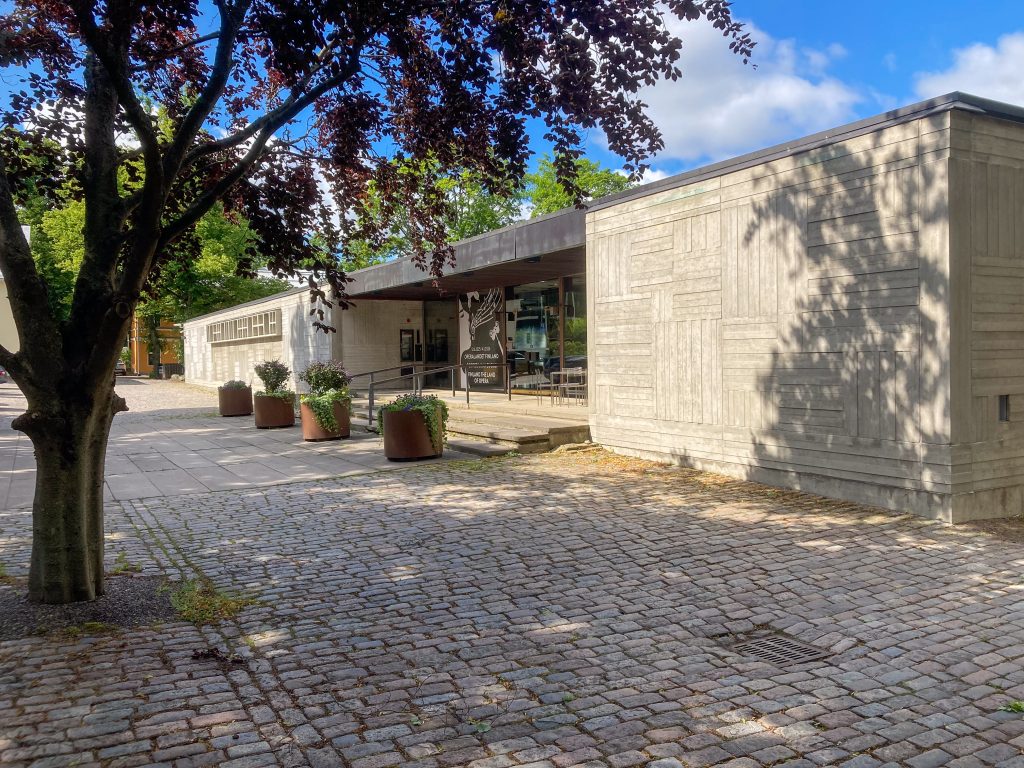
Piispankatu, the street that runs north out of the cathedral plaza, continues a run of elegant buildings of the Russian Empire period that gradually start to mix with the modernist style of the later university buildings. The wooden façade of Et Heem Museum (home to an art and furniture collection of the owners who bequeathed it to a university foundation) is opposite (in physical and architectural terms) the Sibelius Museum (https://sibeliusmuseum.fi/en/). The current building, dating from 1968, is a concrete and glass structure housing both an exhibition of instruments and an exhibition covering the eponymous composer. Classical music buffs will find the small but exquisite museum well worth a visit, particularly if you can catch one of their regular concerts of chamber music.
Mobility Access
With the caveat mentioned above about the brick cobbled roads and pavements, the website’s ‘Come visit us’ section covers most issues. Inside stools are available for use and there are seats around the exhibition; especially useful for sitting and listening to the extracts of music that are part of the displays. The entrance is only about 250 metres from the Tuomiokirkkotori bus stops that also serve the cathedral.
Aboa Vetus
This is part of a duo of cultural buildings that sit on opposite sides of the street (Nunnakatu) adjacent to the river and in the same older part of the city as the cathedral, but a little to its south-west. Aboa Vetus Ars Nova (https://avan.fi/en) to give it its full name, twins two seemingly unrelated elements, archaeology and contemporary art, in a building that was originally built as a grand private residence in 1928. Plans to move a contemporary art collection into the building were extensively revamped when the remains of many buildings from Turku’s medieval past were unearthed during the work. As a result the area under the gardens of the villa has been turned into a fascinating archaeological and historical exhibition detailing Turku’s development as Finland’s main city alongside the displayed remains. For those that know the way the Roman remains that lie beneath London’s Guildhall have been exposed and displayed, the museum has a very similar feel. As intended the two lower floors of the 1928 villa have become spaces for changing exhibitions of contemporary art; whilst we were there one of photography in the new ‘white cube’ gallery rooms and another of installation artworks that spread across the previously domestic spaces on the upper floor. A cleverly crafted modern entrance leads into the ticket desk/shop/restaurant area.

Mobility Access
The usual comprehensive Arrival and Accessibility page on the Aboa Vetus website. The entrance is a bare 300 metres from the same Tuomiokirkkotori bus stops that service the cathedral via a largely pedestrian/cycle road along the tree-lined riverbank (with flat tarmac or paved surfaces).
Taiteen Talo
The simple elegance of Aboa Vetus finds a contrast in Taiteen Talo (Art House Turku – https://taiteentalo.fi/en/) a seemingly jumbled collection of performance spaces, exhibitions, events, artists’ studios and the inevitable café all set in a former tobacco factory. The buildings were constructed across the late 18th and early 19th century and the whole still has an industrial, slightly distressed sensibility. Even the entrances seemed low-key and signage in the site was not always clear. Nonetheless it was an interesting space just to wander around, almost not knowing what you might come across.
Mobility Access
The Taiteen Talo website is, unusually, less forthcoming about accessibility. The three and four storey buildings seem to be linked by concrete internal stairs and goods-style lifts, not always easy for those with mobility constraints, the more so given the central courtyard, which the buildings fan off, is of those brick cobbles that are a feature of the older city’s streetscape. The same access from the Tuomiokirkkotori bus stops as Aboa Vetus.
Turuun Linna (Turku Castle)

A trip along Linnenkatu (loosely Castle Street) on the 1 line bus from the city centre takes you past three different and enjoyable sights. Nearest the end of the line is the city’s castle, founded in the 13th century and the oldest building in Finland that is still in use. So this is no ruin but a large, forbidding structure set on a small rocky knoll that once sat alongside the River Aura (at the point at which the river opens onto an extensive archipelago with the Baltic Sea beyond). Today the Viking Line ferry terminal sits on an intervening slab of reclaimed land which, for the most part, lies hidden by the trees that fill the small park around the castle. It remains a place where you can visit the extensive, restored interior, take a tour, visit the exhibitions and attend events as well as stop for a break in the cafê/restaurant in the large eastern courtyard.
Mobility Access
As you will see from the disarmingly honest and comprehensive page covering accessibility on the website (https://turunlinna.fi/en/getting-here/), this is not an ideal place for those with mobility constraints wanting to visit the interior and we didn’t. But what we did do was wander around the outside of the edifice and stick our noses into the great courtyard beyond the main entrance gate at the east end (nearest the bus stops). It is well worth your time. The bus stops are no more than 50 metres from that main gate and the park itself is a quiet haven with a number of benches to act as rest points.
Kakola

Half-way back into the city along Linnenkatu is this former prison, its various buildings now redeveloped into a museum (about its former incarnation as a prison), a café/bakery, a restaurant, a hotel, a spa, residential apartments and even a micro-brewery and bar. It sits atop a bluff that looks down on the river, but part of the fun associated with a visit is getting the modern funicular from Linnenkatu to the top of the bluff with views down across the river. Because it is part of the public transport network, the funicular was covered by our day tickets. We enjoyed just wandering around the site followed by a sit in the sunshine on the outside terrace of Bageri Å (https://bagerio.fi), the café/bakery. You can do tours of the prison run by the hotel – https://www.hotelkakola.fi/en/nae-ja-koe/.
Mobility Access
Once you are atop the bluff the entrance to the Kakola’s grounds is just across the road from the exit from the funicular and within the former grounds there are only gentle slopes to contend with and all surfaces are smooth hardstanding. The bus stops (line 1 and designated Kakola) are only steps from the lower entrance to the funicular which is fully accessible with no steps or slopes.
Forum Marinum
The final sight on line 1 is this sprawling maritime museum (https://www.forum-marinum.fi/en/), spread over two buildings and, across the wide quay, around ten vessels berthed on the river, including the ocean-going, three-masted naval training ship, Suomen Joutsen, and the combination museum and hotel ship, MS Bore. If you enjoy matters maritime it is an enjoyable place to spend half a day sauntering around, delving into the two museum buildings and exploring the ships. There is a large restaurant with a terrace of outside tables where time can be whiled away on the riverfront. I found that, like some other Finnish historical museums, the displays were very dense with more information than I felt I wanted to take in. There is also a positively surreal exhibit of dozens of outboard engines pinned to a double height wall like some display of lepidoptera.

Mobility Access
Parts of the museum, particularly the vessels berthed in the river, are a real difficulty for those with mobility issues. In addition to the climb up the gangplanks from the dock level there are those steep metal stairs to move between decks within (and for us tall people the challenge of low ceilings). The buildings are all recently revamped so, internally, there are flat surfaces and there are lifts to the upper galleries. There are few seats and, for once, the website has no information about accessibility or the availability of portable stools or wheelchairs for use (and I failed to ask). The site is quite spread out, so it is 400 metres from the museum buildings to the MS Bore and the same distance from that ship to the Suomen Joutsen. There are no benches or seats on the wide quayside area beyond the café terrace.
Turku Art Museum
North from the city’s main square, Kauppatori, the land rises up to another of those rocky knolls where a purpose-built granite building (completed in 1904) houses three or four temporary exhibitions. Usually one drawn from the museum’s art collection (from the nineteenth and twentieth century) and others of more contemporary artists. With the usual café and shop it is a well-presented and manageable museum and one we enjoyed all the more because of an exhibition of haunting ink wash paintings by contemporary Swedish artist, Gunnel Wåhlstrand (https://www.gunnelwahlstrand.com). The building is set in a small park, Puolalanpuisto, dotted with the occasional sculpture.
Mobility Access

We are back in the world of comprehensive website information about accessibility. In this case the information lurks on a webpage titled ‘Location’ within the ‘Visit’ section of the dropdown menu. Getting at the museum is another matter. Because it sits atop the knoll you have to climb up through the park from the nearest roads. That involves a walk up slopes or climbing a number of steps (at the front this means around three flights of stone steps to be negotiated). Our experience suggested taxis can only drop and collect from the nearby roads and the nearest bus stops (on the road outside the main railway station) are an even longer climb up steps of around 200 metres. There are plenty of benches in the pleasant park where rest stops can be made, if needed, and it is possible to walk up to the entrance using the sloping tarmac paths, if steps cause a particular problem. For us it was well worth it.
Activities
A Stroll across ‘Observatory’ Hill
I have put the hill’s name in parentheses because its official name is Vartiovouren (located within the puisto or park of the same name) which seems to mean both Spring Mountain or Guard Mountain. Set just above and behind Aboa Vetus, it is another rocky knoll amidst a peaceful, green space with steep slopes or stairs through the park to the small 1819 observatory that sits at the top. Unusually, once you reach the top there is not much of a view in any direction as trees block all the sightlines, just the simple Neo-classical structure and few other people.
Mobility Access
The hill is a non-starter for those with mobility constraints, the stairs up into the park from the north and east are lengthy and the slopes up through the park from roads on the south and west are quite steep 350-400 metre walks.
Walk down through the park and you reach the Luostarinmäki Museum Quarter (https://luostarinmaki.fi/en/home-page/), an open-air museum of 200 year old wooden houses built for what would nowadays be called blue-collar workers, complete with present day workers dressed in period costume demonstrating the life and crafts of the time. I did not go in (I just didn’t feel like it at the time) but it looks and feels more interesting than its smaller equivalent in Tampere, the Amuri Museum of Outdoor Life (see above).
Mobility Access
Another excellent accessibility page within the museum website to which I only add the fact the walk along the streets from the bus stop mentioned there (lines 4, 8 and 62) is just under 300 metres up a gentle slope.
Trip down the River Aura

Organised by Baltic Travel before we left, this was an hour-long, privately-guided trip down the River Aura on a small electric boat – just us and our guide. The boat was rented through Låna (https://www.lanaturku.fi/?lang=en#hinnasto), a café and boat hire operation on the riverbank opposite the cathedral. It may often have boats available on spec, judging by the fact that we were the only customers on a pleasantly sunny weekday afternoon. Having the guide meant we did not have to pilot the craft and, more importantly, we had someone to open a window onto Turku’s history and its current society and demographics. The history emerges as you pass buildings from each of the last three centuries along the banks. The boat came around at the old dockyard area, where the historical vessels (that form part of the maritime museum, Forum Marinum – see above) are berthed. A gentle, post-trip debrief can take place at the Låna cafê (a large kiosk with tables set out on the quay around it).
Mobility Access
If your balance is not the best, the only, very minor, point for care, is taking the step onto the boat from the jetty given the shift it makes under weight transference. Also, because Låna sits closer to the river level than the street above, you just need to negotiate a seriously cobbled slope of about 50 metres to reach it. However, at street level above this is the very pleasant plaza, Vähätori, which has a few café/restaurants with outside tables; a peaceful place for lunch or just to watch the world go by over a drink.
Food and Drink

Smor
This was very enjoyable and classy place. It is in a semi-basement with a carefully-crafted, straightforward, modern feel to the décor. Just two fixed menus (one of 7 and the other of 5 dishes) with a wine choice available for each. We found the food superb and delicately flavoured. Service was understated and quietly effective. The restaurant is in a nineteenth century building on the river with the entrance tucked, almost hidden, behind a modern grille gate.
Mobility Access
There are about six or so steps down from street level to reach the basement where the main dining room has a stone and partially carpeted flat floor. There are a number of alcoves in side rooms off this area which are reached by a few steps up or down (as are the toilets). The riverfront road seems to be for cyclists and pedestrians, so some taxis drop you on Kauppiaskatu, a short stroll of around 70 metres away. Others do seem to venture onto the riverside road and can drop you by the entrance gate.
Brahen Kellari
https://www.brahenkellari.fi/en
Although this claims to be one of the oldest restaurants in the city it is now in a rather mundane glass-fronted property. It is in a line of other eateries on one of the city’s main drags, Linnankatu (the one that heads 3 kilometres west to the castle), just along from the Turku Market Hall. The menu is that modern take on a traditional Finnish menu which, with interesting variations, echoes that of other Finnish restaurants we ate in. Good quality, tasty local food but with limited vegetarian options. Service was fine. It was quiet when we went (at 19.30 on a Saturday night).
Mobility Access
No issues here as the restaurant faces onto the street and all is on one level. The nearest bus stop, Kauppahalli Saluhallen, on line 1 and several others, is opposite the restaurant.
Grill It! (at Radisson Blu Marina Palace)
https://www.radissonhotels.com/en-us/hotels/radisson-blu-marina-turku/dining/grill-it-marina
This worryingly-named restaurant (suggesting an over-the-top steaks and burger place) crossed our radar because it proved difficult to find a reasonable restaurant in Turku that was open on a Sunday evening. As one might expect, the Radisson is a large, modern hotel but the restaurant’s location, on one side of the broad single space at ground level, faces out onto that lovely riverfront (with an outside terrace for use in warmer weather than we were having that evening). And, yes, it was grill fare, but there was sufficient variety within the menu to find something of interest (some dishes actually coming without fries) and the food was perfectly well-cooked. Better than we might have expected.
Mobility Access
As the building is a late twentieth century, slab building it has good accessibility. There are changes of level within the large ground floor space but it is only a few steps in each case. The non-river side faces Linnankatu (that road again) and the 1,9, 24 and 25 lines serve the Klassikonpolku bus stops which are right outside the hotel.
Hotel: Solo Sokos Hotel Turun Seurahuone

The hotel with the tongue-twisting name is part of a fairly extensive Finnish chain (Sokos Hotels) within their Solo sub-brand (slogan ‘unique and elegant’). It was a well-placed comfortable hotel in a rectangular five storey 1928 design building recently smartened up. We felt its facilities and qualities put it in the four-star range. The room had all we needed from a city centre place. The ground floor space held all the public facilities. The breakfast was the usual extensive buffet, but our one experience in the restaurant for evening dining gave us such slow service that it became distracting and I recall little about the food. Generally there was an inattentive air around service in the bar/lounge/restaurant area; there were rarely many people there in the evening and it felt a bit of an afterthought. The reception staff were friendly and helpful. It was very well located for us, offering several bus routes from stops on neighbouring streets.
Mobility Access
Although there are limitations because the hotel is in a heritage building, we did not find there were any material issues with accessibility. Access from the street to our room was on flat surfaces with a lift available. It is only 400 metres along a flat, paved street to the main square, Kauppatori and, en route, you pass the Old Market Hall (Turun Kauppahalli), another splendid old market, similar to those in Tampere and Turku.
Getting There/Around
We arrived by train and left by the rail-replacement coach. Turku’s station was, to our eyes, a bit oddly designed and I am still not sure to what extent a good bit more future development is planned. It is a through station with a smart, new overbridge linking the platforms to the roads/car parks on either side. It feels empty of staff or any facilities and I include in that ticket offices as well as more obvious ones such as left luggage, waiting spaces, cafés and the like. Certainly that was the view you got emerging on the city side to reach the poorly-signed taxi rank. On departure we found that, across the bridge, on the north side of the station is a large repurposed locomotive workshop called, Logomo. This is self-described as ‘a centre for culture, arts and creative economy’ which is what it looks like. What it does not look like is the building that also houses the station facilities, such as they are – look at this part of the website (https://logomo.fi/en/information/arrival) and click on ‘Train’ to find out what is there. No staff and no ticket office just a ticket machine.
Mobility Access
In practice this is fine because surfaces are flat and there are the lifts, but the paucity of signage can cause confusion on first arrival and there is no-one around to ask.

Getting around the city by bus is as easy and efficient as in the other cities. Your first step is to download the transport app, Föli (https://www.foli.fi/en). Having done that, we just bought daily tickets online for as long as our planned stay. As in Tampere, if you did more than two journeys a day you started to save on the cost of single tickets. Buses run when they say they will and either Föli’s journey planner or Google Maps can help you work out which buses to use.
Mobility Access
There is a detailed page covering bus accessibility (https://www.foli.fi/en/lookingforthese/faq/How-has-accessibility-been-taken-into-account-in-buses). The only information to add is that there is just a step up to get from street to bus, albeit a low one.