As with other lengthier trips I have broken this piece down into what I hope are manageable chunks. There are five separate parts.
Part 1: Prelude, Practicalities and Other Preliminaries
Part 2: Zion and Bryce Canyon National Parks
Part 3: Lake Powell, Slot Canyons and the Navajo Nation
Part 4: Winslow, Route 66 and Death Valley
On the Road: Tooele to Zion N.P.
Tooele
A jet-lagged, mid-afternoon arrival in Salt Lake City militated against a drive direct to Zion N.P., effectively a full day’s drive south. So we stopped just outside the urban sprawl of the city and its satellite towns in the small city (that we Brits would call a town) of Tooele. It was just a convenient stopover place, allowing us clear access south across Utah the next day.
Hotel and Eating Out

Holiday Inn Express
(https://www.ihg.com/holidayinnexpress/hotels/gb/en/tooele/tvyut/hoteldetail)
Needing no more than a comfortable place to sleep and leave the car, the functional mid-market ranges of the big hotel groups seemed an obvious choice in these small south-west cities where little alternative is available. We went with Holiday Inn Express because we have used other hotels in the IHG group and collect their rewards. Architecturally, the buildings are little more than rectangular boxes given a spurious grandeur by some sort of canopied portal, but they are fine for one-night stops. Customer-facing staffing is minimal (one person on check-in and another at breakfast) but everything you really need works, the rooms are spacious and we could choose king-size beds. Breakfasts are serve-yourself bars with limited fruit, cereal, porridge, yoghurt, juice and some hot food (such as bacon and eggs). There are machines for toast (very slow), pancakes and coffee and clear-it-yourself plates and cutlery. They have small indoor pools and gyms and a small shop selling snacks and drinks. Thankfully the relatively few TV screens lining the walls of the breakfast area of Holiday Inns show weather/news channels not sport (see Bonneville Brewery below for my whinge on that score). The relative age of the building seems to dictate the state of the décor. Here in Tooele the brown-colour tone emphasised a certain drabness but that was age rather than a lack of cleanliness. They are surrounded by large car parks and you might need that car to go elsewhere for your evening meal.
Mobility Access
The modern rectangular box architecture means there are flat, smooth surfaces and with elevators to the upper floors, there are no issues on this score. There are ladders but no steps to access the pool.
Bonneville Brewery (https://bonnevillebrewery.com/brewpub/)
The hotel being on a car-orientated estate there are some chain-style eateries nearby. This was the closest. This style of restaurant proliferates in these small cities and towns and, whilst there may be variations in the menu, the plate dishes are large with no pretensions. Décor is as functional as the food. It was here that we were introduced to the American obsession with the TV screen. Every restaurant of this type has a proliferation of TV screens pumping out sports (actually American football for the most part) and it did not seem to matter what time of day it was – breakfast included. I find it irritatingly distracting, the more so because no-one seems to be watching this visual assault.
Mobility Access
Only 200 metres across the tarmac car park from the hotel and no hazards to reach the ground floor eating area so, although there are steps up to the upper floor bar, that means no real issues here.
A Note on Drinking Alcohol in Utah
The above meal also introduced us to Utah’s strict drinking laws. In order to buy a beer I had to produce a photo ID to prove that I was of legal drinking age. I had to go back to the hotel to fetch my driving licence. This action is repeated, with greater or lesser stringency, throughout Utah. Its corollary is that, except for beer, you cannot buy alcohol in shops/supermarkets. If you want to buy wine or anything stronger you have to head for the state-controlled outlets – and make sure you take your passport with you. My UK driving licence did not cut the mustard with the server in the one outlet I tried.
The City of Delta

Zion lies on the south-western fringes of the Colorado Plateau and that means the drive across from Tooele is within the northern part of the Basin and Range landscape (https://www.nps.gov/articles/basinrange.htm). Here you are in the Great Basin, one of the north-south basins that are framed by ridges of mountains that are uplifted geological folds of the earth. Like so much of the landscape it has a dried out feel at the end of summer with the vast irrigational infrastructure, needed to support agriculture, being apparent in large areas of the land. Drawn by the Topaz Internment Site, we made a coffee stop at The Rancher Hotel and Café on the main street in the small city (town) of Delta, a café/diner so archetypal it was worth it just to observe the interactions of the folk of the local farming community.
Activity: Topaz Internment Site
(https://www.nps.gov/places/central-utah-relocation-center-site.htm)
The whole episode of the internment of American citizens of Japanese descent after the attack on Pearl Harbor in World War II is a distressing one. The National Park Service website above sets out some of the history and Delta houses a museum that details the story in more depth. We did not have time to take in the museum but headed out to the site of one of the internment camps, Topaz, 15 miles (24 km) outside Delta. You wend over the grid pattern roads which run along blocks of agricultural land that disappear as the flat basin land gets more open and bleaker. The road ends at a gravel car park with some information boards and a memorial. The flat landscape itself is dispiriting to see – grey gravel peppered with low scrubby desert plants. It was out here that a community of 8,000 lived in wooden barrack-style huts. The huts are long gone and all that is left are areas of concrete hardstanding hidden by the low banks of the grid roads that ran between them. You can drive off onto those gravel roads. It seems there is nothing to see but, as an insight into the way humanity behaves when faced with the exigencies of war and its impact on a largely innocent minority, it was a fascinating place to visit. There are no facilities out here.
Mobility Access
The designation assumes having a car is a given and made on the basis you may only get out to stretch limbs and read the information boards in the gravel car park and that you will drive around the site.

At Cedar City the Colorado Plateau rises steeply, bringing an abrupt end to the Basin and Range region. Over the millennia, the Colorado Plateau has been one of the country’s most geologically stable regions. A block of the earth laid down in sedimentary layers in past geologic ages when it was, variously, part of a tropical sea then a vast inland lake, it has been slowly uplifted without any material folding of the rocks. The result is that the principal geological action on the land has been water in rivers and underground and in the temperature changes that beget an erosion-inducing freeze-thaw cycle. This has carved out the spectacular, varied landscapes that have become the National Parks of the Grand Canyon, Zion, Bryce, Capitol Reef, Canyonlands and Arches; steps in that extraordinary geological phenomenon, the Grand Staircase – https://www.grandcanyontrust.org/blog/geology-rocks-steps-grand-staircase-escalante-cpe/.
Zion National Park
https://www.nps.gov/zion/index.htm
Altitude: 3,750ft /1,150m to 7,000ft/2,150m. Length of Stay: 3 nights
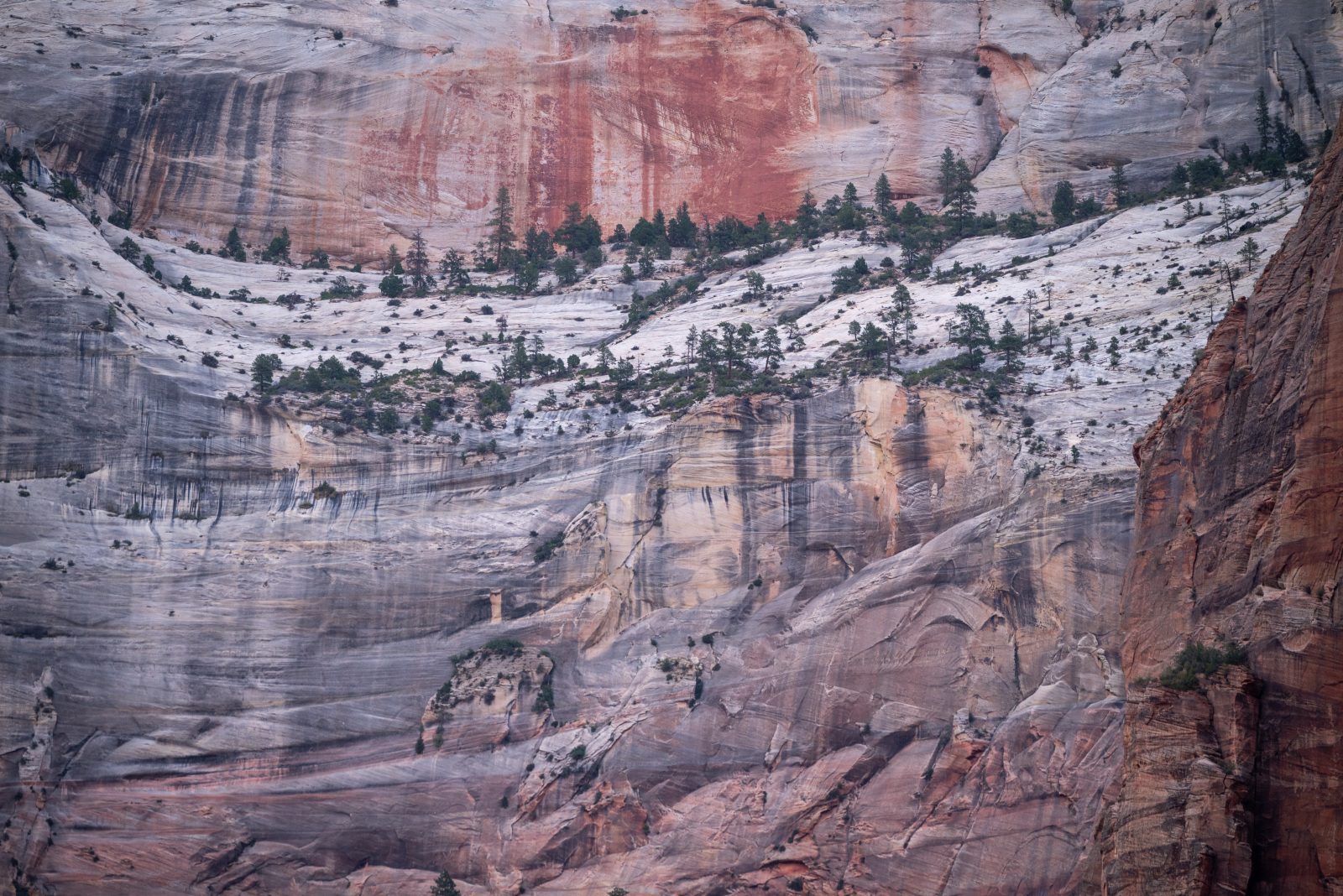
The imposing cliffs of the valley-canyon carved over aeons by the Virgin River are truly awesome, especially from your viewpoint on the valley floor which is the visited heart of the Park. No wonder then that with five million annual visitors Zion is one of the busiest of the US National Parks. It is not large, in fact, it is essentially that deep, winding canyon up which runs a single road that reaches a dead-end at the point beyond which it narrows so much that the Virgin River fills space between the cliffs. To be fair there are other sections to the north-west but this spectacular valley is the real draw. Having said that, don’t ignore the Park’s quieter landscapes because the practical consequences of its popularity and configuration are that (a) the valley is crowded; very, very crowded and (b) you cannot drive your car into the Park. You must leave it at the vast Visitor Center car parks and either walk, cycle or take the shuttle that runs all day up-and-down the canyon road, stopping at the key points. If you are staying at the Park Lodge you can drive somewhat further up to the Lodge. There is nowhere to park on that lower section of the road (except at the Lodge), so even stopping to see the sights in that lower section of the canyon requires taking the shuttle.

It can be quite enclosed within the canyon and that means it can feel quite close if the temperatures are high. With daily temperature rising to around 32°C/90°F, walks that I took which were designated ‘Easy’ by the Park Service were soon hot, sweaty going.
To those used to European-style national parks, such as the UK’s national parks, the scale of organisation at US National Parks is a revelation. Even in these times when cash for public services is being cut back, they are just amazing places to visit – well-structured with massive Visitor Centers providing organised video showings, ranger-led talks and walks and the wealth of helpful information as well as full toilet facilities. Shops loaded with clothes, hats, books, gifts, toys and outdoor gear are part of the mix and the bigger parks have cafes, restaurants, campsite and lodges. At Zion (and other Parks) also make sure you pick up the Park guide at the entry gate. It covers a wealth of helpful information about the park, how to get around, the nature of self-guided walks (or Trails as the NPS prefer to designate them) and the use of the Shuttle.
Activities
Walks
I stuck to the ones designated Easy (five options). You can head along the Moderate ones which are just somewhat longer than Easy ones. For those who are more intrepid (and enjoy lung-busting changes of height) the Strenuous ones are there for you. I chose the Lower Emerald Pool Trail and the Riverside Walk, taking both in the early morning when the air was not so warm. The latter meant a trip in the Shuttle up to the Temple of Sinawava and was my first introduction to how busy the Park gets. Dawn was just breaking as the up-canyon Shuttle arrived. It was packed. It was standing room only all the way to the road end. I discovered that this is because this walk is just the wimps section of a Strenuous trail (The Narrows) that is the most popular in the Park. That walk is up the Virgin River for a further four or so miles and back again. In this case ‘up the river’ means ‘in the river’ as from this point the space between the canyon walls is filled by the, admittedly shallow, river. That walk is clearly the thing to do in the Park and no other trail seemed to be anything like as busy. Indeed on the walk to the Lower Emerald Pool there were others but often I was alone within the natural world. And although the startling vistas draw the crowds, I also found much to enjoy in the details on these walks; in the variety of differing colours and shapes of the rock surfaces, the plant life from reed beds to clinging epiphytes amidst the trees that fill the valley floor, the glorious pungency of the pine resins in the air, the audacious chipmunks and the sound of water.

Mobility Access
The length of these walks may act as a bar to those with mobility constraints but surfaces vary and, for those looking for short walks on smooth surfaces, some trails are paved (such as the Riverside Walk) and you can just go as far as you want and just return to pick up a Shuttle. One of the many excellent aspects of the NPS guides and websites is that you can easily find information about the surfaces, length and height changes not only on trails but also on the paths leading to outlooks. Within Zion N.P. the nature of the valley floor layout means there are only a few marked outlooks, but that is where the shuttle comes into its own.
Park Shuttle
For a surprising part of its length the Shuttle passes through wooded areas which means that views of the imposing cliffs and outcrops is limited from within the bus itself. However there are stops on the route where you can get off and take in Zion’s glories. In particular there are the stops at the Court of Patriarchs and, most spectacular in my view, Big Bend. Because the trails from these points are much less frequented, they are remarkably free of people. At Big Bend there are places to sit and just wallow in the staggering vista. The shuttles are very frequent (and not often packed except early in the day and closer to dusk) so you never feel stuck. Outside the winter season, when the service is discontinued at some times, the shuttle runs from before dawn well into the evening (around 20.00 when we were there). Oh, of course, I should mention that once you are in the Park the shuttle is free to use.

Mobility Access
You do need to manage the steps up into the bus, although I understand that those needing assistance can be helped to get aboard. Given the bar on cars in much of the canyon, used judiciously this is a meaningful way for visitors with mobility constraints to take in the Park’s grandeur.
Another thing to consider is the Park tram tour mentioned on the Lodge website. This hour-long tour runs from (and is booked through) the Lodge and is a variant on the tourist ‘trains’ that now run around so many European cities with a couple of open-sided carriages pulled by a powered ‘engine’. We had booked but the tram had had a mechanical indisposition and our tour was cancelled. They do not run every day and the next tour did not fall within our time in the Park.
Driving the Park
One of the joys of having a detailed hard copy map is that you discover routes that are often hidden from the online tourist. Thus we discovered that a quiet road (Kolob Terrace Road) led out of the small community of Virgin up into the heights of a section of the plateau above the main valley of the Park, weaving in and out of its western boundary. Various stopping points are offered by small car parks at the lesser-known trailheads on this road, but the joy is being in a landscape very different in feel to the main section of the Park, with very few other people to disturb the quiet. The road dead-ends at the Kolob Reservoir so you just drive as far as you want and then return.

The other drive that can be taken is up the spectacular road that winds east up into the mountains and through the tunnel to the Checkerboard Mesa – https://www.utah.com/destinations/national-parks/zion-national-park/places-to-see/checkerboard-mesa/. We had to travel this way for our onward route to Bryce Canyon but, taken out and back, it would make a wonderful half-day drive into yet more spectacular mountain scenery.
Mobility Access
Shortish car trips with no walking but plentiful scenery stops to break up the drives.
Lodge
This is the only lodging in the Park other than campgrounds. Plentiful other options are available in the town of Springdale just outside the Park (and there is a shuttle service that runs from there into the Park). The accommodation and service probably put the Lodge in what I would call a 3-star category; not upmarket luxury but really comfortable and so much more convenient than being outside the Park that there is no hesitation in recommending it as the place to be. But you must book early. At busy times it is booked up nearly a year ahead.
The lodge is a sprawl of buildings lying around a large open green where deer feed on the grass in the early evening, seemingly oblivious to the folk milling around. A two-storey, rustic-style building contains the lodge lobby, a restaurant, a café, a shop and the beer terrace. During the day it becomes a very busy social centre for Park visitors using all the facilities and picnicking on the green or just resting on the many benches that surround it. It quietens a little in the evenings.

The rooms come in a number of shapes and sizes. Our having to re-book meant we had to forego our preferred king-bed room for a twin queen-bed one, but it met all the elements I mention above in the section in Part 1 on Hotel Rooms. Décor has that slightly old-fashioned, wood-rustic character of many of these type of National Park lodge accommodations. It has a small balcony with seats and table.
The Red Rock Grill, an all-day restaurant, serves solid American dinners and, to quote my own journal entry, ‘dismal’ breakfasts. Service seems to follow the quality of the food, being much better in the evenings than in the mornings. The dinner menu is the usual burger/steak and carb fare but with a number of more palatable options (trout with steamed vegetables or a quinoa salad for example). At breakfast it was buffet fare served in a way which reminded me of school canteens with hard, burnt pancakes, lumps of scrambled egg and pallid, undercooked sausages. Cereal is by Kellogg’s. Some chopped melon and good porridge offer brighter spots. Thankfully the Castle Dome Café, which faces onto the green in front of the lodge, offered salads and wraps on top of the inevitable hotdogs and burgers to eat both on the busy outdoor terrace or as a take-out.
Mobility Access
The lodge is quite spread out but all the paths that run between the cabins, the two-storey buildings with bedrooms, the car parking areas and the main Lodge building were wide, flat concrete. There are no elevators in the bedroom buildings and the upper floor is only reachable by a flight of about twenty stairs. There are about four steps to get up to the lower level of the bedroom buildings from the path, although a wheelchair access can be found at each end of the buildings. The Red Rock Grill is on the upper floor of the main building but lift access is available. Access to the Park Shuttle is adjacent to the main building and, although there can be queues during busy times, there are benches at the stop.
On the Road: Zion N.P. to Bryce Canyon N.P.

This is only a short drive from Zion (84 miles/135 km) but there are some very worthwhile stops en route. I have already mentioned the drive eastward taking in the Checkerboard Mesa but, once you clear the eastern gate of the Zion N.P., the road sweeps east then north through the farmland and forest of Long Valley before turning east onto Scenic Byway 12 (https://web.archive.org/web/20040108105721/http://www.byways.org/browse/byways/2020/travel.html?map=40777). See the section on Reading: Non-Fiction in Part 1 for the joys of American Byways more generally.
Red Canyon
https://www.fs.usda.gov/r04/dixie/recreation/red-canyon-visitor-center
The world of Bryce Canyon’s ‘hoodoos’ awaits us but, spread along the roadside not long after the turn off US Route 89 onto Scenic Byway 12, is the ‘hoodoo’ amuse-bouche to the feast to come. This is Red Canyon. Part of the vast Dixie National Forest, it has a Visitor Center (with seasonal opening) well worth a stop, as are the pull-ins on both sides of the road. There are trails for the more mobile and the shortest of them allows you to climb up the short slope above the road to the nearest of these other-worldly rock formations. Don’t worry, you will soon hear more of ‘hoodoos’ when we drive the further 15 miles (23 km) to Bryce Canyon’s own Visitor Center.
Mobility Access
You can see much of the Red Canyon landscape from the car and the roadside. Even taking just a few steps onto the red-orange soil dotted with the pines of the high desert can be managed from the roadside pull-ins.
Bryce Canyon National Park
Altitude: 6,600ft/2,300m to 9,000ft/2,750m. Length of Stay: 4 nights.

Bryce Canyon has a completely different feel to Zion. Zion is valley, looking up. Bryce is canyon rim, looking down. Zion is closed in by those towering cliffs. Bryce is an open landscape with vistas stretching nearly 80 miles away to the east and south. That sense of space means Bryce does not feel as hectic as Zion (and only has about half the number of annual visitors). Many come and just ‘Instagram’ the ‘Amphitheater’, the section of the canyon rim that curls between Fairyland and Bryce Points and houses its astonishing audience of hoodoos (https://www.nps.gov/brca/index.htm) but there is so much more to do and to appreciate within the Park. Take a a drive along the Park’s road to its end (and highest point) at Rainbow Point to watch the sun rise as the deer wander through the surrounding woods; listen to a ranger talk on the geology of this highest step on the Grand Staircase and the formation of those hoodoos; gaze up at the brilliance of the star swarm in the night sky above the Amphitheater; hike down from the rim amongst the hoodoos and the pines and with the inevitable, lung-busting climb back up. With the altitude making Bryce Canyon many degrees cooler, it was a welcome respite from the early autumn heat elsewhere.
And so what is a ‘hoodoo’? It is the American name for a pinnacle rock formation that can be found in various places around the world, but which are nowhere in the same profusion as at Bryce. You can see them in thousands of images but you need to be there, above them and in amongst them, to gain a real sense of their oddity and scale – https://www.nps.gov/brca/learn/nature/hoodoos.htm.
Activities
Viewing the Park
Like Zion, the road through the park has no exit. It is an out-and-back drive. Unlike at Zion the free, seasonal Shuttle (usable only if you have a pass for the Park) only goes as far as the Amphitheater viewing points. The remaining 15 miles (24 km) are only reachable in a private vehicle or on a bicycle. There are car parks and facilities at all the main stopping points, as well as at the Visitor Center adjacent to the Park entrance. There are cafes, a pizzeria, a restaurant and a General Store, the last of which provides supplies and facilities for the large campgrounds. We spent three full days in the Park and felt you needed that time to do it justice, seeing the Park at different times of the day and night and giving ourselves some time just to sit and reflect. The Visitor Guide given to you at the entrance is, like its Zion counterpart, the best starting point for your decisions about what to do and see – and when. That and a visit to the Visitor Center with its explanatory displays, introductory video and ranger-manned information desk.

We gave ourselves half-a-day taking the Southern Scenic Drive to the end of the line at Rainbow Point. For much of the drive you are unaware of the canyon as the trees of the predominantly pine forest shield you from the cliffs of the canyon. Yet it is a beautiful drive with the forest opening up into the occasional broad meadow, fire-ravaged sections of forest and the wandering herds of deer as well as the many viewpoints with their superb views across the canyon. And beyond Sunset Point the viewpoints are much quieter and you can get a greater sense of the peace of the land by being at some of the further viewpoints, such as Rainbow and Inspiration, for the popular times of sunrise and sunset. A walk timed at sunrise from Rainbow Point with no-one else around was one of the highlights.
Mobility Access
I am assuming you have your own car. The Shuttle is useful if you have split up to do differing activities and it is accessible with a step up from the roadside. The information available on the Accessibility page of the website to assess whether a particular viewpoint can be accessed is simply the best I have come across with exact distances to be covered from adjacent car parks and information on ground surface and changes in elevation (https://www.nps.gov/brca/planyourvisit/accessibility.htm).
Walking Trails

So to the walking. As at Zion, they divide the hikes into the three categories: Easy, Moderate and Strenuous. Also here is a comprehensive description of the length of each walk, potential issues and elevation changes. All is set out in the Visitor Guide. The most popular section of the canyon rim, from Sunrise to Sunset Points, is laid with wide smooth paving. This is, by far, the busiest section of the canyon rim and just be aware that there is a longer walk from the car parks to the rim (from 150-450 metres) than at some of the other viewpoints. Of the other named walks, I did two.
Bristlecone Loop walk from Rainbow Point, designated ‘Easy’, was the one that gave me that highlight experience at sunrise. A gentle loop through the pine forest, in addition to the sweeping views to the south, it offers you your own smaller ‘amphitheater’ of hoodoos falling down the canyon sides to the east. In the early morning, with only the birdsong and three deer grazing in the undergrowth for company, this short walk was very special.
Mobility Access
Depending on your personal constraints on mobility this may be manageable, but bear in mind that, although it is a firm, carefully marked-off earth surface, there are many undulations to be coped with as well as the distance.
Queen’s Garden/Navajo Combination Loop is only designated ‘Moderate’ and is a combination of two trails that link Sunrise and Sunset Points. In contrast to the fairly level 900 metre distance around the rim, this loop drops down in amongst the hoodoos in the canyon, covering nearly 3 miles (4.6 km) and, this was the real killer for me, 625ft/191metres in elevation change – that is down and then up. On the way up I had to stop several times just to catch my breath, striking up companionable conversations with fellow sufferers resting on rocks which are the only seating options on the route. This is the Park’s most popular walk. It is busy with people, because you get so close to the hoodoos.

Mobility Access
A non-starter.
Hotel: Best Western Plus Bryce Canyon Hotel
https://www.bestwestern.co.uk/hotels/best-western-plus-bryce-canyon-grand-hotel-45082
On the trip that had to be cancelled we had been booked into Bryce Canyon Lodge, the only lodging within the Park. Seven months ahead and seeking to re-book we found the Lodge was fully booked, so we had to hunt out an alternative. My own research had led me to Clear Sky Resorts Bryce Canyon (https://brycecanyon.clearskyresorts.com/), an intriguing looking resort in the community of Cannonville about a 20 minute drive from the Park. We arrived and, about an hour-and-a-half later, we left having found as an alternative this Best Western in Bryce Canyon City. I do not plan to give the many reasons why we forewent our paid-for accommodation at Clear Sky Resorts. If you are looking at it as an option for your stay, I can cover my thoughts in response to an e-mail or comment.
Bryce Canyon City is barely a town in size and exists along the road that leads into the Park solely for providing service facilities for the Park: accommodation, eating places, tour companies, shops for groceries, gifts and outdoor kit, country and western shows and rodeos. This Best Western hotel is the top end of available accommodation and is a larger version of the modern, functional design of the other chain hotels we stayed in on this trip. Same style of room, same sort of facilities (outdoor pool), pretty extensive breakfast buffet but no other restaurant service and ideally placed for access to the Park being 3 miles (4.5 km) from the Park entrance. This in itself was a huge advantage over accommodation further afield as we readily could come and go during the day. If you can’t stay at the lodge, I would definitely stay in Bryce Canyon City (bear in mind that we booked our stay a bare hour before we arrived so it is not that difficult to find lodging of some sort except on holiday weekends). The hotel also has a stop on the Park Shuttle route.

Mobility Access
With elevators, flat, smooth floors internally and a flat asphalt car park the only issue here is to try and get a room closer to the elevators to minimise the distances to be walked within the hotel building. The outdoor pool has steps with handrail for easy access.
Eating Out
With no restaurant in the hotel, we looked elsewhere to eat. There are plenty of restaurants and fast food outlets in the city but interesting variety of menu is not a strength. We unearthed Bryce Canyon Pines Restaurant for our first meal (https://bcpines.com/bryce-restaurant/). Set 5 miles (8 km) back up Scenic Highway 12, it is linked to the adjacent hotel/cabin and was busy, cheerful and with a ‘western’ sensibility to the basic design and that familiar American menu whose meat-led entrées are circled by burgers, salads and sandwiches and potato-led sides. Solid, large portions were absolutely fine for us after our somewhat frazzled day of switching hotels. Even if you book you may have to wait a few minutes for a table.
Mobility Access
A simple, single-storey building with solid, smooth floors and direct access from the car parking area. There are some bench seats that can be used whilst you wait for your table.
We visited the Bryce Canyon Lodge to have a coffee during the next day and, tempted by the menu at their Grand Fireplace restaurant, came back – twice (https://www.visitbrycecanyon.com/dining/the-lodge-at-bryce-canyon-restaurant). The lodge is, of course, in that American rustic style and the large wood-lined room was bustling on both nights. The menu options, cooking and service were just a couple of steps up from anything so far on the trip. We really enjoyed it, even with the drive home meaning no drinking for the driver. First-come, first-served dining meant a wait in the lobby before being shown to your table but there are plenty of seats and nooks with display cases to explore and a small shop to boot.
Mobility Access
Inside the restaurant is on the same level as the reception area. Both have flat, carpeted floors. There are seats for those who need to wait for their table. There is a smooth, paved walk of about 50 metres up a very gentle slope to reach the entrance doors from the adjacent car park.
Getting Around
For the mobility constrained having your own car would be the best option, but the free Park shuttle bus which runs from the accommodation in Bryce Canyon City is a useful tool for getting to the Visitor Center and seeing the best-known viewpoints. You do need to be aware the Shuttle does not run in the winter months and that you need to buy a pass for the Park before you board in the town.
