As with other lengthier trips I have broken this piece down into what I hope are manageable chunks. There are five separate parts.
Part 1: Prelude, Practicalities and Other Preliminaries
Part 2: Zion and Bryce Canyon National Parks
Part 3: Lake Powell, Slot Canyons and the Navajo Nation
Part 4: Winslow, Route 66 and Death Valley
On the Road: Monument Valley to Winslow
Crossing from very north of the Navajo Nation to a city just outside its southern fringes, we decide to meander our way across, taking in scenery and stops and more of the atmosphere of the Navajo Nation. It was a day-long tour of 220 miles (350 kms).
Tuba City
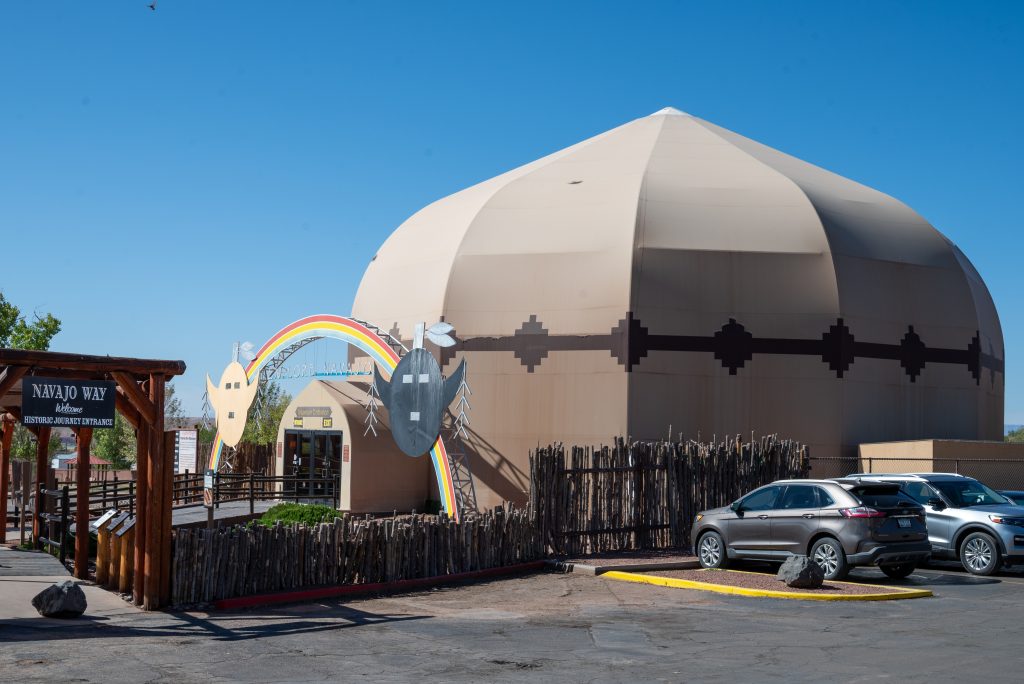
This, the most populous community within the Navajo Nation, is a convenient stop but also home to the Tuba City Trading Post and, handily set behind it, the Explore Navajo Interactive Museum. It also happened to be served by the same car park as Hogan Espresso, a full-service coffee shop with inside and shaded outdoor space (and no website) that gave us our needed doses of caffeine and fruit smoothie.
The Museum’s focus is obvious (https://discovernavajo.com/museums-on-navajo/) and, with time needed for travel, we could not give it the attention it warranted. It gave insights into the Nation’s history and culture with interactive and static displays. There is no entrance fee, but you can make a donation should you wish. In the Trading Post building next door is an exhibit focused on the Navajo Code Talkers, an aspect of the War in the Pacific that only became more widely known in 1968 when the secrecy imposed on the project was lifted (https://www.neh.gov/article/code-talkers-were-americas-secret-weapon-world-war-ii). The Trading Post itself contains a large selection of American Indian art and craft.
Moving south we crossed the Hopi Indian Reservation, an island of a different culture sailing in the surrounding Navajo Nation. The Hopi tend to congregate in busy villages (often built atop the mesas from which some of their American-English names are taken). It is a contrast to the Navajo’s more grazing-focused culture where space and privacy plays a part in keeping your distance from your neighbour. I feel that by this stage (just over two weeks) we felt a little scenically and culturally tired and needed more of a rest and refresh. The result was that we pressed on without stopping, except for gas and coffee, arriving in Winslow after about seven hours travelling.
Winslow
Altitude: 4,900 ft/1,500 m. Length of Stay: 3 nights.
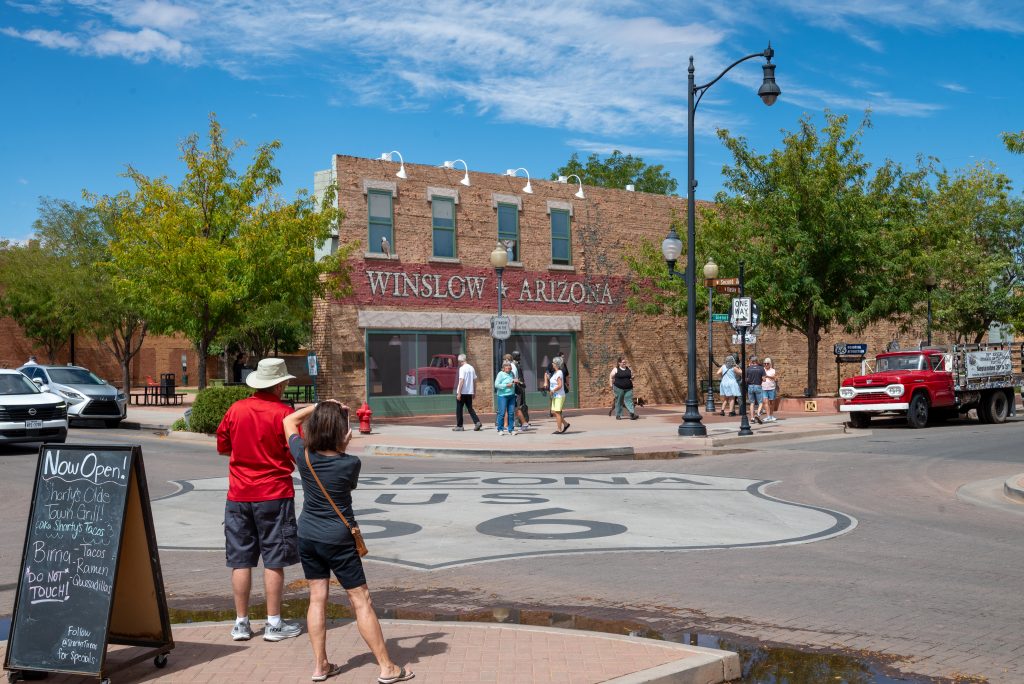
Why Winslow? Well, that this small city is just an hour’s drive from Petrified Forest National Park was one reason – but the city of Holbrook is much closer. The clincher was La Posada Hotel which seemed to be an ideal spot for the rest and refresh we wanted. And it was. Indeed it was a joy to stay there for many reasons. However, Winslow attracts travellers passing through principally because of its position on Route 66 and because of this:
Well, I’m a-standin’ on a corner in Winslow, Arizona
Such a fine sight to see.
It’s a girl, my Lord, in a flatbed Ford
Slowin’ down to take a look at me.
(From the song Take it Easy written by Jackson Browne and Glenn Frey and released as The Eagles first single in 1972)
I am not aware of any other place that makes so much from just one verse of a song. Go to the ‘corner’ (actually the junction of Old Route 66 and N Kinsley Ave) and you will see on one corner a small plaza with statues of Frey and Browne, a mural depicting the girl in the flatbed Ford and, parked in the street, an actual flatbed Ford. On another corner is the Standin’ on the Corner gift shop selling Eagles and Route 66 memorabilia which store is mirrored on a third corner by The Take it Easy Store selling much the same sort of memorabilia. On the fourth corner is a retro-diner rejoicing under the name the Sipp Shoppe. Walk fifty metres along either street and you can add on the Route 66 Plaza (complete with outdoor stage), the Flatbed Ford Café, several more Route 66 memorabilia and retro-clothes stores and a steady stream of people photographing themselves before the mural, the statues and the flatbed Ford. Many are, of course, wrinklies from my generation but not all by any means.
Hotel : La Posada
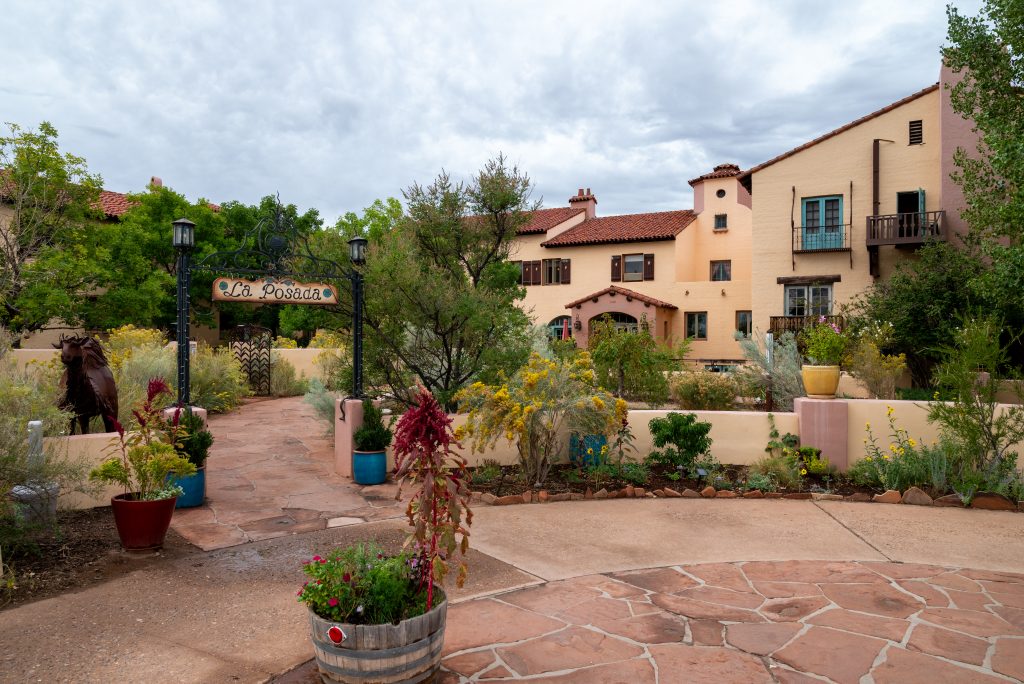
Built as a railway hotel in the 1920s, it became the railway company’s offices and then their storage space before being restored in the late 1990s as this wonderful, quirky place that remains redolent of the era of the 1930s whilst having been fully updated. It was built as part of the Fred Harvey Company’s empire, founded in 1876 to provide up-market service facilities for the railroad – dining cars, restaurants, hotels. I had never heard of this company, which worked with the railways to bring tourism to the American south-west, yet it seems to have had an almost iconic status. There were the renowned waitresses known as Harvey Girls (Judy Garland played one in the 1946 film of that name). There were striking individual hotels, many the work of their chief architect for 38 years from 1910, the extraordinary Mary Colter. Those designs included the one she regarded as her masterpiece – La Posada. The hotel website covers some of this history and its restoration with a comprehensive self-guiding tour (https://irp.cdn-website.com/c227ebcc/files/uploaded/LaPosada_Booklet_2013_Cropped.pdf).
The décor of the hotel and the rooms is a mix of period-style furniture and fittings, historical artefacts and photographs, American Indian art and soft furnishings, and modern art, particularly the paintings of Tina Mion (https://tinamion.com). All this encased within the Spanish Revival and Mission styles of Colter’s original design. It had plentiful spaces to relax inside and out, delightful quirky gardens, a ‘trading post’ style shop and an excellent bar and restaurant. There are no 21st century facilities such as pool, gym or spa but that did not matter to us. Our room was entertainingly decorated, had all we needed bar a fridge and, when we asked if we could store our picnic stuff in one of the hotel’s fridges, they produced a small fridge we could use in the room. That was just an example of service that was friendly and always helpful. Our ground floor room had a patio with loungers, chairs, table and shade umbrella.
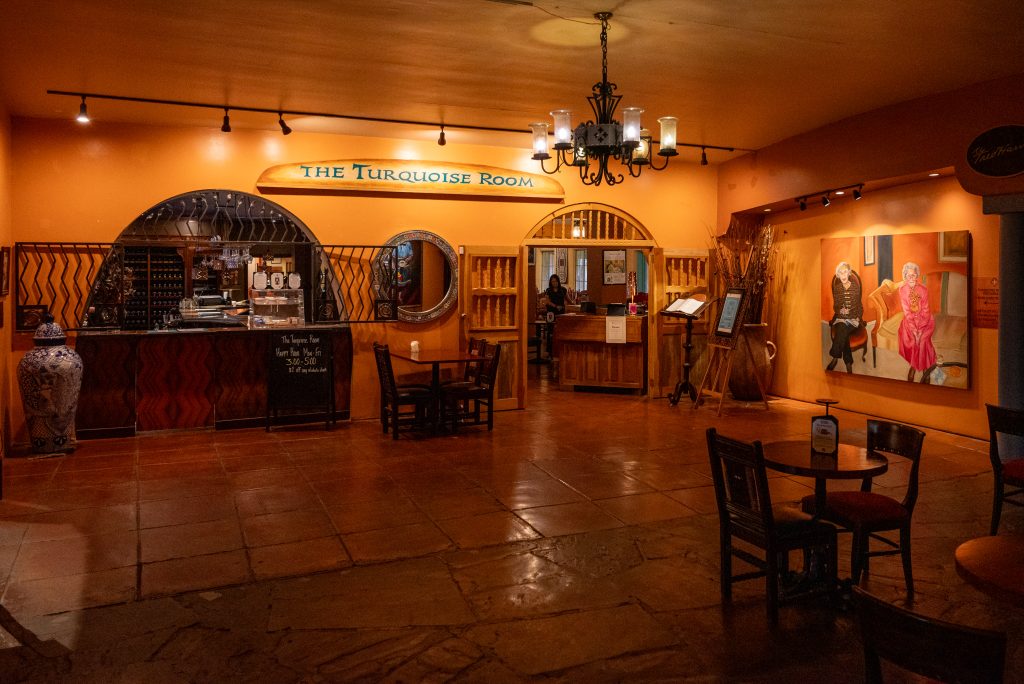
We ate our morning and evening meals in the restaurant, The Turquoise Room. Whilst not quite haute cuisine, this was the best restaurant we enjoyed until we hit Salt Lake City. We ate breakfast and dinner here during our stay and were not disappointed.
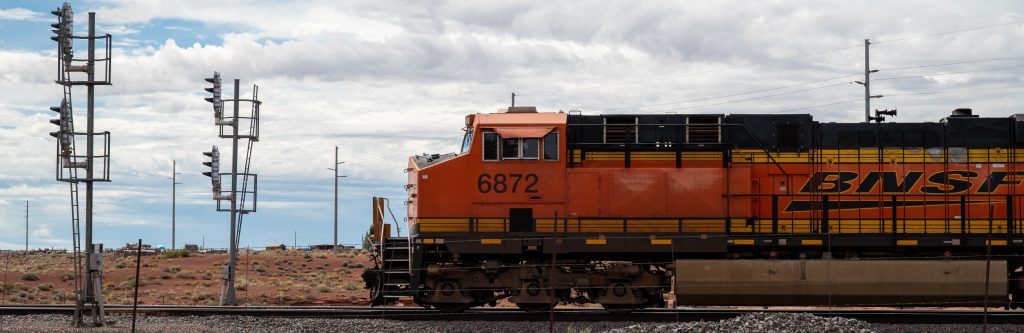
At the end of the south garden there is a railway platform. Here the BNSF Railway (once the famed Atchison, Topeka and Santa Fe Railway but now part of the Berkshire Hathaway group) still runs. The unimaginably long freight trains that are unknown in most of Europe rumble past at regular intervals during the day, hauled by multiple diesel units. The Southwest Chief is the only passenger service, running through once a day in each direction on its journey to Los Angeles from Chicago, stopping in the early hours of the morning to drop and collect the rare passenger (most now arrive by car). Does this mean noise? For us, no, the trains never disturbed our sleep and added a dimension of ‘old west’ romance.
Mobility Access
The protected status of the building means no elevator to the upper floor but there are plentiful rooms on the ground floor. Floor surfaces are smooth and flat throughout (stone-flagging and tile) and the short access walkway from the car park is paved.
Around the City
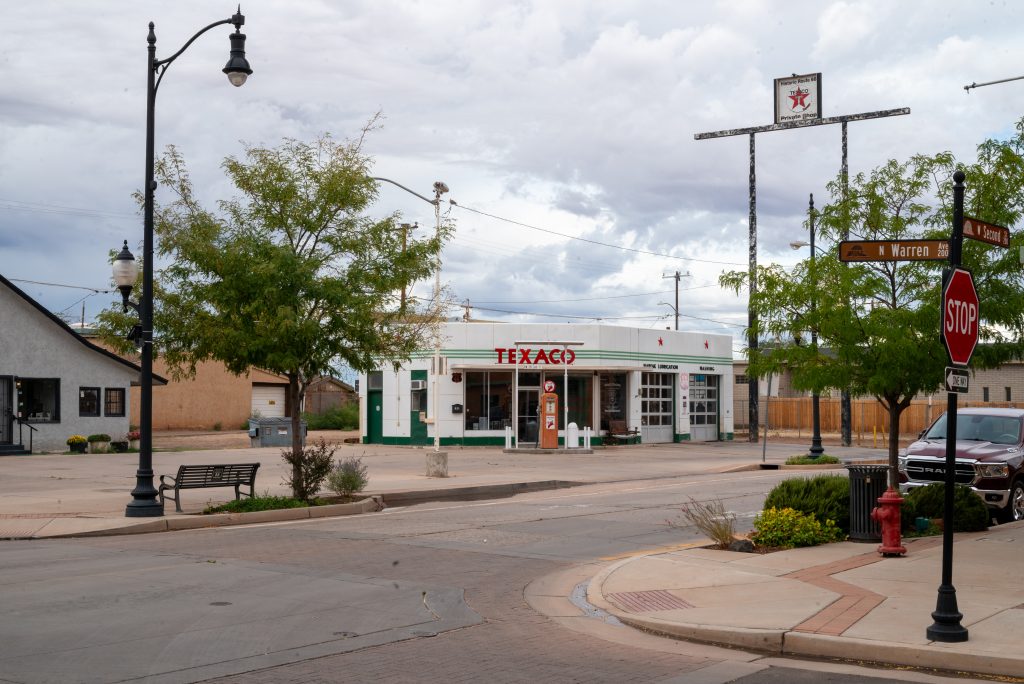
Beyond that ‘Corner’ and the attendant historic district of nineteenth and early twentieth century residential and commercial buildings, Winslow is not the most exciting tourist town but, for me, had other hidden attractions. It is a quintessential small south-western city with a strong association with the railroad which is still the main employer. However, it was my fascination with the contrast between the poorer and the better off parts of this community (population 9,000) that led to me spending a couple of hours just cruising the streets by car, camera at the ready. Here are the used car lots and scrap metal yards just short distances from the neat public administration buildings. Here are the homes on their plots of varying degrees of neatness with yards either with tended beds and lawns or dirt patches littered with abandoned household goods. Here, within the nineteenth century buildings of the Historic District, are the small shops and eating places cheek-by-jowl with the shopfronts of failed businesses, dark behind their glass. And here are the edge of town shopping malls, motels and auto-services living in the shadow of the banked flyover of Interstate 40 carrying its uncaring traffic past to better known places.
A wander on foot around the Historic District takes in the quirky little First Street Pathway Park trapped between road and railway and a drive to the east edge of the city finds the small 9/11 Memorial Park caught in the fork of Old Route 66 where the road separates into west and east running carriageways. Both somehow in keeping with the city’s small town sensibility (https://www.visitwinslow.com).
Petrified Forest National Park
https://www.nps.gov/pefo/index.htm
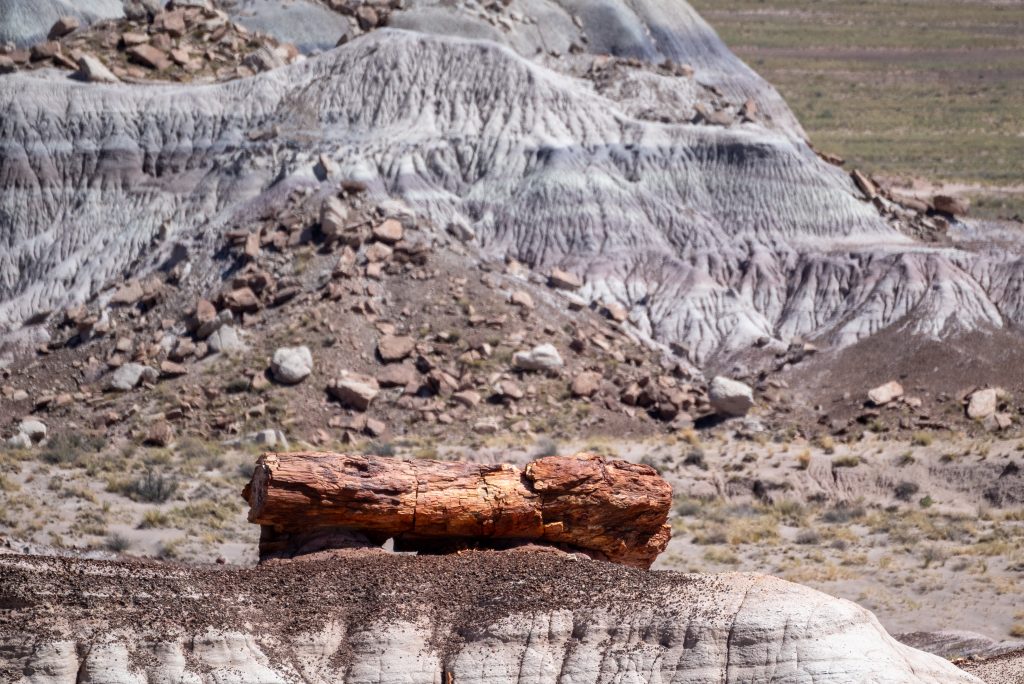
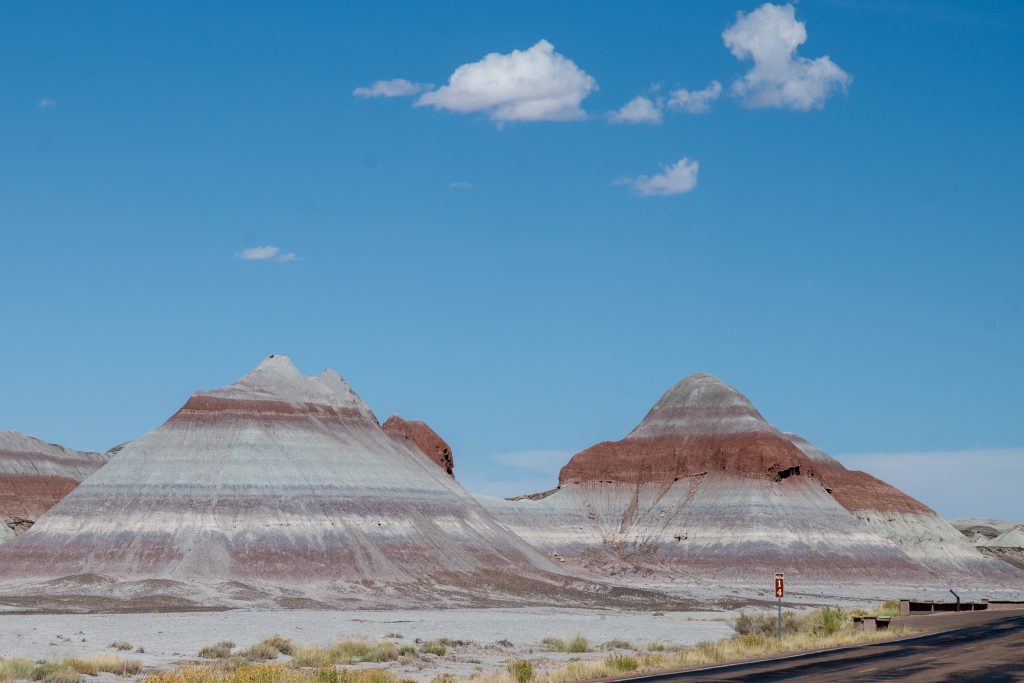
Tucked in a seemingly remote part of Eastern Arizona, Petrified Forest feels a little remote from the grand parks of southern Utah, yet it is an absolutely fascinating place to visit. Although it is a smaller park there are a wealth of captivating landscapes along its 28 mile park road. It was an hour’s drive from Winslow to either north or south entrance. We drove the park from south to north but either way works as there are Visitor Centers at each end of the road. The drive takes in the sights as varied as the multi-hued mounds and hills of the Painted Desert to the moonscape-like views from Blue Mesa (in this landscape the Apollo astronauts trained for their walks on the Moon’s surface). There are petroglyphs and a rather sad rusted relic to mark the location of Historic Route 66 (now no more than a line on a map here). There is the Painted Desert Inn (another Mary Colter restoration) sitting on the bluff that looks across the open landscape to the north and where you can buy your souvenir, visit the Park information displays, buy your ice cream and sit for your picnic lunch. And within many of these landscapes are the fossilised, petrified trees. A simple walk (Giant Logs Trail) around the slopes behind the southern Visitor Center brings you close up to these rock trees with their crystalline, dark red-brown colourations and in other places the end of these trees, exposed by erosive forces, poke out of the solid rock within which they were created.
A fee to be paid at the entrance gates, unless you have your America the Beautiful Pass (see Practicalities in Part 1). With only a tenth of the visitors of a Zion or Bryce Canyon the Park never felt crowded nor the car parks and overlooks overrun with people. Just doing a slow drive, stopping often and with a break at the Inn and Visitor Center, made this a very easy day’s visit.
Mobility Access
Most of the sights are visible from viewpoints along the Park road. All these are readily accessible. A few sights require a longer walk (details from the Visitor Center). We only ventured onto the Giant Logs Trail, a gravel loop-path that rises up a low slope; manageable for some. The Painted Desert Inn has no lift and some sections, including the viewing terrace and restrooms, are on a lower level. Reach this by walking round the outside of the building as there are some very gentle wide steps down whilst the stairs inside are much steeper.
Route 66: Winslow to Kingman
https://www.nps.gov/articles/route-66-overview.htm
Strictly, of course, this road runs from Chicago to Santa Monica but many parts have disappeared into the landscape or been subsumed or bypassed by Interstate highways. However, in the 1980s a group of individuals from Seligman, Arizona set up an association to promote the preservation of the Route, turning Arizona into the heartland of Route 66 tourism (https://www.historic66az.com). Now every town on those parts of the remaining road, and every trading post style gas station in between, majors on memorabilia and includes obligatory hulks of classic cars in various states of decay as well as those old petrol pumps and many a plastic dinosaur. The restaurants and cafes breathe Americana and their car parks are full of Harleys and RVs following the route.
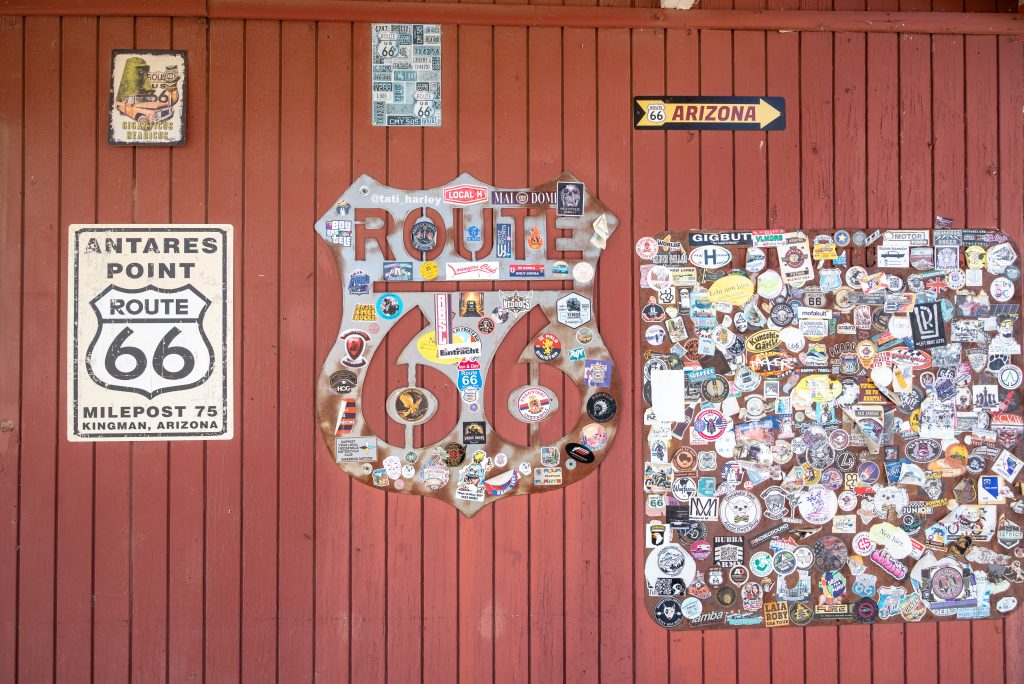
Whilst we had a taster in Winslow, one of the longest remaining stretches is the 88 mile (140 km) loop north from Seligman, a town west of the city of Flagstaff, to Kingman which was to be our next overnight halt. There are a number of other sights off the route westward from Winslow but the drive to Kingman was, with stops to shop, buy gas, ingest caffeine and just gawp at the scenery and the denizens of the road, a near six hours. So we did not venture to Meteor Crater, Walnut Canyon National Monument, Sunset Crater Volcano National Monument or any other of several interesting sounding places along the way.
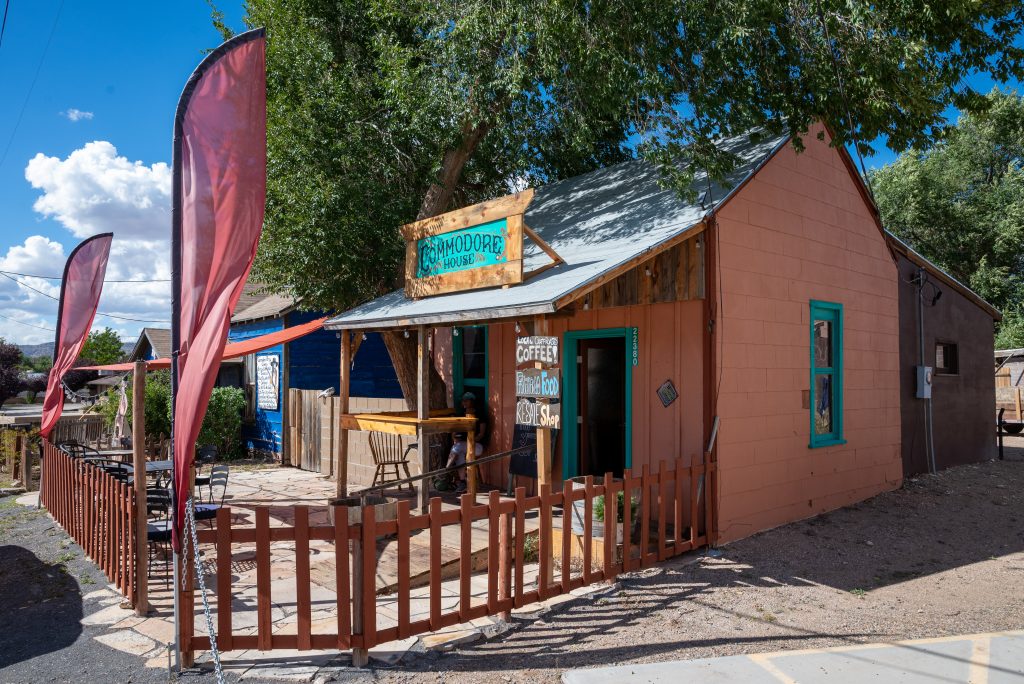
Seligman is known as the birthplace of Route 66 and, along the Route as it runs through this small place, the diners and memorabilia stores shout its status in kitsch signs and décor. There is not a lot else there and certainly nowhere to eat our Whole Foods picnic except, as we discovered, the shaded bench outside the Justice Court. Afterwards we found ourselves some more shade on the open veranda of the Commodore Coffee House. This is one of the more unusual coffee stops on our meanderings in the region – housed in a one room wooden shack, it seemed to be run in a delightfully haphazard way by local folk for local folk as well as passers-through like us. It was mercifully free of Route 66 paraphernalia and felt like a throwback to the hippie era, bar the up-to-date way with preparing the teas and coffees.
Kingman
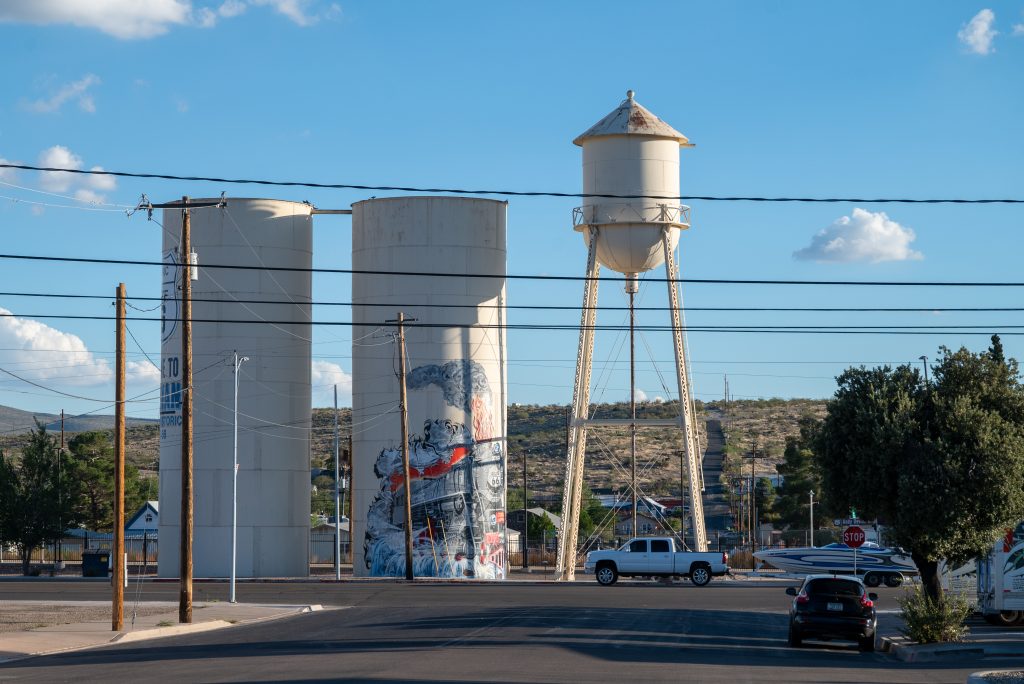
Kingman is a junction city for road and rail and was a sensible overnight stop on the lengthy 500-plus mile (800+ kms) stretch from Winslow to Death Valley. It is another location that is big on Route 66 but which is an altogether more substantial place than Seligman or Winslow. The Historic Downtown area has a number of Art Deco buildings and others on the Register of Historic Places and makes for a pleasant wander in the warmth of a late September evening.
We were there scouting restaurants because we were actually staying four miles up Route 66 in that part of the city where the one-night stay hotels cluster around the junction of the Interstate.
Hotel: Holiday Inn Express
The archetypal one-night stay hotel as described in Part 1 and little to separate it in feel, facilities and staffing from that in Tooele (see On the Road: Tooele to Zion N.P. in Part 2). It served its purpose well.
Mobility Access
Large tarmac car park level with the ground floor lobby and elevators. Smooth floors throughout with no awkward steps or other obstructions for those with our type of mobility constraints.
Eating Out
Seeking some respite from the generic ubiquity of the offer in most southwestern towns, we head to the only vegetarian restaurant downtown to find that they are closing. So we walk along the historic downtown’s main drag, Beale Street, to the Grand Canyon Brewing Distillery (https://www.grandcanyonbrewery.com/locations), which is a large two storey brewpub with an outdoor space, a huge U-shaped bar, the inevitable wall-to-wall televisions, cheerful but faintly madcap service and that south-western style menu that has its own tweaks from those in other similar places. At least the fish (mahi-mahi) didn’t come with fries (sadly it was overdone so dry) but the Mac + Cheese was lukewarm with the orange ‘cheddar’ cheese a glutinous mass atop the sauce-less pasta. It was Saturday night and the place was not busy (and the piped music not too obtrusive). We were almost the last people to leave – at around 21.00.
Mobility Access
We ate in ground level bar space where all is flat smooth floors accessible from the paved sidewalk. Free short-term parking is available on Beale Street and the neighbouring streets and we easily found a space within 50 metres of the brewpub.
On the road: Kingman to Death Valley
A 250 mile (400 km) drive which, with a diversion to Harry Reid Airport in Las Vegas to change cars (see Car Rental and Driving in Part 1) and other stops for bathroom and caffeine breaks, is nearly eight hours of travelling. 35 miles (56 kms) down the road from Kingman we enter Nevada. We needed no signs to tell us so. On the Arizona side of the Colorado River, Bullhead City is a typical small south-western city. Across the river Laughlin is a copse of skyscrapers proclaiming Nevada as the home of gambling. They are all casinos. From then on nearly every gas station, hotel or motel carries the word ‘casino’ somewhere in its title.
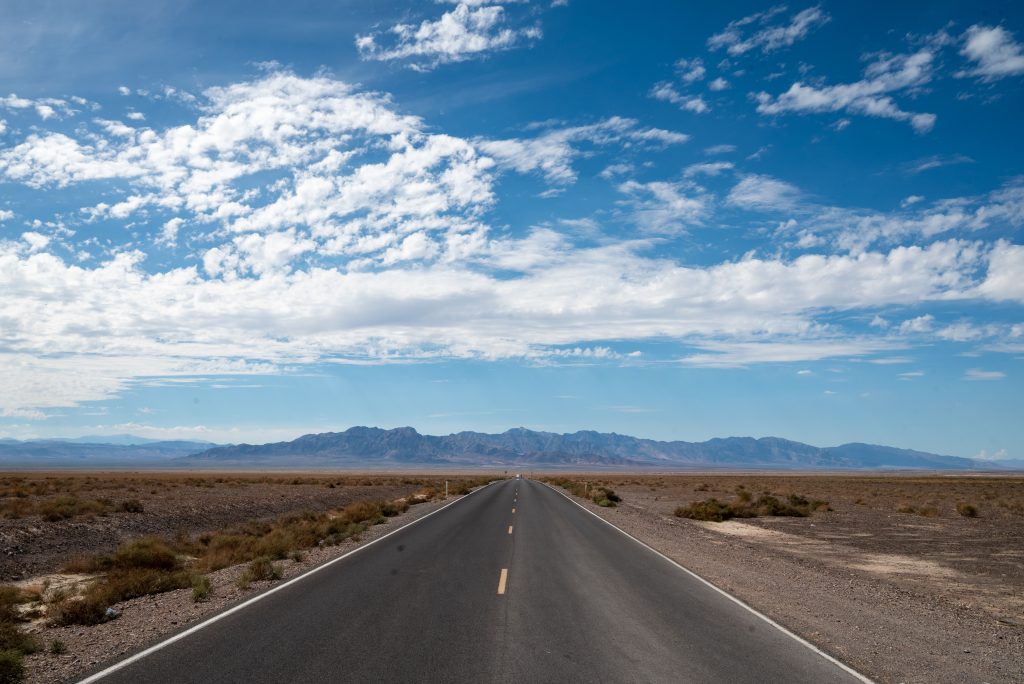
But the landscape here is the Mojave Desert and we are back in the topography of Basin and Range. That means long, long stretches of near straight roads travelling northwards up the wide flat valley floors in parched looking landscapes where the only vegetation is low-lying scrub. The tarmac far ahead of you shimmers into mirage reflections. Towns develop ribbon-style astride the wide highways. Las Vegas interrupts this landscape with grid-pattern roads that run past private gated housing estates for miles, the only change coming with the economic substance of the streets you are passing through. On the desert fringes the less well-off homes, closer to the gambling core, the larger, neater and more private ones. The Strip itself is only glimpsed as a distant line of towers. It is nearly five decades since I wandered the Strip and that left me with no wish to return.
Having selected our replacement car at the airport, we are soon back in the open, dry Basin and Range landscape and coffee time is taken in the wonderfully-named Pahrump, a larger town laid along a highway. Having Google Mapped ‘coffee’ we have happened upon a small mall of slightly unprepossessing shops and businesses to visit O Happy Bread (https://ohappybread.com) because it seemed convenient. We enter expecting the usual coffee shop, despite the Boulangerie-Patisserie sign on the front, only to find bread and pastries displayed that could have come straight out of a Parisian equivalent. There is also a sign on the counter that reads:
‘We make our sandwiches on FRENCH bread. French bread has a crunchy crust. However if you prefer soft bread ask for pain blanc. Pain blanc is soft sliced bread.’
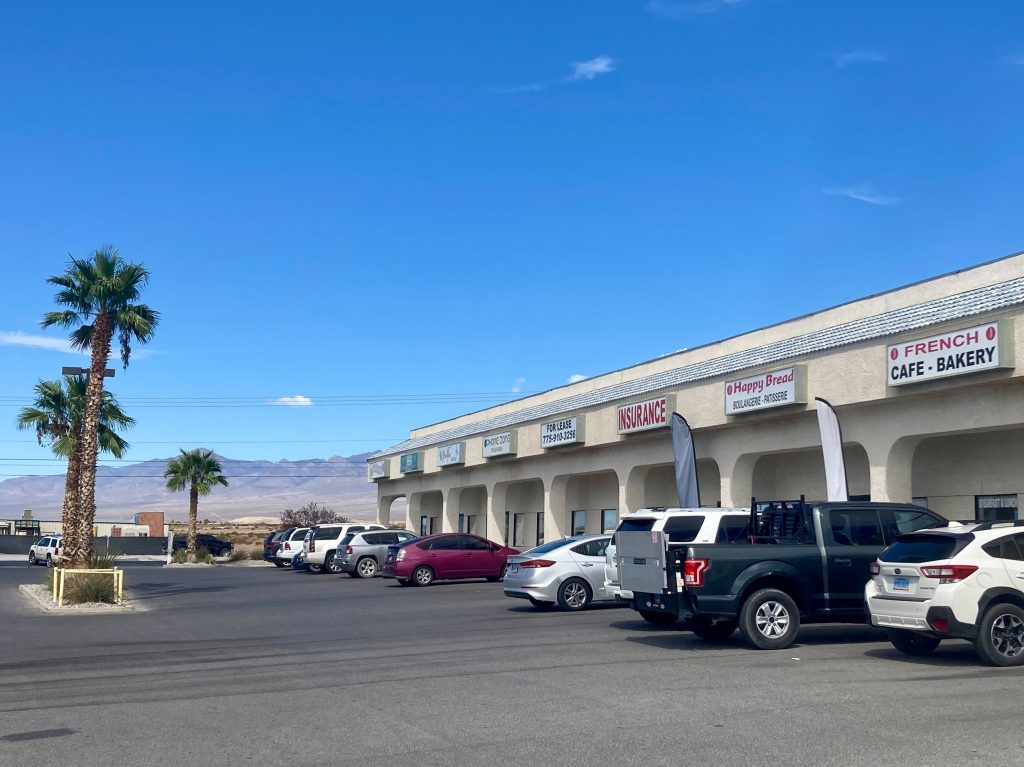
I loved this sign on several levels: the promise it held, the understood need for explanations and the implied insult that anyone would prefer the use of soft pap for their sandwich. Sadly we were not in the market but instead had palmiers with our coffee and tea. Fortified for the desert heat, we turned west towards our destination as the afternoon sun ramped the temperature ever closer to 100°F/38°C.
Death Valley
Altitude: 190 ft/59 m below sea level. Length of Stay: 4 nights.
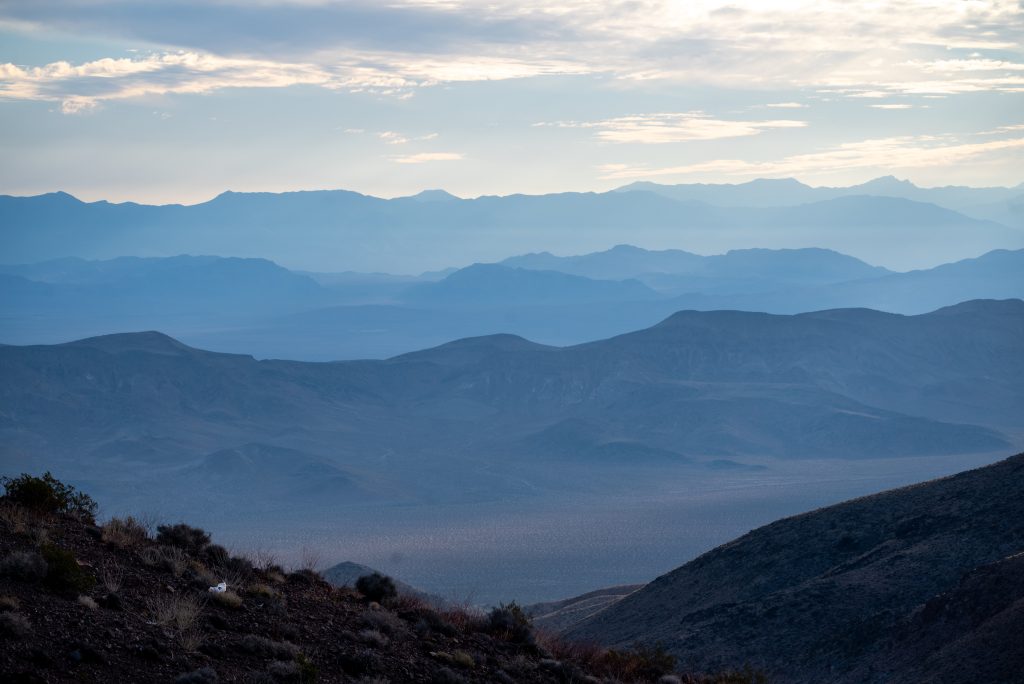
For some bizarre reason I had a picture of Death Valley as a bleak, flat, wide-open landscape. It is open, of course, but, for some unknown reason, I had not picked up on the logic of the word ‘valley’. In the context of Basin and Range topography, the heart of the National Park is quite a narrow valley compared to the broad valleys further east in Nevada, the most spectacular section no more than 5 miles wide pinched between two mountain ranges whose highest point is over 11,000 ft (3,300 m). And within the fringes of this valley are a wild array of intriguing different terrains and sights. It was also home to by far the best Park accommodation that we used.
Hotel: The Inn at Death Valley
https://www.oasisatdeathvalley.com/lodging/the-inn-at-death-valley/
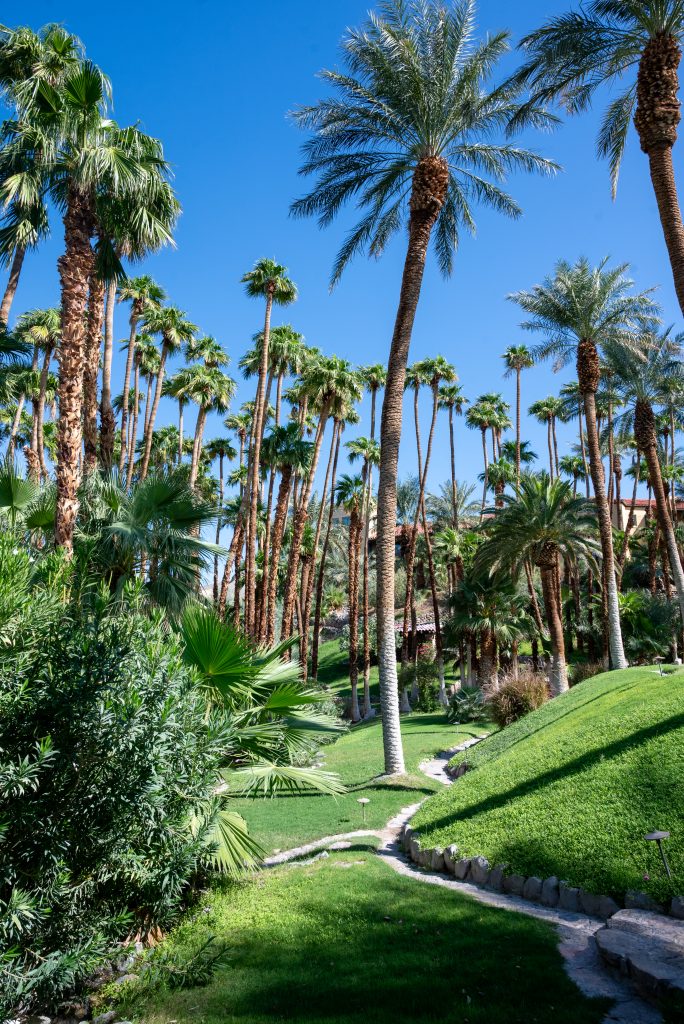
Furnace Creek is a tiny town that survives on the fact it is the place where the Park’s Visitor Center sits alongside a gas station, some tour and off-road vehicle businesses, a straggling of homes, two campgrounds and the enormous resort known as the Oasis at Death Valley. This is two separate sets of accommodation: The Ranch, a family-orientated resort of cabins and more motel-style rooms with shop, restaurants, ice-cream shop, golf course and stables and, just under a mile away, the up-market Inn. Built up the eastern slope of the valley side amidst carefully tended gardens the 66-room Inn was a wonderful place to stay. Not only are you in the heart of the Park but the facilities (80ft/25m pool, spa, gym) and the plentiful air-conditioned spaces for reading and writing mean it is a relaxing place to shelter from the overwhelming heat of the middle part of the day. We were fortunate that, despite our cancellation of the earlier proposed trip, Trailfinders were able to secure the necessary booking for us.
The main hotel building (with bar, restaurant, seating areas and many of the rooms) dates from the 1920s and was for decades part of the Fred Harvey Company’s stable (see La Posada, in the section on Winslow above). It is at the highest point of the hotel complex with gardens, more rooms and the leisure facilities coming in a series of steps down to the valley floor where they have built a semi-circle of casitas around a lawn part-shaded by palm trees.
Dining at the Inn’s restaurant is for all three meals and we found all the food we had there very good. Breakfast is a menu-based meal not a buffet and could be taken on the hotel’s west facing terrace gazing out across the valley.
Service is also of high quality throughout. As evidence I hold up the helpfulness with which they dealt with some concerns we had about the location of our room given our mobility constraints. We were shown to our room one level down from the reception lobby area – by stairs. They had a temporary fault with the elevator linking the floors in the main building (it had broken down that day and was fixed the day we left). It was a beautifully decorated room (in a country-house style) with a balcony, but when I explored the grounds I discovered that the elegant pool complex sits 80 stone steps and about 200 metres distant at the bottom of the valley slope, making access unrealistic for us. The position was explained to staff and they asked for a little time to work on alternatives. About half-an-hour later we were offered either the use of a golf-cart on-call or a move to one of the casitas (each of which come with its own golf-cart for accessing other parts of the resort). Practicalities dictated that we went for the latter option. The casita was a bare 50 metres walk from the pool complex and, with the lift out of action, the regular walk down the stairs to access the restaurant/bar/lounge areas felt unnecessarily constraining even with an on-call golf cart.
The casitas are larger spaces with a separate sitting area and a small kitchenette, although the décor was more straightforward than our tasteful room in the main building. But we had that cart to run between casita and main building and car park. It all worked wonderfully well for us.
Mobility Access
Even with the elevator in operation a room in the main building still requires that trek down through the gardens to reach the pool/gym/spa complex. So I would recommend choosing your room carefully and in consultation with the hotel. Other than that, all surfaces in the main building are relatively smooth and flat. Paths are stone or asphalt. There are two additional points to be aware of. First there is a broad, grand set of twenty steps from the car drop off point to the hotel terrace and entrance lobby (the elevator is elsewhere). Secondly the car park is at the same level as the pool and casitas (reached from the body of the hotel by the same elevator – it drops through the rock to the car park level) and there is a tunnel about 50 metres long from the elevator to the car park area.
Death Valley National Park
https://www.nps.gov/deva/index.htm
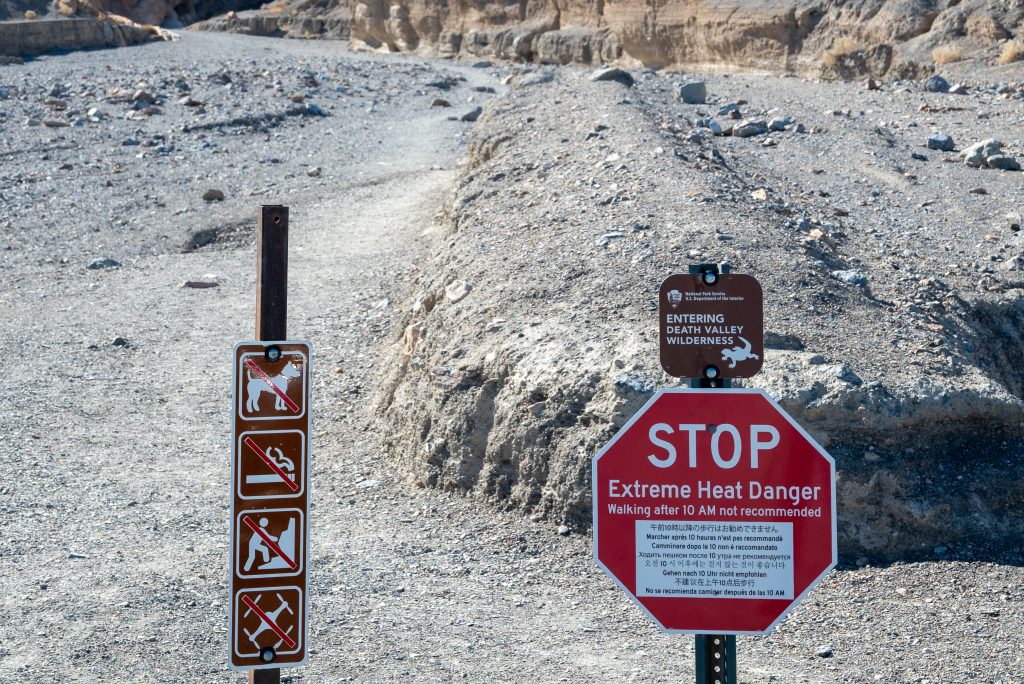
The late September heat means you do not want to be long away from an air-conditioned space (in Inn or vehicle) during that time from mid-morning to late afternoon. My suggestion is that, if you are going to be here when the temperature is at higher levels, you re-adjust your sightseeing so that you can be at viewpoint locations at sunrise or just before sunset or be prepared for only short periods out of your car. There is plenty to see for the car-orientated voyager, the more so if you venture outside the park. By some distance this was the largest Park/Monument we visited, which means driving distances are correspondingly longer. There is no shuttle here. The sights and trails are too far apart and there are just too many roads criss-crossing the Park for that sort of thing to be practical. It also means that, except for the sunset viewpoints, the Park rarely feels over-busy. As always, the Park guide and the Visitor Center are your starting point and your main guide. For us the only feasible activity, given heat and mobility constraints, was ogling at the stunning scenery so I have just picked out a few highlights below and separately touched on our drives outside the Park.
Although we are in one of the driest places on earth, we happened to arrive only a few days after a rainstorm. The result of this, in such a dry landscape, is that large quantities of rock, sand and mud are swept off slopes into the valley by the run-off water. Two consequences arise. One is that temporary pools can add to the beauty of the scene from somewhere like Dante’s Peak. The converse is that many roads are temporarily blocked and you may not be able to access certain parts of the Park at all. The Park website usually has alerts that explain where sights and roads are closed.
Mobility Access
As a general point, sadly, the Park does not have the same superb accessibility information online that is available for Zion and Bryce. I suggest you double-check the access situation with the rangers at the Visitor Center before deciding which sights to visit. I have set out some information on individual places below.
Dante’s Peak
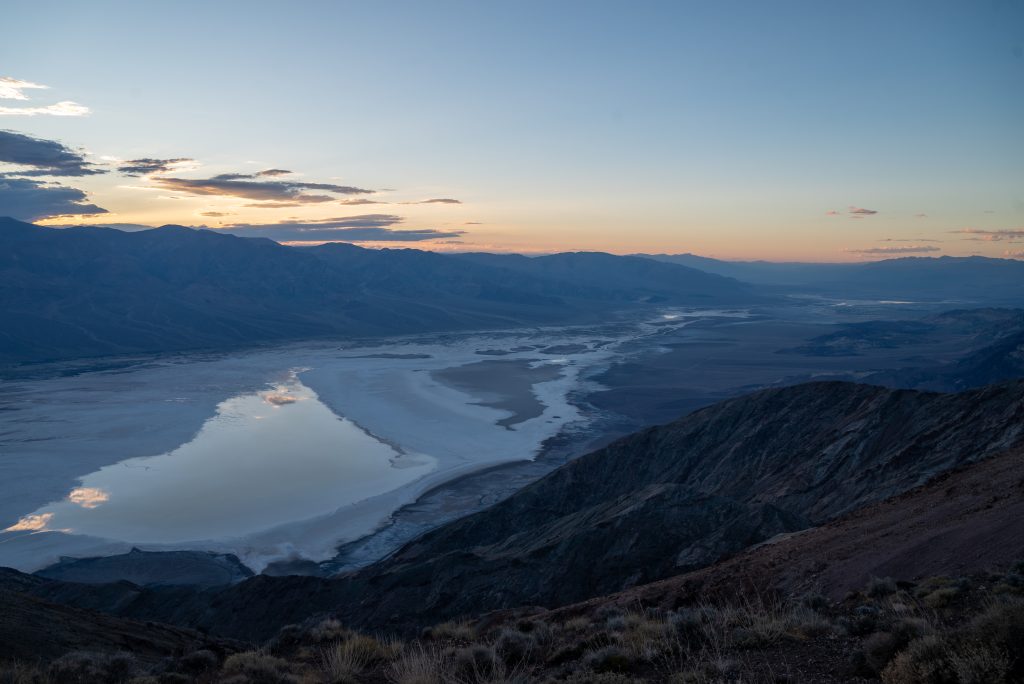
Go at sunset, go at dawn. This magical viewpoint is over 5,500 ft/1,600 m above the valley below. Reached by a narrow, very winding asphalt road it boasts a car park, a large stone-paved viewing area with the odd bench seat, information boards and a staggeringly atmospheric, almost 360° view. For the more mobile you can take a trail higher up along the ridgeline.
Mobility Access
As you have to take a car to the viewpoint (no large vehicles are allowed on the road), then there are no concerns at all once you are there, although you might want your own seat if you are going to spend some time taking in the vistas.
Mesquite Flat Sand Dunes
The Mesquite Flat parking area off the road gives a broad view across this expanse of sand dunes. You just have to expect that the beauty of the rolling dunes will be peppered with fellow tourists wandering hither and thither on the sands.
Mobility Access
Whilst a walk into the landscape may be unrealistic for those with mobility issues, the dunes seen from the paved paths around the car park are an impressive sight.
Zabriskie Point
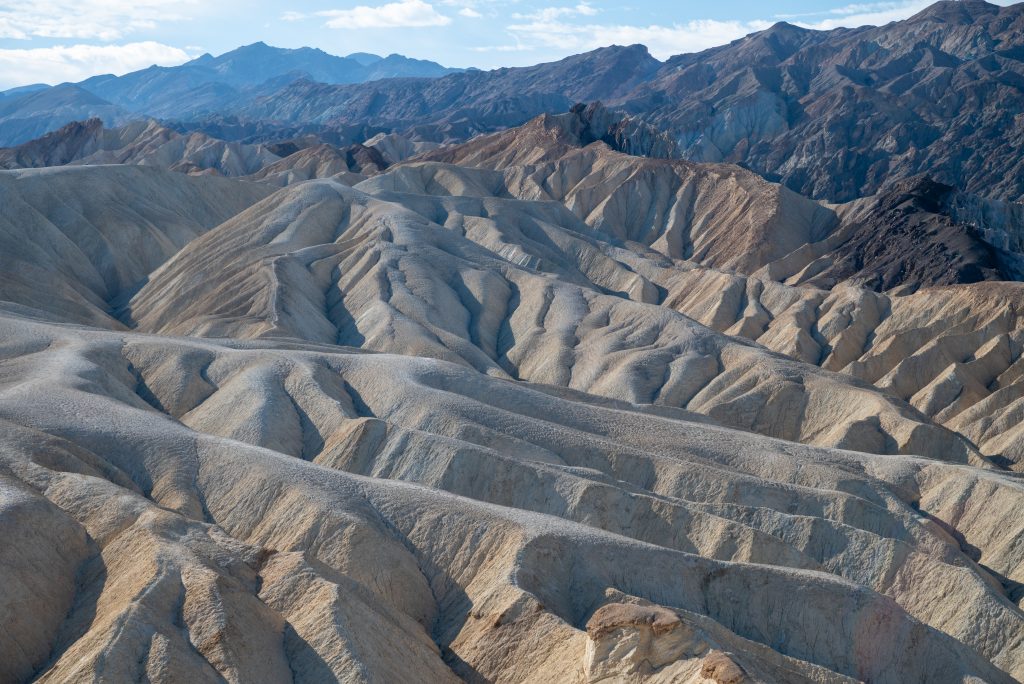
Another excellent sunrise/sunset stop, although the Badlands scenery is weird enough here to warrant a stop at any time. Bear in mind it is probably the most popular viewpoint in the Park and that, in order to reach the viewpoint from the car park you need to walk up a paved road for about 400 metres.
Mobility Access
Although the walk up the slope (and the heat) can put beyond reach the large, flat asphalt viewing area (there are no seats here), you can get a sense of the oddity of the Badlands landscape by walking around 70 metres from the car park along the flat section of the path and then a few metres across the rocky surface to left or right.
Father Crowley’s Overlook
Located away on the western boundary of the Park, we felt this outlook delivered less than it promised. Yes, if you are into geology, the view from the large overlook car park is fascinating and, yes, there may be the added bonus of a distant Top Gun like flypast by military jets practising their low-level flights, but rocks block your view of the Panamint Valley to the east. I would take it in as part of a drive in or out of the park, as we did.
Mobility Access
The overlook (with rail barrier) shares space with the car park all with paved or asphalt surfaces.
Drives Outside the Park
West to Lone Pine
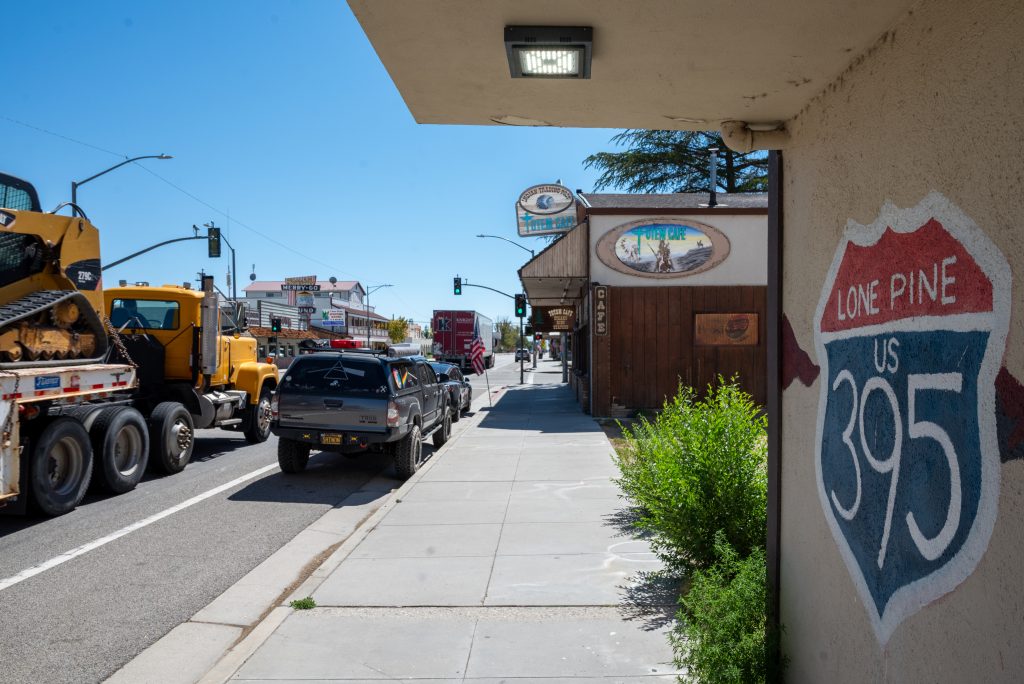
We were headed to Lone Pine because it housed the nearest laundromat to the Park, even if it was two mountain ranges and 100 miles (170 km) to the west. The drive through the park takes you past not only Mesquite Flats and Father Crowley’s Overlook but also the near salt flats of Salt Creek and past the entrance to Mosaic Canyon and the facilities of the Park villages of Stovepipe Wells and Panamint Springs. Beyond Father Crowley’s Overlook the road heads across the Joshua tree fields of the Darwin Plateau before it dives down out of the Park into the wide Owens Valley with its backdrop of the Sierra Nevada and, towering above the small town of Lone Pine, the highest point in the US outside Alaska, Mount Whitney. The town itself seems to offer little to the passing tourist, unless you are into the climbing and hiking in the Sierras or a film buff (for the nearby Alabama Hills are a much-used location in movies and the town has a film museum and an annual film festival).
Mobility Access
A day in which the scenery was viewed, largely, whilst travelling in the car with occasional stops to stretch bodies out.
South-East to Shoshone and Amargosa Opera House
Leaving the Park in the other direction brought us a day of unexpected gems to see. First we had Eagle Mountain which seems to stand like a grey-red island rising from the Amargosa Valley as you head down SR 127 from Death Valley Junction. Our destination was Shoshone, a ‘blink-and-you-miss-it’ village (population 22) that is home to the Shoshone Museum (https://shoshonemuseum.org) whose attraction was the advertised ‘Big Mammoth’ fossil. But having reached the village we needed sustenance first and the small cluster of buildings here offered up the Crowbar Café & Saloon (https://www.shoshonevillage.com/crowbar-cafe-and-saloon/). When we went in it was as empty as the pictures on the website except that the bar was being patrolled by the taciturn manager. Coffee old-style (refillable mug from a filter jug) and tea were our tipples and we sat and watched the arrival and then departure of a tour group of Harley-Davidson-riding seniors from northern Europe who came in, used the restrooms and spent not a penny. The small museum next door is little more than a large wooden shed-like space crammed with a fascinating and eclectic collection of exhibits, the most interesting of which was of the extraordinary women who had contributed to the history of the area. These included a display of pre-electricity irons whose sheer weight left us in awe of the women’s ability to use them and, more interestingly, the story of ballerina Marta Becket. At Death Valley Junction we had passed a decrepit building in the Spanish Colonial Revival style and assumed it was an abandoned ruin. Her story in the display, and a thoroughly engaging conversation with the woman manning the desk later, meant we discovered that it is far from derelict and we resolved to stop, for it was once home to performances by Marta (she had been in the corps de ballet of shows on Broadway).
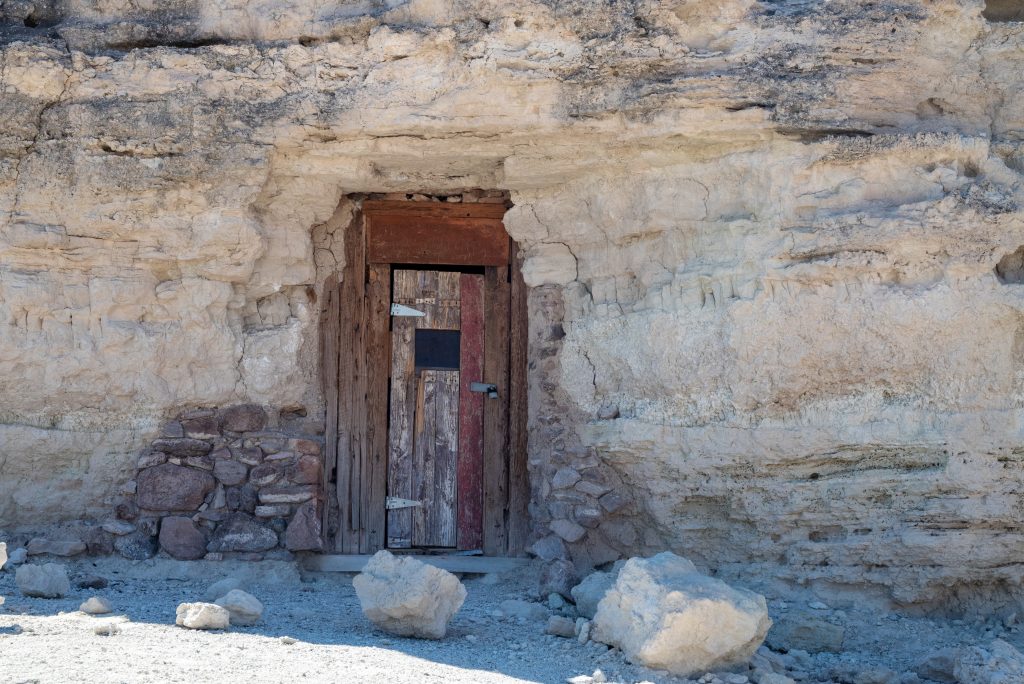
But first another chance conversation with a man emerging from the village Post Office led us to Dublin Gulch. A short drive up a gravel track beside the Post Office is the local cemetery (straight out of an imagined Western movie) and, cut into the rock of the low gulch, the vestiges of the homes of miners, who came to work for the borax mining company that brought short-lived prosperity during the middle of the 20th century. This little gem was easily topped on our return journey by our visit to Amargosa Opera House Hotel (https://www.amargosaoperahouse.org/hotel/), for that seemingly derelict building is still a small operating hotel, the prime draw of which is the remarkable story of Marta Becket and her transformation of a ruined hall into the eponymous opera house. Having bought the building with her husband in 1967 she not only had the opera house restored but decorated both the house and many of the hotel’s rooms with her own murals and performed on stage nearly every night (audience or no audience), giving her last performance in 2012 aged 88. The reception attendant very kindly invited us to look around the public rooms and then showed us one of the mural-decorated bedrooms. Sadly the opera house itself had been damaged by the recent floods and was closed.
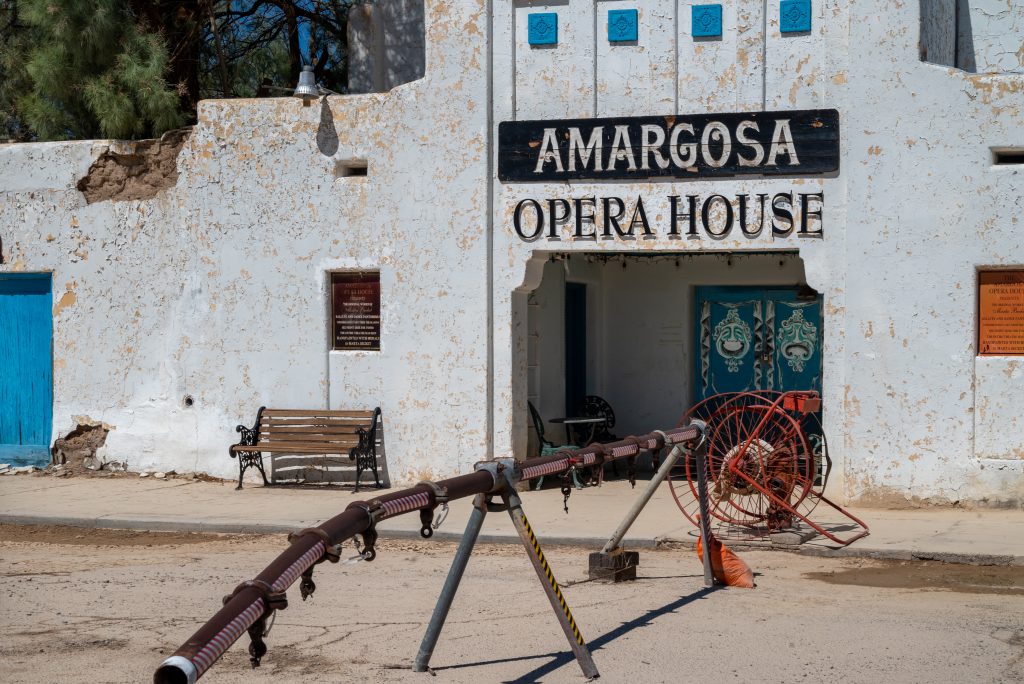
This short day out to a seemingly unprepossessing location was an unexpected, simple jewel to be treasured.
Mobility Access
The café, museum and Amargosa Hotel are single storey buildings with access direct from the road outside, so are straightforward to visit. The Dublin Gulch ruins are walkable from the village but the track is rough so take the car. Once at the former homes you can peek inside but there is rough ground outside with some level changes to negotiate.